Key takeaways
- Peec.ai is a solid AI visibility monitoring tool, but it stops at diagnosis — it shows you where you're invisible, not how to fix it
- There's no built-in content generation, no AI crawler logs, no traffic attribution, and no Reddit or YouTube insights
- The "Actions" feature added in early 2026 suggests next steps but deliberately avoids automating them, leaving execution entirely to you
- For teams that need to act on data, not just read it, the gaps are significant enough to matter
- Several alternatives go further, combining monitoring with content generation, crawler data, and revenue attribution
Peec.ai does one thing genuinely well: it shows you where your brand appears (or doesn't appear) in AI search results. If you've never had visibility into how ChatGPT, Perplexity, or Google AI Overviews talks about your brand, opening Peec for the first time feels like turning on a light in a dark room.
But here's the thing about turning on a light. It shows you the mess. It doesn't clean it up.
After spending time with Peec.ai and comparing it against what content teams actually need in 2026, some real gaps emerge. Not bugs or broken features -- just structural limits in what the platform was built to do. This guide walks through each one honestly, because "it tracks mentions" is not the same as "it helps you rank in AI search."
The monitoring-only ceiling
Peec.ai's core loop is: run prompts, see who gets cited, track your share of voice over time. That's useful. But the moment you ask "okay, what do I actually do about this?" the platform starts to run out of answers.
The Peec team acknowledged this directly when they launched Actions in February 2026. Their own blog post framing was: "You don't need another dashboard. You need answers." They built Actions specifically because teams kept asking what to do next after seeing the data.
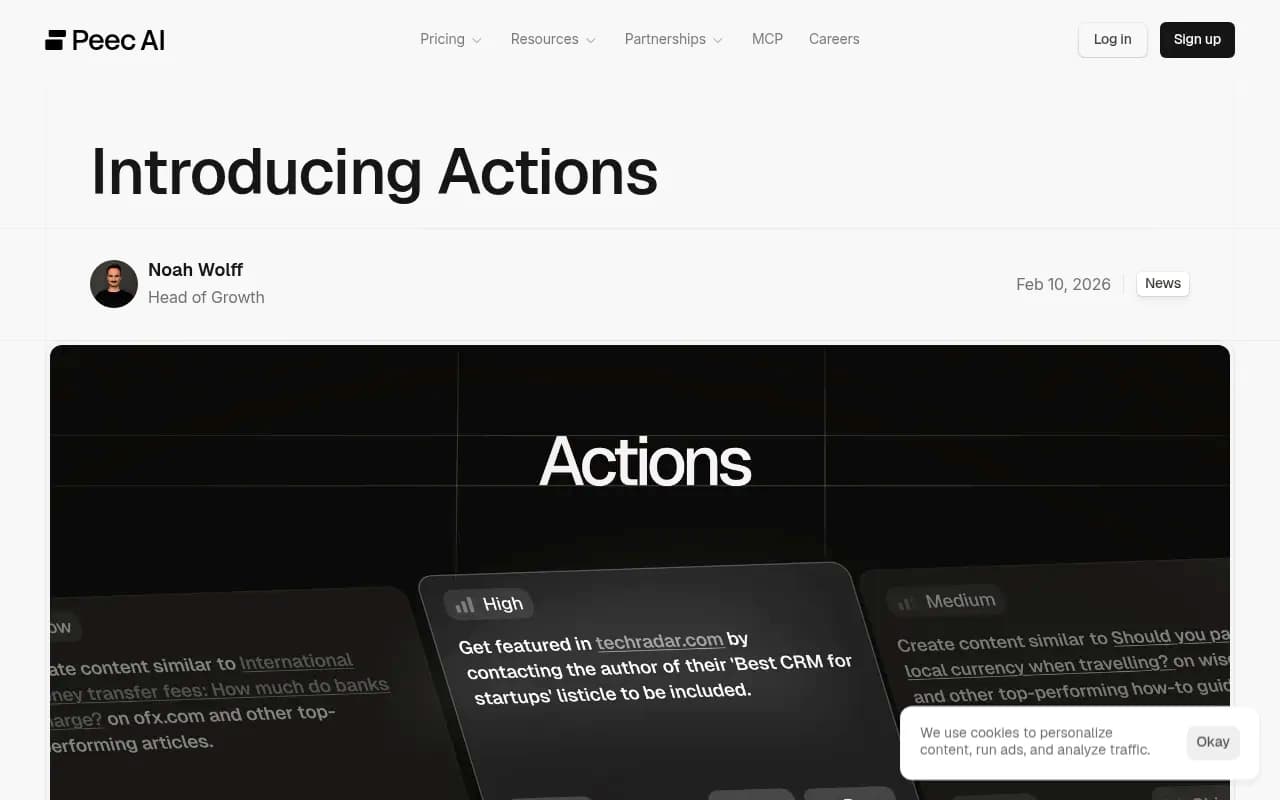
Actions groups similar citation sources, shows where competitors are winning, and suggests steps you could take. It's a meaningful improvement. But Peec is also explicit that Actions doesn't write content, doesn't auto-generate anything, and doesn't automate execution. The suggestion is: here's a direction, now go figure out the rest yourself.
For a small team that just wants to know if they're showing up in AI results, that might be fine. For a content team trying to systematically close visibility gaps, it's a significant limitation.

No content generation or optimization
This is the biggest gap for most content teams. Peec.ai tells you which prompts competitors rank for that you don't. It does not help you create content to close those gaps.
That means after every reporting cycle, someone on your team has to:
- Manually interpret which gaps are worth pursuing
- Research what kind of content AI models tend to cite for those prompts
- Write or commission that content without any AI-grounded brief
- Publish and then wait to see if it moves the needle
That's a lot of manual work sitting between "here's your visibility data" and "here's your improved visibility score." The gap between insight and execution is where most GEO efforts stall.
Platforms like Promptwatch have built content generation directly into the visibility workflow -- using real prompt data, citation patterns, and competitor analysis to generate briefs and articles that are specifically engineered to fill the gaps AI models are exposing. It's not generic content; it's content tied to specific prompts where you're losing.

No AI crawler logs
When an AI model starts citing your content more often, do you know why? When it stops, do you know what changed?
Peec.ai doesn't give you visibility into how AI crawlers interact with your website. You can see the output (citations) but not the input (crawler behavior). This matters more than it sounds.
AI crawler logs tell you:
- Which pages AI agents are actually reading on your site
- How often they return to specific pages
- Whether they're hitting errors or blocked content
- The timeline from when a page is crawled to when it starts getting cited
Without this, you're optimizing blind. You might publish a great piece of content and see no citation lift, but have no idea if the problem is the content itself or whether AI crawlers are even reaching the page.
This is one of the more technical gaps in Peec's offering, and it's one that matters a lot for teams doing serious GEO work.
Limited prompt intelligence
Peec.ai lets you track prompts, but the depth of prompt-level data is thin compared to what's available elsewhere.
Specifically, what's missing:
- Volume estimates for each prompt (how many people are actually asking this?)
- Difficulty scores (how competitive is this prompt to win?)
- Query fan-outs (how does one prompt branch into related sub-queries?)
Without volume and difficulty data, you're tracking prompts without knowing which ones are worth winning. A prompt where you're invisible might have 50 monthly searches or 50,000. Treating them the same way is a resource allocation problem.
The Peec blog has published good thinking on how to choose prompts for LLM tracking -- but that guidance is manual. There's no in-platform scoring to help you prioritize automatically.
No traffic attribution
Here's a question that matters to every marketing team: is your AI visibility actually driving revenue?
Peec.ai tracks citation share. It doesn't connect that to website traffic, leads, or conversions. So you can watch your visibility score improve over six months and have no way to tell your CMO whether it translated into anything real.
This isn't a niche requirement. Attribution is how marketing teams justify budget. If you can't show that GEO work drives traffic and revenue, it's hard to get resources for more of it.
Some platforms have started building this connection -- linking AI crawler data to actual visitor sessions, so you can see when someone arrives via an AI search engine and what they do next. Peec doesn't have this yet.
Google AI Overviews: tracked but underweighted
To Peec's credit, they've published solid research on AI Overviews. Their analysis of 500,000 prompts found that AI Overviews appeared 86% of the time -- making it the most common AI search surface by a wide margin, bigger than ChatGPT and Perplexity combined.
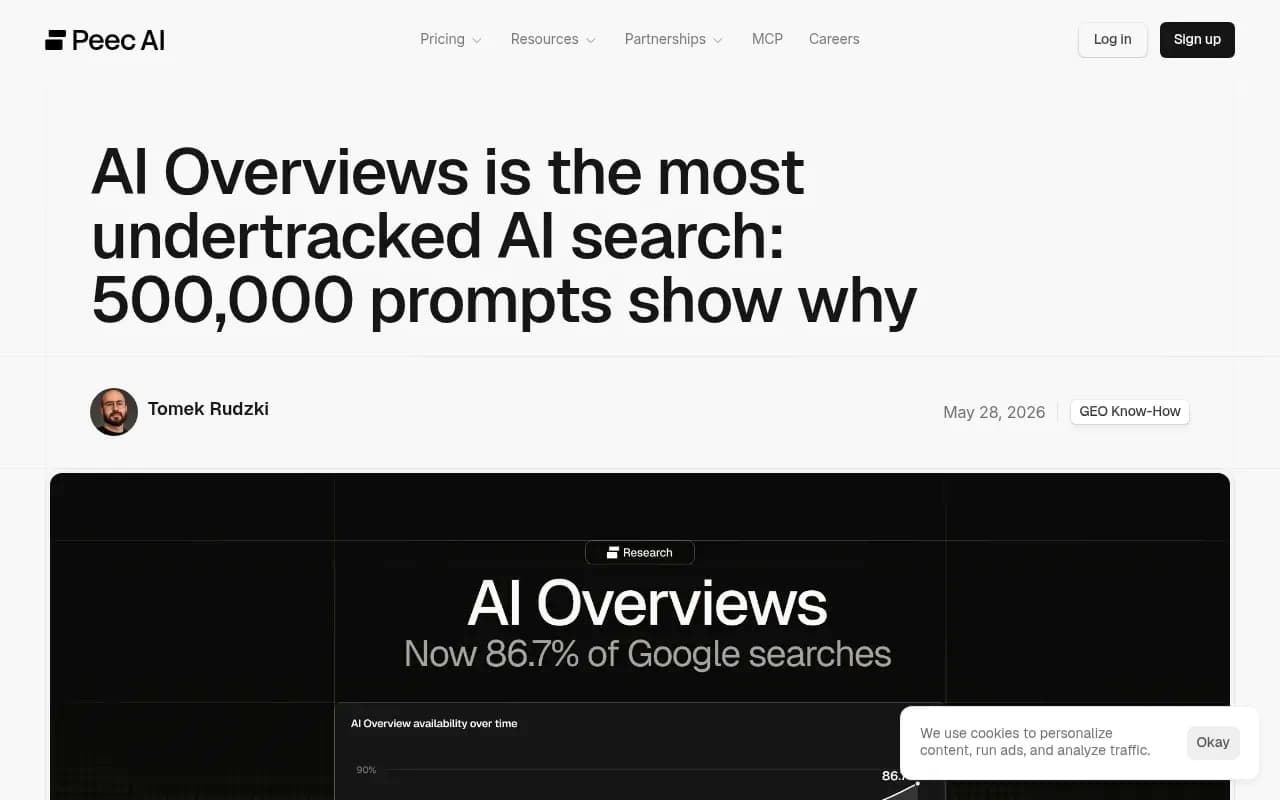
The research is good. But the platform's actual tracking of AI Overviews has historically been weaker than its ChatGPT and Perplexity coverage. There's an EU/non-EU gap in how AI Overviews appears (it shows up 76% of the time in EU markets vs. higher rates elsewhere), which adds complexity to regional tracking.
For brands that get significant traffic from Google -- which is most brands -- undertracking AI Overviews means undertracking the AI surface that probably matters most to their organic visibility.
No Reddit or YouTube insights
A lot of AI model citations don't come from brand websites. They come from Reddit threads, YouTube videos, and third-party review sites. If a Reddit discussion is driving ChatGPT to recommend your competitor, you'd want to know that.
Peec.ai focuses on your domain's citation performance. It doesn't surface the Reddit threads or YouTube videos that are influencing AI responses in your category. That's a meaningful blind spot for competitive analysis.
Understanding which external sources AI models trust in your space -- and whether you're present in those conversations -- is increasingly important for GEO strategy. It's the kind of offsite intelligence that most monitoring tools, including Peec, don't offer.
How Peec.ai compares to alternatives
Here's a direct comparison across the capabilities that matter most for content teams:
| Capability | Peec.ai | Promptwatch | Otterly.AI | Profound | AthenaHQ |
|---|---|---|---|---|---|
| AI visibility monitoring | Yes | Yes | Yes | Yes | Yes |
| Content gap analysis | Basic (Actions) | Yes | No | Partial | No |
| Content generation | No | Yes | No | No | No |
| AI crawler logs | No | Yes | No | No | No |
| Traffic attribution | No | Yes | No | No | No |
| Prompt volume/difficulty | No | Yes | No | Partial | No |
| Reddit/YouTube insights | No | Yes | No | No | No |
| ChatGPT Shopping tracking | No | Yes | No | No | No |
| Google AI Overviews | Yes | Yes | Yes | Partial | Yes |
| Multi-language/region | Partial | Yes | No | Yes | Partial |
The pattern is consistent: Peec.ai is a monitoring tool. Most of the alternatives in the monitoring-only category (Otterly.AI, AthenaHQ) have similar gaps. The meaningful differentiation comes from platforms that have built optimization and execution capabilities on top of monitoring.


Who Peec.ai actually works well for
It's worth being fair here. Peec.ai isn't a bad tool -- it's a tool with a specific scope.
It works well if:
- You're just getting started with AI visibility and need to understand the baseline
- You have a separate content team and workflow that can act on monitoring data independently
- You're primarily interested in tracking citation share over time, not optimizing it
- Budget is a constraint and you need basic monitoring without paying for features you won't use
It starts to fall short when:
- Your team needs to close gaps, not just identify them
- You want to understand why your visibility is changing, not just that it changed
- You need to connect AI visibility to revenue metrics
- You're competing in categories where Reddit and YouTube heavily influence AI recommendations
What to use instead (or alongside)
If you're hitting the limits of Peec.ai, the decision comes down to what you actually need.
For teams that want a full optimization loop -- find gaps, create content, track results -- Promptwatch is the most complete option available. It combines the monitoring Peec does with content generation, crawler logs, prompt intelligence, and traffic attribution. The 2026 comparison of 12 GEO platforms rated it as the only "Leader" across all categories.
For teams that just want better monitoring with more model coverage, tools like Otterly.AI or Scrunch cover similar ground to Peec with slightly different model mixes and pricing.
For enterprise teams with complex attribution needs, Profound or Bluefish AI have stronger enterprise feature sets, though at higher price points.
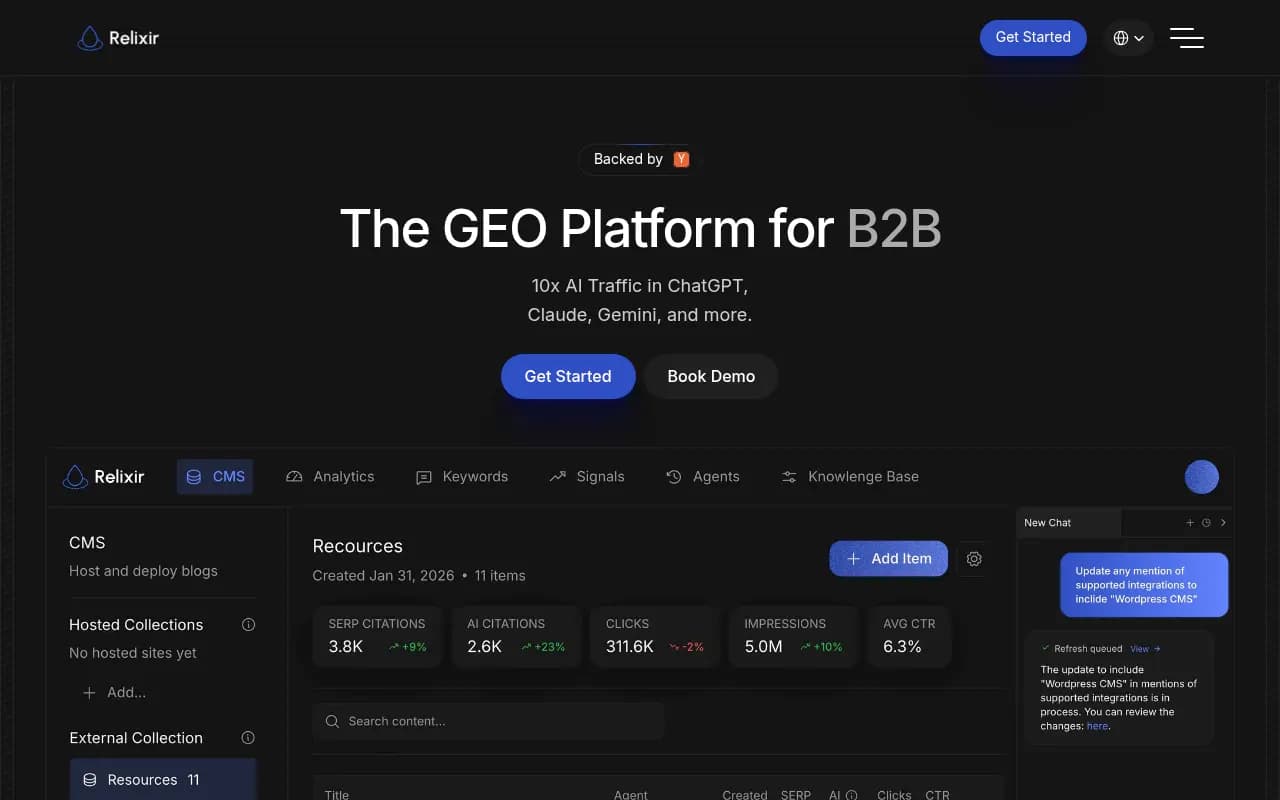
For teams that want to act on data but don't have in-house content capacity, a platform like Relixir combines GEO monitoring with AI content generation in a more integrated way than Peec's Actions feature.
The honest summary
Peec.ai is a reasonable starting point for AI visibility monitoring. The data is real, the interface is clean, and the Actions feature shows the team understands what users actually need.
But "suggests steps" is not the same as "helps you take them." In 2026, the gap between knowing you're invisible in AI search and actually fixing it is where most content teams are stuck. Peec shows you the gap. It doesn't help you cross it.
If you're using Peec and finding yourself constantly exporting data to figure out what to write next, that's not a workflow problem. That's a tool scope problem. The question is whether the monitoring-only model is enough for what your team needs to accomplish.