Key takeaways
- Brandlight is an Israeli-built, enterprise-only AI visibility platform that tracks how brands show up across ChatGPT, Gemini, Perplexity, Copilot, and Claude, and it's raised roughly $36M total after a $30M Series A in early 2026.
- There is no published pricing anywhere on the site. Third parties estimate an entry point somewhere around $199-$750/month for smaller engagements, with enterprise contracts reportedly running $4,000-$25,000+/month, but none of this is confirmed by Brandlight itself.
- The platform is genuinely broad: Visibility & Insights, Content, Commerce, Partnerships, and a Technical module that reads server logs to show which AI crawlers actually hit your site.
- It's rated 4.9/5 on G2 from 236 reviews, with real praise for dashboard usability and actionable insight, but recurring complaints about a steep learning curve, no self-serve tier, and an "Attribution" module still listed as coming soon.
- If you're not a multi-brand Fortune 500-type company with a six-figure AI visibility budget, you'll get more for less money elsewhere in this category.
What Brandlight.ai actually is
Brandlight positions itself as the AI visibility layer that global CMOs use to see, and try to influence, how AI systems describe their brands. That's a mouthful, but the pitch underneath it is simple: ChatGPT, Gemini, Perplexity, and the rest are quietly becoming the new front door for brand discovery, and most companies have zero idea what those systems are telling people about them.
The company was founded in October 2024 in Israel and has moved fast. A $5.75M seed round in April 2025 was followed by a $30M Series A in February 2026, led by Pelion Venture Partners with Cardumen Capital and G20 Ventures joining in, putting total funding around $36M. That's real money for a company that's barely two years old, and it shows in how much product surface they've built.
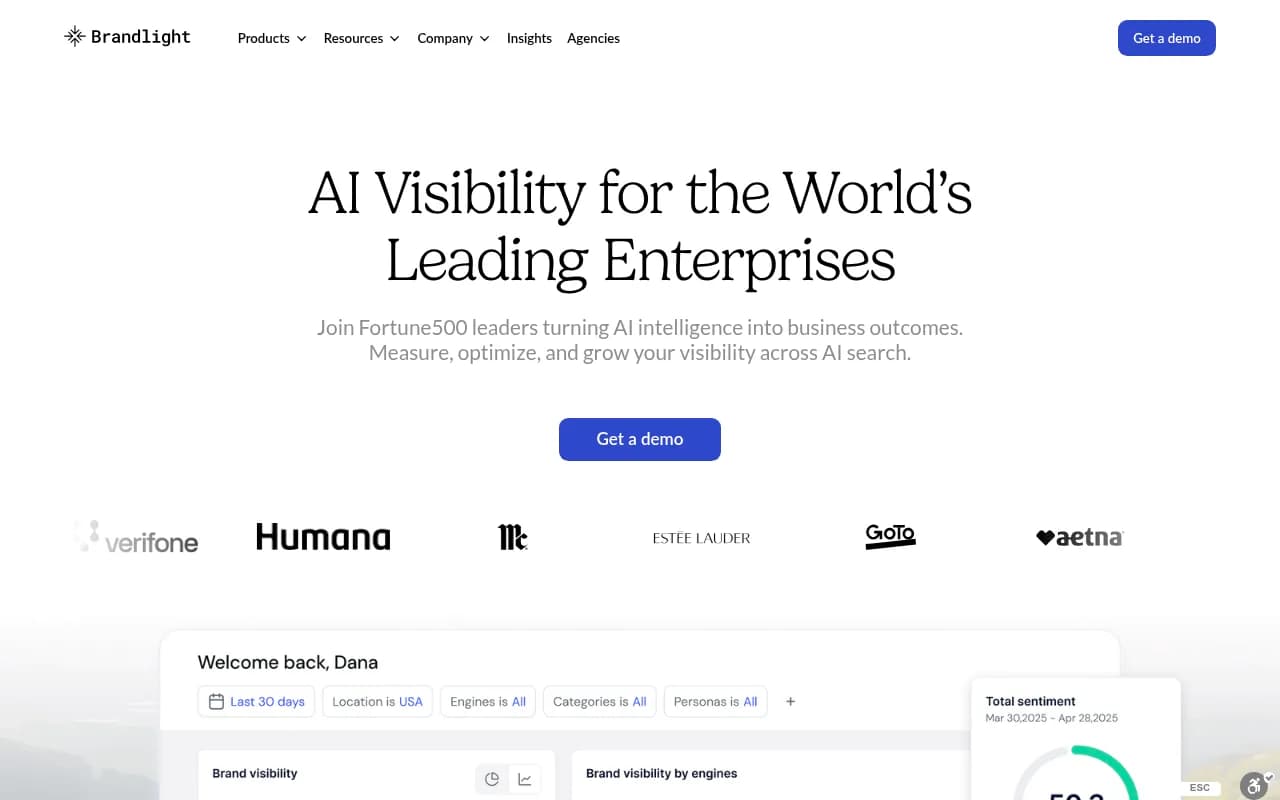
The customer logo wall on their homepage includes Kimberly-Clark, The Hartford, Estée Lauder, Humana, and Verifone. This is not a tool built for a solo marketer or a Series A startup. It's built for organizations that manage several brands across several regions and need one dashboard to roll it all up.
The product, module by module
Brandlight's platform splits into five connected pieces, and understanding them is the fastest way to decide if this tool matches your problem.
Visibility & Insights
This is the core tracking layer. It monitors how a brand and its sub-brands appear across ChatGPT, Gemini, Perplexity, Copilot, and Claude (some dashboards also show Grok), scoring presence, sentiment, and competitive position per query. A sample dashboard the company shows publicly tracks Nike's sub-brands, Air, Jordan, Converse, and others, side by side across engines. It's a genuinely useful way to see fragmentation across a brand portfolio that most tools in this category aren't built to handle.
Content
The Content module scores existing pages on a "Content Strength Score" and recommends new topics prioritized by expected visibility impact. It also benchmarks your content against competitors'. What it does not do is publish anything for you. Drafts and recommendations go to your team or CMS for human review, which is a meaningfully different model from platforms that generate and push content automatically.
Technical
This is the part that impressed us most in the research. The Technical module analyzes raw server logs to show crawl frequency and coverage by AI engine, flags indexability issues, and calculates a discoverability score. A public example shows chase.com at 67% discoverability with 6,500 open issues and only 2,000 of 16,500 potential sources actually cited. Most AI visibility tools stop at "were we mentioned?" Brandlight goes a step further back in the pipeline to ask whether the crawlers even got in the door.
Commerce and Partnerships
Commerce tracks how a brand's products show up in AI shopping and agentic-commerce surfaces, an area only a handful of vendors are building for yet. Partnerships scores which third-party publishers and media outlets are shaping how AI talks about you, useful intelligence if you're planning PR or content placements aimed at earning citations rather than clicks.
Coverage and scale claims
Brandlight's research arm, at research.brandlight.ai, reports analyzing 1.8 billion AI data points daily and 183 million AI answers, serving 148+ large enterprises. Those numbers have grown fast since earlier figures cited 100M+ answers, which tells you the company is scaling quickly, though it also means any number you read today will likely be stale in a few months.
One research piece worth flagging: Brandlight ran a study comparing answers from official AI APIs against what real consumers see in the actual ChatGPT, Gemini, and Perplexity interfaces, using the same 900 questions. The overlap between API-based answers and UI-based answers was only 6-12%. That's a real finding, and it's a fair critique of any competitor that samples brand mentions through APIs rather than live interfaces, since API responses and what a user actually sees can diverge wildly. Worth knowing when you're evaluating any tool in this space, not just this one.
Pricing: the elephant in the room
Here's the frustrating part. Brandlight publishes no pricing anywhere. The /pricing and /plans URLs both return 404, confirmed independently by multiple reviewers who went looking. Every engagement starts with a sales call, and multiple sources report there's no free trial at all, just a paid three-month pilot to start.
Third-party estimates put entry pricing somewhere around $199-$750/month, with enterprise tiers reportedly landing anywhere from $4,000 to $25,000+ per month depending on scope, markets, and how many brands you're tracking. None of this is verified by Brandlight, and given how wide that range is, you should treat it as a rough guess rather than a quote.
For context, here's how that compares to other vendors that do publish prices:
| Platform | Published entry price | Pricing transparency | Best fit |
|---|---|---|---|
| Brandlight | Not published (est. $199-$750+/mo) | Sales call required | Multi-brand Fortune 500s |
| Profound | $99/mo (ChatGPT only) | Fully public | Deep self-serve enterprise measurement |
| Semrush AI Toolkit | $99/mo add-on | Fully public | Existing Semrush teams |
| Peec AI | Fully public | SMBs and agencies | |
| Otterly.ai | ~$29/mo | Fully public | Solo operators, small teams |
| Scrunch AI | $250/mo (Core) | Fully public | Mid-market monitoring |
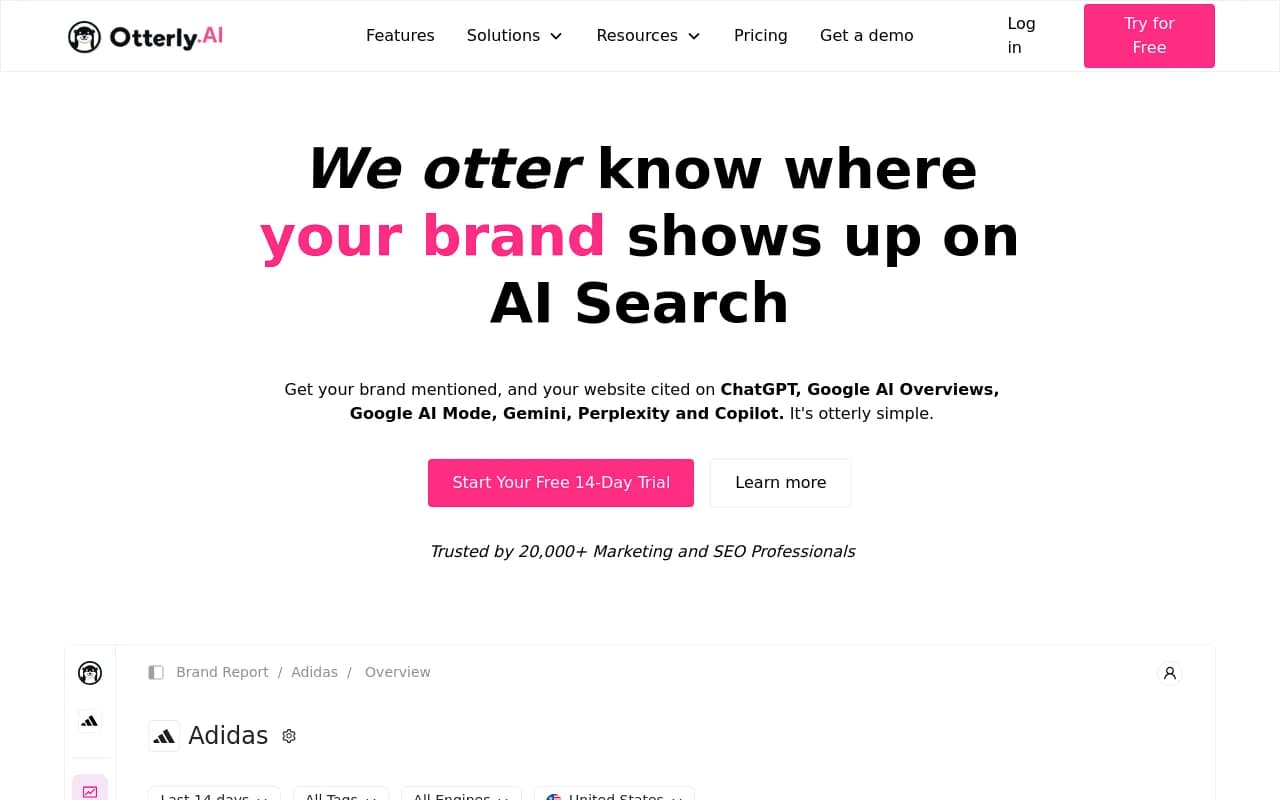
If transparent pricing matters to your procurement process, that's a real strike against Brandlight before you even see the product.
What real users say
Brandlight's G2 profile currently shows 4.9/5 across 236 reviews, with 97% at five stars. That's a strong showing, and the specific quotes back it up. One SVP of Performance and Search likes "the interface and the easy access to data" and that "all of the dashboard capabilities are also exportable." A Head of AI Strategy says the insights "informed our GEO strategy & tactics" with "clear, measurable" results. A Senior Manager of SEO credits the platform with filling gaps other data sets can't cover across AI platforms and third-party citations.
But the criticism is consistent across every source we checked, not just G2. Users flag pricing opacity directly in G2's own AI-generated review summary. One VP of Marketing Operations put it plainly: "Brandlight gives us clear direction on where we can improve, but our internal bandwidth is limited," meaning the tool tells you what to fix but doesn't fix it for you, and that's a real gap if your team is already stretched. Another SVP said the hardest part is figuring out "what actions to take from the insights we get from the data." And the Attribution module, the piece that would connect AI visibility to actual revenue, is still listed as "coming soon."
Onboarding is also not quick. G2's average reported time to implement is two months, with Brandlight's own enterprise materials describing 30-90 days to reach full productivity on governance features.
Where Brandlight genuinely earns its enterprise price tag
A few things stand out as real differentiators rather than marketing copy:
- Server log analysis that shows crawler activity by engine, which most competitors in this category skip entirely.
- Multi-brand, multi-region support built for portfolios, not single brands.
- SOC 2 Type 2 compliance and a "frictionless onboarding" claim that doesn't require sharing PII or internal system access, which matters for regulated industries like healthcare and financial services.
- A dedicated AI Optimization Expert and account executive rather than a purely self-serve dashboard.
Where it falls short
- No published pricing, no self-serve tier, no free trial. If you want to test drive before committing budget, this isn't the platform.
- Content recommendations route to humans for review, not to your CMS automatically. That's a defensible design choice for brand safety, but it means the "action" layer still depends heavily on your team's capacity.
- The Attribution module, arguably the most important piece for justifying ROI to a CFO, isn't live yet.
- It's not built for SMBs or single-brand companies. The whole architecture, and the pricing that comes with it, assumes multiple brands and multiple markets.
How it stacks up against the rest of the category
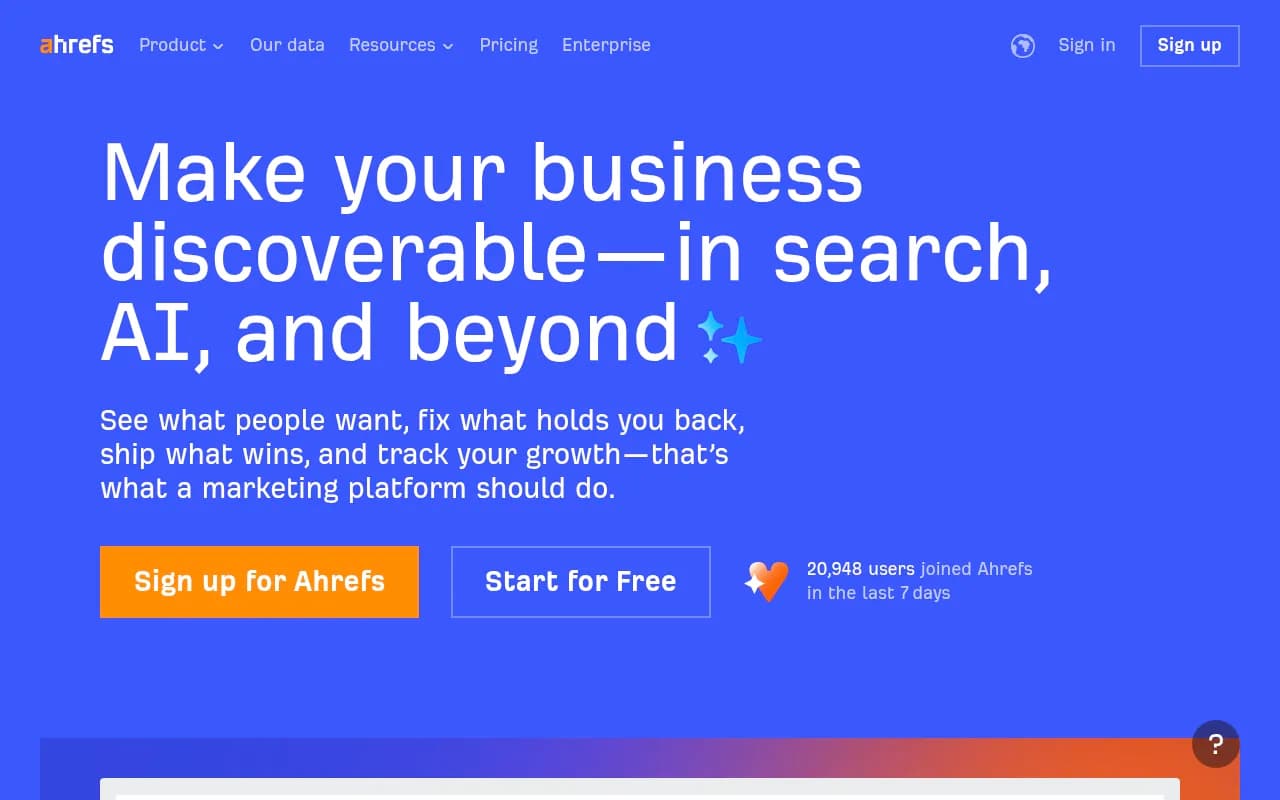
AI visibility is a crowded field in 2026, and Brandlight's own published comparison piece (written by its own AI GTM Lead, worth noting) ranks itself first against Semrush, Ahrefs Brand Radar, Amplitude, Evertune, Peec AI, Profound, and Otterly.ai. Take that with the same skepticism you'd apply to any vendor ranking itself first, the underlying engine coverage and feature claims are still useful data points, just read them knowing who wrote them.

The honest positioning is this: Brandlight competes most directly with Profound and Scrunch AI on depth of measurement, but neither of those platforms tries to be as broad across commerce, partnerships, and crawl diagnostics. On the flip side, both of those competitors publish prices and offer far cheaper entry points, which matters if you're not yet ready for a five or six-figure annual contract.
If your organization is evaluating AI visibility and GEO tools more broadly, and you don't yet need Brandlight's enterprise-scale portfolio features, Promptwatch is worth a look. Unlike monitoring-only platforms, Promptwatch pairs visibility tracking across ChatGPT, Gemini, Claude, Perplexity, Copilot, Google AI Overviews, and AI Mode with AI crawler logs, Reddit and YouTube citation tracking, and Content Agents that actually draft and publish GEO-optimized content to your CMS on a schedule, not just flag what's missing. It's used by 1,840+ brands and agencies, rated 4.7/5 on G2, and its published plans start at $95/month, a very different pricing conversation than Brandlight's sales-only model.

Who should actually buy Brandlight
Brandlight makes sense if you check most of these boxes: you manage multiple brands across multiple markets, you're in a regulated industry where SOC 2 compliance matters to procurement, you have budget for a five or six-figure annual engagement, and you want a dedicated team helping interpret the data rather than a pure self-serve dashboard. Companies like Kimberly-Clark and The Hartford fit that profile, and the reviews from people in similar roles back up that the platform earns its keep for them.
If you're a solo marketer, a small SEO team, or a company running one or two brands, the math doesn't work in your favor. You'll spend weeks in sales conversations to get a number, wait months for full implementation, and still need internal bandwidth to act on what the dashboard tells you. Tools with public pricing and faster setup will get you comparable visibility data for a fraction of the cost and commitment.
For a wider view of what's out there before you commit budget either way, the GEO software directory at bestgeosoftware.com is a reasonable place to compare more of these platforms side by side without sitting through a sales demo first.
The bottom line
Brandlight is a real, well-funded, technically capable platform that does things most of its competitors don't, particularly on crawl diagnostics and multi-brand portfolio management. It's also opaque about pricing in a category where that's increasingly unusual, and its own users say the hardest part isn't seeing the data, it's knowing what to do with it. If you're the kind of enterprise Brandlight is built for, budget the sales call and the pilot. If you're not, there are cheaper, faster, and more transparent ways to find out what AI is saying about your brand.