Key takeaways
- Most AI visibility tools are monitoring dashboards. They show you data, then leave you to figure out what to do with it -- which makes ROI hard to prove.
- Promptwatch is the only platform in this comparison that closes the loop from gap identification to content creation to revenue attribution, making it the easiest to justify with a business case.
- Profound is the strongest pure-monitoring option for enterprise teams that already have content and strategy resources in-house.
- Otterly.AI is genuinely useful for small teams or agencies that need affordable, fast setup -- but the ceiling is low.
- Searchable is a niche player with limited feature depth; it works for basic brand monitoring but struggles to compete on actionability or analytics.
Your CFO doesn't care about AI visibility scores. They care about whether the $300/month (or $3,000/month) you're spending on a GEO tool is doing anything measurable for the business. That's a fair question, and it's one most AI visibility platforms are surprisingly bad at answering.
The category has exploded in 2026. There are now more than 40 tools claiming to help brands appear in ChatGPT, Perplexity, Google AI Overviews, and other AI search engines. Most of them are dashboards. They show you a number, maybe a trend line, and then... that's it. You still have to figure out what to change, write the content, publish it, and hope something moves.
This guide compares four platforms that come up frequently in buying conversations: Searchable, Promptwatch, Profound, and Otterly.AI. The question isn't just "which one has more features" -- it's which one gives you the clearest path from spend to outcome, because that's the only argument that works in a budget review.
What "justifying to your CFO" actually means
Before getting into the tools, it's worth being specific about what a CFO-friendly business case looks like for a GEO platform.
You need to answer three questions:
- What are we getting that we couldn't get before?
- How does this connect to revenue or pipeline?
- What would it cost us not to have it?
A tool that shows you a visibility score answers question one, barely. A tool that shows you which content gaps are costing you citations, generates the content to fill them, and then tracks whether that content actually gets cited -- and whether those citations drive traffic -- answers all three.
That's the lens we're using here.
The four platforms at a glance
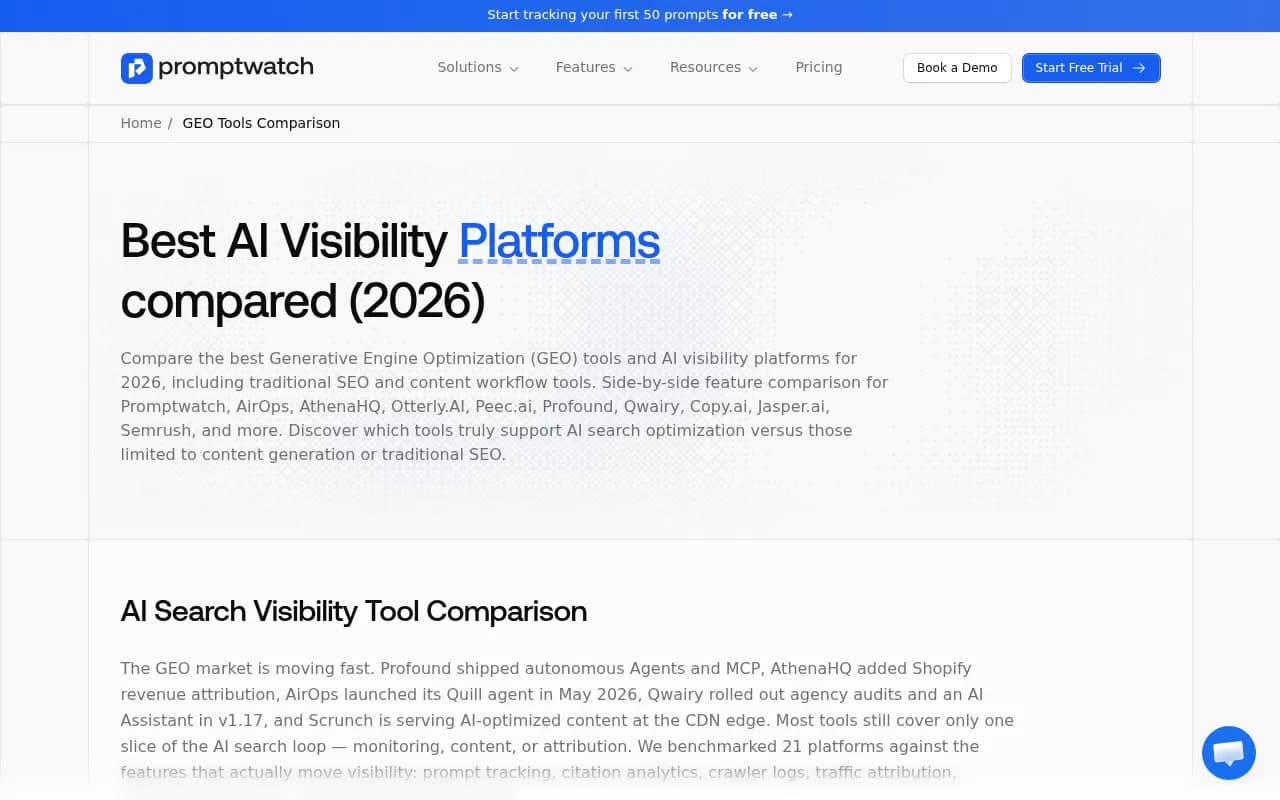
| Platform | Primary focus | Content generation | Crawler logs | Traffic attribution | Starting price |
|---|---|---|---|---|---|
| Promptwatch | Full GEO stack | Yes (AI Content Agents) | Yes | Yes | $99/mo |
| Profound | Enterprise monitoring | No | No | Limited | ~$500/mo+ |
| Otterly.AI | Brand monitoring | No | No | No | ~$49/mo |
| Searchable | Basic monitoring | No | No | No | ~$49/mo |
The table tells most of the story. Three of these four tools are monitoring products. One of them is an optimization platform. That distinction matters enormously when you're trying to show a return.
Promptwatch: the one that closes the loop
Promptwatch is built around what it calls the action loop: find the gaps, create content that fills them, track the results. It sounds simple, but no other platform in this comparison actually does all three.

The gap-finding piece uses Answer Gap Analysis, which shows you the specific prompts where competitors are getting cited but you aren't. Not a vague "your visibility is low" alert -- actual prompts, with the competitor responses, so you can see exactly what content is missing from your site.
The content creation piece is where Promptwatch separates itself most clearly from the field. Content Agents generate articles, comparisons, and briefs grounded in real prompt data, citation patterns, and competitor analysis. This isn't a generic AI writer -- it's producing content specifically engineered to answer the gaps AI models are already exposing. The $99/mo Essential plan includes 5 articles per month; Professional ($249/mo) gives you 15.
The tracking piece includes page-level visibility data, AI crawler logs (which show you when ChatGPT or Perplexity actually crawls your pages and whether those crawls lead to citations), and traffic attribution that connects AI visibility to actual sessions and revenue. That last part is what makes the CFO conversation possible. You can show a timeline: we published this page, Perplexity crawled it 11 days later, it started appearing in citations, and here's the traffic it drove.
Promptwatch also monitors 10 AI models -- ChatGPT, Perplexity, Google AI Overviews, Google AI Mode, Claude, Gemini, Meta/Llama, DeepSeek, Grok, Mistral, and Copilot -- which matters because your customers aren't all using the same AI search engine.
For the CFO conversation, Promptwatch is the easiest to justify because you can build a before/after story. Before: we weren't appearing in these prompts. After: we published content targeting these gaps, and here's the visibility and traffic change. That's a business case, not a vanity metric.
Profound: strong data, limited action
Profound is a serious enterprise product. It has deep prompt analytics, competitive benchmarking, and solid coverage across major AI models. If your team's job is to understand the AI search landscape and report on it, Profound gives you a lot to work with.
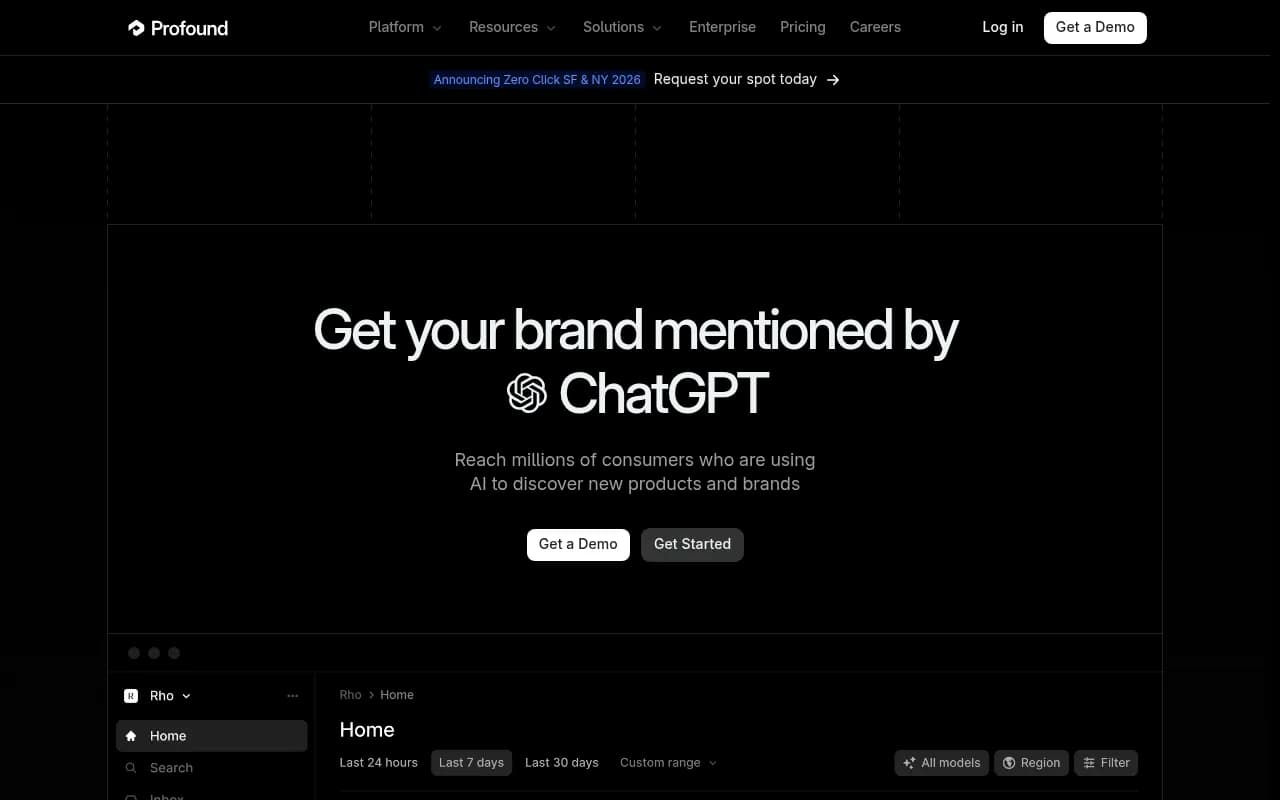
The limitation is that Profound stops at the insight layer. It shows you where you're winning and losing in AI search, but it doesn't help you do anything about it. There's no content generation, no content briefs, no crawler logs, and limited traffic attribution. You get excellent data and then you're on your own.
That's fine if you have a large content team and a dedicated SEO strategist who can take Profound's data and turn it into an execution plan. For enterprise teams at companies like a Booking.com or a large agency, that's a reasonable workflow.
But it creates a gap in the CFO conversation. You can show visibility trends, but connecting those trends to revenue requires additional tooling and manual work. Profound's pricing also sits at a significantly higher entry point than Promptwatch, which means you're paying more for a tool that covers less of the optimization cycle.
The honest summary: Profound is excellent at what it does, but what it does is only half the job.
Otterly.AI: good for getting started, limited ceiling
Otterly.AI was one of the earlier purpose-built AI monitoring tools, and it still has a clean, easy-to-use interface. Setup is fast, the platform coverage is reasonable, and the pricing is accessible.
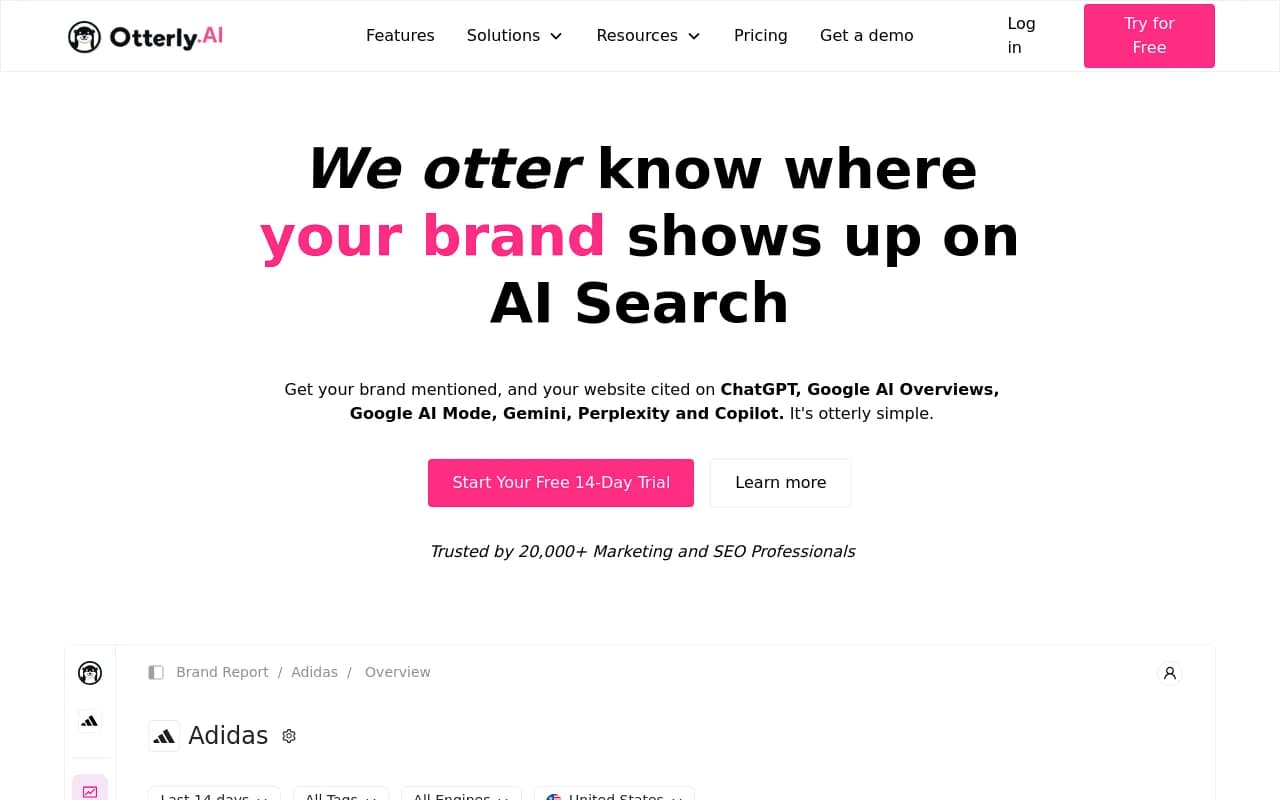
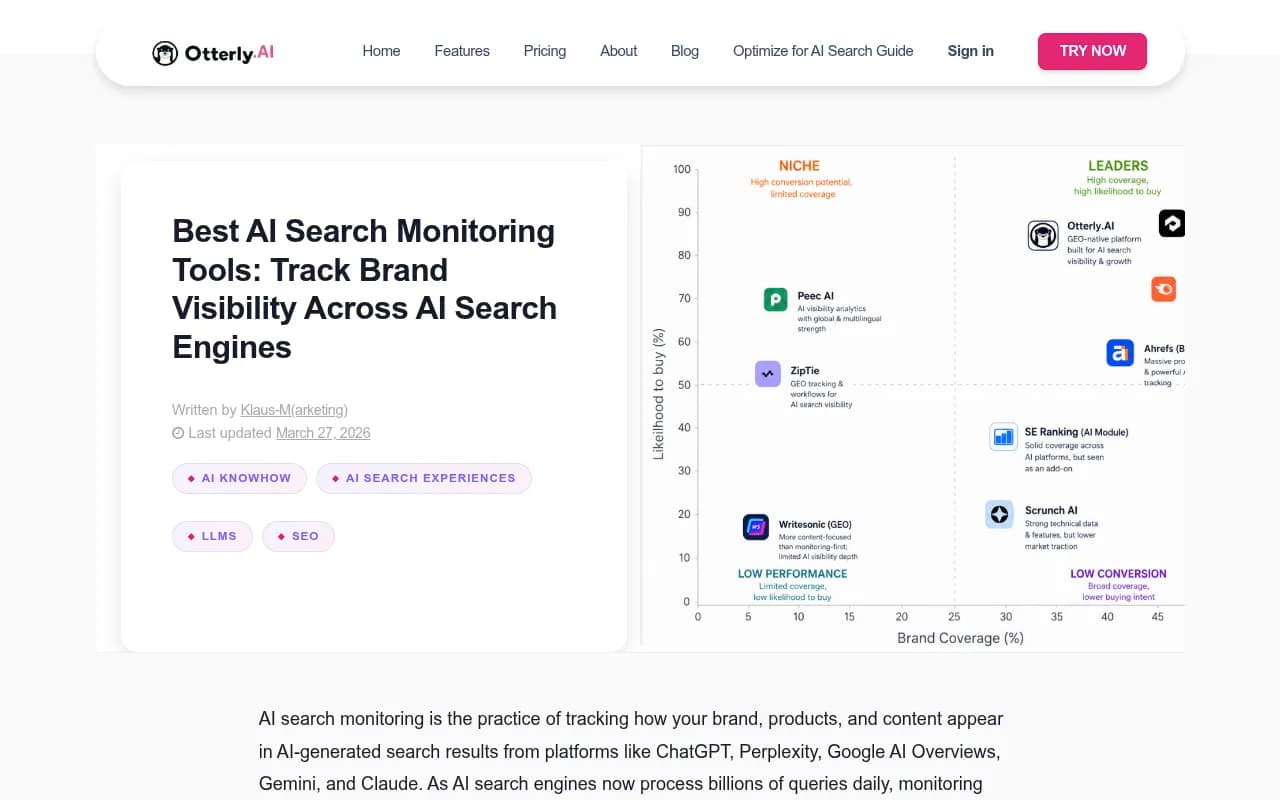
For a small marketing team or a solo SEO consultant who just wants to know whether their brand is showing up in ChatGPT and Perplexity, Otterly.AI gets the job done. It tracks mentions, citations, and competitive positioning across the major AI platforms.
The ceiling is the problem. There's no content generation, no crawler logs, no traffic attribution, and no prompt volume or difficulty scoring to help you prioritize what to work on. You get monitoring data and then you're left to act on it with other tools.
For a CFO conversation, Otterly.AI is hard to justify beyond "we know what's happening." That's worth something, but it's not a business case -- it's situational awareness. If your CFO asks what changed because of this tool, the honest answer is "we have better visibility into a problem we're still solving elsewhere."
Otterly.AI makes sense as a starting point or as a supplementary tool for teams that already have content production capacity. As a standalone investment, the ROI argument is thin.
Searchable: limited scope, limited case
Searchable is a narrower product. It covers basic brand monitoring across a handful of AI platforms and provides some competitive context. For very early-stage teams that just want to dip a toe into AI visibility tracking, it's low-friction.
But in a direct comparison with the other three tools here, Searchable doesn't have the feature depth to compete. No content generation, no crawler logs, no traffic attribution, no prompt intelligence, no Reddit or YouTube tracking. The monitoring itself is less comprehensive than Otterly.AI, and the actionability gap is even wider than Profound's.
Justifying Searchable to a CFO in 2026 is genuinely difficult. The category has matured enough that "we're monitoring AI search" is no longer a differentiating answer -- the question is what you're doing with that monitoring. Searchable doesn't give you much to work with on that front.
Head-to-head: what each platform actually delivers
| Capability | Promptwatch | Profound | Otterly.AI | Searchable |
|---|---|---|---|---|
| AI model coverage | 10 models | 10+ models | 5 major models | Limited |
| Prompt tracking | Yes | Yes | Yes | Basic |
| Competitor benchmarking | Yes | Yes | Yes | Limited |
| Answer gap analysis | Yes | No | No | No |
| Content generation | Yes (AI Agents) | No | No | No |
| AI crawler logs | Yes | No | No | No |
| Page-level citation tracking | Yes | No | No | No |
| Traffic attribution | Yes | Limited | No | No |
| Reddit/YouTube tracking | Yes | No | No | No |
| ChatGPT Shopping tracking | Yes | No | No | No |
| Prompt volume & difficulty | Yes | No | No | No |
| Multi-language/region | Yes | Yes | Limited | No |
| Free trial | Yes | Yes | Yes | Yes |
| Entry price | $99/mo | ~$500/mo+ | ~$49/mo | ~$49/mo |
The CFO conversation, tool by tool
Here's how the budget conversation actually plays out with each platform.
With Promptwatch
"We're using this to find the specific prompts where competitors are getting cited but we aren't, generate content to fill those gaps, and track whether that content drives traffic. Last quarter, we published 12 pages targeting identified gaps. Eight of them are now being cited by Perplexity and ChatGPT. That drove X sessions and contributed to Y pipeline."
That's a business case. It has inputs, outputs, and a feedback loop.
With Profound
"We're using this to understand our AI search visibility across 10+ models and benchmark against competitors. It gives us excellent data on where we're winning and losing."
Follow-up question from CFO: "What have you done with that data?"
This is where it gets uncomfortable. Profound doesn't help you answer that question -- you need to have done the work elsewhere and connect the dots manually.
With Otterly.AI
"We're tracking our brand mentions and citations across ChatGPT, Perplexity, and Google AI Overviews. We can see trends over time."
CFO: "Is it going up?"
You: "Yes/no."
CFO: "What are we doing about it?"
You: "That's handled by our content team separately."
This isn't a bad conversation, but it's not a strong one either. Otterly.AI is a monitoring cost, not an optimization investment.
With Searchable
The conversation is similar to Otterly.AI but with less data to back it up. At this point in 2026, basic monitoring is table stakes, not a budget line item.
Which platform fits which team
The right tool depends on what your team actually looks like and what you're trying to accomplish.
If you're a marketing or SEO team that wants to own the full AI visibility cycle -- from identifying gaps to creating content to proving ROI -- Promptwatch is the clearest choice. The pricing is reasonable relative to what it covers, and the action loop gives you something concrete to show for the spend.
If you're an enterprise brand with a large in-house content team, a dedicated SEO strategist, and a need for deep prompt analytics and executive reporting, Profound is worth the higher price. You're paying for data quality and enterprise features, and you have the resources to act on the insights independently.
If you're a small team or agency just getting started with AI visibility and you want something affordable and easy to set up, Otterly.AI is a reasonable entry point. Just go in with realistic expectations about what it can and can't do.
Searchable is hard to recommend over the other three in a direct comparison. The feature gap is too wide.
A note on the broader market
These four platforms represent a spectrum that exists across the whole GEO category right now. Most tools are monitoring products that were built quickly to capture demand in a fast-moving market. A smaller number are trying to be full optimization platforms.
The monitoring-only tools aren't bad -- they're just incomplete. The problem is that "incomplete" is hard to defend in a budget conversation when the question is ROI. A visibility score that doesn't connect to content actions, and content actions that don't connect to traffic, and traffic that doesn't connect to revenue -- that's a chain with too many missing links.
The platforms that will survive the next consolidation wave are the ones that can answer the CFO's question directly. Right now, Promptwatch is the only one in this comparison that can do that end-to-end.
Bottom line
If you're walking into a budget review and need to defend a GEO platform investment, the question to ask yourself first is: can I show a before/after story with this tool? Can I point to content we created because of it, citations that resulted from that content, and traffic or revenue that followed?
Promptwatch is built to make that story possible. Profound gives you excellent data but leaves the story-building to you. Otterly.AI gives you awareness. Searchable gives you less than that.
For most marketing and SEO teams in 2026, the CFO-friendly choice is the one that doesn't just tell you what's happening -- it helps you change it.