Key takeaways
- Searchable is a well-funded AI search visibility platform (£1.4M ARR in under 5 months, $14M Series A) but pricing details are not publicly listed -- you need to contact sales for most tiers
- The platform is strong on monitoring: citation tracking, brand mentions across ChatGPT, Perplexity, and Google AI Overviews, and a clean dashboard
- Known gaps include limited Claude tracking, no AI crawler logs, and no built-in content generation -- which matters if your team needs to act on the data, not just read it
- For mid-market B2B SaaS teams ($5M-$50M ARR), the monitoring-only model may leave you with data but no clear path to improving visibility
- If you need a full optimization loop -- find gaps, create content, track results -- platforms like Promptwatch cover more ground at comparable price points
What Searchable actually is
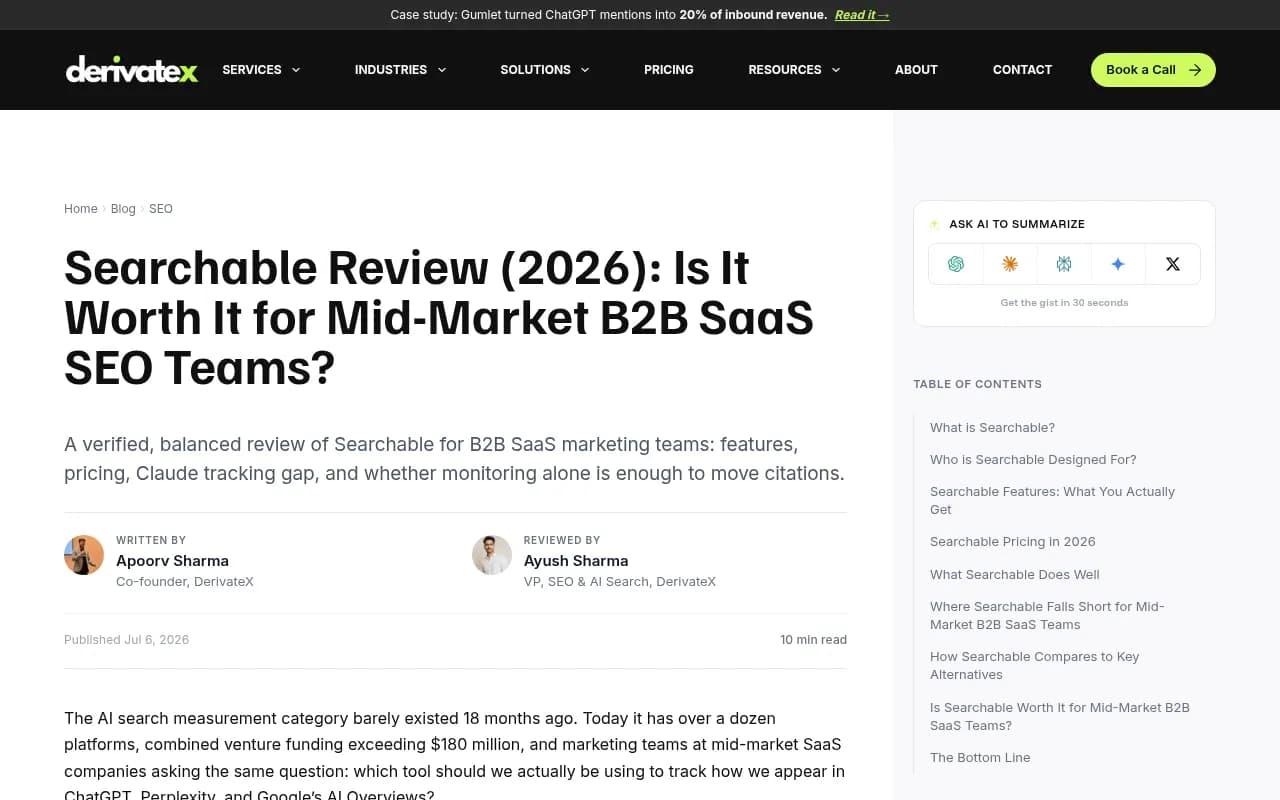
Searchable launched publicly in January 2026, founded by British serial entrepreneur Chris Donnelly. By May 2026, it had tracked over 12,000 brands, analyzed more than 45 million citations, and hit £1.4 million in ARR in under 4.5 months. That growth rate attracted a $14 million Series A from Headline at an $85 million valuation.
Headline's portfolio includes Bumble, Farfetch, and Sonos -- and notably, they previously backed Semrush before its $1.9 billion acquisition by Adobe. So when Headline bets on an AI search platform, it's worth paying attention. The thesis is that Searchable is the Semrush of the AI search era.
That's a compelling story. Whether the product delivers on it at mid-market price points is a different question.
The core product tracks how brands appear across AI search engines -- ChatGPT, Perplexity, Google AI Overviews, and others. You get visibility scores, citation data, competitor comparisons, and brand mention tracking. It's clean, fast, and clearly built by people who understand what marketing teams want to see.
Searchable's pricing structure (what we know)
Searchable does not publish a full pricing page with tier-by-tier breakdowns. This is a common pattern in the AI visibility category -- platforms often use sales-led pricing, especially for anything above a starter plan.
Based on available information from user reviews, the Derivatex agency review, and community discussions, here's what we can piece together:
| Tier | Approximate cost | Prompts tracked | Sites | Key limitations |
|---|---|---|---|---|
| Starter / Trial | Free or low-cost entry | Limited | 1 | Very restricted data access |
| Growth | ~$200-$400/mo (estimated) | ~50-100 prompts | 1-2 | No crawler logs, limited competitor data |
| Professional | ~$500-$800/mo (estimated) | ~200+ prompts | 3-5 | Claude tracking gaps, no content generation |
| Enterprise | Custom / sales-led | Unlimited | Multiple | Full feature set, custom SLAs |
These figures are estimates based on third-party reviews and user reports. Searchable has not published a public pricing page as of July 2026, so treat these as directional rather than exact.
What is confirmed: the platform is not cheap. For mid-market teams, you're likely looking at $300-$600/month minimum for a meaningful prompt set, which puts it in direct competition with platforms that offer considerably more functionality at similar price points.
What you actually get at each level
Monitoring and citation tracking
This is where Searchable is genuinely strong. The platform tracks brand mentions across multiple AI engines, shows you citation frequency, and lets you compare your visibility against competitors. The dashboard is well-designed and the data updates regularly.
For a team that just wants to answer "are we showing up in AI search?" -- Searchable does that well.
Competitor visibility comparison
You can see how competitors rank across different AI models for shared prompts. This is useful context. If your main competitor is appearing in 60% of relevant ChatGPT responses and you're at 12%, that's a clear signal something needs to change.
The limitation is that Searchable shows you the gap but doesn't help you close it. There's no built-in content gap analysis that maps your existing pages against AI responses, and no content generation tools to help you create what's missing.
Claude tracking -- the known gap
This is worth flagging explicitly. Multiple reviews, including the detailed Derivatex agency review, note that Searchable has limited coverage of Claude (Anthropic's AI). Claude has become a significant player in AI search, particularly in professional and B2B contexts. A platform that doesn't track it reliably is missing a meaningful slice of the picture.
This isn't a dealbreaker for every team, but if your audience uses Claude -- and many B2B buyers do -- it's a real gap.
What's missing: crawler logs and content tools
Two things that mid-market teams often discover they need, and that Searchable doesn't currently offer:
AI crawler logs. These show you when ChatGPT, Perplexity, or Claude's crawlers visit your site, which pages they read, and whether they're encountering errors. Without this, you're flying blind on the technical side of AI indexing. You might have great content that AI models simply aren't reading because of a crawl issue you can't see.
Content generation. Knowing you're invisible for a prompt is step one. Writing the content that fixes it is step two. Searchable stops at step one.
Is it worth it for mid-market B2B SaaS teams?
Mid-market SaaS teams -- roughly $5M to $50M ARR -- have specific constraints. Budget is real but not unlimited. The marketing team is usually 3-8 people. They need tools that connect to pipeline, not just brand metrics.
Here's the honest assessment:
Where Searchable works well:
- You're early in AI visibility and need a clean dashboard to understand the baseline
- Your primary concern is brand monitoring -- are we showing up, are competitors outranking us
- You have a separate content team that can act on the data independently
- You're primarily focused on ChatGPT and Perplexity (not Claude)
Where it falls short:
- You need to actually improve your AI visibility, not just measure it
- You want to understand why AI models aren't citing you (crawler logs)
- Your team needs content briefs or AI-generated drafts grounded in prompt data
- Claude coverage matters for your audience
- You want to connect AI visibility to traffic and revenue attribution
The monitoring-only model is a real constraint. At $300-$600/month, you're paying for data that tells you there's a problem. Fixing the problem requires a separate workflow, separate tools, and separate budget.
How Searchable compares to alternatives
The AI visibility category has grown fast. Here's how Searchable sits relative to the main alternatives mid-market teams evaluate:
| Platform | Monitoring | Content generation | Crawler logs | Claude tracking | Approx. price |
|---|---|---|---|---|---|
| Searchable | Strong | No | No | Limited | ~$300-600/mo |
| Promptwatch | Strong | Yes (Content Agents) | Yes | Yes | $99-$579/mo |
| Otterly.AI | Basic | No | No | Limited | $29-$189/mo |
| Profound | Strong | No | No | Yes | $500+/mo |
| AthenaHQ | Strong | No | No | Yes | $400+/mo |
| Peec.ai | Basic | No | No | Limited | $49-$199/mo |
Promptwatch is the clearest alternative worth evaluating if you want more than monitoring. It covers the full loop: Answer Gap Analysis to find what prompts you're missing, Content Agents to generate articles and briefs grounded in real prompt data, and page-level tracking to see when new content starts getting cited. Crawler logs show you exactly which AI agents are hitting your site and what they're reading.

For teams that want a simpler, cheaper monitoring-only tool, Otterly.AI and Peec.ai are worth a look at lower price points.


If enterprise-grade monitoring with strong competitor analysis is the priority and budget isn't the constraint, Profound is a solid option.
The monitoring-only problem
This is worth spending a moment on because it affects the whole category, not just Searchable.
Most AI visibility platforms were built to answer one question: "Where do we show up?" That was the right question in 2024 when the category was new and teams just needed to understand the landscape.
In 2026, the question has shifted. Teams now know they're not showing up enough. They need to know why, and they need help fixing it. A dashboard that shows you a visibility score of 18% is useful for about one meeting. After that, the question is: what do we do about it?
Searchable, like most monitoring-focused platforms, doesn't have a great answer to that second question. You export the data, bring it to your content team, and hope they can translate "we're not cited for X prompt" into a content brief that actually moves the needle.
That's a workflow gap that matters more at mid-market than at enterprise, where you might have a dedicated SEO team with the bandwidth to bridge it.
Practical recommendations by team type
If you're a 2-3 person marketing team at a $10M ARR SaaS company: Searchable's pricing is likely too high for what you get. You'd be better served by a platform that combines monitoring with content guidance, so your limited bandwidth goes toward fixing problems rather than just identifying them. Promptwatch's $99/month Essential plan or $249/month Professional plan gives you monitoring plus content generation in one workflow.
If you're a 5-8 person marketing team with a dedicated SEO function: Searchable is worth evaluating if you already have content production capacity. The monitoring data is good, and your SEO team can translate it into action. The Claude gap is still a concern -- ask them directly about their roadmap on that before signing.
If you're an agency managing multiple mid-market clients: The lack of published multi-client pricing is frustrating. You'll need to negotiate custom terms, and the absence of crawler logs and content tools means you're adding complexity to your workflow. Platforms with built-in content generation and agency tiers are worth comparing carefully.
If you're evaluating for enterprise ($50M+ ARR): Searchable's enterprise tier likely includes more features and dedicated support. At that level, the monitoring capabilities are strong enough to justify the conversation. But still pressure-test the Claude tracking gap and ask about their roadmap for content optimization features.
What to ask Searchable before buying
If you're in a sales conversation with Searchable, these are the questions worth pushing on:
- What's the current state of Claude tracking, and when does full coverage ship?
- Do you have any AI crawler log functionality, or is that on the roadmap?
- How does the platform help me act on the data -- is there any content brief or gap analysis feature?
- What does the prompt set look like at each tier -- are these custom prompts I define, or fixed templates?
- How is pricing structured for multiple sites or brands?
- What does the contract look like -- monthly, annual, minimum commitment?
The answers will tell you a lot about whether the platform is built for your workflow or whether you'll end up with a monitoring dashboard that sits open in a browser tab but doesn't drive action.
The bottom line
Searchable is a well-built monitoring platform with genuine momentum. The funding, the growth rate, and the Headline backing are all real signals. For teams that need to understand their AI search baseline and have the internal capacity to act on the data independently, it's worth evaluating.
But for most mid-market B2B SaaS teams, monitoring alone isn't enough anymore. The category has matured past "are we visible?" into "how do we get more visible, faster?" Searchable's current feature set doesn't fully answer that second question, and the pricing -- especially without a public tier breakdown -- makes it hard to assess value before you're already in a sales cycle.
If you want a platform that closes the loop from gap identification to content creation to citation tracking, compare Searchable against options that were built with that full workflow in mind from the start.