Key takeaways
- Scrunch is a strong monitoring platform that tracks brand citations across 7 LLMs including ChatGPT, Perplexity, Gemini, Claude, and Google AI Overviews.
- The pricing jump from $100/month (Explorer) to $500/month (Growth) is steep, and the Growth plan is what most businesses actually need.
- The headline Agent Experience Platform (AXP) feature is still in limited testing as of 2026 and carries potential SEO risks.
- Scrunch shows you what's happening in AI search but doesn't help you fix it -- there's no built-in content generation or gap analysis.
- For teams that need to act on insights, not just collect them, platforms with optimization layers are worth evaluating alongside Scrunch.
What Scrunch actually is
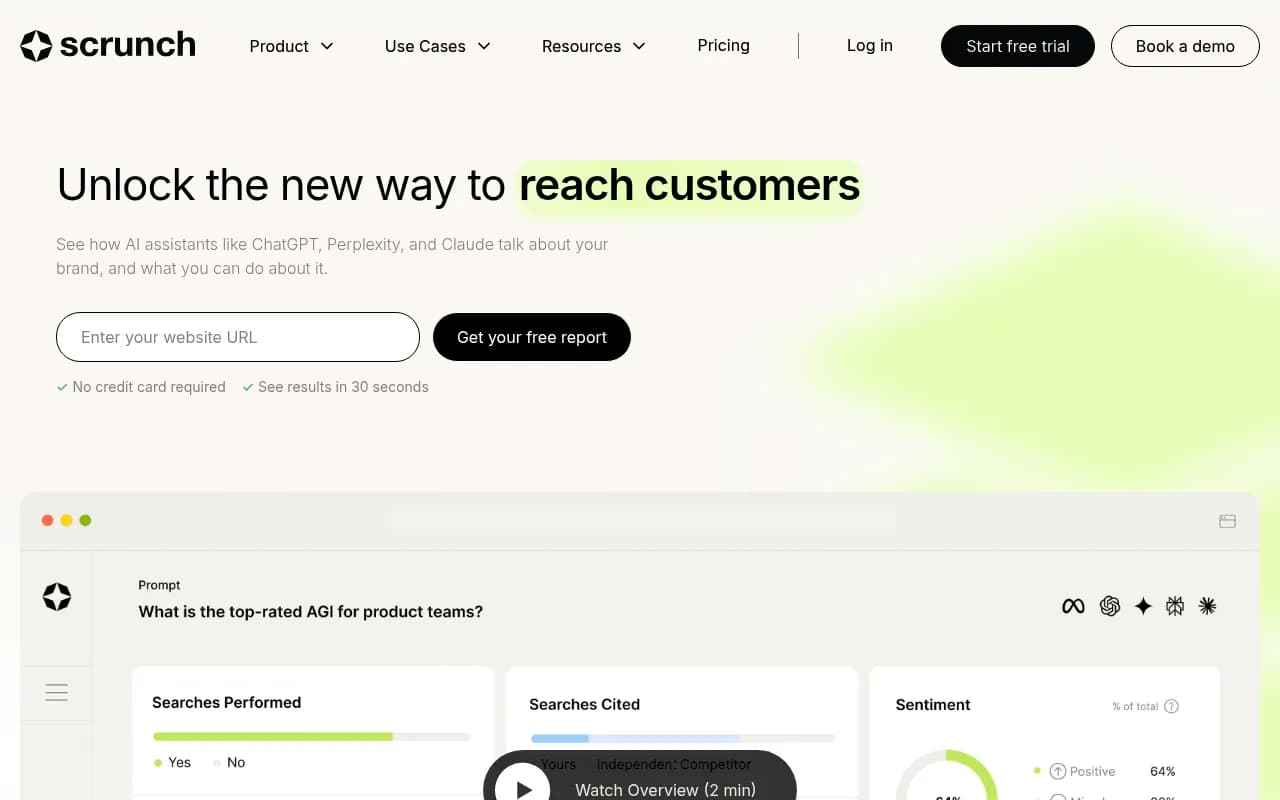
Scrunch came out of beta in March 2025, raised a $15M Series A in July 2025, and has positioned itself as a "brand optimization for the AI era" platform. Total funding sits around $19M since its 2023 founding.
In practice, Scrunch does three things:
- It generates conversational prompts based on your category and runs them through a list of LLMs on roughly a three-day cycle.
- It reports on share of voice, sentiment, citations, and competitor presence per prompt.
- It layers on AI bot traffic monitoring through a Google Analytics integration, plus page-level audits.
There's also the much-marketed Agent Experience Platform (AXP) -- a middleware layer that intercepts AI bot requests at the CDN edge and delivers a pre-rendered, AI-optimized version of your site. It's conceptually interesting, but as of early 2026, it's still in limited testing. Most buyers are evaluating Scrunch on prompt tracking and bot analytics alone.
What Scrunch does well
LLM coverage on the Growth tier
The Growth plan tracks seven LLMs simultaneously: ChatGPT, Perplexity, Gemini, Claude, Meta AI, Google AI Overviews, and Google AI Mode. That breadth matters. User behavior is fragmenting across platforms, and a tool that only covers one or two engines gives you a distorted picture of your actual AI visibility.
Bot traffic attribution
One genuinely useful feature is the Google Analytics integration that attributes website traffic to AI crawlers. Knowing which pages AI bots are reading -- and how often -- is actionable data that most monitoring tools don't surface cleanly. This is closer to what crawler log analysis provides, and it's one of Scrunch's more differentiated features at this price point.
Clean dashboard and workspace
Multiple reviewers call out the UI as a genuine strength. Navigation is clear, data is well-organized, and the workspace structure works for agency teams managing multiple brands. If you're demoing this to a client or presenting in a quarterly review, the visuals hold up.
Competitor tracking
Scrunch lets you track competitor mentions alongside your own, which is useful for benchmarking share of voice. Seeing that a competitor appears in 60% of prompts where you appear in 20% is the kind of data that gets budget approved.
Where Scrunch falls short
The pricing gap is real
The Explorer plan at $100/month sounds accessible, but it's limited enough that most businesses quickly realize they need the Growth plan at $500/month. That's a 5x jump with no middle tier. For agencies managing multiple clients, the math gets uncomfortable fast.
No content layer
This is the core limitation. Scrunch tells you where you're not showing up. It doesn't help you figure out what content to create, or actually create it. The platform generates insights; what you do with them is entirely up to you and your team.
For a $500/month tool, that's a meaningful gap. You're essentially paying for a dashboard that surfaces problems, then going elsewhere to solve them.
Prompt methodology questions
One concern worth flagging: Scrunch generates its own prompts based on your category rather than tracking what users actually type into AI systems. As one reviewer put it, "you're not tracking what users actually ask AI systems -- you're tracking Scrunch's interpretation of what they might ask." This is a legitimate methodological critique. If the prompts don't reflect real query patterns, the visibility data can be misleading.
The AXP is unproven
The Agent Experience Platform is Scrunch's most technically ambitious feature, and also its most uncertain one. Intercepting AI bot requests at the CDN edge and serving a different version of your site raises real questions about cloaking -- a practice that can get you penalized in traditional search. There's limited independent evidence that AXP moves the needle on AI citation rates, and the "black box" nature of the implementation makes it hard to audit.
For most marketing teams, this is a feature to watch rather than a reason to buy.
Who Scrunch is actually built for
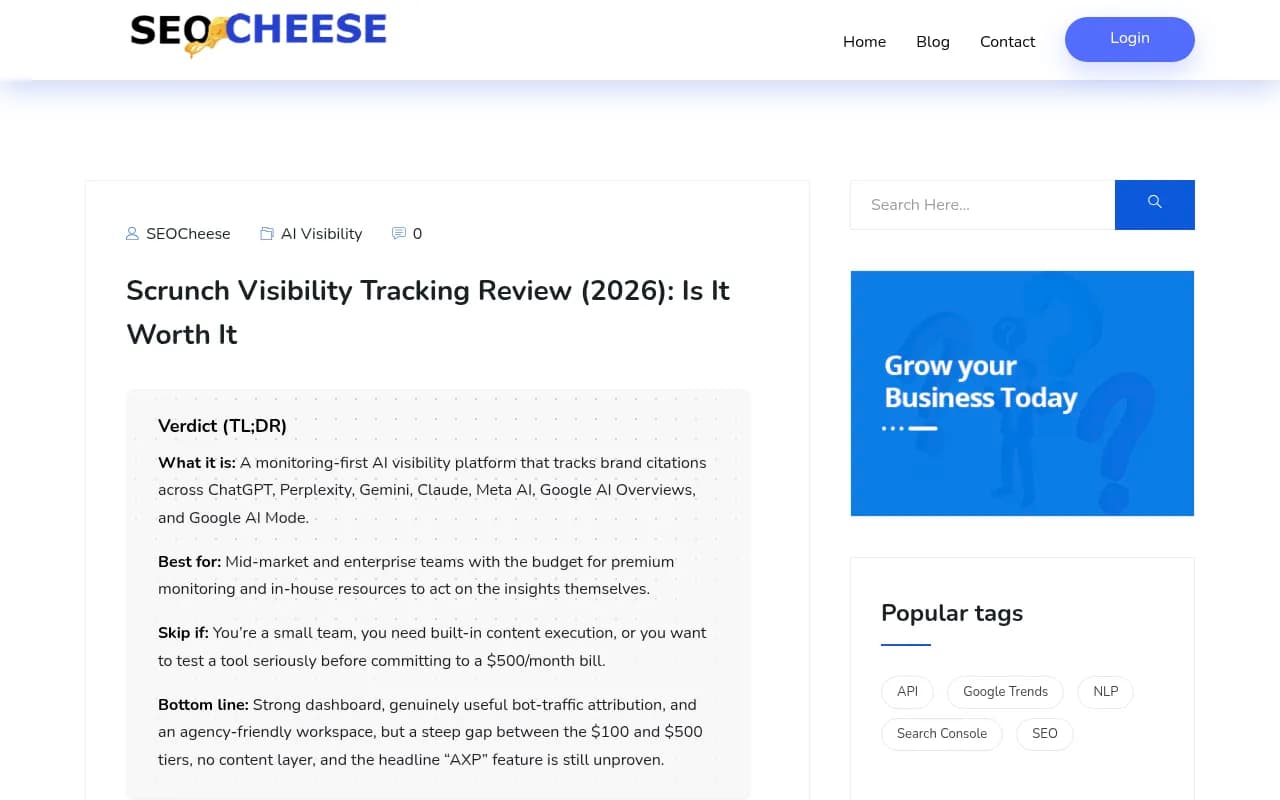
Scrunch makes the most sense for mid-to-large enterprises with:
- Dedicated technical SEO or marketing ops teams who can translate monitoring data into action
- JavaScript-heavy websites where AI crawler accessibility is a genuine infrastructure problem
- Budgets that can absorb $500/month without needing to justify every line item
- In-house content teams who don't need the platform to generate content for them
It's a harder sell for:
- Small teams or solo practitioners who need the tool to do more of the heavy lifting
- Agencies with thin margins who need to justify per-client costs
- Teams that want to go from "we're invisible in AI search" to "here's the content we published to fix it" within the same platform
How Scrunch compares to alternatives
The honest framing here is that Scrunch sits in a "monitoring-first" category alongside tools like Otterly.AI, Peec AI, and AthenaHQ. These platforms are good at showing you data. The question is whether data alone is what you need in 2026.
| Platform | LLM coverage | Content generation | Crawler logs | Prompt methodology | Starting price |
|---|---|---|---|---|---|
| Scrunch | 7 LLMs | No | Via GA integration | Platform-generated | $100/mo (limited) |
| Otterly.AI | 4-5 LLMs | No | No | Platform-generated | Lower |
| Peec AI | 3-4 LLMs | No | No | Platform-generated | Lower |
| AthenaHQ | 8 LLMs | No | No | Platform-generated | Higher |
| Profound | 6+ LLMs | No | No | Platform-generated | Higher |
| Promptwatch | 10 LLMs | Yes (built-in AI writer) | Yes (real-time) | Real query data | $99/mo |
The monitoring-only model is under pressure across the category. Of 73 new monitoring platforms launched in the past year, fewer than 25% raised meaningful follow-on funding -- a sign that the market is consolidating around platforms that can demonstrate ROI beyond dashboards.
Scrunch vs Otterly.AI
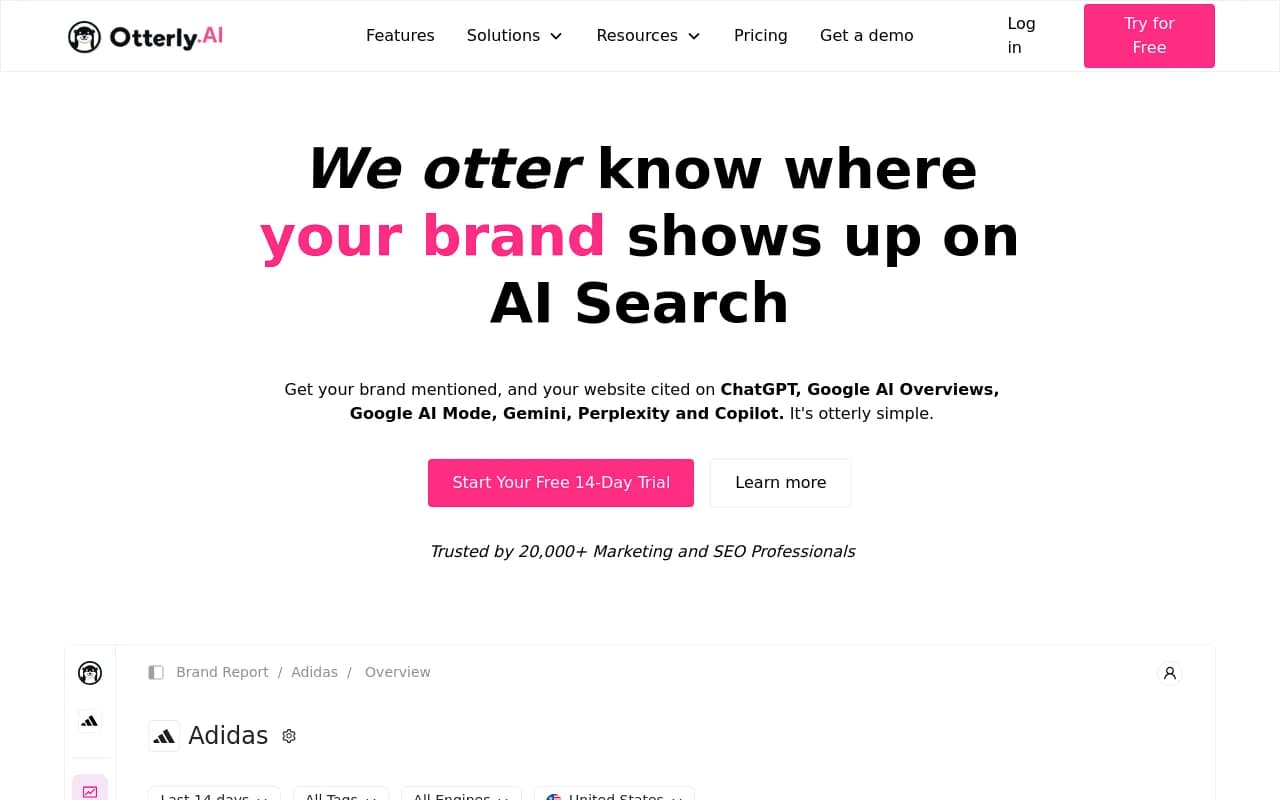
Otterly is cheaper and simpler. If you just want a quick read on brand mentions across a few LLMs without the overhead, Otterly works. Scrunch offers more LLMs, better reporting, and the bot traffic attribution layer. The tradeoff is price.
Scrunch vs Peec AI
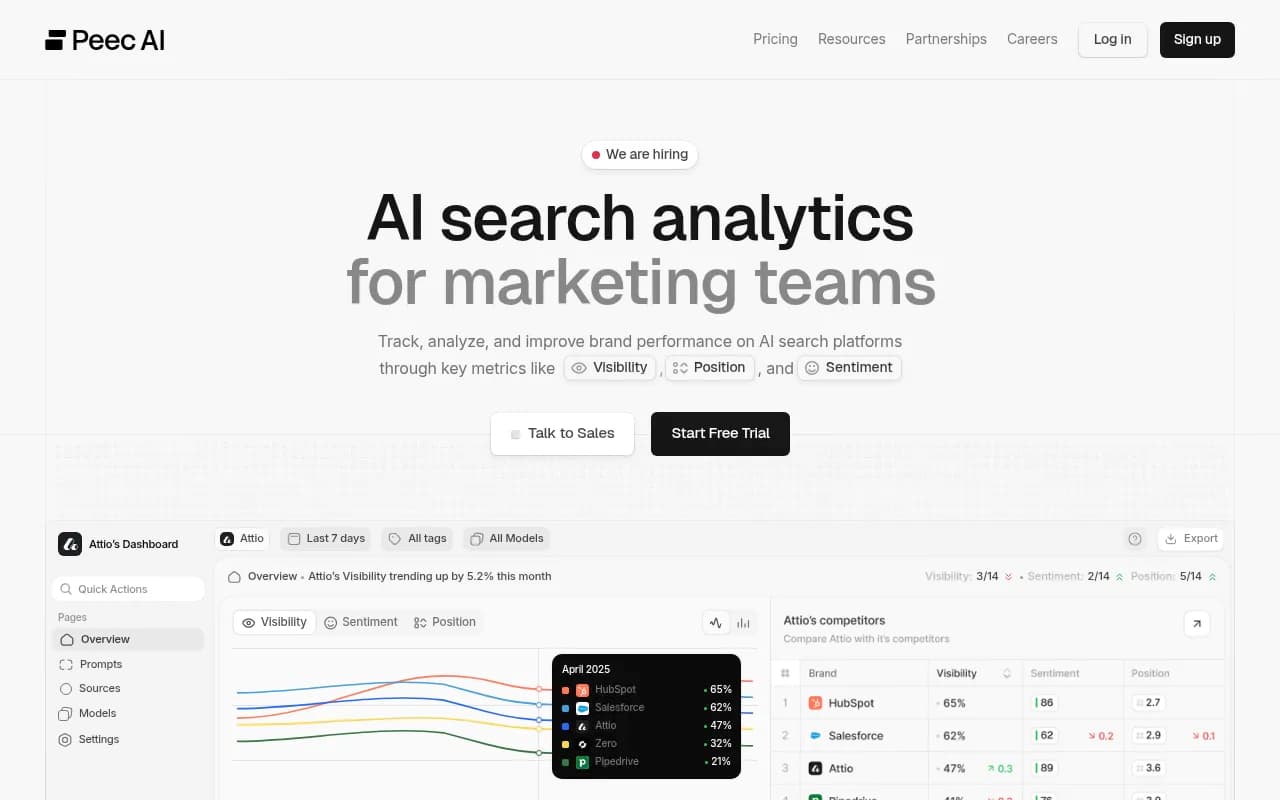
Peec AI is similarly monitoring-focused with a lower price point. Scrunch's UI and workspace structure are meaningfully better for team use. If you're a solo operator, Peec might be enough. If you're running a team, Scrunch's organization features justify some of the premium.
Scrunch vs Profound
Profound is Scrunch's closest competitor in terms of positioning and price. Both target enterprise buyers, both have strong dashboards, neither has a built-in content layer. Profound has slightly different LLM coverage and its own feature set worth evaluating independently. Neither platform helps you act on what you find.
Scrunch vs Promptwatch
This is where the comparison gets interesting. Promptwatch covers 10 LLMs (more than Scrunch's 7), includes real-time AI crawler logs (not just a GA integration), and -- critically -- has a built-in AI writing agent that generates content based on citation data and prompt gap analysis. The Essential plan starts at $99/month, which is actually cheaper than Scrunch's entry tier for comparable or better feature depth.
The core difference: Scrunch shows you the gap. Promptwatch shows you the gap and helps you close it.

The monitoring-only question
Here's the thing about monitoring-only tools in 2026: they were the right product for 2024. When AI search was new and brands were just trying to understand whether they appeared at all, a clean dashboard with citation tracking was genuinely valuable.
The market has moved. Most marketing teams now know they have an AI visibility problem. What they need is help solving it.
The workflow gap is real. A tool that tells you "you're not appearing in prompts about [your category]" is useful. A tool that then shows you which specific content gaps are causing that, generates draft articles targeting those gaps, and tracks whether those articles start getting cited -- that's a different product category entirely.
Scrunch is a good monitoring tool. But if your team's question has shifted from "are we visible?" to "how do we get more visible?", you'll hit the ceiling of what monitoring alone can do fairly quickly.
That's not a knock on Scrunch specifically -- it's a structural limitation of the monitoring-first approach. The same critique applies to Otterly, Peec, AthenaHQ, and most of the other platforms in this space.
Practical considerations before buying
A few things worth thinking through before committing to Scrunch:
The free trial situation. Scrunch's trial is limited enough that it's hard to evaluate the Growth plan features without paying. Budget for at least one month at the $500 tier if you want a real test.
Your team's capacity. Scrunch's value scales with your ability to act on its data. If you have a content team that can take "we're missing visibility for these 15 prompts" and turn it into a content calendar, Scrunch works well. If you're a two-person marketing team, you might spend more time looking at dashboards than doing anything about them.
The AXP decision. Don't buy Scrunch primarily for the Agent Experience Platform. It's not ready for production use at most organizations, and the cloaking risk is real enough that you'd want independent validation before deploying it.
Annual vs monthly billing. Annual agreements unlock roughly a 17% discount. If you're confident in the platform after a trial month, the annual commitment makes financial sense.
Verdict
Scrunch is a well-built monitoring platform with genuine strengths: broad LLM coverage, clean UI, useful bot traffic attribution, and an agency-friendly workspace. The $500/month Growth plan is what most businesses actually need, and at that price it's competitive with Profound for enterprise monitoring use cases.
The limitations are also real. No content generation, no built-in gap analysis, a prompt methodology that some reviewers find questionable, and a headline feature (AXP) that isn't ready for most buyers yet.
Whether Scrunch is worth it depends almost entirely on what you already have. If you have strong in-house content capabilities and just need better visibility data, Scrunch delivers. If you need a platform that takes you from "we're invisible" to "we published content and our citations improved," you'll need to either pair Scrunch with other tools or look at platforms that close the full loop.
The monitoring-only era of AI visibility tools is winding down. Scrunch knows this -- the AXP is an attempt to move up the value chain. But until that feature matures, Scrunch is best understood as a premium monitoring dashboard, not an optimization platform.