Key takeaways
- BrightLocal is the cheapest way to start: its Local AI Visibility Tracker is included in the Track plan, covers up to 20 prompts per location, but only tracks Google AI Overviews, AI Mode and ChatGPT.
- Birdeye and Yext are built for large multi-location brands. Both cover more AI engines, but neither publishes prompt limits, and Yext does not publish pricing either.
- Promptwatch is the only one of the four that joins prompt tracking to AI crawler logs, visitor analytics and a content agent, with monitors per country, language, US state or city and local targeting at exact coordinates on Business plans.
- Most comparison articles on this topic are written by vendors, including BrightLocal, Birdeye and Promptwatch itself. Verify claims with a trial before you commit.
- Pick by shape of business: one to twenty locations leans BrightLocal, hundreds of locations leans Birdeye or Yext, and teams that want tracking plus execution lean Promptwatch.
What local prompt tracking actually means
Local prompt tracking is simple to describe. You take the questions real customers ask an AI engine, things like "best emergency plumber near me" or "dentist open Saturday in Leeds", run them on a schedule from a specific place, and record whether your business is named, where it lands, and which sources the answer cites.
The hard part is the "from a specific place" bit. A brand-level visibility score can look healthy while three of your fifty locations are invisible. Birdeye makes this argument loudly, saying AI engines evaluate each location independently. It is a vendor saying it, but it matches how local answers behave: the same prompt returns different businesses depending on where it is asked.
So when you compare tools, four questions matter more than any feature grid:
- Can it track at location level, or only brand level?
- Which AI engines does it actually query?
- How many prompts per location sit behind each score?
- Does it tell you what to fix, or just report a number?
The four tools at a glance
| Tool | Built for | AI engines covered | Prompts | Pricing | Execution |
|---|---|---|---|---|---|
| BrightLocal | Agencies, small location counts | Google AI Overviews, AI Mode, ChatGPT | Up to 20 per location | From $31/mo annual per location (Track plan) | AI Insights from the Manage plan |
| Birdeye | Multi-location brands, 100 to 10,000+ locations | ChatGPT, Gemini, Perplexity, AI Overviews, AI Mode, Claude, Grok (vendor claim) | Not public | Custom | Agent-led fixes to listings, reviews, citations (vendor claim) |
| Yext | Enterprise multi-location brands | Google Search, Maps, AI Overviews, ChatGPT, Gemini, Claude, Perplexity | Not public | Not public | Listings and knowledge graph platform |
| Promptwatch | Brands and agencies wanting tracking plus fixing | 12 AI platforms from real interfaces | Plan-based, 50 to 350+ | From $95/mo | Content Agent, Action Board, CMS publishing |
Two notes on that table. The Yext and BrightLocal engine details come from BrightLocal's own comparison article, so treat them as a competitor's description. And the Birdeye coverage list comes from Birdeye's own blog, which ranks Birdeye first.
BrightLocal: the low-friction starting point
BrightLocal is a local SEO platform that has been around long enough to have rank tracking, a local search grid, citation building and Google Business Profile audits in one login. It added a Local AI Visibility Tracker that sits inside those plans rather than being sold as a separate AI subscription.
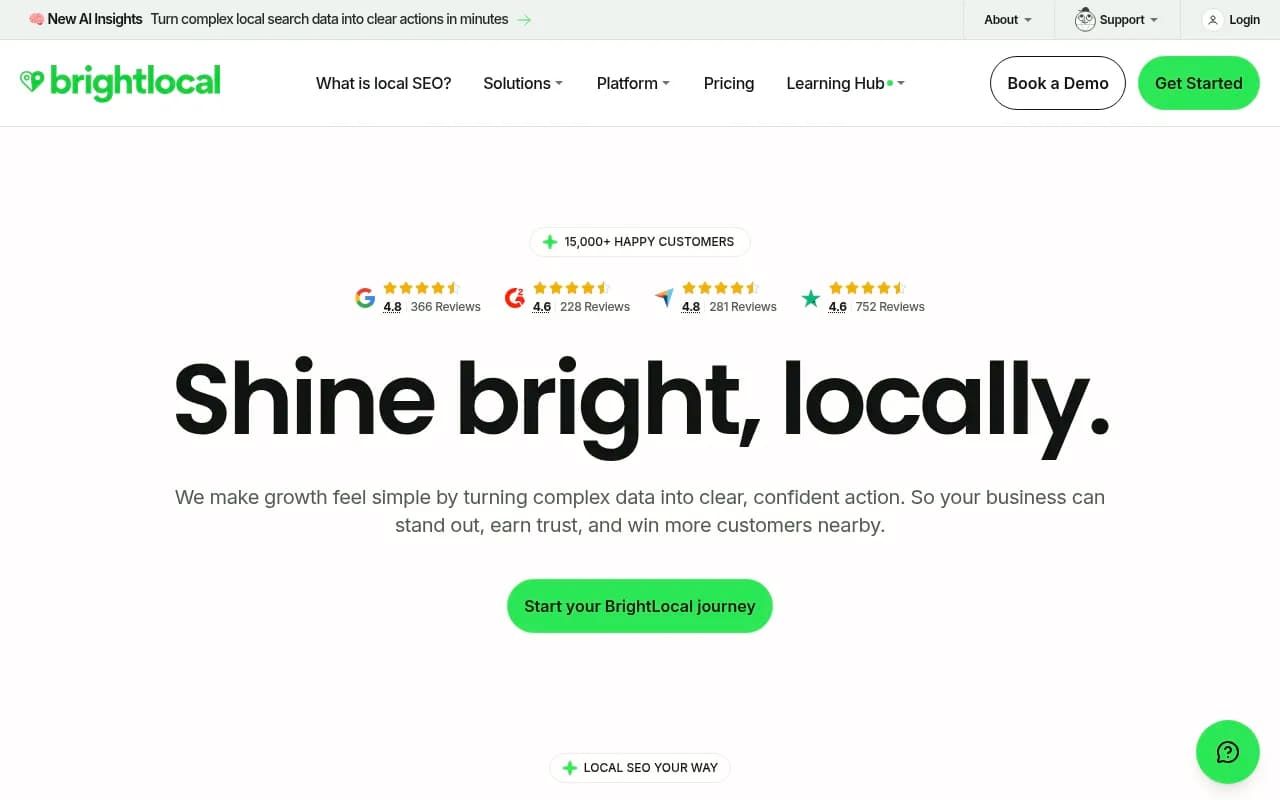
From the official pricing page, annual billing for one location runs $31 a month on Track, $40 on Manage and $49 on Grow. Monthly billing is $41, $54 and $65. Earlier third-party roundups quoted $29, so check the page yourself. Track for 2 to 5 locations is $47 a month on annual billing, 6 to 10 is $62, and 91 to 100 locations is $393. Over 100 is price on request. The AI Visibility Tracker is on the cheapest plan, while AI Insights, which turns report data into prioritised actions, starts at Manage.
What you get: up to 20 prompts per location, across Google AI Overviews, AI Mode and ChatGPT. What you do not get: Gemini, Claude or Perplexity. I could not verify whether markets outside the US and UK are covered, so ask before you sign if you operate elsewhere.
My take: this is the sensible first step for an agency with a handful of clients or a business with a few sites. It is tracking and advice, not content production. If your problem is "we do not even know if we show up", it answers that cheaply.
Birdeye: location-level diagnosis for big brands
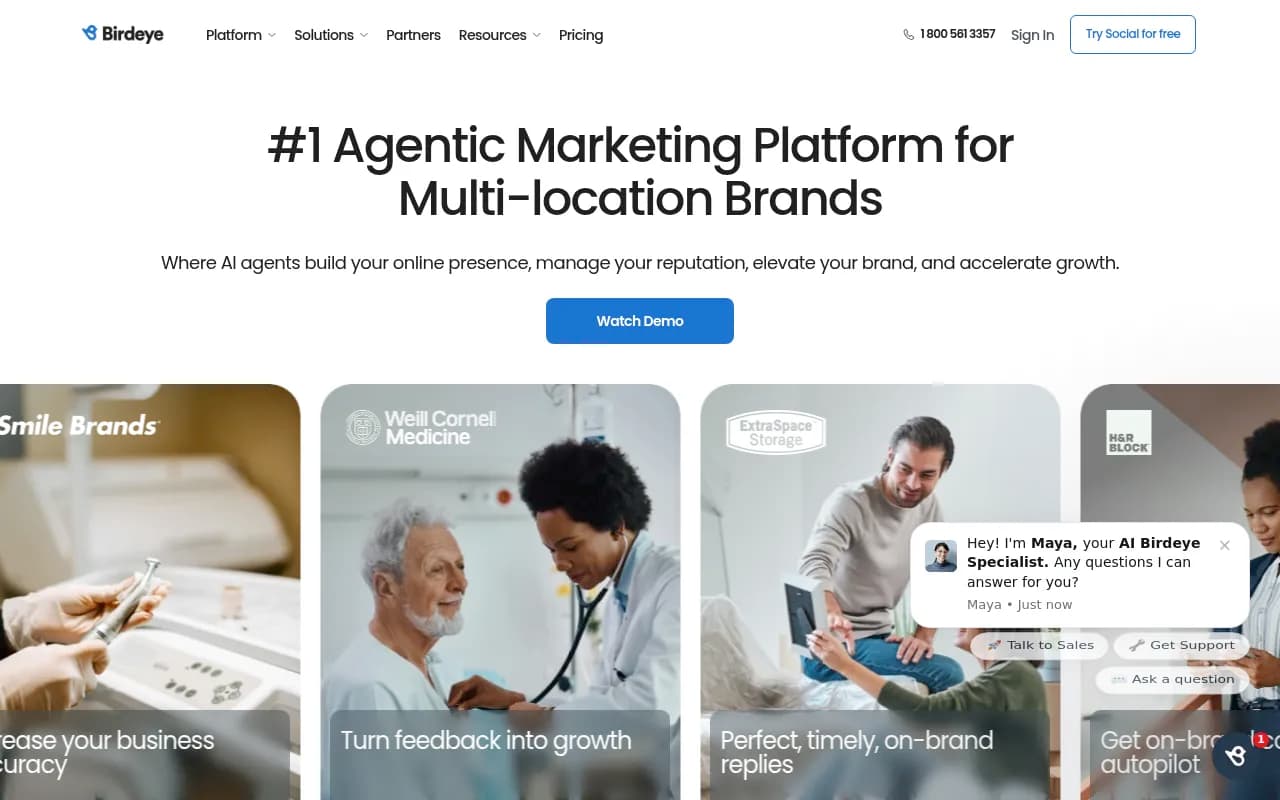
Birdeye started as a reviews and reputation platform and has moved into AI search with a product it positions for brands with 100 to 10,000+ locations. It says it covers ChatGPT, Gemini, Perplexity, Google AI Overviews, AI Mode, Claude and Grok, monitors at location level, and uses agents to fix listings, reviews, citations and local pages.
The case for it is real if you already run Birdeye for reviews. The review and listing data that AI engines lean on lives in the same system as the tracking, so a gap can turn into a fix without leaving the platform. Compare that to the travel citation data from Promptwatch Data (Sep 28 to Oct 4, 2026), where booking and search sites earned 2.42% of the 4.18% total citation share across the 17 top domains shown, more than half. Aggregators and review sites do most of the talking, and that is exactly the territory Birdeye works in.
The caveats are about transparency. Pricing is custom, based on queries tracked, locations and engines. A third-party estimate puts it around $299 per location per month, but I found no official figure and would not budget from it. The question to put to their sales team is how many prompts per location sit behind one visibility score. Also remember that nearly everything public about the agent-led execution comes from Birdeye's own marketing.
Yext: the listings platform with a scouting layer
Yext is the old guard of multi-location listings management, and its Scout tool is the AI visibility layer. According to BrightLocal's comparison, Scout monitors brand mentions across Google Search, Google Maps, AI Overviews, ChatGPT, Gemini, Claude and Perplexity. Maps coverage is a notable difference from the others.
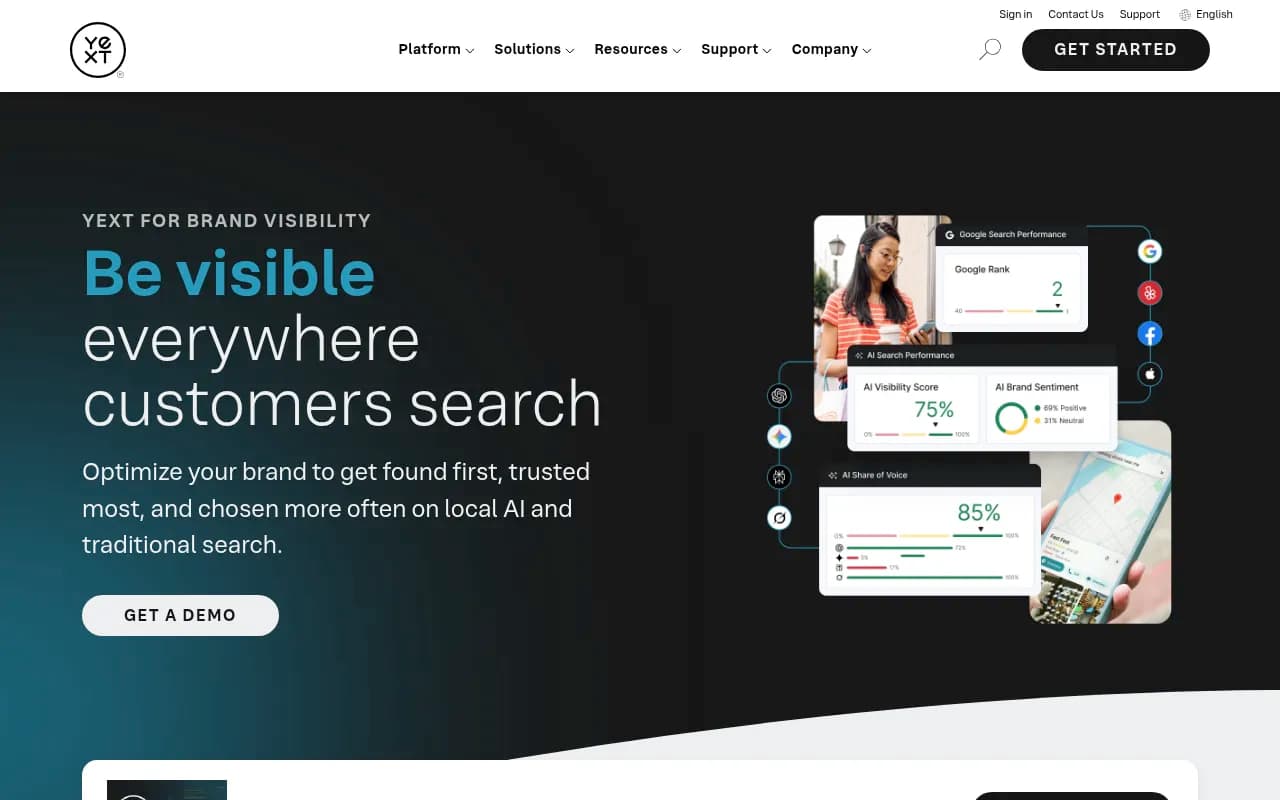
The trade-off is opacity. Prompt counts and pricing are not public in any source I found, and I did not scrape Yext's own pages, so treat this section as thinner than the others. Yext makes the most sense when you already pay for it as your system of record for business data across hundreds of locations. As a standalone purchase just to track prompts, it is hard to justify without a quote in hand.
Promptwatch: tracking plus the loop that fixes it
Promptwatch is an AI visibility and GEO platform rather than a local listings tool, which is the most important thing to understand before comparing it with the other three. It will not manage your Google Business Profile or push listing updates. What it does is track, trace, act and measure on AI answers, including local ones.

On the local side, monitors run per country, language, US state or city, and state or city tracking is available on Business, agency and Enterprise plans. Business, Agency Scale and Enterprise also get local GEO/SEO targeting at exact coordinates: you pin a monitor to a spot (accuracy radius 20 m to 5 km) so ChatGPT, Google AI Overviews and Google AI Mode answer as if asked from there. That is a closer match to "near me" behaviour than a city label.
The data comes from the real interfaces of ChatGPT, Gemini, Perplexity, Google AI Overviews, AI Mode, Copilot, Meta AI and others rather than APIs alone, because user-facing answers and citations can differ from API output.
Beyond tracking, three things separate it here:
- AI crawler logs that are IP-verified, so you can tell whether a location page was never read by GPTBot or was read and not cited.
- Visitor analytics to see whether AI answers send traffic and conversions.
- A Content Agent (Business and Enterprise) that writes and publishes pages against your gaps to WordPress, Webflow or Framer.
The fanout data is useful for local content too. Promptwatch Data found average fanout query length falling from about 117 characters in early December to around 53 by April 2026, and recommends headings that read like short search queries with entity and category first. For a local page, that means "service + city" headings. One caveat: the report's intro says a prompt can trigger 3 to 8 or more searches, while its averages sit near 1 to 2, so use the averages as a guide, not a promise.
Pricing, to confirm at promptwatch.com/pricing: Essential is $95 a month (50 prompts), Professional $245 (150 prompts), Business $579 (350 prompts). Agencies pay $199, $399 or $799 for Kick-off, Growth and Scale, with unlimited projects and prompts. A 7-day free trial is available on monthly billing.
Honest limits: the Business plan is the first with local coordinate targeting, state and city tracking, and the Content Agent, so a small local shop on Essential gets country-level monitoring and not pin-drop precision. And per-location reporting for a 500-site franchise is a different workflow from Birdeye's location-first design.
Where the real differences are
Tracking versus doing
BrightLocal tracks and suggests. Birdeye and Yext claim tracking plus execution, but execution means listings, reviews and citations. Promptwatch tracks and then executes on content and measures the result, but leaves listings to other tools. These are different jobs. Many teams will end up with a listings tool and a visibility tool, not one winner.
Engine coverage
BrightLocal covers three engines. Yext names seven surfaces including Maps. Birdeye names seven engines. Promptwatch covers a broader set, including Copilot, Meta AI and Amazon Alexa. If your customers use Gemini or Perplexity heavily, BrightLocal's lack of them matters.
Pricing honesty
Only BrightLocal and Promptwatch publish numbers. Birdeye and Yext both require a conversation, and for enterprise buyers that is normal. But if you are comparing, you cannot compare what you cannot see, so get written quotes with prompt and location counts.
Citations still decide a lot
Across verticals, Promptwatch Data shows aggregators and marketplaces out-citing brand sites. In automotive prompts in August 2026, marketplaces like Autotrader and Cars.com outranked every car brand. For local businesses, the lesson is dull but useful: keep your listings accurate on the platforms AI actually cites, and collect reviews there.
Which one should you pick
| If you are... | Start with |
|---|---|
| An agency with a few local clients and a small budget | BrightLocal |
| A brand with 100+ locations already using review software | Birdeye |
| An enterprise already running Yext for listings | Yext Scout |
| A team that wants tracking, crawler data and content that fills gaps | Promptwatch |
| A multi-location brand wanting to test several | Run a trial on BrightLocal and Promptwatch, get quotes from the others |
A practical test: pick five locations, including two you know are weak. Write 10 realistic prompts per location. Run them in each tool for two weeks and compare whether the tool found the same weak spots you already know about, and whether it told you something new. Whatever surprises you is what you are paying for.
If you want to explore more options, the AI rank tracking directory lists many alternatives, including local specialists. And if you need a human team to handle the content and technical side, 1001 SEO Media runs local SEO and generative engine optimization work for agencies and brands, using Promptwatch as its AI visibility platform.
Bottom line
BrightLocal is the cheap, clear entry point. Birdeye and Yext fit large location estates, but you will need quotes and a pointed question about prompts per location. Promptwatch is the pick if tracking is only half the job and you want crawler data and content execution in the same place. You can start with the free AI visibility report or the 7-day trial before spending anything.