Key takeaways
- Prompt volume is a modeled estimate of how often people ask AI engines about a topic. No AI company publishes a prompt log, so every number you see comes from a vendor's own approximation.
- Vendors build the figure in different ways (consumer panels, scaled Google demand, clustered questions). The methods disagree, and I found no independent accuracy audit of any of them.
- Prompts are long, varied and rewritten by the engine before it searches, so exact-match prompt counts are sparse and a keyword-style volume number is a poor fit.
- Use prompt volume as a rough signal of topic size. Verify it against sources you control: Search Console, analytics AI referrals, and your own sales calls and forms.
- Do not confuse demand volume with the number of prompts a tool lets you track. Pricing tiers sell the second thing.
The short answer
Do search volumes for AI prompts exist? Sort of. Something is sold under that name, and some of it is useful. But it is not the same kind of number as the one in your keyword tool.
Keyword volume comes from a fairly stable thing: lots of people typing the same short phrase into one search engine. Google, via its own logs, has a count. Prompt volume has no equivalent. OpenAI, Google, Anthropic and the rest do not publish how often a given prompt is sent. Mission Growth puts it plainly: AI prompt volume is a modeled estimate, not a count pulled from a query log, and every vendor builds its own approximation from a panel, a broker feed or a set of real user questions.
So the honest framing is this. You are not looking up a fact. You are reading one vendor's model of demand. Whether that is helpful depends on how the model was built and how much data sits behind the specific topic you care about.
Two things people call prompt volume
Before going further, a trap. The same two words get used for unrelated things.
- Demand volume: an estimate of how often people ask AI engines about a topic. This is what the rest of this guide is about.
- Panel size: how many prompts you track, or how many your pricing tier allows. Mission Growth notes that Botrank's glossary uses the term both ways.
A quick test: if the number only moves when you add or remove prompts from a list you built, you are looking at panel size, not demand. Plenty of tool comparison pages blur this. Otterly.AI's tiers, for example, are quoted by a third-party comparison as $29/month for 15 prompts, $189 for 100 and $489 for 400. Those are tracking limits. They say nothing about how many people ask anything.
Why a keyword count does not carry over to prompts
Keyword volume works because people repeat themselves. Prompts mostly do not.
In a study of donated chat histories (171,264 conversations from 613 users across four AI platforms), nearly 80 percent of user prompts contained more than 20 terms. The sample is volunteers recruited through one service and English only, so do not treat it as a picture of your buyers. But the direction is clear. Prompts are long, and long text rarely repeats verbatim.
The WildChat authors, who collected about 1 million conversations by offering free ChatGPT access in exchange for logging consent, describe its user prompts as the most diverse among the datasets they compared. Same story.
Then the engine rewrites the prompt. In that same chat-history study, almost all of the web queries the platforms generated from prompts had fewer than 10 to 15 terms.
Promptwatch Data shows the same pattern from the retrieval side. In its ChatGPT query fanouts report, one prompt can trigger 3 to 8+ separate searches, and the average fanout query length fell from about 117 characters in December to roughly 53 characters (six to eight words) once fanouts returned in April 2026. The text a user types is not the text the engine searches for.
That has a practical consequence. Even a perfect count for a prompt's exact wording tells you little about the queries that actually retrieve your page.
How vendors actually build the number
This is where it gets interesting, because the methods genuinely differ. Per Mission Growth's breakdown (which says it re-verified its vendor rows in September 2026):
| Vendor | Data foundation | Refresh | Notes |
|---|---|---|---|
| Profound | Double opt-in consumer panel | Weekly, under one week latency | Covers ChatGPT, Gemini, Perplexity; sources disagree on Claude |
| Evertune | Panel described as 25M internet users' activity | No fixed cadence stated | Enterprise GEO |
| SISTRIX | 62M real Google user questions clustered into 1.4M topics | Not stated | Calls the result "an approximation"; derived from Google demand, not AI usage |
| OmniSEO (PQV) | Prompt Query Volume | Monthly, rolling 30-day window | Tiered pricing |
| Ahrefs | Parent keyword's Google demand scaled by a platform ratio from AI referral traffic | Not verified | "AI adjusted volume" per prompt |
Profound markets its Prompt Volumes feature as the first to estimate AI search volume, built from anonymized consumer panels rather than API outputs. Its page also says "exact keyword volumes", while its own FAQ and independent sources describe the numbers as estimates. I would read "exact" as marketing.
Ahrefs takes a different route. Its comparison page says each prompt carries an AI adjusted volume: the parent keyword's Google search demand, scaled by a platform-specific ratio from Ahrefs' aggregated AI referral traffic. Ahrefs also claims Profound's estimates are extrapolated from clickstream data. Profound says panel. These two claims conflict, and both come from the vendors, so treat each as a claim, not a finding.

The split matters. A panel of AI conversations tries to observe prompts. A scaled Google figure infers AI demand from search demand. They can produce different answers for the same topic, and neither has been independently checked against what buyers ask.

The margin-of-error problem nobody puts on the dashboard
A headline panel size sounds reassuring. Millions of users, hundreds of millions of prompts. But the error on your number depends on how many observations sit behind your topic, not the whole panel.
Mission Growth borrows a Pew Research example. A sample of 1,067 people gives about plus or minus 3 points. A subgroup of about 160 gives about plus or minus 8. The same logic applies here. A broad topic like "project management software" may have plenty of observations. Your niche B2B category might have a handful, and the modeled figure for it is mostly noise.
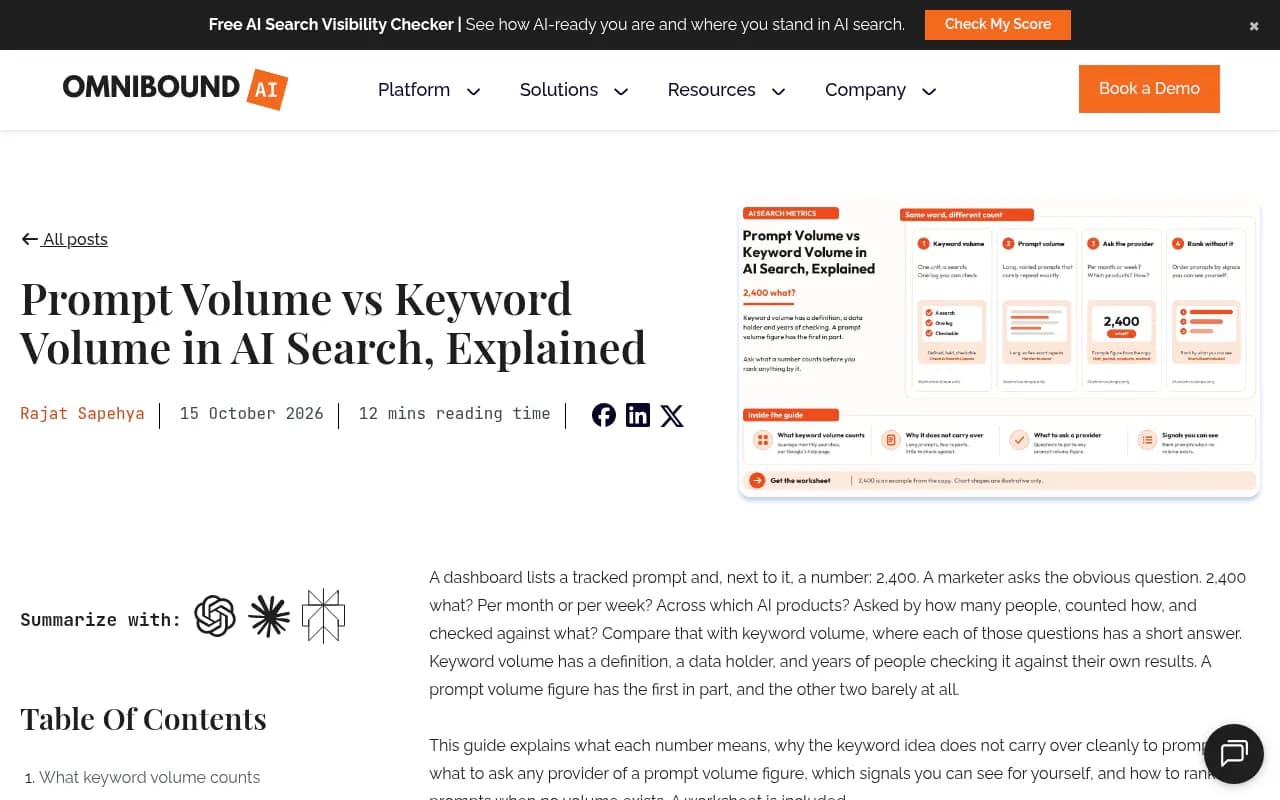
So when a dashboard shows 2,400 next to a tracked prompt, ask what that means. Is it conversations, prompts or users? Over what period? Which engines, countries and languages? Omnibound's explainer frames the same checklist and adds the one that matters most: has the figure been checked against a source you control, and can you repeat that check?
It also says it knows of no independent study that checks how well such estimates match real buyer behavior. I could not find one either.
What the skeptics say
Steve Toth called prompt volume "not measurement. It's extrapolation stacked on top of guesswork" in a LinkedIn post. There is also an r/aeo thread asking whether AI search volume is a real metric, started because tools kept launching "exact" prompt volume features.
I think the skeptics are half right. The word "exact" is indefensible. But dismissing everything misses that a panel of real conversations is a legitimately different source from a Google keyword count. It is imperfect, unaudited and still better than nothing for sizing a topic, as long as you hold it loosely.
A practical way to test any prompt volume figure
Here is the routine I would run before putting a number in a deck.
- Identify the sense. Demand estimate or panel size? Use the add-or-remove test above.
- Get the method in writing. Panel, broker feed, clustered questions, or scaled Google demand? A vendor that answers clearly has given you something to test.
- Check the unit and window. Prompts, conversations or users, per week or month, which engines and regions.
- Look at your topic's sample. Ask how many underlying observations support it. Niche topics get noisy.
- Triangulate with your own data. Compare against AI-feature impressions in Google Search Console, AI assistant referrals in analytics, and what buyers actually bring up in sales calls and forms. None shows a prompt, but together they approximate interest in a topic.
- Report shares and ranges. Say "roughly a third of this topic's demand sits on ChatGPT, modeled by vendor X", not "4,812 monthly prompts". State whether it was checked.
What to do when volume is missing or shaky
Many real buyer questions will have no volume at all. That is normal, and it does not mean they do not matter. If buyers raise a topic in conversations and decisions turn on it, it deserves a page. You do not need a number to justify that.
What tends to matter more than demand is whether you win the citation. Promptwatch Data's average sources per response report shows ChatGPT cites about 5 sources per web-search answer, while Google AI Overviews and Perplexity cite about 10. Those slots are scarce. A modest-demand prompt where you are cited beats a huge-demand prompt where you are absent.
Three adjustments follow from the fanout data:
- Write headings that read like search queries, since the engine searches in short fragments.
- Cover the sub-questions a prompt splits into: comparisons, pricing, alternatives, how-tos.
- Segment before you prioritize. Profound's own research suggests personas and brand-direct versus open-ended prompts behave differently, so a single blended number can hide the segment you care about.
Tools worth knowing
Demand estimates and visibility tracking answer different questions. Estimates say how big a topic might be. Tracking tells you whether AI actually mentions and cites you.
For the tracking and fixing side, an end-to-end platform like Promptwatch pairs prompt volumes and difficulty scoring with query fan-outs, IP-verified AI crawler logs and visitor analytics, so you can see whether a page was read, cited and clicked. Its data comes from real AI interfaces, not a user panel, so it does not claim to measure how often prompts are asked. That is a reason to cross-check it against your own analytics rather than a reason to avoid it.

If you want to compare more options, the GEO software directory at bestgeosoftware.com lists a wide range of trackers.
| Question you are asking | Better source |
|---|---|
| How big is this topic roughly? | Vendor prompt volume, held as a range |
| Is anyone arriving from AI? | Analytics AI referrals |
| Are we showing up in Google's AI features? | Search Console impressions |
| What do buyers really ask? | Sales calls, forms, support tickets |
| Are we cited, and where? | A visibility platform with citation data |
| How many prompts can I track? | Pricing page (this is not demand) |
Frequently asked questions
Does prompt volume exist the way keyword volume does?
No. AI platforms hold the prompt logs and publish topic shares for a product at most, not counts by prompt. A tool's figure is an estimate, and its quality depends on its method.
Can I trust it?
As one signal for topic size, yes, cautiously. As a prompt count, no. I found no independent accuracy audit of any vendor.
Is it worth paying for?
Only if the vendor explains its method and you can test it against your own data. A number you cannot test is trivia.
How should I report it?
Say whether it is measured or modeled, name the producer, give shares and ranges instead of single counts, and state what it was checked against. If it was not checked, say that.
Bottom line
Prompt volume is a modeled estimate with a margin of error that is almost never shown. Use it to rank topics roughly, never to forecast traffic. Then verify with Search Console, analytics and what your buyers tell you directly. If you want help building that measurement habit into an SEO and GEO program, 1001 SEO Media works on exactly that kind of AI search reporting.