Key takeaways
- Yes, personas change AI answers. A Profound study of 71,147 responses found different personas on the same prompt shared only about 1 in 4 brand mentions, versus roughly 2 in 5 when the same persona repeated the prompt.
- That second number matters. Run-to-run noise is already large, so a persona effect only counts if it beats the baseline variance between repeated runs.
- Persona tracking exists in Promptwatch (every plan), Profound, Semrush Enterprise AIO and Chatoptic. Pricing and depth differ a lot.
- AI-drafted personas are fine for tracking. Build them from real customer data, and keep brand names out of them.
- I found no independent, non-vendor study of persona effects in B2B or SaaS. Treat the vendor evidence as strong for consumer categories and suggestive elsewhere.
Why this question matters now
For years, prompt tracking meant a list of questions, run on a schedule, with a visibility number at the end. That number is an average over an imaginary person. Nobody who buys your product is that person.
Real prompts carry context. Semrush's enterprise team gives a good example: an email marketing manager at a mid-sized charity asks for a CRM evaluation checklist that covers GDPR and costs under $20K a year. The model now knows the role, the industry, the compliance need and the budget ceiling. A bare prompt like "best CRM" gives it none of that.
So the question for 2026 is practical. If context changes the answer, a blended visibility score can hide the segment where a competitor wins. Let's look at what the evidence says.
Do buyer personas actually change AI answers?
What the Profound study found
Profound ran 71,147 responses across clothing, furniture and credit-card queries on ChatGPT, Claude and Gemini, and compared personas on the same prompt. The headline numbers:
- Different personas shared only about 25% of brand mentions and about 20% of citations.
- The same persona asked repeatedly shared about 40% of brands. So switching persona cut brand overlap by roughly 15 percentage points.
- Cited-domain overlap was 34% for the same persona and 20% for different personas.
- Income had the clearest effect. Low-income clothing personas got resale sites like Poshmark and Depop. High-income personas got luxury brands. Representative T-shirt prices ran $8-24 for low income, $10-58 for middle income and $140-1,650 for high income.
- High-income personas averaged 7.5 brand mentions and 4.8 citations per response, against 5.8 and 4.1 for low-income personas.
The less comfortable finding: models added assumptions nobody asked for. Clothing queries from personas in their 50s and 70s were about 39 percentage points more likely to contain the word "women". The model is guessing, and your tracking will pick up those guesses.
The part people skip: baseline noise
Look at that second bullet again. The same persona asking the same question gets overlapping brands only about 40% of the time. AI answers are noisy even with nothing changed.
That means a persona effect is real but modest in relative terms. Persona drops overlap from about 40% to about 25%. You will not see it in a single answer. You see it across many prompts and many runs, which is also what Promptwatch Data's unique-domains report recommends: measure across many prompts, because one prompt tells you little. In that report (Sep 28 to Oct 4, 2026), 47.6% of ChatGPT responses with citations cited 10 or more domains, and organic prompts hit 52.5%. Wide source lists mean more room for persona-driven variation, but also more noise.
The honest caveats
- Profound sells persona tracking. The study is vendor research.
- It covers consumer and finance categories. I found no independent study for B2B or SaaS.
- Personalization is a separate issue. In November 2025, Lily Ray reported that her own ChatGPT answers rarely matched tracking tools, because ChatGPT rewrote her prompts using her history and New York City location. A persona simulates context. It does not replicate a real user's memory.
My read: personas are worth tracking, as a segmentation lens rather than a ground-truth simulation of any one buyer.
How persona context reaches the answer
One detail from Promptwatch Data's ChatGPT query fanouts report changes how you should write personas. The model does not search the web with your persona text. It compresses everything into short, keyword-style queries, and those fanout queries are what get matched to your content.
The report shows average query length falling from about 117 characters in early December to the high 80s in February and March, and about 53 characters in April. Average searches per response moved from 2.15 in early December to about 1.84 by early March, then 1.0 when fanouts returned in April. The report also says a single prompt can trigger "3-8+" searches. That conflicts with its own averages, so I would treat the averages as the measured figure and the higher range as the upper end of what individual prompts can do.
The practical consequence: a persona matters when it changes the compressed query. "Needs SOC 2 and API rate limits" survives compression. "Values work-life balance" doesn't. Write personas around constraints, budgets and decision criteria, not personality.
Prompt tracking tools with persona support
Here is what I could verify. Pricing for several enterprise features was not public.
| Tool | Persona approach | Entry price | Notes |
|---|---|---|---|
| Promptwatch | Persona profile wraps each tracked prompt at run time; reusable from the Brand Book | $95/mo (Essential) | Persona stacking on every plan; one persona per monitor |
| Profound | Persona tracking by audience segment | Free 7-day trial, then custom | Persona pricing not found |
| Semrush Enterprise AIO | Persona-based prompt generation per audience | Enterprise, not published | Generates prompts, then tracks them |
| Chatoptic | Persona AI Visibility runs prompts with audience context | Not verified | Listed on its prompt tracking page |
Prices come from Promptwatch's own 8-tool comparison, which is vendor-authored and was checked in late October 2026. One third-party roundup lists Promptwatch at $89/mo, so confirm on the pricing page before you buy.
Promptwatch
Promptwatch handles personas as a wrapper. The prompt text stays identical, and a persona profile (name, description, optional age range and education level, and a persona prompt) is applied at run time. Personas live in the Brand Book and can be reused across monitors. Each response gets a Persona card, and persona insights show visibility, position and sentiment per persona on a radar chart against the general audience, pointing out the persona with the biggest gap.

Two things I like. First, it keeps prompt text constant, so you are comparing the persona and not a rewritten question. Second, it is on every plan, including the $95/month Essential tier, which is unusual when persona features elsewhere sit in enterprise packages.
The trade-off is real. It is one persona per monitor, so comparing four audiences means four monitors and four times the responses. Fifty prompts across four personas becomes 200 prompts' worth of volume. Promptwatch's collection also runs through real UI sessions, logged out and location-matched, which is a better fit for persona work than API calls, since user-facing answers can differ from API output. Promptwatch says it is the only tool with persona stacking. Chatoptic and Profound both sell something similar, so I would not repeat that claim.
Profound
Profound published the study above and offers persona tracking. It is enterprise-oriented with custom pricing after a trial.
It is the one with the most public research behind persona effects. Its recommendation to measure visibility by persona and by platform is sensible. For a head-to-head, see Promptwatch vs Profound.
Semrush Enterprise AIO
Semrush's approach starts one step earlier: it generates prompts for each audience, because most teams define prompt sets by instinct. It targets what Semrush calls "volume without variety", hundreds of prompts that all reflect the same perspective. It sits in the enterprise tier.
Chatoptic
Chatoptic markets "Persona AI Visibility", running every tracked prompt with audience context. I could not verify pricing, and it is not in our catalog, so check its site directly.
Other trackers worth a look
If you are shopping broadly, the GEO software directory at bestgeosoftware.com and the AI rank tracking directory list far more options. I did not verify persona features in other catalog tools such as [tool:peec-ai] or [tool:otterly-ai], so ask before assuming. Both are tracking-focused.
Building personas that do not poison your results
Start from real data
CleverX draws an honest line between two kinds of persona. AI-drafted ones take about 30 minutes from 5-10 transcripts. Customer-validated ones take 2-3 days from 15-25 transcripts plus survey and behavioral data. For tracking, AI-drafted is usually enough, as long as the source material is real. Their warning is worth keeping: use AI to synthesize customers you know, not to invent ones you have never met.
Support tickets, sales call notes and survey free text are all valid inputs. A general assistant like [tool:chatgpt] can draft the structure. Orbit Media's testing found AI personas produce answers more specific to your ideal client, while generic prompts give "average information".
Keep brands out of the persona
A persona that names or hints at a brand biases the result. Promptwatch's own example persona describes the buyer's goals and says nothing about which tool to pick, which is the right model. If your persona says "a marketer who loves HubSpot", you are measuring your prompt, not the model.
Pick roles, not demographics
For B2B, three buyer roles cover most evaluations:
- The engineer, who checks API limits and SOC 2.
- The department head, who checks seat pricing.
- The economic buyer, who checks total cost of ownership.
Age and gender fields invite the stereotyping Profound documented. Use them only if they genuinely change the buying decision.
Synthetic personas for the cold start
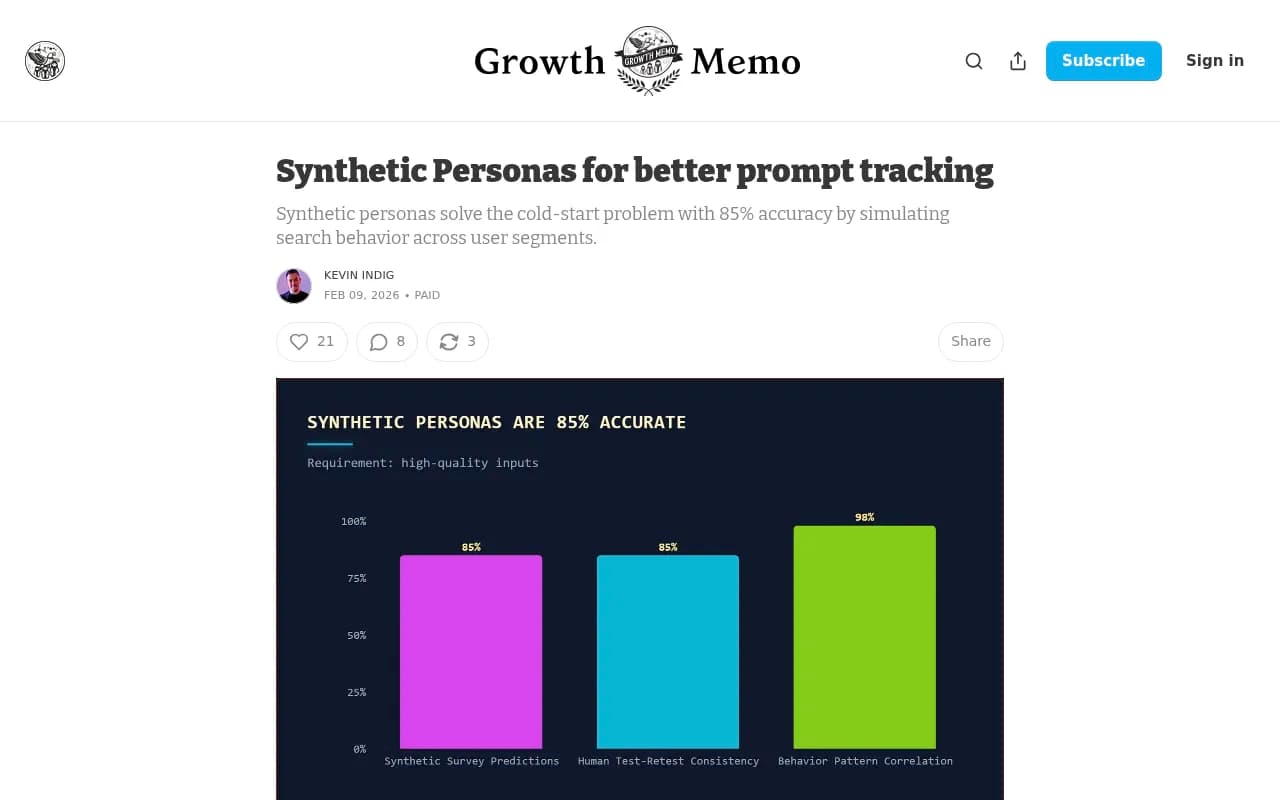
Kevin Indig's Growth Memo post from February 9, 2026 argues synthetic personas solve the cold-start problem with 85% accuracy by simulating search behavior across segments. The post is paywalled, so I cannot verify the method behind the figure. It is a useful idea, and I would test it against your own data before leaning on the number.
A practical setup, step by step
- Pick two to four personas tied to real buying roles or segments. More than that and response costs balloon.
- Write each from customer data, around constraints and criteria. No brand names.
- Keep the prompt set identical across personas. Change only the persona.
- Run a baseline: the same persona several times, so you know your noise floor (expect roughly 40% brand overlap).
- Compare personas across dozens of prompts, not single answers. Look at visibility, position and sentiment per persona.
- Act on the biggest gap. If one persona never sees you, check which sources that persona's answers cite and whether you appear there.
- Re-run after publishing and check whether the gap closed.
Watch out for prompt drift. Copies of prompts per persona diverge over time as people edit them. Wrapper-style persona features avoid this, because the prompt text is stored once.
What I would do
If you are on a budget, start with one persona layer on your top 50 prompts and a baseline run. Spend nothing on a second tool until you have seen a real gap between personas.
If you are a consumer or retail brand, income and budget personas are likely to matter most, based on the Profound results. If you are B2B, expect smaller effects, and verify them yourself, since nobody has published independent B2B data yet.
Either way, treat persona results as a diagnostic. When a persona shows a gap, the fix is content and sources: pages that answer that buyer's constraints, and mentions on the third-party sites that persona's answers cite. Tools that only report the score leave that part to you. Promptwatch adds a content gap analysis and Content Agent on top of tracking if you want the fix handled in the same place, and its free AI visibility report is a no-login way to see where you stand first.
For more background on the metrics themselves, the Promptwatch Academy on Visibility Score explains how scores are built, and the GEO tools comparison covers the wider market.
Bottom line
Personas change AI answers by roughly 15 points of brand overlap in the one large study we have, against a noisy 40% baseline. That is enough to hide a competitor's stronghold inside an average. It is not enough to justify twenty personas. Run a few, anchor them in real data, and judge every difference against your own run-to-run noise.