Key takeaways
- Most wasted prompt tracking budget comes from the setup: prompts nobody would ever type, one-off readings, and no plan for what to do with the data.
- A single ChatGPT response tells you very little. Promptwatch Data found that 47.6% of ChatGPT responses with citations cite 10 or more domains (Sep 28 to Oct 4, 2026), so one prompt is a thin sample.
- Platform behavior changes overnight. ChatGPT's use of the site: operator jumped from 0.37% to 16.8% of fanout queries in one day (Aug 8, 2026), which made older fanout mappings stale.
- Track position, tone, and who gets cited next to you, not just whether you were mentioned.
- A tracker only measures. The money is in what you do with the gaps it finds.
Why the first 90 days decide whether tracking pays off
I have watched teams sign up for an AI visibility tool, load 300 prompts in an afternoon, and then stop opening the dashboard by week six. The subscription keeps billing. The insight never arrives.
The first 90 days are where the habits form. Pick the wrong prompts, run them once, read the wrong number, and you end up with a report nobody trusts. Fix those early and the same budget gets you something you can act on.
Here are the nine mistakes I see most, roughly in the order they show up.
Mistake 1: Tracking prompts nobody would actually type
The most common waste is a prompt list written from the brand's point of view. "Best enterprise-grade synergistic platform for omnichannel lifecycle orchestration" is not something a buyer says to ChatGPT. It is something a product marketer says in a meeting.
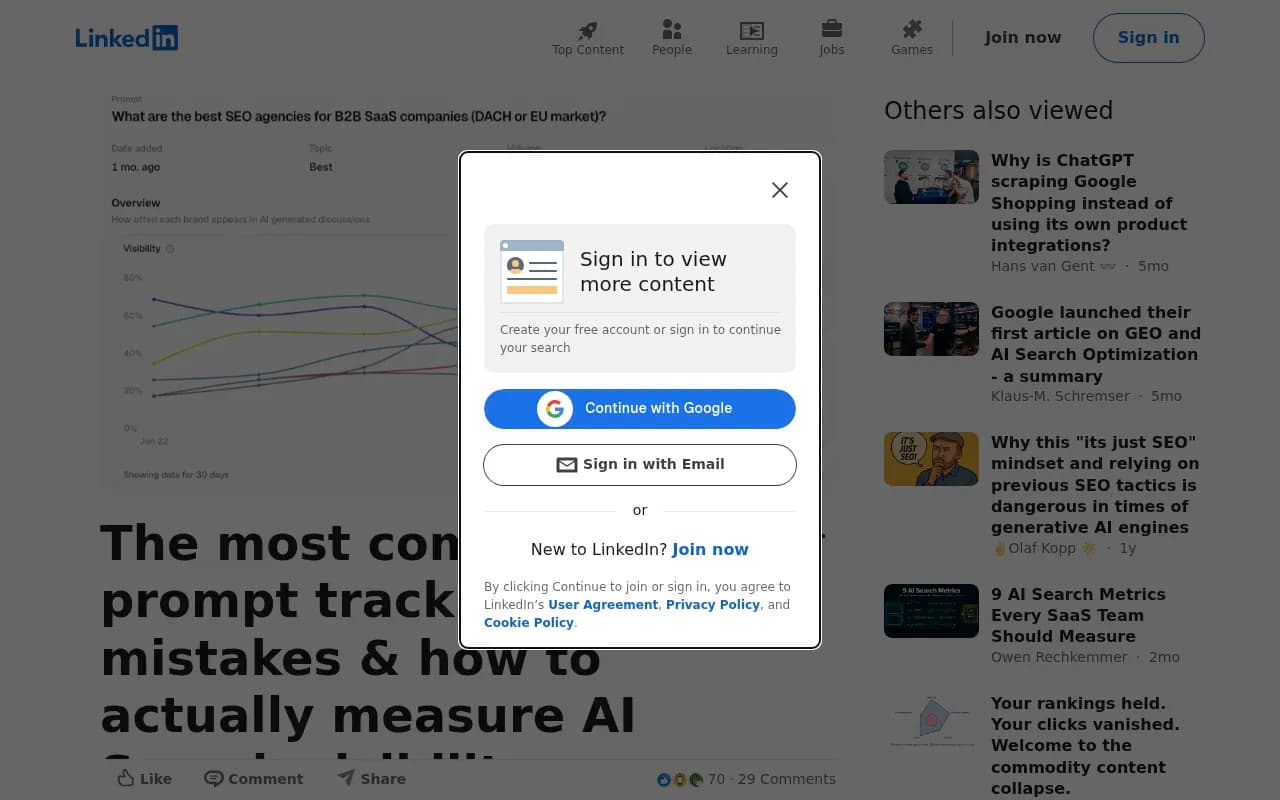
Bad prompts cost you twice. You pay for the responses, and you get answers that tell you nothing about real demand. A LinkedIn piece by Buschner on common prompt tracking mistakes makes the same point: tracking bad prompts wastes resources, and every prompt should be tested before you commit to it.
How to fix it:
- Pull prompts from real sources: Search Console queries, People Also Ask, sales call transcripts, support tickets.
- Write them the way a person types to a chatbot, in full sentences, with the context a buyer would include.
- Cover the three types: organic questions with no brand, brand-specific questions, and competitor comparisons.
- Check volume and difficulty where your tool provides them, so you aren't tracking a prompt that nobody asks.
Platforms such as Promptwatch include prompt volumes and difficulty scoring plus suggestions from Search Console, which helps with exactly this step.

Mistake 2: Trusting a single run of a single prompt
AI answers vary. Run the same prompt twice and you may get different brands, a different order, and different sources. Treating one response as the truth is like judging a keyword ranking from a single logged-in search.
The Buschner article recommends testing each prompt two to three times before you trust it. I'd go further: judge the average across a prompt set, not any single prompt.
Promptwatch's data on unique domains per response shows why. In the Sep 28 to Oct 4, 2026 window, 47.6% of ChatGPT responses with citations cited 10 or more domains, and only about 1% cited a single domain. When answers pull from that many sources, one response is a snapshot of one draw. Promptwatch's own recommendation from that report is to measure citations across many organic prompts, because a single prompt tells you little.
How to fix it:
- Run each monitor daily at minimum so noise averages out.
- Report trends over weeks, never a single day.
- Group prompts into topics and judge topics, not individual prompts.
Mistake 3: Only asking "was I mentioned?"
A mention is a binary. It hides almost everything useful. You can be mentioned fifth in a list of five, described as "a cheaper option with fewer features," and still count as a win in a simple tracker.
Track at least these dimensions together:
- Position: where you land in the order of brands in the answer.
- Share of voice: your slice of all brand mentions across the prompt set.
- Sentiment and the specific claims the AI makes about you.
- Citations: whether your own pages are the sources, or someone else's page is.
Reading them together locates the problem. Low share of voice is a coverage problem. Late position is a prominence problem. Mentions without citations to your domain usually mean a content or crawlability problem. Weak sentiment is a reputation problem. If you only count mentions, all four look identical. The Academy pages on Visibility Score and citations vs mentions explain how to separate them.
Mistake 4: Ignoring who gets cited next to you
Your competitors are not always the brands you think. In many categories the real rivals for citation space are review sites, marketplaces, docs, and listicle publishers.
Promptwatch Data shows this clearly by industry. For software prompts, GitHub, Microsoft's docs, and G2 lead ChatGPT citations. For travel, Skyscanner, Going, and Tripadvisor lead. In automotive, marketplaces like Autotrader and Cars.com outrank every car brand. If your tracking only lists your direct competitors, you miss the third-party domains that actually shape the answer.
How to fix it: check which domains appear in the same responses as you, then decide whether you compete with them, partner with them, or get listed on them.
Mistake 5: Building strategy on a stale fanout map
ChatGPT does not just run your prompt as a search. It generates its own queries, called query fanouts, and your content has to match those, not the user's literal wording. Promptwatch's query fanout data suggests writing headings that read like search queries and re-auditing your keyword-to-heading mapping after major ChatGPT updates.
That last part matters because behavior shifts without warning. On August 8, 2026, ChatGPT started using the site: operator at scale. The share of fanout queries using it went from 0.37% to 16.8% in a single day, and average fanouts per response rose from about 1.08 to about 1.83. Anyone who built a fanout map before that date was working from old information.
The flip side is also a mistake: rewriting your whole content strategy the day a number moves. Check whether the shift is platform-wide before you touch anything. One day of change across every tracked brand is the platform. One day of change for you alone is something you did, or something a competitor did.
How to fix it: monitor continuously, annotate known platform changes on your charts, and compare against competitors before reacting. The query fanouts guide walks through reading them.
Mistake 6: Mixing markets, languages, and personas in one monitor
An AI answer in the US in English is not the answer in Germany in German. It also changes with who is asking. Lump them into one pool and the average describes nobody.
How to fix it:
- Keep one monitor per country and language. In Promptwatch, a monitor's language and location are fixed when it is created, so markets never blend.
- Add personas where buyers differ, such as a CFO versus a developer, and compare each against the general audience.
- For local businesses, pin tracking to real locations rather than a country. Business plans and up can target exact coordinates for "near me" queries.
Mistake 7: Tracking everything and fixing nothing
This is the budget killer. A team spends months building a dashboard of visibility scores and never publishes a new page, updates a weak one, or fixes a crawl error. The score drifts. The invoice does not.
Most tools in this space stop at monitoring. Peec AI, Otterly.AI, and similar trackers answer "were we mentioned?" and leave the rest to you. That is fine if you have a content team ready to act on every finding. If you don't, you are paying to watch.
A useful test: for every metric on your dashboard, name the action it triggers. If you can't, remove it.
The tools differ a lot here. A rough comparison:
| Approach | What you get | What you still do yourself | Examples |
|---|---|---|---|
| Monitoring only | Mentions, position, sentiment | Find gaps, write content, publish, verify | Peec AI, Otterly.AI |
| Monitoring plus audits | Tracking plus site checks | Content creation and publishing | SE Ranking's AI visibility software, Semrush |
| Monitoring plus execution | Tracking, gap analysis, content generation, publishing, re-measurement | Review and approve | Promptwatch |
Promptwatch is built around that last row: its Action Board prioritizes what to fix, the Content Agent writes and publishes pages against your gaps, and page tracking checks whether the new page got crawled, cited, and clicked. Content Agent access starts on the Business plan, so confirm what your tier includes at promptwatch.com/pricing.
Other tools worth a look if you are shortlisting:



For a wider view, the GEO software directory at bestgeosoftware.com lists many more options.
Mistake 8: Never checking whether AI can read your site
Sometimes the problem is not your content. It is access. If AI crawlers hit errors on your pages, or your robots.txt blocks them, no amount of prompt tracking will fix a visibility gap that starts at the front door.
This is easy to miss because most trackers only look at AI answers, not at your server. Crawler logs close that gap by showing which AI bots read which pages and where they fail. That lets you separate an access problem from a content problem before you spend on either. Promptwatch's AI crawler logs do this with IP-verified requests, and its free Agentic Readiness Check is a quick first test of which crawlers can read your site.
Crawler behavior also moves. Promptwatch's AI crawler traffic report breaks down weekly verified requests from OpenAI, Anthropic, Google, Perplexity, and Mistral, and its Meta-WebIndexer data shows one crawler going from roughly 2% to nearly 38% of tracked requests in a few weeks. A robots.txt written last year may not reflect today's bots.
Mistake 9: Skipping the revenue question
Visibility is not the goal. Traffic and conversions are. Teams that never connect AI mentions to site visits end up defending the budget with a score nobody in finance understands.
Set up visitor analytics early so you have a baseline from day one. Note that attribution has gotten harder: ChatGPT stopped sending a referrer on October 8, 2026, so you may need to count visits tagged with utm_source=chatgpt.com. The Academy guide on attributing AI traffic covers the setup.
Also keep some perspective on what moves. Promptwatch's content half-life report found that landing pages and docs stayed cited longest, while news lost half its pages within 36 days. If your tracked wins come from news-style content, expect them to decay and plan refreshes.
A 90-day plan that avoids all nine
Days 1 to 30: set up properly
- Build a prompt set from real queries, 30 to 50 per topic cluster, across organic, brand, and comparison types.
- Create separate monitors per country and language.
- Install visitor analytics and check crawler access.
- Record a baseline. Do not react to week-one numbers.
Days 31 to 60: find the real gaps
- Review position, share of voice, sentiment, and citations together.
- List the third-party domains cited beside you.
- Compare content coverage against the prompts AI answers. A content gap analysis is the shortcut here.
- Prune prompts that return nothing useful.
Days 61 to 90: act and re-measure
- Publish or refresh pages for the top gaps.
- Track each page: crawled, cited, clicked.
- Annotate platform changes so you don't misread them.
- Report on traffic and conversions, not just scores.
Quick audit checklist
| Mistake | Symptom | Fix |
|---|---|---|
| Unrealistic prompts | Answers never mention any brand | Source prompts from real queries |
| Single-run readings | Scores swing daily | Use daily runs and weekly trends |
| Mention-only metrics | Wins that feel empty | Add position, sentiment, citations |
| Ignoring co-cited domains | Surprise competitors | Review top cited domains |
| Stale fanout maps | Content stops matching | Re-audit after platform shifts |
| Mixed markets | Averages that fit nobody | One monitor per market |
| Tracking without action | Dashboard, no change | Tie each metric to an action |
| No crawl check | Cited rarely despite good content | Review crawler logs |
| No revenue link | Budget questioned | Add visitor analytics early |
What to do this week
Open your current prompt list and delete anything a real customer would never type. Then pick one metric on your dashboard and write down the action it should trigger. If you can't, you have found your first wasted dollar.
If you want to see how your brand looks before you commit to anything, Promptwatch offers a free AI visibility report and a 7-day trial on monthly plans. For more options in the category, the AI rank tracking directory at ai-rank-tools.com is a good place to compare.