Key takeaways
- Start with about 40 prompts, not 400. SE Ranking recommends 20 to 40 prompts across 2 to 3 AI models, tracked for at least 30 days, before you draw conclusions.
- Split the list into six groups: category discovery, problem-led, comparison, brand-specific, pricing and buying, and integration and docs. Never pool brand-specific prompts with organic ones, because they behave differently.
- Promptwatch Data shows 52.5% of organic ChatGPT responses cite 10 or more domains, versus 21.3% for brand-specific prompts. The two groups need separate baselines.
- For software prompts, your own docs, help center and vendor pages earn about 3x the citation share of review sites like G2 and Capterra, so docs-style prompts belong in the first 40.
- Most tools can run a list this size. What differs is whether they only report, or also show crawler activity, traffic and content gaps.
Why 40 and not 400
Keyword tracking spoiled us. You had volume, a position, a competitor column. Prompt tracking gives you none of that in a clean form. There is no reliable query volume, no fixed ranking, and the same question can produce different brand recommendations depending on session context or location.
The lazy response is to track fifty variations of "best [category] software" and call it a strategy. That covers one slice of how buyers use AI. The opposite mistake is dumping 500 prompts into a tool, getting a noisy average, and learning nothing.
Forty is a workable middle. It is small enough to review by hand every week, and large enough to cover the full buying journey for a B2B SaaS product. A Reddit thread from a product marketer describes a similar setup for a mid-market SaaS: roughly 50 tracked prompts across product, category and competitor terms, 6 AI platforms, weekly cadence. SE Ranking's guidance lands in the same range.
The list below is a starting point. Swap in your real category, your real competitors and the phrases your sales team hears on calls. Anything that does not map to how your buyers talk is wasted space.
How the 40 are split
SE Ranking names five prompt types: informational, comparative, instructional, brand-specific and transactional. That is a good taxonomy, but for B2B SaaS I find it easier to think in six buckets tied to the buying journey.
| Group | Prompts | Buyer stage | What it tells you |
|---|---|---|---|
| Category discovery | 8 | Awareness | Whether you are in the consideration set at all |
| Problem-led | 7 | Awareness | Whether AI links your product to the pain it solves |
| Comparison and alternatives | 8 | Consideration | How you stack up against named rivals |
| Brand-specific | 6 | Consideration | What AI says about you when asked directly |
| Pricing and buying | 6 | Purchase | Whether AI gets cost, plans and fit right |
| Integration and docs | 5 | Evaluation | Whether your docs and help center get cited |
Keep each group in its own tag or topic inside your tool. Brand comparison prompts in particular skew category metrics if you mix them in, which SE Ranking also warns about.
The 40 prompts
Replace [category] with your product category (for example "customer success platform"), [Brand] with your name, [Competitor] with a real rival, and [role] and [company size] with your ICP. Write them the way a person would type them into ChatGPT, not the way you would write a keyword.
Category discovery (8)
These are organic prompts where no brand is named. They are your share-of-voice baseline.
- What is the best [category] software for mid-market companies?
- Top [category] tools for a 100-person SaaS company
- Which [category] platform should I choose in 2026?
- Best [category] software for [role] teams
- Best [category] tools for startups on a tight budget
- Best enterprise [category] platforms for regulated industries
- What are the leading [category] vendors?
- Most reliable [category] software according to user reviews
These are commercial prompts, and Promptwatch Data from Sep 28 to Oct 4, 2026 shows what they cite: product pages (26.0%), landing pages (20.6%), listicles (15.0%) and comparisons (7.9%) make up almost 70% of commercial citations. If you are missing from this group, look at your product and landing pages first, then at the listicles that name your competitors. The content type report has the full breakdown.
Problem-led (7)
Buyers often start with a pain point, not a category name. These prompts show whether AI connects the problem to your product.
- How do I reduce customer churn in a B2B SaaS company?
- How can I automate [process your product automates] without hiring more people?
- What software helps [role] teams with [core job to be done]?
- How do I track [metric your product measures] across multiple tools?
- What is the best way to [outcome] for a [company size] company?
- Why is our [problem] getting worse and what tools fix it?
- How do companies like mine handle [workflow]?
Informational prompts pull a slightly different mix. Per the same report, how-tos account for 10.7% of informational citations and docs for 8.5%, both above their share in commercial prompts. That tells you a good how-to guide can get you cited here even when your product page would not.
Comparison and alternatives (8)
This is where deals get decided, and where B2B buyers love to use AI. Track both directions: you versus them, and them versus everyone.
- [Brand] vs [Competitor]
- [Competitor] vs [Brand]: which is better for [use case]?
- [Competitor] alternatives
- Best alternatives to [Competitor] for small teams
- [Competitor A] vs [Competitor B] (without you in it)
- Is [Brand] better than [Competitor] for enterprise?
- [Brand] vs [Competitor] pricing and features
- Switching from [Competitor] to something cheaper
Prompt 20 is the useful odd one. You are not named, so it shows whether AI volunteers you as a third option. Promptwatch Data shows competitor comparison prompts (like Asana vs Monday.com) cite 10 or more domains in 49.1% of responses, so the sources are broad and a single page will not carry you.
Brand-specific (6)
What AI says when someone asks about you directly. These are often the last thing a buyer checks before booking a demo.
- What is [Brand] and what does it do?
- Is [Brand] any good? What do users say?
- What are the pros and cons of [Brand]?
- Who are [Brand]'s main competitors?
- Who is [Brand] best for?
- Is [Brand] legit and secure?
Treat these differently from everything above. In Promptwatch Data from the same week, brand-specific prompts most commonly cite just 5 domains (14.9% of responses), and only 21.3% cite 10 or more. Organic prompts hit that mark 52.5% of the time. So brand prompts are narrow, and a handful of sources, often your own site plus a few review pages, decide the answer. Here, tone and accuracy matter more than whether you are mentioned. The report's own advice is to track how ChatGPT describes you, not only whether you are cited.
Pricing and buying (6)
The purchase stage. AI is happy to quote your pricing, and it is often wrong.
- How much does [Brand] cost?
- [Brand] pricing plans compared
- Cheapest [category] software with [must-have feature]
- Is [Brand] worth the price for a [company size] team?
- What should I ask a [category] vendor before signing?
- [Category] software with a free trial or free plan
If AI states an outdated price or invents a free plan, that is a fix-it-now item. It usually means the model is learning from an old page, a third-party review or a stale comparison article.
Integration and docs (5)
These are the prompts most B2B SaaS teams forget, and they matter for a specific reason. Promptwatch Data for software prompts (Sep 28 to Oct 4, 2026) shows GitHub leading at 1.2% of citations, learn.microsoft.com at 0.98% and G2 at 0.73%. By source type, docs and help centers earned 2.64% and vendor sites 2.01%, against 1.57% for review sites and analysts. Vendor pages plus docs combined (4.65%) are roughly 3x the review sites. The software citation report is worth reading in full.
- Does [Brand] integrate with Salesforce?
- How do I set up [Brand] with [popular tool in your stack]?
- [Brand] API documentation and rate limits
- How to migrate from [Competitor] to [Brand]
- What security certifications does [Brand] have?
The lesson: your own docs are a ranking asset in AI answers. If prompt 38 cites a competitor's docs or a forum thread instead of yours, that is a content gap you can close this week.
Make each prompt represent a family
A single typed prompt is not what the model searches. ChatGPT turns it into one or more web searches, called query fanouts. Promptwatch's fanout data shows the average number of searches per response was 2.15 in early December 2025, fell to about 1.84 by early March, and came back at exactly 1.0 per response in April. Query length shrank too, from about 117 characters in December to about 53 characters (roughly 6 to 8 words) from April.
I would not read too much into the exact numbers, because they move with every model update. The practical point holds: the sub-questions behind a prompt are short and plain. They look like "X vs Y", "X pricing", "X alternatives" and "how to X". When you write your 40, make sure each core product theme has those variants somewhere in the list. If you do not know what the sub-queries are, a free tool like the ChatGPT query fan-out generator gives you a starting guess.
A caution on the Reddit and social side. ChatGPT cited reddit.com for around 4% of its citations until August 14, 2026, when that share fell to about 0.5% (Promptwatch Data). In the week of Sep 28 to Oct 4, ChatGPT drew just 0.46% of citations from social platforms, while Google AI Overviews drew 12.2% (social citations by AI model). So a Reddit-led strategy might help in AI Overviews and do nothing in ChatGPT. Run your prompts on more than one model and compare.
Where the prompts come from
SE Ranking's framework suggests several sourcing methods: converting existing SEO keywords, mining People Also Ask and AI Overviews, and digging through Reddit and community threads. All of those work. For B2B SaaS I would add three more:
- Sales call transcripts. The exact phrases prospects use are the best prompts you will ever find.
- Support tickets and onboarding questions, which feed the integration and docs group.
- Competitor review pages on G2 and Capterra, where buyers explain why they switched.
A useful warning from the CommonMind write-up on real versus synthetic prompts: most tools track synthetic prompts, meaning ones you or the tool wrote. Real user prompt data exists (Profound's Prompt Volumes is an example, validated against 1.3B+ conversations), and Bing Webmaster Tools has an AI Performance report with grounding queries. Treat synthetic prompts as a controlled test panel, not a census of what buyers do.
Which tools can run a list like this
Almost every AI visibility tool will accept 40 prompts. What matters is what happens after you see the numbers. Below is a short look at the options I would shortlist, with pricing deliberately left out where I could not verify it. Check each vendor's site.
Promptwatch
Promptwatch is an end-to-end AI visibility platform rather than only a tracker. For a 40-prompt list, the Essential plan ($95/mo, 50 prompts) fits the starter set exactly, and Professional ($245/mo, 150 prompts) leaves room to grow. Confirm current plans at promptwatch.com/pricing. It tracks prompts in the real interfaces of ChatGPT, Google AI Overviews, Gemini, Perplexity and others, by country and language, with prompt volumes and difficulty, tags, topics and personas for grouping the six buckets above. Brand Narrative pulls out the claims AI makes about you, which is handy for the brand-specific and pricing groups. Where it goes further than a tracker is what comes next: AI crawler logs show whether bots can read your docs, and the Content Agent (Business plan) can write and publish the pages that fill gaps. There is a 7-day free trial on monthly billing, and a free AI visibility report if you want a first read.

Profound
Profound is the best-known enterprise option. Its prompt tracking page highlights prompt volume validation against 1.3B+ real conversations, CSV upload, a prompt builder, tags, personas, and country, city or language filters, with daily tracking. It is strong on monitoring. If you want a head-to-head, there is a Promptwatch vs Profound page.

SE Ranking and SE Visible
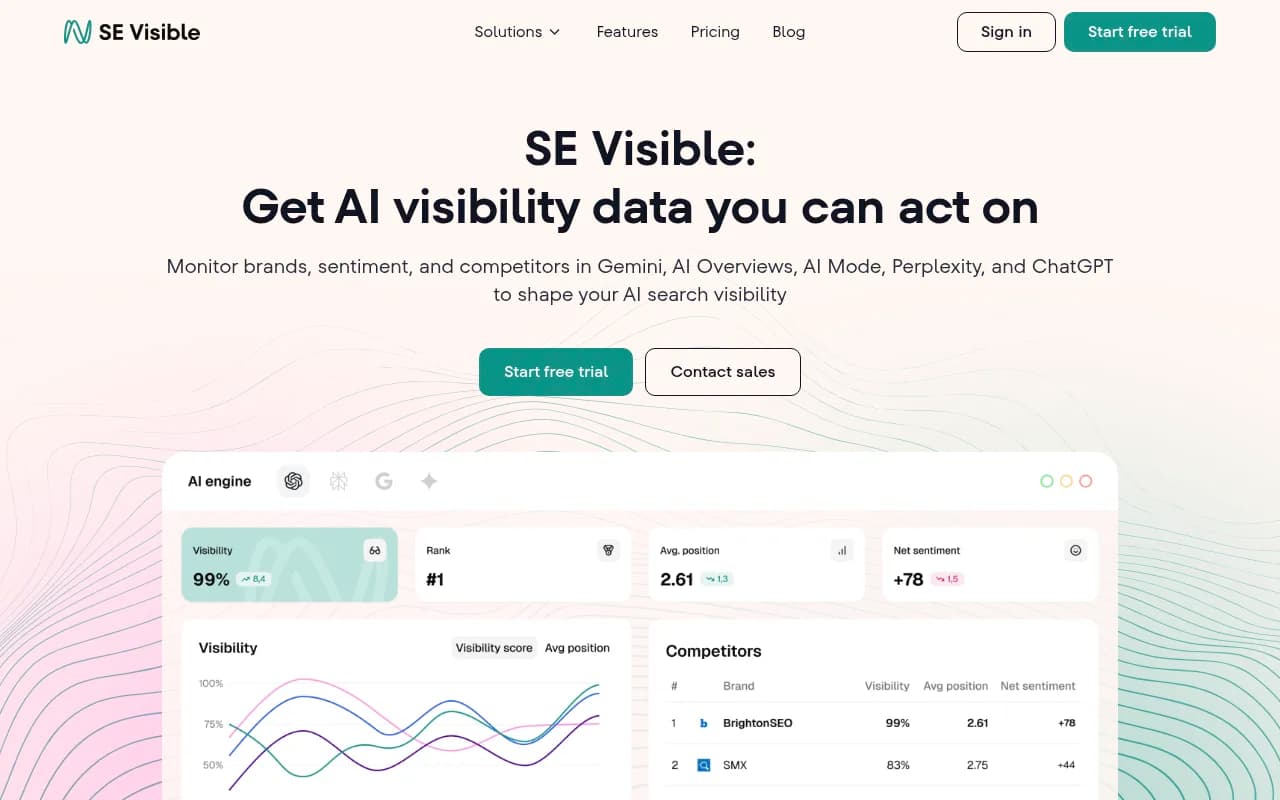
SE Ranking wrote the best public framework for choosing prompts, and its AI visibility product follows the same logic. A reasonable pick if your team already lives in SE Ranking for classic SEO.
Peec AI and Otterly.AI
Both are monitoring-focused and priced as lighter options. Fine for a starter list, but expect no crawler logs or content generation. The comparisons are at Promptwatch vs Peec and Promptwatch vs Otterly.


BrandViz.AI and Siftly
Two smaller platforms aimed squarely at B2B SaaS teams. Worth a look if you want a vendor that frames everything around SaaS buying journeys, though I would test their coverage of your specific prompts before committing.


Quick comparison
| Tool | Tracks prompts across AI engines | Crawler logs | Content creation | Best for |
|---|---|---|---|---|
| Promptwatch | Yes, real interfaces | Yes, IP-verified | Yes (Content Agent) | Teams that want to fix gaps, not just see them |
| Profound | Yes, daily | Not a focus | Via agents | Enterprise monitoring with volume data |
| SE Ranking / SE Visible | Yes | No | Limited | Existing SE Ranking users |
| Peec AI | Yes | No | No | Basic monitoring |
| Otterly.AI | Yes | No | No | Low-cost monitoring |
| BrandViz.AI, Siftly | Yes | Varies | Varies | SaaS-specific setups, verify first |
For wider browsing, the GEO software directory lists many more options by category.
Setting up the first 30 days
A tracking list is only useful if someone looks at it. Here is a rhythm that does not need a full-time analyst.
- Week 1: load the 40 prompts, tag them by group, and pick 2 or 3 AI models. Add your top three competitors so share of voice means something.
- Weeks 1 to 4: do nothing to the content. Let the baseline settle. AI answers swing run to run, and a single day tells you almost nothing.
- End of week 4: read results by group, not as one blended score. Compare organic groups to each other and brand-specific prompts to each other.
- Pick three gaps. One from category discovery, one from comparison, one from docs. Fix those first.
- Re-run for another 30 days and see if anything moved.
What to look at in each group:
- Category discovery: are you mentioned, in what position, and which domains does the answer cite?
- Comparison: does the model describe your differences accurately?
- Brand-specific: sentiment and factual errors.
- Pricing: whether the numbers match your pricing page.
- Docs: whether the cited source is yours.
Also check whether AI crawlers can reach your site at all. If you want to test this quickly, the free Agentic Readiness Check shows which AI crawlers can read your pages. A prompt where you never appear sometimes has nothing to do with content. It is a blocked bot.
Common mistakes
Tracking only "best of" prompts. They are easy to write and easy to report, and they cover maybe a quarter of what buyers ask.
Pooling brand and organic prompts. Per the unique-domains data above, they behave like different products. A blended average hides both.
Changing the list every week. Add prompts, sure, but keep a stable core so trends mean something.
Ignoring model differences. Reddit mattered in one place and nearly vanished in another. A single-model view will mislead you.
Reading one run as truth. SE Ranking's 30-day minimum is there for a reason.
Stopping at reporting. The point of the list is the fix: a new comparison page, an updated pricing page, a better docs section. If your tool cannot connect a gap to an action, you will end up with a nicely formatted spreadsheet of problems.
What to do next
Copy the 40 prompts above into a sheet, replace the brackets with your real category, competitors and ICP, and delete any that your buyers would never type. Load them into whichever tool you pick, tag the six groups, and leave them alone for 30 days. Then fix three gaps. That is a better first quarter of GEO than most teams manage with five times the prompts.
If you want a fast look before you commit to anything, run the free AI visibility report and see where you stand on the category discovery group first.