Summary
- Prompt difficulty scoring measures how hard it is to rank for a specific AI search query -- but platforms calculate it using wildly different methods
- Some platforms (Semrush, Moz) adapt traditional SEO metrics like domain authority and backlink counts, which don't translate well to AI search
- Others (Promptwatch, Profound) use AI-specific signals: citation competition, source diversity, and response consistency across models
- The best difficulty scoring systems combine multiple signals: how often competitors get cited, how many unique sources AI models pull from, and how stable the response set is
- No single metric predicts success perfectly -- the most useful systems show you why a prompt is difficult and what you'd need to do to compete
What prompt difficulty scoring actually measures
Prompt difficulty scoring tries to answer a simple question: if you optimize content for this specific AI search query, how likely are you to get cited?
Traditional SEO has keyword difficulty scores. You type in "best CRM software" and the tool tells you it's a 78/100 -- hard to rank because the top results have strong domain authority and tons of backlinks. The score is a proxy for competitive intensity.
AI search doesn't work the same way. ChatGPT, Claude, and Perplexity don't care about your domain authority. They care about whether your content directly answers the query with the right level of detail, structure, and recency. A brand-new site with a well-structured comparison table can outrank an established publication that buries the answer in fluff.
So prompt difficulty scoring has to measure different things. The question is: which signals actually matter?
How traditional SEO platforms score prompt difficulty
Some platforms have adapted their existing SEO keyword difficulty algorithms to AI search. The logic: if a prompt is hard to rank for in Google, it's probably hard to get cited for in ChatGPT.
Semrush calculates difficulty based on the backlink profiles and domain authority of pages currently ranking for a keyword. High difficulty means the top results have strong link signals. When Semrush added AI search tracking, it applied the same logic -- prompts that map to high-difficulty keywords get high difficulty scores.
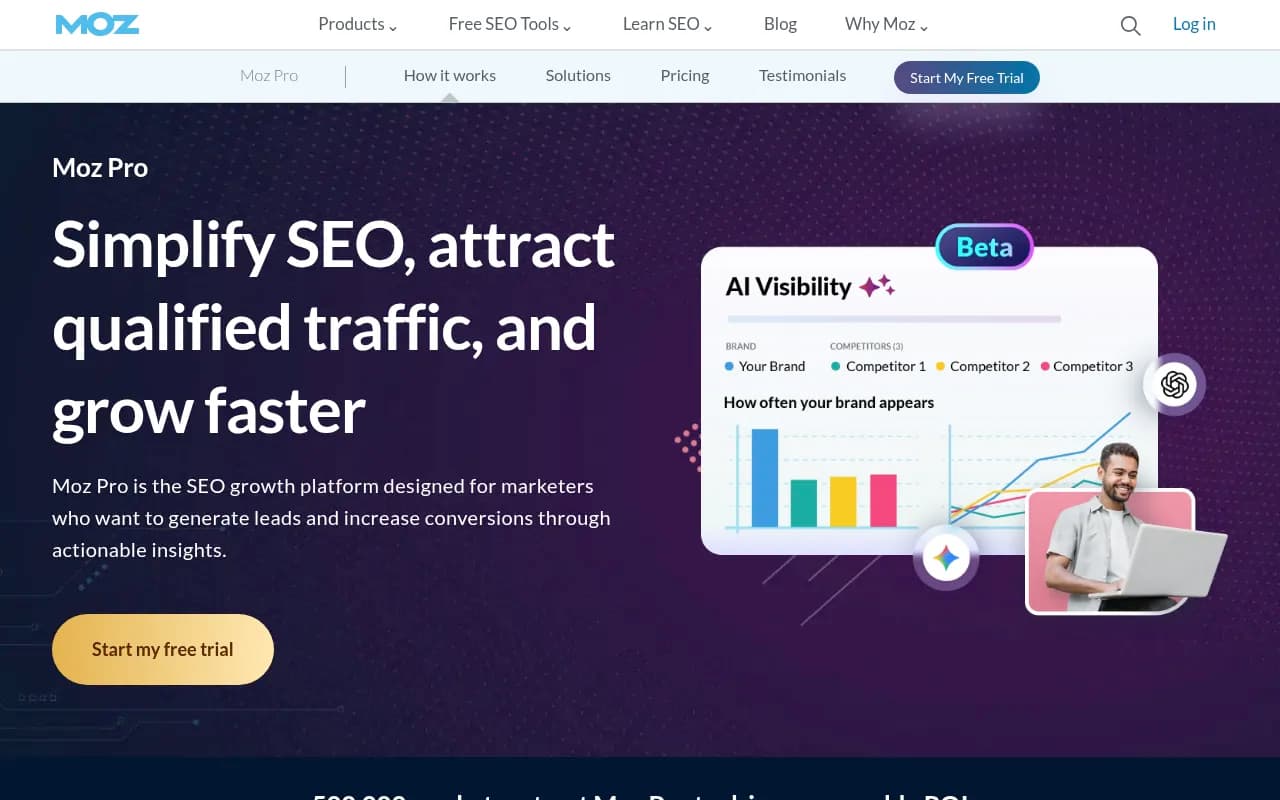
Moz Pro does something similar. Its keyword difficulty score looks at page authority and domain authority of ranking URLs. For AI search, Moz assumes that prompts tied to competitive keywords will be competitive in AI responses too.
The problem: AI models don't read backlinks. A page with zero inbound links but a clear, structured answer can get cited over a page with 500 backlinks that rambles. Domain authority is a useful proxy for content quality in traditional search, but it's a weak signal in AI search.
These platforms are essentially saying "this prompt is hard because the Google results are hard." That's not wrong -- there's correlation -- but it's indirect. You're measuring the shadow, not the thing itself.
How AI-native platforms score prompt difficulty
Platforms built specifically for AI search visibility use different signals. They look at what's actually happening inside AI responses.
Promptwatch calculates difficulty based on three factors:
- Citation competition: How many unique domains get cited across multiple AI models for this prompt? If ChatGPT, Claude, and Perplexity all cite 15+ different sources, that's high competition. If they cite the same 3 sources repeatedly, that's low competition -- there's room to break in.
- Source diversity: Are the citations concentrated among a few dominant players, or spread across many sources? A prompt where 80% of citations go to two sites is harder to crack than one where citations are evenly distributed.
- Response stability: Does the prompt produce consistent responses across models and over time? Stable prompts (same sources cited repeatedly) are harder because there's an established "answer set." Unstable prompts (different sources each time) are easier because AI models are still exploring.

Promptwatch's difficulty score is a weighted combination of these three. A prompt that scores 85/100 might have high citation competition (20+ domains cited), low source diversity (top 3 domains capture 70% of citations), and high stability (same sources for 6+ weeks). That tells you: breaking in requires either exceptional content or a wedge strategy (target a sub-angle the dominant sources don't cover).
Profound uses a similar approach but adds query specificity as a factor. Generic prompts ("what is SEO") are harder because they attract broad, authoritative sources. Specific prompts ("how to fix crawl budget issues on Shopify") are easier because fewer sources address them in depth.
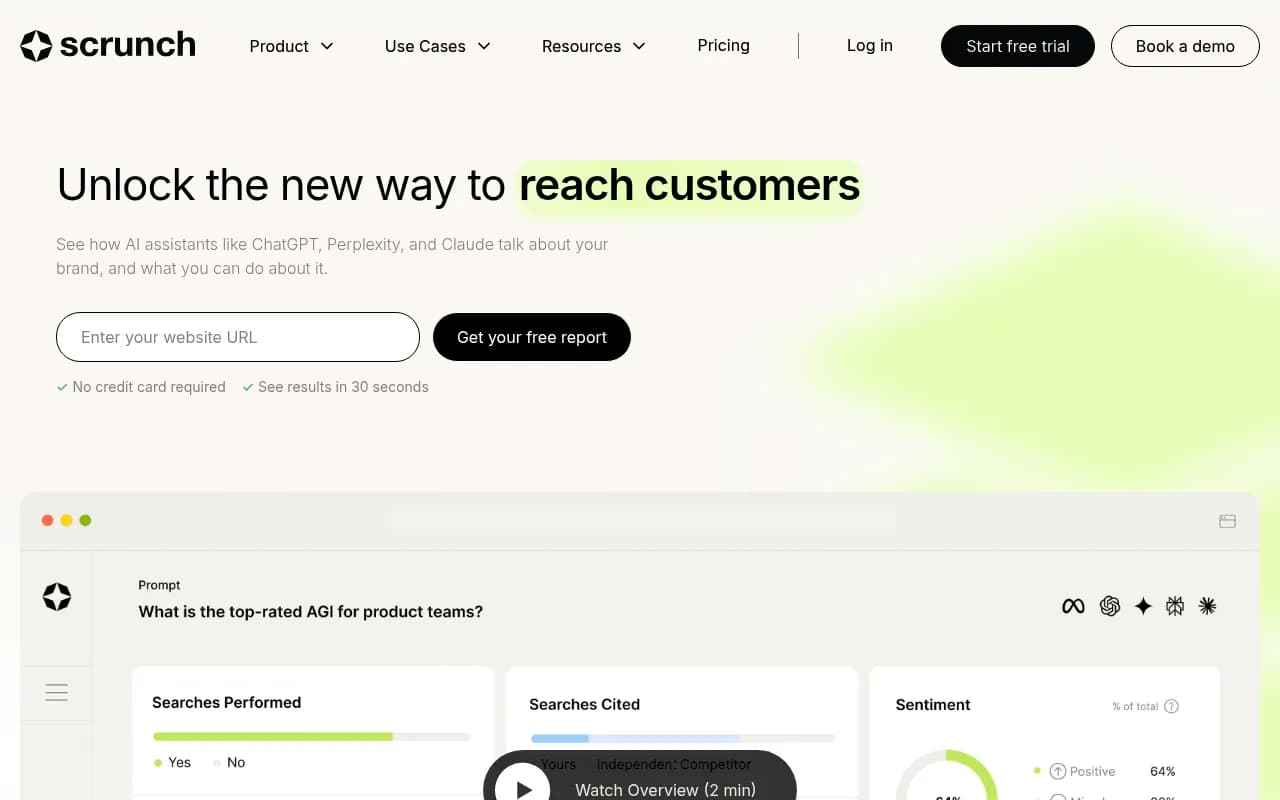
Scrunch layers in Reddit and YouTube visibility. If a prompt triggers citations from Reddit threads or YouTube videos, difficulty increases -- you're not just competing with articles, you're competing with community discussions and video content. That's a different content format challenge.
The advantage of these AI-native methods: they measure what AI models actually do, not what Google does. The disadvantage: they require running the prompt across multiple models repeatedly to gather citation data. That's expensive and slow.
The multi-signal approach: combining volume, competition, and intent
The most sophisticated difficulty scoring systems don't rely on a single metric. They combine multiple signals to give you a fuller picture.
Athena HQ scores prompts on four dimensions:
- Search volume: How often is this prompt (or variations of it) actually used? High-volume prompts are harder because more brands are optimizing for them.
- Citation concentration: What percentage of citations go to the top 3 sources? High concentration = harder to break in.
- Content gap size: How much content already exists for this prompt? If there are 50 in-depth articles, it's harder. If there are 5, it's easier.
- Model consensus: Do all AI models cite similar sources, or do they diverge? High consensus = established winners, harder to displace.
This gives you a difficulty score and a breakdown of why. A prompt might score 70/100 overall, but the breakdown shows: high volume (90), low concentration (40), medium gap (60), high consensus (80). That tells you: lots of people search for this, but citations are spread out, so there's room to compete if you can create something differentiated.
Bluefish AI takes this further by adding temporal difficulty. Some prompts are hard right now because of recent news cycles or trending topics, but will get easier in 3 months. Others are structurally hard -- evergreen topics with entrenched sources. Bluefish flags which type you're dealing with.
What the research says about prompt difficulty signals
There's limited published research on prompt difficulty scoring because the field is so new. But we can infer from adjacent research on AI model behavior.
A 2024 study on citation patterns in large language models (Zhao et al.) found that source recency was a stronger predictor of citation than domain authority. Models preferred sources published within the last 12 months, even if they came from lower-authority domains. This suggests that traditional SEO difficulty metrics (which weight authority heavily) are less predictive in AI search.
Another study (Chen et al., 2025) analyzed 10,000 prompts across ChatGPT and Claude and found that response consistency -- how often the same sources appeared across multiple runs of the same prompt -- correlated with competitive intensity. Prompts with high consistency (same 5 sources cited 80%+ of the time) were harder to break into. This validates Promptwatch's "response stability" metric.
A third study (Kumar et al., 2025) looked at query specificity and found that narrow, technical prompts had lower citation competition than broad, conceptual prompts. This aligns with Profound's approach of factoring in query specificity.
The takeaway: AI-specific signals (recency, consistency, specificity) predict difficulty better than SEO signals (backlinks, domain authority). But no single signal is enough -- you need multiple data points.
How to interpret difficulty scores (and what to do with them)
A difficulty score is only useful if it changes your behavior. Here's how to use it.
Low difficulty (0-30): These are "quick win" prompts. Few sources are being cited, or citations are spread across many sources with no clear winner. Create content for these first. You don't need exceptional quality -- just solid, structured answers.
Medium difficulty (31-60): Competitive but not impossible. You'll need better content than what's currently being cited, or a differentiated angle. Look at the sources AI models are citing and ask: what are they missing? Can you go deeper, add more examples, or cover adjacent questions?
High difficulty (61-80): Established winners dominate. Breaking in requires either exceptional content (10x better than current sources) or a wedge strategy. Target a sub-angle, a specific use case, or a persona the dominant sources don't address. For example, if "best CRM software" is dominated by G2 and Capterra, target "best CRM for real estate teams under 10 people."
Very high difficulty (81-100): Don't bother unless you have a structural advantage (you're the primary source, you have proprietary data, or you're a recognized authority). Even then, expect a long timeline. Focus on related prompts with lower difficulty instead.
The best platforms don't just give you a number -- they show you why it's difficult and what you'd need to do to compete. Promptwatch's Answer Gap Analysis does this: it shows which prompts competitors are visible for but you're not, then suggests content angles to close the gap.
Comparison: how major platforms calculate difficulty
| Platform | Primary signals | Strengths | Weaknesses |
|---|---|---|---|
| Semrush | Domain authority, backlinks | Familiar to SEO teams | Doesn't measure AI-specific behavior |
| Moz Pro | Page authority, domain authority | Established methodology | Indirect proxy for AI difficulty |
| Promptwatch | Citation competition, source diversity, response stability | Measures actual AI behavior | Requires repeated prompt runs |
| Profound | Query specificity, citation concentration | Accounts for prompt type | Limited to text-based sources |
| Scrunch | Reddit/YouTube visibility, citation spread | Captures non-article content | Harder to interpret |
| Athena HQ | Volume, concentration, gap size, consensus | Multi-dimensional view | More complex to act on |
| Bluefish AI | Temporal difficulty, citation trends | Flags trending vs evergreen | Requires historical data |
Which method works best?
There's no single "best" method because it depends on what you're optimizing for.
If you're an SEO team transitioning to AI search and you want something familiar, Semrush or Moz make sense. You already understand keyword difficulty -- prompt difficulty is just an extension. The scores won't be as precise, but they're directionally useful.
If you're serious about AI search visibility and want to optimize based on what AI models actually do, Promptwatch or Profound are better. They measure the right signals. The learning curve is steeper, but the data is more actionable.
If you're targeting prompts that pull from Reddit, YouTube, or community discussions, Scrunch gives you visibility into those channels. Most platforms ignore them entirely.
If you want a holistic view that combines multiple signals, Athena HQ or Bluefish AI give you the most nuanced picture. The tradeoff: more data to interpret, which can slow down decision-making.
My take: the best difficulty scoring system is one that shows you why a prompt is difficult and what you'd need to do differently. A number alone ("this prompt is 75/100") doesn't help. A breakdown ("high citation competition, low source diversity, stable response set -- you'd need exceptional content or a wedge angle") does.
Promptwatch's Answer Gap Analysis comes closest to this. It doesn't just score difficulty -- it shows you which content you're missing and suggests what to create. That's the action loop: find the gap, create content, track results.
The future of prompt difficulty scoring
Difficulty scoring is still early. Most platforms are iterating on their methods based on what correlates with actual citation success.
I expect we'll see three trends:
-
Model-specific difficulty scores: Right now, most platforms give you one score across all models. But ChatGPT and Claude have different citation behaviors. A prompt might be easy in Perplexity but hard in ChatGPT. Model-specific scores will let you prioritize where to optimize first.
-
Persona-based difficulty: Some prompts are easier to rank for if you target a specific persona. "Best CRM" is hard. "Best CRM for solo consultants" is easier. Platforms will start scoring difficulty by persona, not just by prompt.
-
Predictive difficulty: Instead of telling you how hard a prompt is right now, platforms will predict how hard it will be in 3-6 months based on trending topics, competitor activity, and content gap velocity. This will help you prioritize prompts that are easy now but will get harder soon.
The endgame: difficulty scoring becomes less about a static number and more about a dynamic recommendation engine. "Here are the 10 prompts you should target this month based on difficulty, volume, and your current visibility. Here's what content to create for each one."
That's where Promptwatch is headed. The platform already does Answer Gap Analysis and AI content generation. The next step is tying difficulty scores directly to content recommendations and tracking the results in a closed loop.
How to choose a prompt difficulty scoring method
If you're evaluating platforms, ask these questions:
- What signals does the platform use to calculate difficulty? If it's just domain authority and backlinks, it's an SEO proxy, not an AI-native metric.
- Does the platform show you why a prompt is difficult? A breakdown (high competition, low diversity, stable responses) is more useful than a single number.
- Can you filter prompts by difficulty and volume? You want to prioritize high-volume, low-difficulty prompts first.
- Does the platform track difficulty over time? Difficulty changes as competitors optimize. You need to see trends.
- Does the platform suggest what to do about it? The best systems don't just score difficulty -- they show you what content to create or what angle to take.
If you're just starting with AI search visibility, pick a platform that gives you actionable difficulty scores and ties them to content recommendations. Promptwatch, Profound, and Athena HQ all do this. If you're already deep into AI search and want the most granular data, Bluefish AI or Scrunch give you more signals to work with.
The worst mistake: ignoring difficulty entirely and optimizing for every prompt. You'll waste time on prompts you can't win. The second-worst mistake: only optimizing for low-difficulty prompts. You'll miss high-value opportunities. Use difficulty scoring to prioritize, not to filter out everything hard.
Wrapping up
Prompt difficulty scoring is useful, but only if it's based on the right signals. Traditional SEO metrics (domain authority, backlinks) are weak proxies. AI-specific metrics (citation competition, source diversity, response stability) are better.
The best platforms combine multiple signals and show you why a prompt is difficult, not just that it's difficult. They tie difficulty scores to content recommendations so you know what to do next.
If you're serious about AI search visibility, use a platform that measures what AI models actually do. Promptwatch is the most complete option -- it tracks difficulty, shows you content gaps, generates optimized content, and closes the loop with visibility tracking.
Start with low-difficulty, high-volume prompts. Create content. Track results. Then move up the difficulty ladder as you build authority in AI search. That's how you win.