Key takeaways
- Profound is the most data-rich of the three, built for enterprise teams that need deep analytics and are willing to pay for them ($99-$499/mo depending on tier).
- Otterly.AI is the most affordable entry point ($29/mo), good for smaller teams or agencies that want basic prompt monitoring without a big commitment.
- Peec AI sits in the middle, with a clean interface and competitive gap analysis starting at €89/mo, making it a reasonable fit for mid-market B2B and SaaS teams.
- All three are primarily monitoring tools. None of them close the loop by helping you create content that actually gets cited -- they show you the problem but leave the fix to you.
- If your team needs to act on AI visibility data, not just observe it, you'll want a platform that goes further than these three.
Why mid-market teams are suddenly shopping for AI visibility tools
Something shifted in 2025. Marketing teams that had been watching the "AI search" trend from a distance started feeling it in their pipeline numbers. According to McKinsey's AI Discovery Survey of 1,927 U.S. adults, AI search is now the number one source of insights for 44% of users, ahead of traditional search at 31%. Google AI Overviews hit 2 billion monthly users. And organic click-through rates, when AI Overviews appear, dropped roughly 70%.
The result: mid-market teams started asking a question they'd never had to ask before. "Does our brand even show up when someone asks ChatGPT or Perplexity about our category?"
That question is what drove the growth of platforms like Profound, Otterly.AI, and Peec AI. Each one promises to answer it. But they answer it differently, at different price points, and with different levels of depth. This guide is a direct comparison of all three -- what they actually do, where they're weak, and which one makes sense depending on your situation.
The three platforms at a glance
Before going deep, here's a quick overview of where each tool sits:
| Profound | Otterly.AI | Peec AI | |
|---|---|---|---|
| Starting price | $99/mo | $29/mo | €89/mo |
| Best for | Enterprise / large brands | Small teams, agencies | Mid-market B2B, SaaS |
| AI models covered | Multiple (ChatGPT, Perplexity, Gemini, etc.) | Multiple | Multiple |
| Competitor benchmarking | Yes (strong) | Basic | Yes (core feature) |
| Content gap analysis | Limited | No | Yes |
| Content generation | No | No | No |
| Crawler log access | No | No | No |
| Traffic attribution | Limited | No | No |
| Free trial | Yes | Yes | Yes |
The pattern is clear even at a glance: all three are monitoring-first platforms. None of them help you create content or fix the gaps they surface.
Profound: Enterprise depth, enterprise price
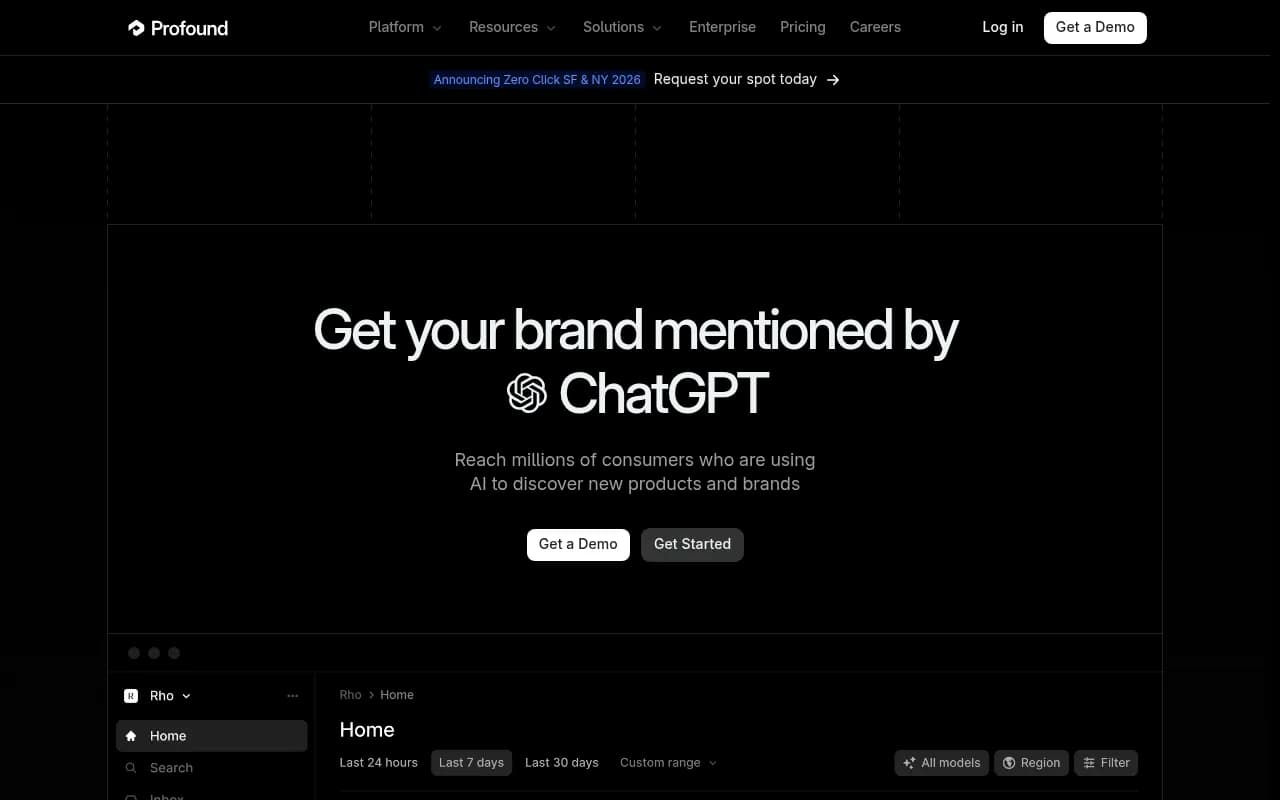
Profound is the most fully-featured of the three. It's built for brands that need to track AI visibility at scale -- multiple products, multiple markets, multiple competitors -- and want the data presented in a way that can inform a real strategy.
What it does well
The platform's dashboards are genuinely impressive. You get share-of-voice tracking across AI models, prompt-level breakdowns showing where your brand appears and where it doesn't, and competitive benchmarking that shows how you stack up against specific rivals. For enterprise marketing teams that need to report AI visibility metrics to leadership, Profound gives you the charts and numbers to do that.
Profound also has what it calls a "read/write AI model," meaning it can surface recommendations about what content to create. That's a step beyond pure monitoring. But -- and this matters -- it still leaves the actual execution to your team. The recommendations are useful, but they don't generate the content for you.
For agencies, Profound has a dedicated agency mode with brand configurations and client-facing reporting environments. If you're managing AI visibility for multiple clients, that's a meaningful workflow feature.
Where it falls short
Price is the obvious issue. At $499/month for a full enterprise tier, Profound is out of reach for most mid-market teams. The $99/month entry tier exists, but it's limited enough that you'll likely feel the ceiling quickly.
The deeper issue is the same one that affects all three platforms: Profound tells you where you're invisible, but it doesn't help you become visible. You get the data. You get the gap analysis. Then you're on your own to figure out what to write, get it written, publish it, and wait to see if it moves the needle. For teams without dedicated content resources, that's a significant gap.
Who it's for
Enterprise marketing teams, large agencies, and brands with dedicated SEO or GEO resources who can actually act on detailed analytics. If you have a content team ready to execute on the insights, Profound gives them excellent raw material.
Otterly.AI: The budget-friendly starting point
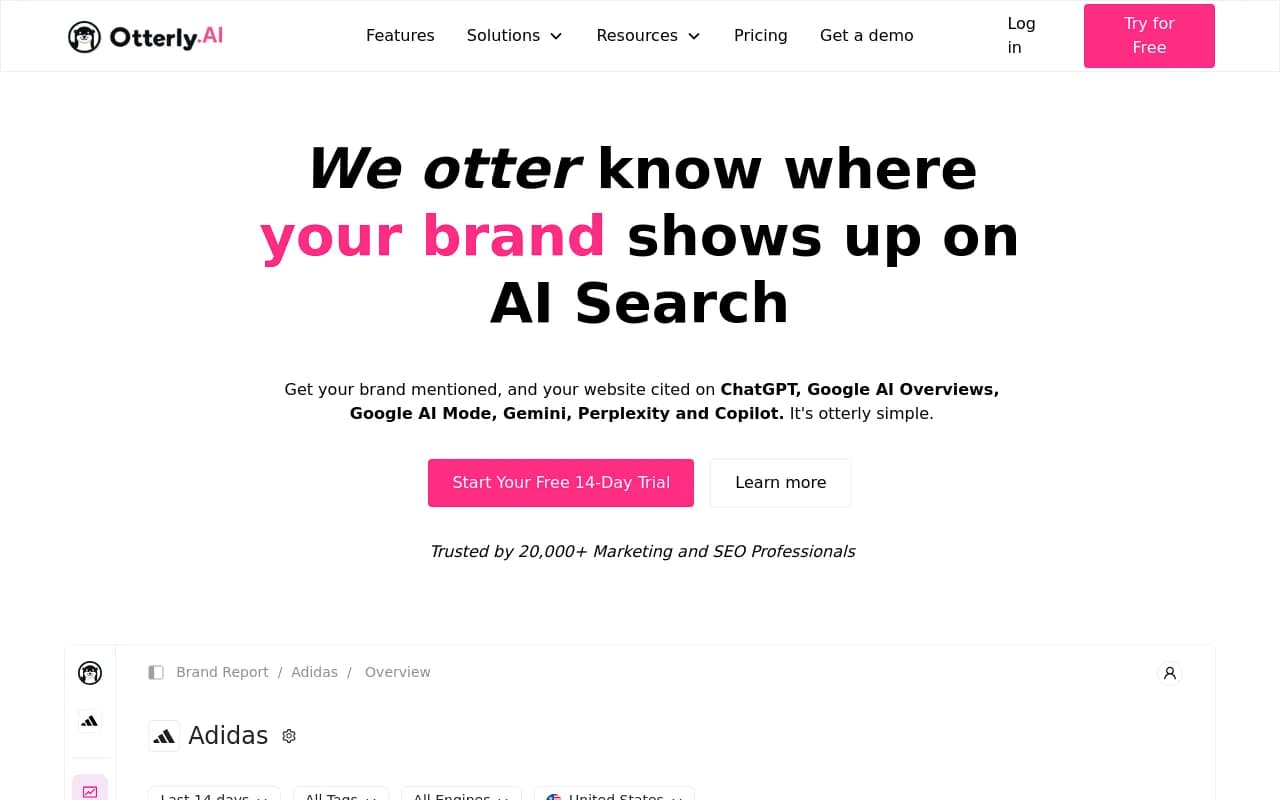
Otterly.AI is the most accessible of the three. At $29/month, it's designed for teams that want to start tracking AI visibility without a major budget commitment. It's also popular with agencies that need a lightweight tool to show clients something -- anything -- about how their brand appears in AI search.
What it does well
Otterly's core function is automated prompt testing. You set up a list of prompts relevant to your brand and category, and Otterly runs them regularly across AI models to show whether your brand appears in the responses. The interface is clean and relatively easy to onboard. For teams that are just starting to think about AI visibility, it's a low-friction way to get a baseline.
The GEO audit feature is also worth noting. Otterly can flag basic optimization opportunities on your existing content -- things like whether your pages are structured in a way that AI models can easily parse and cite.
Where it falls short
Otterly is genuinely limited in analytical depth. Competitive benchmarking is basic compared to Profound or Peec AI. There's no traffic attribution, no crawler log access, and no content generation. The prompt volume and difficulty data you'd need to prioritize which gaps to fix first isn't there.
For a team that wants to move from "we know we have an AI visibility problem" to "here's our plan to fix it," Otterly doesn't give you enough to work with. It's a starting point, not a strategy tool.
Who it's for
Small marketing teams, early-stage SaaS companies, and agencies that want to give clients a basic AI visibility report without spending much. It's also a reasonable choice if you're not yet sure how much you'll actually use AI visibility data and want to test the waters cheaply.
Peec AI: The mid-market sweet spot
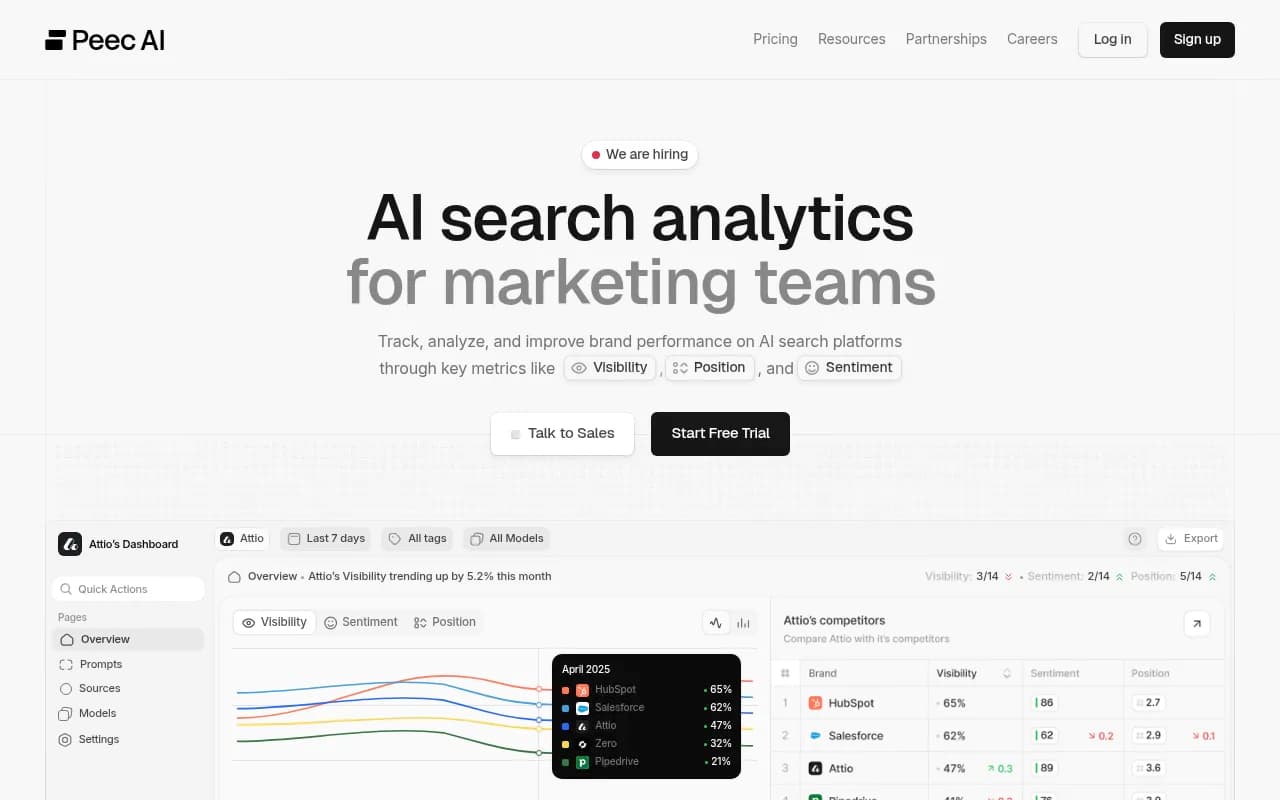
Peec AI is the most natural fit for the mid-market teams this guide is aimed at. It's priced between Otterly and Profound (starting at €89/month), and its feature set reflects that positioning -- more depth than Otterly, less complexity than Profound.
What it does well
Peec's standout feature is competitive gap analysis. The platform shows you not just where your brand appears in AI responses, but specifically where competitors are getting cited and you're not. That's a more actionable framing than pure share-of-voice data, because it tells you which specific prompts and topics you're losing on.
The dashboard is clean and designed for speed. You can get a meaningful read on your AI visibility situation without spending hours configuring the tool. For a marketing manager or SEO lead at a mid-market company who needs to understand the landscape quickly, Peec AI is probably the fastest path to a useful answer.
Multi-language support is also worth mentioning. If your brand operates across multiple markets, Peec's language coverage is a practical advantage over some competitors.
Where it falls short
Like the others, Peec AI is a monitoring and analysis tool. It surfaces the gaps but doesn't close them. There's no content generation, no crawler log analysis, and limited traffic attribution. The competitive gap analysis is genuinely useful, but once you know which prompts you're losing, you're back to figuring out on your own how to win them.
Who it's for
Mid-market B2B and SaaS teams that want more than basic monitoring but aren't ready for enterprise pricing. If your primary question is "where are our competitors beating us in AI search, and what topics should we prioritize?" Peec AI answers that question well.
Head-to-head: Feature comparison
Here's a more detailed breakdown across the dimensions that matter most for mid-market teams:
| Feature | Profound | Otterly.AI | Peec AI |
|---|---|---|---|
| Brand mention tracking | Yes | Yes | Yes |
| Competitor benchmarking | Strong | Basic | Strong |
| Share of voice metrics | Yes | Limited | Yes |
| Competitive gap analysis | Limited | No | Yes (core feature) |
| Prompt volume / difficulty | Limited | No | Limited |
| Content recommendations | Yes (no generation) | Basic | Limited |
| Content generation | No | No | No |
| Crawler log access | No | No | No |
| Traffic attribution | Limited | No | No |
| Reddit / YouTube tracking | No | No | No |
| Multi-language support | Yes | Limited | Yes |
| Agency features | Yes (strong) | Yes | Limited |
| Starting price | $99/mo | $29/mo | €89/mo |
| Free trial | Yes | Yes | Yes |
The table tells the same story in every row: these are observation tools. They're good at showing you the state of your AI visibility. They're not built to change it.
The gap none of them fill
This is worth saying plainly, because it's the thing most buyers miss when evaluating these platforms.
Knowing you're invisible in AI search is step one. It's a necessary step. But it's not the hard part. The hard part is figuring out which specific content gaps to prioritize, writing content that AI models will actually want to cite, publishing it, and then tracking whether it worked. That full loop -- find the gap, fix it, verify the fix -- is what actually moves your AI visibility score.
Profound, Otterly, and Peec AI all stop at step one (or maybe step one and a half). They're diagnostic tools. That's genuinely useful, but it means your team still needs to do most of the work.
If you want a platform that completes the loop -- gap analysis, content generation grounded in real citation data, and tracking that connects visibility to actual traffic -- Promptwatch is worth looking at. It's the only platform in a recent 12-tool comparison rated as a leader across all categories, specifically because it's built around taking action, not just reporting.

The distinction matters most for mid-market teams that don't have a large content operation. If you have a 2-person marketing team, getting a detailed gap analysis from Profound or Peec AI is only useful if you can actually act on it. A platform that helps you generate the content to close those gaps changes the math significantly.
How to choose between the three
Here's a practical decision framework:
Choose Profound if:
- You're at a larger company with a dedicated SEO or GEO team
- You need enterprise-grade reporting for leadership or clients
- Budget isn't the primary constraint
- You have content resources ready to act on detailed analytics
Choose Otterly.AI if:
- You're just starting to track AI visibility and want a low-cost entry point
- You're an agency that needs basic AI visibility reports for clients
- You want to test whether AI visibility data is actually useful for your team before committing more budget
Choose Peec AI if:
- You're a mid-market B2B or SaaS company that wants competitive gap analysis
- You need multi-language coverage
- You want more depth than Otterly but can't justify Profound's price
- Your primary question is "where are competitors beating us?" rather than "how do we fix it?"
Consider going beyond all three if:
- Your team needs to act on AI visibility data, not just observe it
- You want content generation built into the same workflow as your gap analysis
- You need traffic attribution that connects AI visibility to actual revenue
- You're tracking AI crawler activity on your own site
A note on the broader market
These three platforms aren't the only options. The AI visibility space has grown quickly, and there are now tools at every price point and capability level.
For teams that want to explore further, a few worth knowing about:

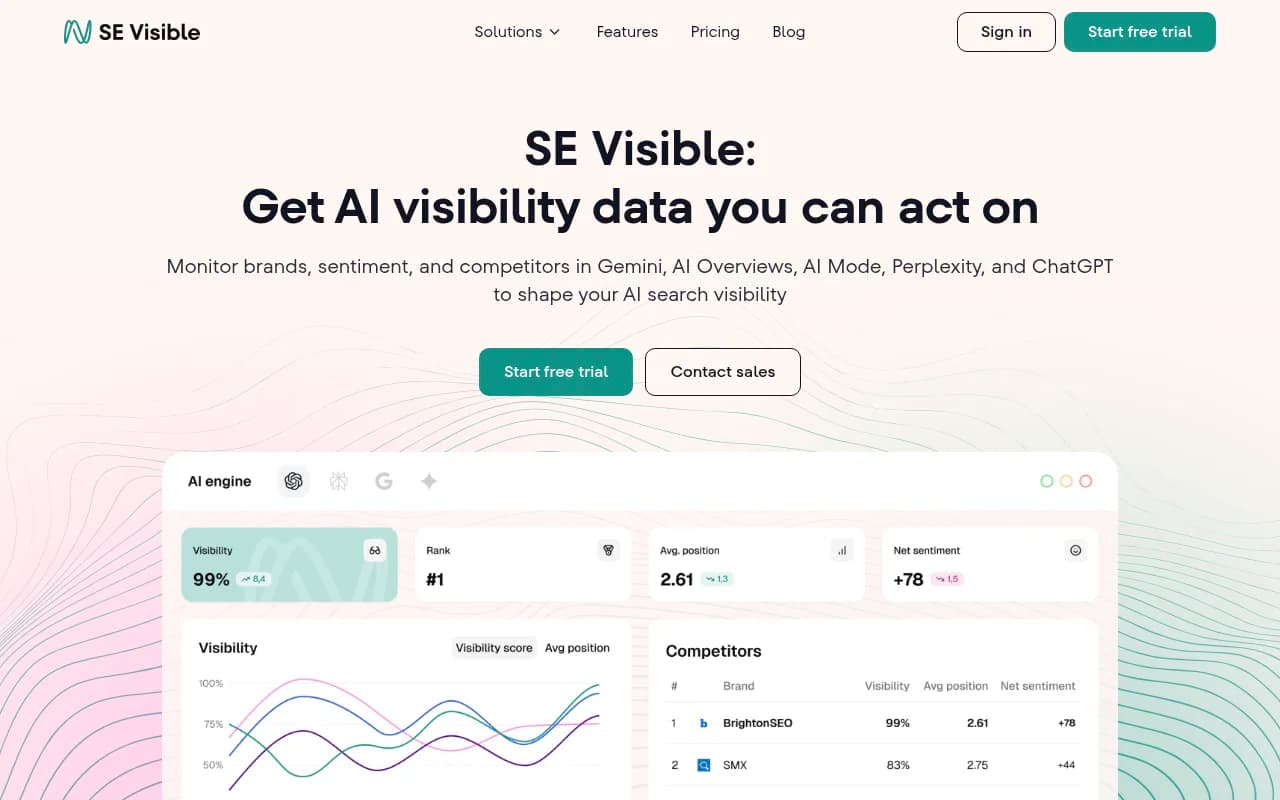
Each takes a slightly different angle -- Scrunch AI focuses on optimization alongside monitoring, Athena HQ has strong enterprise features, and SE Visible is particularly strong for agencies tracking AI Mode specifically.
The market is still maturing. Pricing and feature sets are shifting quickly, and several platforms that looked strong in 2024 have already been outpaced by newer entrants. Whatever tool you choose, it's worth reassessing every six months or so -- the gap between monitoring-only tools and full optimization platforms is widening fast.
Bottom line
Profound, Otterly.AI, and Peec AI are all legitimate tools for understanding your AI search visibility. Profound gives you the most data. Otterly gives you the lowest barrier to entry. Peec AI hits a reasonable middle ground for mid-market teams that care about competitive positioning.
But they share a fundamental limitation: they show you the problem without helping you solve it. For teams that have the internal resources to act on monitoring data, that's fine. For teams that don't, the monitoring data becomes an expensive reminder of a problem you can't fix.
The more useful question isn't "which of these three should I buy?" It's "what does my team actually need to improve our AI visibility?" If the answer is data and dashboards, these platforms deliver. If the answer is a closed loop from gap identification to content creation to traffic attribution, you'll need to look further.