Key takeaways
- Conductor is the most accessible of the three for content teams, with faster onboarding and AI-assisted recommendations, but AEO was added on top of an SEO foundation rather than built from scratch.
- BrightEdge has the deepest keyword database and strongest technical SEO capabilities, but its complexity means a 2-3 month ramp time and it was designed for traditional Google search.
- Profound was purpose-built for AI visibility, tracking 10+ AI engines with 400M+ prompt insights, and scores highest on AEO-specific metrics in independent rankings.
- All three carry custom enterprise pricing with no self-serve option, which makes them hard to evaluate without going through a full sales cycle.
- For teams that need to close the loop between AI visibility data and content creation, a dedicated GEO platform like Promptwatch fills gaps that all three leave open.
Your board approved the enterprise SEO budget. You've sat through three demos. Now you're trying to figure out whether Profound, Conductor, or BrightEdge is actually the right call for a team that needs to show up in ChatGPT, Perplexity, and Google AI Overviews -- not just rank on page one.
This is a genuinely hard decision, partly because all three platforms have been repositioning themselves around AEO and GEO over the past 18 months. The marketing language has converged. The feature lists look similar at a glance. But the underlying architectures are quite different, and those differences matter a lot depending on what your team actually needs to do.
Here's an honest breakdown.
What we're comparing
Before getting into the specifics, it's worth being clear about what "AEO" means in this context. Answer Engine Optimization is the practice of making your content visible and citable in AI-powered search experiences: ChatGPT, Perplexity, Claude, Google AI Overviews, Gemini, and the rest. It's distinct from traditional SEO in that the ranking signals are different -- AI engines care about whether your content is authoritative, structured, and present in the sources they trust, not just whether you have keyword density and backlinks.
All three platforms now claim AEO capabilities. The question is whether those capabilities were built natively or bolted on.
Conductor
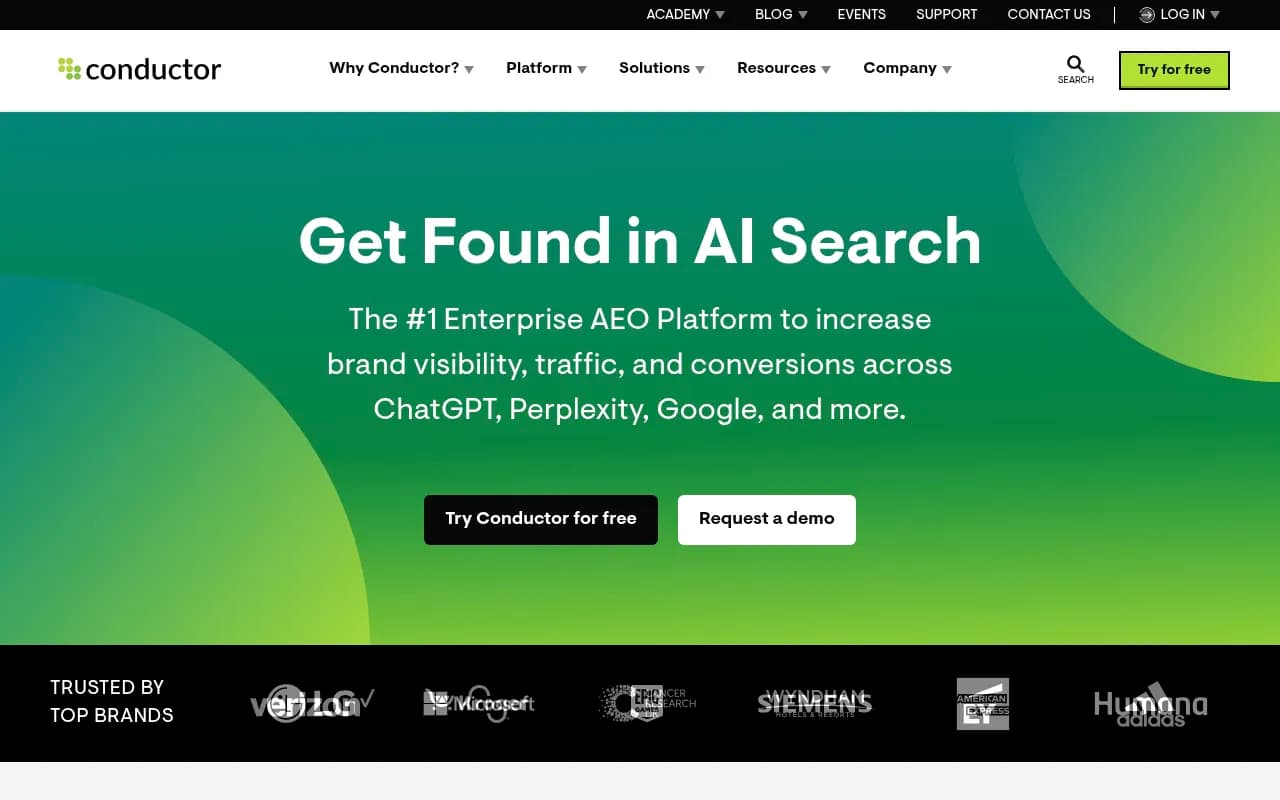
Conductor started as a pure enterprise SEO platform and has been adding AI visibility features aggressively since 2024. The result is a platform that does a lot of things reasonably well, with a user experience that's notably more accessible than its competitors.
What it does well
The onboarding story is genuinely better. Most enterprise SEO tools take months to deploy across a large organization. Conductor typically gets teams up and running in 2-3 weeks. That matters for large marketing departments where adoption is often the real bottleneck.
The content workflow is also strong. Conductor's AI-assisted content recommendations are grounded in keyword and intent data, and the platform integrates with CMS tools in a way that makes it practical for editorial teams to actually use the insights. It's not just a data dashboard -- there's a path from insight to action.
On the AEO side, Conductor tracks AI engine visibility and has added prompt-level monitoring. Its Conductor vs. Profound comparison page positions it as the "#1 enterprise AEO platform," though that claim is contested by independent rankings (more on that below).
Where it falls short
AEO is a feature layer on top of an SEO platform, not the core. That means the AI visibility capabilities are less granular than what purpose-built tools offer. The default rank tracking cadence is weekly, which is a real problem in AI search where cited domains can shift 40-60% in a month. Weekly snapshots miss a lot.
There's also no self-serve option and no transparent pricing. Getting a number requires going through a full enterprise sales process, which takes weeks. For teams that want to evaluate quickly, that's friction.
BrightEdge
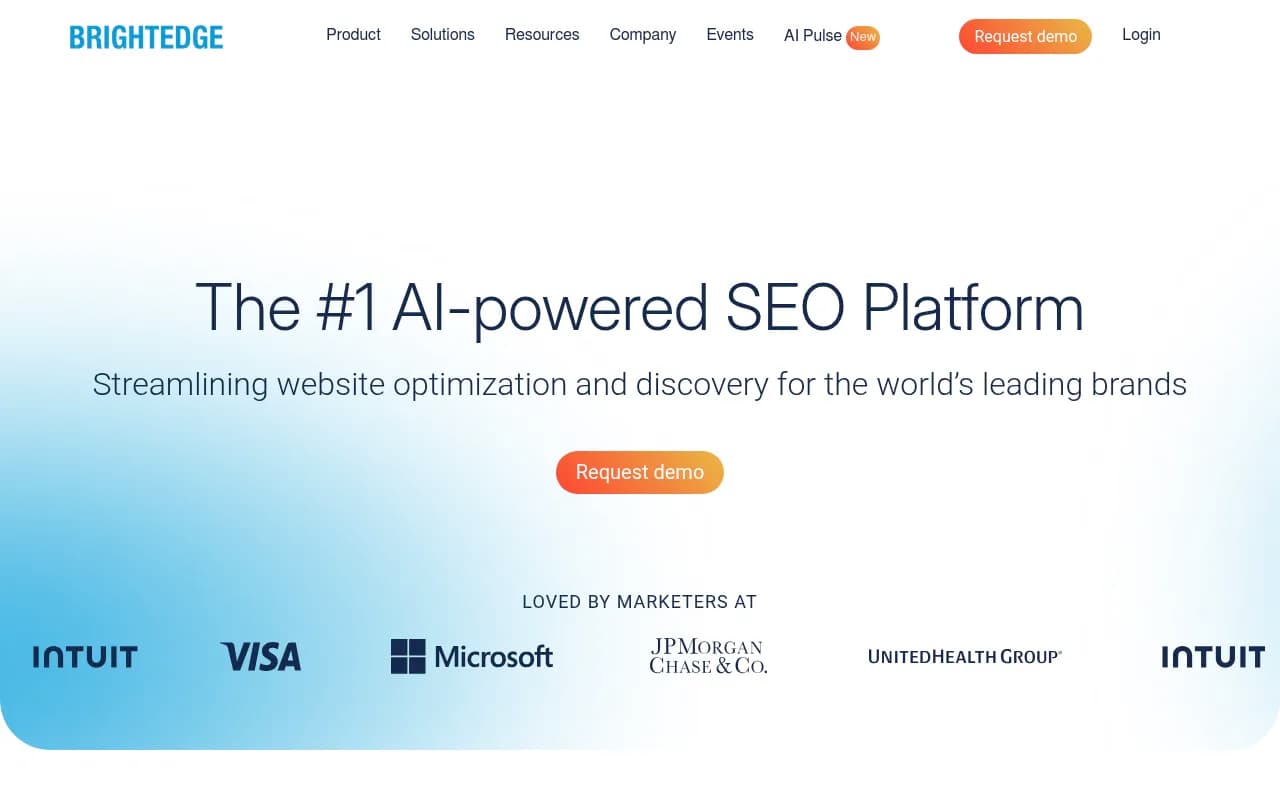
BrightEdge has been in the enterprise SEO market since 2007 and has the most mature keyword database of the three -- over 10 billion keywords with real-time tracking across geographies and SERP features. It's the platform of choice for organizations that want analytical depth and are willing to invest in the ramp time to get there.
What it does well
The Data Cube is genuinely impressive. For competitive keyword intelligence at scale, BrightEdge has more data than either Conductor or Profound. If you're managing a large site with complex competitive dynamics across multiple markets, that depth matters.
BrightEdge has also invested in AI visibility features, including tracking for Google AI Overviews and other generative search experiences. Its multi-engine breadth is solid, and the reporting infrastructure is built for enterprise stakeholders who need credible quarterly dashboards.
The platform also has strong integrations with Adobe Analytics, Google Analytics 4, and other enterprise data stacks, which makes it easier to connect SEO performance to business outcomes in environments where attribution is already complex.
Where it falls short
The complexity is real. A 2-3 month onboarding timeline is common, and the platform is designed for teams with dedicated SEO analysts who can interpret and act on the data. For organizations where the SEO team is small or where content and SEO functions are split, BrightEdge can become an expensive dashboard that nobody has time to fully use.
Like Conductor, BrightEdge was designed for traditional Google search. The AI visibility features are meaningful but not the core product. Independent comparisons note that BrightEdge "optimises for analytical depth and multi-engine breadth" while the AI citation layer that now drives B2B discovery is "structurally outside the feature set" of both platforms.
Profound
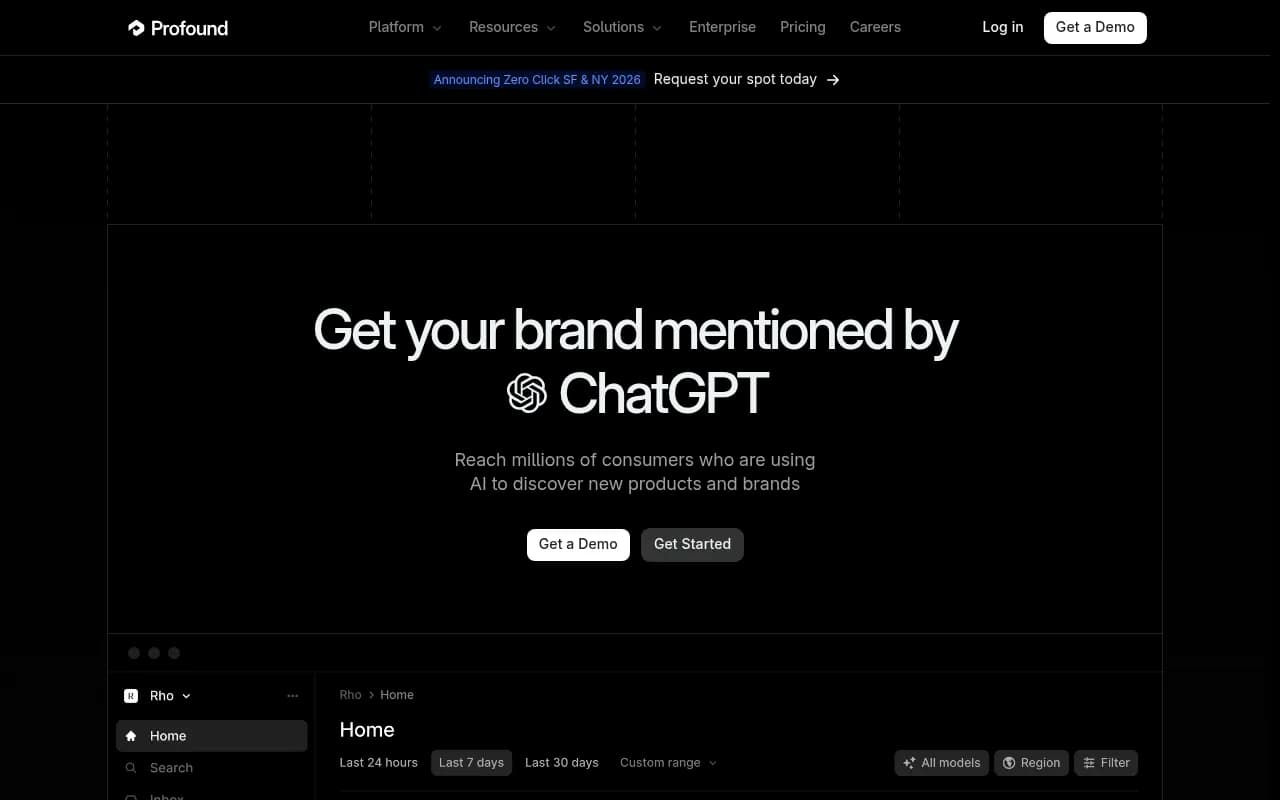
Profound is the newest of the three and the only one that was purpose-built for AI visibility rather than retrofitted. It tracks 10+ AI engines, has processed 400M+ prompt insights, and holds SOC 2 Type II certification. In a 2026 independent ranking of AI visibility platforms, it scored 92/100 on an AEO-specific scoring framework -- the highest of any platform evaluated.
What it does well
The AI engine coverage is the widest of the three. Profound tracks ChatGPT, Perplexity, Claude, Gemini, Google AI Overviews, and several others, with prompt-level data that shows exactly which queries your brand is and isn't appearing for. That granularity is useful for teams that are trying to understand their AI visibility gaps systematically rather than anecdotally.
The prompt intelligence is also more sophisticated than what Conductor or BrightEdge offer. Profound surfaces prompt volumes and difficulty scores, which lets teams prioritize which AI visibility gaps to close first rather than treating all gaps equally.
For enterprise teams where AI search is already a pipeline question -- meaning they can see AI-sourced traffic in their analytics and need to grow it -- Profound's data model is a better fit than either of the traditional SEO platforms.
Where it falls short
Profound has the same enterprise-only access problem as the others. Custom pricing, no self-serve, no trial. The buying process is a commitment.
It's also worth being honest that Profound's traditional SEO capabilities are thinner than BrightEdge or Conductor. If your team needs a single platform to handle both traditional search and AI visibility, Profound won't fully replace either of the others. It's a specialist tool, not a generalist one.
Head-to-head comparison
| Feature | Conductor | BrightEdge | Profound |
|---|---|---|---|
| Primary focus | Enterprise SEO + AEO | Enterprise SEO + AI visibility | AI visibility (AEO-native) |
| AI engines tracked | Multiple | Multiple | 10+ |
| Keyword database | Large | 10B+ keywords | Not primary focus |
| Onboarding time | 2-3 weeks | 2-3 months | Days |
| Tracking cadence | Weekly (default) | Real-time available | Near real-time |
| Content recommendations | Yes (AI-assisted) | Limited | Limited |
| Prompt-level data | Basic | Basic | Advanced |
| Self-serve option | No | No | No |
| Pricing | Custom enterprise | Custom enterprise | Custom enterprise |
| Best for | Content + SEO teams | Technical SEO analysts | AI visibility specialists |
| AEO maturity | Added feature | Added feature | Core product |
The gap all three share
Here's the thing that the head-to-head comparison doesn't fully capture: all three platforms are primarily monitoring tools. They show you where you're visible and where you're not. The harder problem -- what to do about it -- is where the gaps appear.
Conductor has the best content workflow of the three, but it's built around traditional SEO signals. BrightEdge has the most data, but data without action is just expensive reporting. Profound has the best AI-specific data model, but it doesn't have a built-in content generation layer that closes the loop between "you're invisible for this prompt" and "here's the content that would fix it."
For teams that need to move from visibility data to actual content creation to tracking whether that content improved their AI citations, a dedicated GEO platform fills that gap more directly. Promptwatch is one platform that's built specifically around that cycle -- find the gaps, generate content grounded in citation data, track whether it worked.

That's not to say the enterprise platforms are wrong for every team. If you have a 50-person marketing department, complex multi-domain infrastructure, and a dedicated SEO analyst team, Conductor or BrightEdge may be the right foundation. Profound makes sense if AI visibility is your primary concern and you're willing to run it alongside a traditional SEO tool.
But if you're evaluating these platforms and wondering why the demos feel like they're showing you data without telling you what to do with it, that's not a perception problem. It's a structural one.
How to choose
The honest answer is that the right platform depends on what your team's actual bottleneck is.
If your bottleneck is traditional SEO execution at scale -- technical audits, keyword tracking, competitive intelligence across a large site -- BrightEdge has the deepest capabilities, assuming you have the analyst resources to use them.
If your bottleneck is getting content and SEO teams aligned and moving faster on recommendations, Conductor's usability advantage is real. The shorter onboarding time and AI-assisted content workflow make it more likely that insights actually turn into published content.
If your bottleneck is specifically AI search visibility -- you can see AI-sourced traffic in your analytics and need to grow it systematically -- Profound's purpose-built data model is the strongest of the three for that specific problem.
And if your bottleneck is closing the loop between AI visibility data and content creation, none of the three fully solves that problem on their own.
One more thing worth noting: all three platforms require a full enterprise sales cycle before you can see real numbers. Before committing to that process, it's worth getting a baseline read on your current AI visibility with a tool that has a free trial or self-serve option. That gives you something concrete to bring into the enterprise demos rather than starting from zero.
A note on pricing
None of the three publish pricing. Based on market data, enterprise contracts for BrightEdge and Conductor typically run $25,000 to $50,000 annually. Profound's pricing is in a similar range for enterprise tiers.
That's a meaningful commitment, and it's worth being clear-eyed about what you're buying. You're buying data infrastructure and reporting credibility for stakeholder reviews. The actual work of improving AI visibility -- identifying content gaps, creating content that gets cited, tracking whether it worked -- still requires your team's time and judgment, regardless of which platform you choose.
For teams that want to run a faster, more affordable evaluation before committing to an enterprise contract, tools like Profound's self-serve tier (if available), or dedicated GEO platforms with transparent pricing, can give you a working baseline in days rather than months.
Bottom line
Profound is the strongest purpose-built AEO platform of the three. Conductor is the most usable for mixed content and SEO teams. BrightEdge has the most data for traditional search, with AI visibility as a meaningful but secondary capability.
None of them fully solve the problem of turning AI visibility gaps into published content and tracking the results. That's the work that still needs to happen after the dashboard shows you where you're invisible.