Key takeaways
- Google's own help page says ads can show above, below, or within AI Overviews, so the old assumption that AI answers are ad-free is out of date.
- You cannot buy a citation. The ad auction and the retrieval system that picks cited sources are separate pipelines.
- The biggest risk is not losing your citation. It is a competitor's ad sitting next to an answer that already names them and not you.
- Defend in this order: earn the citation, watch the prompts where rivals buy the slot, then bid selectively on prompts where you are absent.
- Google Ads does not segment reporting for ads shown within AI Overviews, so you need your own prompt-based tracking to see the whole screen.
What actually changed
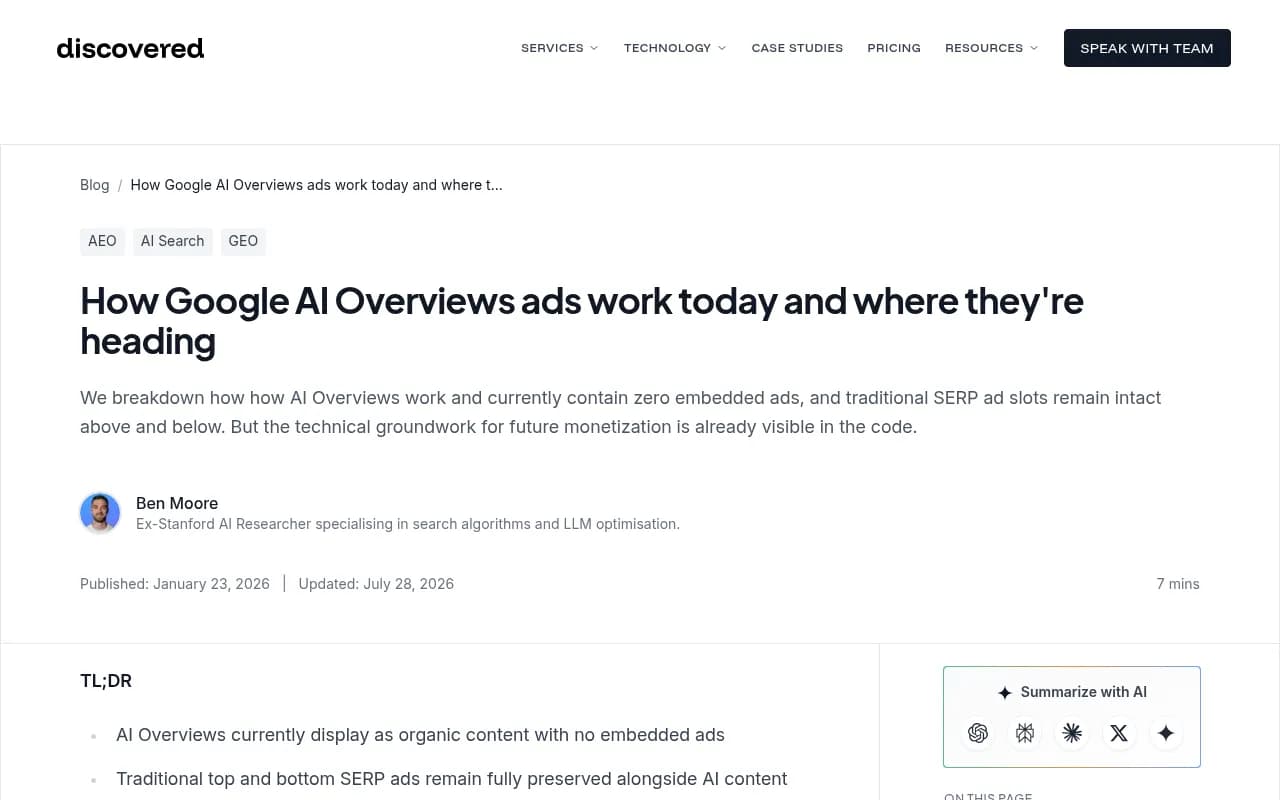
For a while, the comfortable story was that AI Overviews were organic-only. Some of the early technical analysis supported that. Discovered Labs, for example, looked at Google's network traffic in January 2026 and found no embedded ads inside the Overview, with traditional ad slots sitting above and below.
That story is stale. Google's Ads Help page on AI Overviews now documents three positions: above, below, and within the AI Overview. Above and below placement is available in all 200+ markets where AI Overviews run, and existing text, shopping, local, or app ads in Search, Shopping, Performance Max, and App campaigns are eligible. For placement within the Overview, search and shopping ads from existing Search, Shopping, and Performance Max campaigns are automatically eligible. The ad still has to win the auction and speak to both the query and what the Overview says.
Notice the last part. Advertisers do not need a special campaign type. If a competitor already runs broad match or Performance Max against your category, they may be showing up in AI Overviews without ever deciding to.
The Discovered Labs write-up is still useful for one reason: it showed Google renders the AI content (around 61ms) before ad tracking fires (around 68ms) and links ad impressions to AI-enhanced searches through an internal query ID. The plumbing for monetizing the answer surface was there well before the help page said so.
Paid and organic are different systems
This is the part most budget conversations get wrong. Lemniscate Growth puts it plainly: ad slots are filled by an auction that weighs bid, relevance, and quality against a query. Citations are filled by retrieval, where the system finds documents that answer the question, evaluates them for authority and specificity, and cites what it used. Money moves the ad and nothing else.
Deepak Gupta frames the same idea in terms of position: an ad sits beside the answer, a citation sits inside it. When an assistant names three vendors, that carries the weight of the system's judgment. The sponsored unit does not, and buyers can tell.
So the failure mode has a specific shape. If you buy ads while being invisible in the organic answer, you are, in Gupta's words, buying proximity to your competitor's endorsement. The reader sees the recommendation, sees that the ad is an ad, and the recommendation wins.
I would add one caution. Both of those pieces are frameworks from practitioners, not controlled experiments. They are logically sound, but treat the budget percentages floating around as rules of thumb, not measured results.
The three threats to your citation
When a competitor buys the slot, three different things can happen to you. They need different responses.
1. The ad frames the answer before you do
On branded prompts, the Overview is usually about you already. A competitor's ad above or inside that answer is the first commercial message the buyer reads. Your citation is intact, but the framing is contested. This is classic conquesting, with higher stakes because one synthesized paragraph carries all the framing.
2. The screen gets more crowded
Lemniscate Growth makes a fair point here: organic citation is not being replaced, but the real estate around it is getting more crowded. Even if you keep your citation, the share of attention it gets can fall because there is simply more on the screen.
3. You were never in the answer
On non-branded research prompts, the answer names whichever vendors retrieval found and trusted. An ad does not change that list. If you are absent, a competitor's ad is the only commercial voice, and you have nothing to defend. This is the worst of the three, and it is a content problem, not a media problem.
How the ad layer behaves in ChatGPT, for comparison
Google does not publish how often ads appear in AI Overviews, and I found no data on how often paid ads and organic citations co-occur there. ChatGPT is the better-documented case, and it shows what an ad layer looks like once it scales.
Promptwatch Data's report How Often Does ChatGPT Show Ads? covers May 20 to August 17, 2026:
- Ads appeared in an average of 20.1% of ChatGPT responses that ran a web search over the 90 days.
- There were no ads until May 27, when they showed in 1.69% of responses. The rate passed 30% on July 1 and stayed there, with a daily peak of 43.9%.
- Over the past 7 days the average was 32.4%.
- By prompt type, ad-bearing responses over the past 7 days were 73.3% organic prompts, 18.0% brand-specific, and 8.6% competitor comparisons.
That last split is a volume mix, not the chance that a given prompt type triggers an ad. Organic prompts dominate because there are simply more of them. Still, the lesson carries over: ads went from nothing to a third of searched responses in about five weeks. Nobody should assume the Google surface will stay quiet. Promptwatch's own advice is to check ad visibility across several days before drawing conclusions, and to track which advertisers and landing pages win the slot on your prompts.
What survives in an AI Overview: content types
If citation is the asset to protect, it helps to know what gets cited. Promptwatch Data's AI Overviews citation types report for July 2026 breaks down the month:
| Content type | Share of July 2026 AI Overview citations |
|---|---|
| Listicle | 18.0% |
| Product page | 16.3% |
| How-to | 15.1% |
| News article | 13.5% |
| Video | 5.9% |
| Social post | 5.1% |
| Landing page | 4.7% |
| Comparison | 3.6% |
Two trends matter. From July 28, product pages were the most cited format every day, ending the month at 17.9% against 16.2% for listicles. Product pages were around 9% in January and have nearly doubled since. Listicles fell from about 26% in Q1 to about 18% in July. Video went from about 2.7% in January to more than 6% by late July.
Practically, that means product pages deserve the same attention you give editorial content: structured specs, clear pricing, fresh availability. Keep your list content, and keep investing in video.
There is a catch, and Silktide's analysis names it: ranking first does not guarantee getting quoted. Citing Search Engine Land, they note the overlap between AI Overview citations and organic rankings grew from 32.3% to 54.5% between May 2024 and September 2025. That is more than half but far from all. AI Overviews seem to prefer specific, extractable passages, and a statistic buried inside a transactional product page resists citation. Backlinks alone do not buy your way in either.
A defense plan, in order
Step 1: build a fixed prompt set
Lemniscate Growth's suggestion is sensible: pick thirty to fifty commercially relevant questions, run each five to ten times a month, and record three rates: ad presence, answer mention, and citation presence. Answers are volatile, so a single run tells you almost nothing. Monthly sampling gives you a number you can chart.
Split the prompts into branded, comparison, and non-branded research. They need different strategies.
Step 2: sort prompts into four buckets
| Situation | What it means | Response |
|---|---|---|
| You are cited, no competitor ad | Healthy | Maintain content freshness. Do not bid here first. |
| You are cited, competitor ad present | Contested framing | Consider defensive bidding on branded terms, and tighten the on-page claims AI quotes. |
| You are absent, competitor ad present | Worst case | Fix content first. Test paid as a stopgap. |
| You are absent, no ads | Open ground | Earn the citation cheaply before rivals start paying. |
One counterintuitive point from Lemniscate: buying ads against prompts where the answer already recommends you is often the least efficient spend, while buying against prompts that name a competitor is frequently the most. That follows from Gupta's argument that an ad beside an answer naming only competitors is fighting the answer, but I would still test it before committing, since the evidence is practitioner judgment.
Step 3: protect branded prompts defensively
On branded queries, the case for buying your own slot is strongest. Competitor conquesting is old, but the AI framing makes it sharper. Bid on your brand and bottom-funnel terms so a rival does not own the first commercial message above an Overview describing you. Also read the answer itself: is it accurate? An inaccurate summary of your product is a content and entity problem that no ad fixes.
Step 4: earn citation on research prompts
This is where spend has no effect, so this is where content and authority work goes. Write self-contained passages that answer one specific question. Put them on a domain with subject authority, corroborated elsewhere. Use semantic HTML so the page is easy to parse. Give product pages real specifications. Content that only makes sense if the reader is already on the page does not get retrieved.
Step 5: use paid where it genuinely earns its place
Gupta lists cases where paid placement makes sense. They are worth keeping:
- You need speed (a launch, funding announcement, or seasonal window) and citation authority takes months.
- Your category is new and there are few organic conversations to be cited in.
- You already have organic presence and want to appear both in the answer and beside it.
- You have a measurable conversion event and short sales cycles.
He also notes that ChatGPT ads serve only Free and Go tier users, with paid plans ad-free. I could not verify that independently, so confirm it before building a B2B plan around it. If correct, a CISO at a company that pays for AI tooling may never see those ads.
The measurement trap
Google Ads currently does not offer segmented reporting when your ads show within Search AI Overviews, so you cannot isolate their performance. A PPC forum thread says the same about AI Mode, though that is anecdotal. The consequence: if your ad appears in an answer that already cites you, paid gets the click credit and the organic work that put you in the answer gets none. Most AI-answered queries also end without a click, so the organic contribution often generates no session at all.
The fix is to stop attributing the surface and track it as a share metric, as above. Two quarters of monthly data is usually enough for the correlation between citation share and branded demand to become legible. Assign one owner to the prompt set and report all three parts (ad, mention, citation) to the same audience. If the paid team and SEO team report separately, nobody sees the screen the buyer sees.
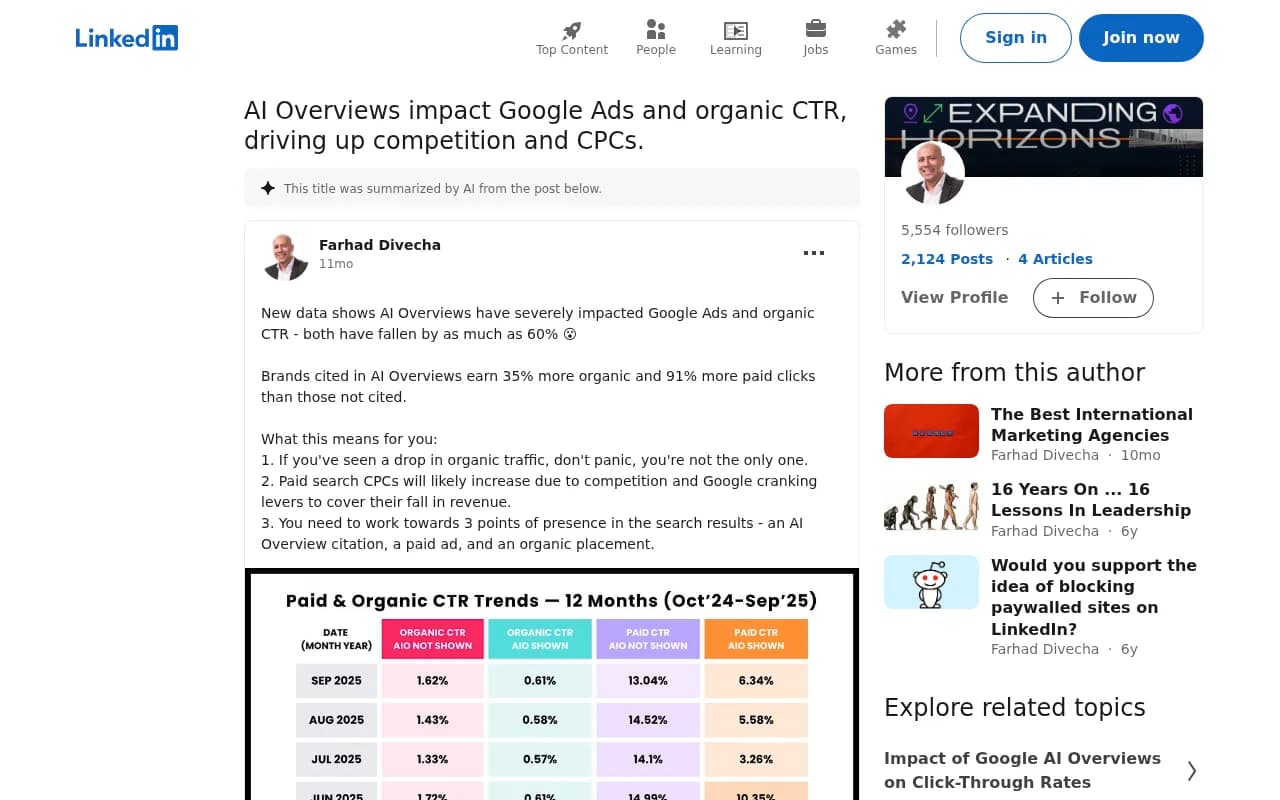
A word on claims you will see online: one LinkedIn post says AI Overviews earn 35% more organic clicks and 91% more paid clicks when the brand is cited, and that CPCs will rise. It is a secondary source with no methodology attached, so I would not build a budget on it. Directionally it matches the logic (being cited helps your ads too), but verify before quoting it.
Tools for tracking both layers
You need something that captures real AI answers across repeated runs, not a one-off screenshot. Promptwatch tracks the actual interfaces of Google AI Overviews, AI Mode, ChatGPT, and others, and its Ads Radar shows which advertisers bid on your prompts, with their ad copy and landing pages. That is the closest thing to seeing the competitor's slot. Its citation and content-gap reporting then shows where you are absent.

If you are comparing options, other trackers in the catalog include Profound for enterprise monitoring:

Otterly.AI for basic, affordable prompt tracking:

And Semrush if you want AI tracking bolted onto an existing SEO suite:
For your own search data, Google Search Console remains the free baseline:
| Need | Option | Note |
|---|---|---|
| See who buys the slot on your prompts | Promptwatch (Ads Radar) | Shows advertisers, copy, landing pages |
| Monitor mentions and citations | Profound, Otterly.AI | Monitoring focus |
| Add AI tracking to existing SEO workflow | Semrush | Fixed prompt sets |
| Page-level search data | Google Search Console | Free, no AI Overview ad segmentation |
For a wider shortlist, the GEO software directory at bestgeosoftware.com lists more tools than fit here.
Why brand still matters
A Westwood One piece makes the broader argument that if people already know your name, AI search helps you; if they do not, it buries you. It is an opinion essay from an audio advertising company with an obvious interest in brand advertising, so weigh it accordingly. But the underlying mechanism is plausible. Branded prompts are the ones you can defend with a modest ad budget, and branded demand is built upstream, over time.
FAQ
Can I pay Google to be mentioned inside an AI Overview?
No. You can pay for an ad that may show above, below, or within the Overview if it wins the auction and fits the query and the Overview content. The cited sources and generated text come from retrieval, which is not purchasable.
Should I bid on prompts where the answer already recommends me?
Usually not first. Defensive bidding on your branded terms is reasonable if competitors are conquesting. Beyond that, put the money where the answer names only rivals.
How often should I check?
Monthly, with several runs per prompt. Daily checks produce noise. If ads in your category are ramping fast, as they did in ChatGPT, check weekly for a while.
Can I see my AI Overview ad performance in Google Ads?
Not separately. Google's help documentation says there is no segmented reporting for ads shown within AI Overviews, so judge results on downstream pipeline and use your own prompt tracking for visibility.
Bottom line
Treat the citation as the asset and the ad slot as a contestable layer around it. Defend your branded prompts with a small, targeted budget, earn your place on research prompts with specific, extractable content, and track all three rates (ad, mention, citation) from one prompt set. If you are only going to do one thing this quarter, run that prompt set and find the prompts where a competitor holds the slot and you are not in the answer.