Key takeaways
- A monthly AI reputation report answers four questions: are we mentioned, what do the engines say about us, which sources shape that answer, and did anything we did move the numbers.
- Track every metric per AI engine and keep the window length identical month to month. Promptwatch Data shows the source mix differs sharply between ChatGPT, Perplexity and Google AI Overviews.
- Use rolling trends, not single-day swings. A one-day drop can be a platform change or a data-collection issue.
- Slack automation is a delivery layer. Pick one source of truth, schedule the summary, and put the human commentary on top.
- Reviews, FAQ pages and press releases matter more when a prompt names your brand, so PR owns more of the AI answer than it usually assumes.
Why PR teams need their own AI report
SEO teams already report on rankings and AI visibility. PR teams need something different. Your question is not "did we get cited?" but "what is the machine telling buyers, journalists and investors about us, and is it true?"
A branded prompt like "is [Company] any good?" is a reputation moment. Promptwatch Data's report on ChatGPT content types (Sep 28 to Oct 4, 2026) found that for branded prompts, product pages take 23.3% of citations and landing pages 22.8%. Reviews climb to 5.6%, over 3x their overall share. FAQ pages are 4.8% and press releases 2.1%. So the pages you control matter, but third-party reviews have an outsized say exactly when someone asks about you by name.
That is the PR angle in one paragraph. Collect reviews on trusted sites, keep your FAQ and product pages accurate, and measure whether the answers improve.
What goes in the monthly report
Keep it to one page of numbers and one page of commentary. Longer reports do not get read.
1. Presence
- Share of voice: your slice of all brand mentions across tracked prompts, versus named competitors.
- Average position: where you land in the order of brands inside an answer. Lower is better.
- Visibility score by engine, not blended. A blended number hides the fact that you may be strong in ChatGPT and absent in AI Overviews.
2. Narrative and accuracy
- The top claims AI makes about you (pricing, support, reliability, leadership) and how often each appears.
- Claims marked accurate or inaccurate by a human, and the page that likely taught the model the wrong thing.
- Sentiment score per engine and per topic, with a note on what moved it.
This is the section only PR can write well. A tool can pull out the claims. Someone who knows the company has to say which ones are wrong.
3. Sources
- Top cited domains and URLs for your priority prompts.
- Which of those are earned (press, reviews, analyst pages) versus owned.
- Social citations: Reddit, YouTube, LinkedIn. Treat these per engine.
The engine split matters a lot. In Promptwatch's November 2026 social citation data (Oct 11 to Nov 9), social platforms were 13.16% of Google AI Overviews citations, 1.94% of Perplexity's and 0.64% of ChatGPT's. YouTube alone was 6.71% in AI Overviews. A PR plan built around Reddit threads will do something very different in each engine.
4. Impact and actions
- What you shipped last month (launch, press hit, review drive, corrected FAQ).
- What changed in the numbers after it.
- What you will do next month, with an owner.
The template
Copy this into a doc or Notion page. Fill the numbers from your tracking tool, then write the commentary yourself.
MONTHLY AI REPUTATION REPORT: [Month, 2026]
Window: [start date] to [end date] (same length as last month: yes/no)
Engines: ChatGPT / Gemini / Perplexity / AI Overviews / Claude
Prompt set: [n] prompts, [n] branded, [n] category, [n] competitor comparison

1. HEADLINE (2 sentences, written by a human)

2. PRESENCE
| Engine | Visibility | Share of voice | Avg position | vs last month |

3. NARRATIVE
Top 5 claims about us: claim | engines saying it | accurate? | source page
Sentiment by engine: [score] ([change])

4. SOURCES
Top 10 cited domains | type (owned/earned/review/social) | change
New citations gained / lost this month

5. RISKS
Inaccurate claims, negative reviews surfacing, competitor narrative gains

6. WINS
Press or review coverage that now gets cited

7. NEXT MONTH
Action | owner | due date | expected effect

NOTES ON DATA QUALITY
Any platform changes, collection issues, or prompt-set changes this month
The last block is easy to skip and shouldn't be. If you changed the prompt set mid-month, say so, or the trend line will lie.
Metric pitfalls to write into your process
Use rolling trends
In August 2026, Promptwatch recorded reddit.com's share of ChatGPT citations falling from 3.83% to a 0.52% average, an 86.4% relative drop. The report itself says the size is provisional because a data-collection issue can't be ruled out, and advises checking collection volume before reacting. Good advice. If your report screams about a one-day swing, you will spend a week explaining it to the CMO.
Keep windows equal
The November social report compares a 30-day window against an October report that covered 7 days. Fine for a rough look, but a PR report should not mix them. Fix the window length in the template and stick to it.
Count a citation once per response
Citations are counted once per response per page. If a vendor counts differently, your month-over-month numbers break when you switch tools.
Expect news to decay
Press coverage does not stay cited. Promptwatch's content half-life data shows news pages lose half their citations within about 36 days, while landing pages and docs last months. A big launch story helps this month's report and fades fast. Evergreen owned pages carry the long-term answer.
Choosing a tracking source
The report is only as good as the data feeding it. You need prompts run from the real interfaces of the engines, per-claim narrative data, and citations you can export.
Promptwatch covers most of this in one place. It tracks ChatGPT, Gemini, Perplexity, Claude, Google AI Overviews and others, pulls out individual claims in Brand Narrative, and lets you mark them accurate or inaccurate with Fact Check on Business plans and above. Its Slack integration can deliver scheduled briefings into channels, and you can also export PDF reports on a schedule. Plans start at $95/month on promptwatch.com/pricing, and there is a free AI visibility report if you want a baseline first.

Other options in the same space, with different strengths:
| Tool | Angle | Fits PR teams that |
|---|---|---|
| [tool:brand24] | Social and web listening | Need mentions and sentiment outside AI answers |
| [tool:meltwater] | Media and social intelligence | Already run media monitoring and want one vendor |
| [tool:llmclicks] | AI visibility with hallucination detection | Care most about wrong claims |
| [tool:otterly-ai] | Lightweight AI visibility tracking | Want a cheap monitor to start |
| [tool:reputation-com] | Reviews, listings and surveys | Own review volume as a lever |
| [tool:profound] | Enterprise AI visibility | Need enterprise scale and support |
A realistic stack is a classic listening tool for press and social, plus an AI visibility platform for what the engines say. Compare more options in the GEO software directory at bestgeosoftware.com.
Automating delivery in Slack
Be honest about what automation does here. It moves numbers into a channel on a schedule. It does not write your headline or judge which claims are wrong. Do the commentary by hand and automate the rest.
Option 1: native scheduled briefings
If your visibility platform has a Slack integration, start there. It removes a moving part. Set a monthly summary to post in a channel like #pr-ai-reputation, and a weekly one for the working team.
Option 2: email into a channel
Slack channels have an email address. Schedule a PDF or dashboard email from your tool, send it to that address, and the report lands in the channel where people can discuss it. This is low-tech and works with almost any tool. Slack's older marketing reports post describes the same idea, though it names apps that may no longer exist, so treat the principle as useful and the tooling as dated.
Option 3: a workflow tool in the middle
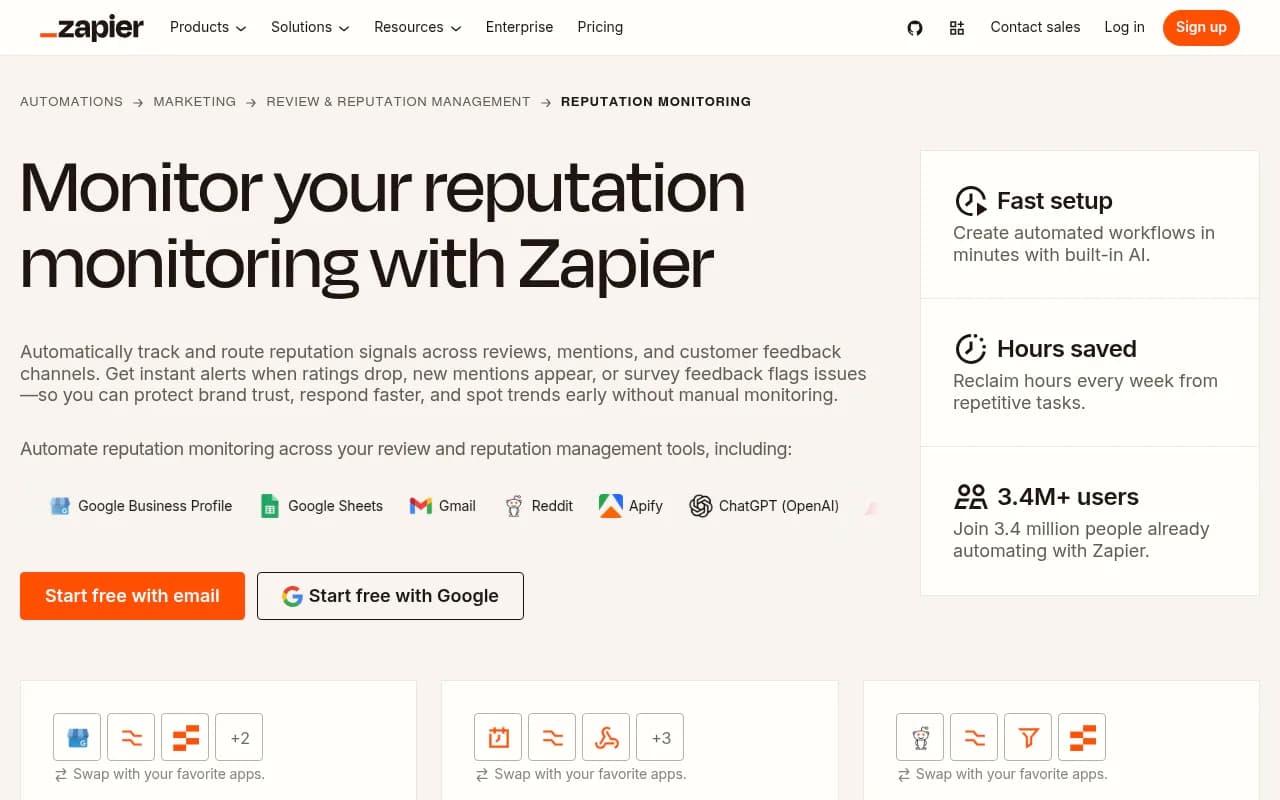
When your source has an export or API but no Slack feature, route it through an automation platform. [tool:zapier] has a page of reputation monitoring automations that cover Slack, Google Business Profile, Reddit, Google Sheets and ChatGPT, with alerts when ratings drop or new mentions appear.
For more control or self-hosting, [tool:make-formerly-integromat] and [tool:n8n] do the same job. A typical flow:
- Trigger on a schedule (first working day of the month, 9:00).
- Pull the numbers from your tool's API or a Google Sheet it feeds.
- Compare against last month and flag changes above a threshold.
- Post a formatted message to the channel with a link to the full report.
- Open a thread for the PR lead to add commentary.
A message format that gets read
AI reputation, [Month]
Visibility: ChatGPT 41 (+3) | Gemini 35 (-1) | Perplexity 38 (+6) | AIO 22 (0)
Share of voice vs top 3 competitors: 24% (+2 pts)
Sentiment: 62 (+1)
New inaccurate claim: "[claim]" on 2 engines. Source: [page]
Top new citation: [URL]
Full report: [link]
Commentary in thread. Owner: @name
Short, numeric, one flagged risk, one link. Anything longer becomes wallpaper.
Alerts versus the monthly report
Keep two channels. Real-time or weekly alerts (a new inaccurate claim, a sharp sentiment drop, a negative review surfacing) go to a working channel. The monthly report goes to a leadership-facing channel. Mixing them trains people to mute both.
Running the meeting around it
The report exists to trigger decisions. A 30-minute monthly review works:
- 5 minutes on the headline and presence numbers.
- 10 minutes on inaccurate or negative narrative items.
- 10 minutes on sources: which earned placements are getting cited, which are not.
- 5 minutes assigning next month's actions.
Typical actions that come out of it: correct an FAQ page that states an outdated price, run a review drive on the one trusted site AI keeps citing, pitch the publication that ranks as a top source for your category, or publish a press page that states your facts plainly.
Common mistakes
- Reporting a blended score and losing the per-engine story.
- Changing the prompt set every month, which breaks comparisons.
- Treating sentiment as the whole picture. Sentiment and visibility are separate: you can be mentioned a lot and described badly.
- Skipping the human check. A tool can flag a claim, but it cannot know your pricing changed last week.
- Automating everything, including the commentary. Leadership reads the thread, not the chart.
A quick setup checklist
- Pick 40 to 100 prompts that mirror how buyers, journalists and investors ask about you, split into branded, category and competitor prompts.
- Choose a tracking source and fix the monthly window.
- Copy the template above and fill it for last month as a baseline.
- Connect delivery to Slack with the simplest option that works.
- Assign an owner for commentary and an owner for each action.
- Review the template after three months and cut anything nobody used.
If you want to browse more tracking options before committing, the AI rank tools directory lists many of them side by side.