Key takeaways
- No credible published benchmark splits ChatGPT mention rate by city size (metro, mid-size, small town). Anyone quoting one is guessing or selling something.
- The closest local data says ChatGPT recommends only about 1.2% of business locations, versus 35.9% for Google's local 3-pack. The original SOCi report should be checked before you cite it.
- The 27.6% ChatGPT mention rate from MarketScale is a B2B number. Do not use it as a local benchmark.
- A "good" rate is relative: your own fixed-prompt baseline, your competitors in the same city, and the trend over consecutive months.
- Build city-size tiers yourself with a simple method, described below.
The honest answer first
I went looking for a clean table that says "metro businesses get mentioned X% of the time, small-town businesses Y%." It does not exist. Not in the research I could find, and not in first-party data either. Promptwatch Data has no report on local or city-size mention rates, and the third-party material is thin.
That matters because a lot of articles on this topic quietly invent tiers. "Aim for 15% in large metros, 25% in small towns." Where would that come from? Nobody has run that study in public. Contently says the same thing about GEO generally: there is no universal benchmark yet, because citation rate depends heavily on industry, prompt set, and competition. Its advice is to run a fixed prompt set, record your current percentage per engine, and measure against that starting point.
So this guide does two things. It shows you the real numbers that exist, with their limits. And it gives you a method to produce city-size benchmarks that are actually yours.
What the real numbers say
The local data: ChatGPT is very selective
The most useful local figure comes from a study attributed to SOCi, covering roughly 350,000 business locations across 2,751 brands:
- ChatGPT recommended 1.2% of locations.
- Gemini recommended 11%.
- Google's local 3-pack showed a location 35.9% of the time on average.
- ChatGPT-recommended places averaged 4.3 stars.
That makes ChatGPT about 30 times more selective than the map pack. A caveat: I only found secondary reposts of this study, not the primary report, so I could not verify its date, methodology, or whether it breaks results down by city size. Find the original before you put the figure in a client deck.
If you manage multi-location brands, SOCi is worth a look for its own research and tooling.
Take the direction of the finding seriously even if you hold the exact numbers loosely. For a typical local business, a mention rate in the low single digits on generic "best X near me" prompts is not a sign you are failing. It may be the norm.
The B2B number that gets misused
MarketScale's State of GEO report (Jul 21 to Oct 19, 2026) covers 162 projects, 12,202 prompts, and 508,305 responses. The average mention rate across five engines is 24.06%, and ChatGPT leads at 27.6%. Its citation rate averages 19.8%, with ChatGPT at 25.8%.
Those are B2B brands, tracked on B2B prompts, many of them with no geographic component. Comparing your dentist's practice in Tulsa to a 27.6% figure is a category error. The report itself says it describes the tracked sample, not all companies or all AI answers.
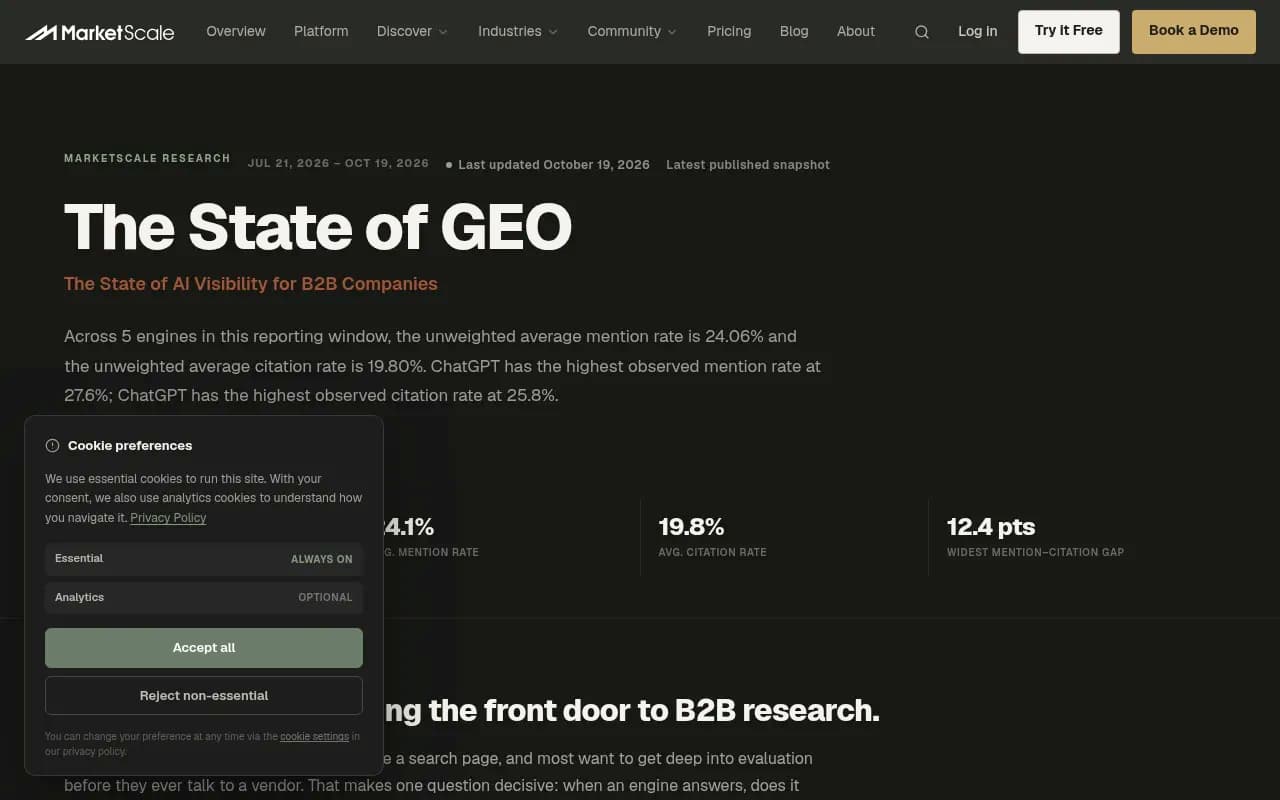
It is still useful for one idea: mentions and citations are separate metrics. Getting named is not the same as getting cited, and the report found a gap of up to 12.4 points between the two on some engines.
Why city size should matter (in theory)
I have no data proving the effect, so treat this as a hypothesis worth testing, not a finding:
- Big metros have more competitors per category, so the pool of eligible businesses is larger and each one's share is smaller.
- ChatGPT's answers are crowded anyway. Promptwatch's data shows 47.6% of ChatGPT responses with citations cite 10 or more domains (Sep 28 to Oct 4, 2026), and 52.5% for general prompts with no brand named. Local queries in a big city plausibly pull from many directories and listicles.
- Small towns have fewer businesses and fewer third-party pages about them. That can cut both ways: less competition, but also less material for the model to draw on, so it may skip you or lean on a handful of directories.
All of that is plausible. None of it is established. Which is why you should measure it.
What ChatGPT tends to cite for local-style prompts
We do have solid data on what kinds of pages ChatGPT cites overall. In Promptwatch's content-type report (Sep 28 to Oct 4, 2026), product pages took 22.4% of classified citations, landing pages 16.8%, and listicles 13.6%. For commercial "best X" prompts, product pages rose to 26.0%, landing pages to 20.6%, and listicles to 15.0%. Reviews took 1.7% overall but rose to 5.6% on branded prompts.
For a local business the practical reading is:
- Keep your own service and landing pages complete, one per service and location.
- Get onto the third-party "best of" listicles that cover your city.
- Keep review profiles current, since reviews matter more once someone names you.
There is also a content-freshness angle. In Promptwatch's half-life study, landing pages and docs stayed cited longest, while news lost half its pages within 36 days. A local news mention helps briefly. A solid service page lasts.
And don't count on Reddit. Promptwatch Data shows reddit.com's share of ChatGPT citations fell from roughly 4% to 0.5% on August 14, 2026, and ChatGPT drew just 0.46% of its citations from social platforms in the week of Sep 28 to Oct 4 (social citations report). Google AI Overviews got 12.2% from social. If your local plan leans on community threads, it matters which engine you care about.
How to build your own city-size benchmark
Here is the method. It takes a weekend to set up and gives you numbers no blog post can.
Step 1: Define your tiers
Pick tiers that reflect your market, not a textbook. A workable starting point:
| Tier | Rough definition | Why it might behave differently |
|---|---|---|
| Large metro | 1M+ population | Many competitors, many directories, crowded answers |
| Mid-size city | 150K to 1M | Moderate competition, decent third-party coverage |
| Small town | Under 150K | Few competitors, but thin web coverage |
The cutoffs are arbitrary. Choose them once and keep them fixed.
Step 2: Write a fixed prompt set per city
Use 20 to 50 prompts per city, built from the same templates so cities stay comparable:
- "best [service] in [city]"
- "who is the most trusted [service] near [neighborhood]"
- "[service] in [city] with good reviews"
- "affordable [service] in [city]"
- One or two comparison prompts naming a competitor
Don't change the wording between runs. A single prompt tells you very little, so volume across prompts is the point.
Step 3: Define what counts
Decide up front:
- Mention: your business name appears in the answer.
- Citation: your domain appears in the source list.
- Both are tracked separately, as MarketScale also insists.
Then compute mention rate as responses naming you divided by total responses. Run each prompt several times, because answers vary.
Step 4: Benchmark against competitors in the same city
Your own rate means little alone. Track the top five local competitors with the same prompts. In each city, your relative share of mentions is the number that tells you whether you are winning. A 4% mention rate in a metro where the leader has 9% is a very different story from 4% in a town where the leader has 5%.
Step 5: Run it monthly and watch the trend
Contently's point stands: a rising trend across consecutive months matters far more than any absolute number borrowed from another company. Log results in a spreadsheet and add a column for city tier.
After three or four cities per tier, you will have the first real city-size benchmark for your category. It is small and unofficial. It is also yours.
Tools that help you measure this
You can do the first round by hand in ChatGPT itself.
Beyond a few dozen prompts, manual checking stops being practical. AI visibility platforms automate the repeated runs, and a few handle location specifically. For example, Promptwatch tracks the real ChatGPT interface by country on every paid plan, with state and city tracking from the Business plan, plus Visibility Score, Share of Voice, and Position, which maps well onto the benchmark method above. Confirm current plan limits at promptwatch.com/pricing.

Some other options, with an honest note on fit:
| Tool | Local angle | Good for |
|---|---|---|
| Promptwatch | City tracking on Business plan, crawler logs, content gap analysis | Measuring and then fixing visibility |
| Tibly | Built for local businesses | Simple local AI visibility checks |
| BrightLocal | Local SEO platform | Citations and listings alongside rankings |
| Birdeye | Reviews and reputation for multi-location brands | Review volume and ratings |
| Yext | Listings for multi-location brands | Consistent business data at scale |
| Synup | Listings, reviews, local visibility | Agencies managing many locations |

If you want to compare more options, the directory at bestgeosoftware.com lists GEO platforms side by side.
What moves a local mention rate
The benchmarks are murky, but the levers are not. Based on the ChatGPT behavior above and general local SEO practice:
Fix the basics that feed AI answers
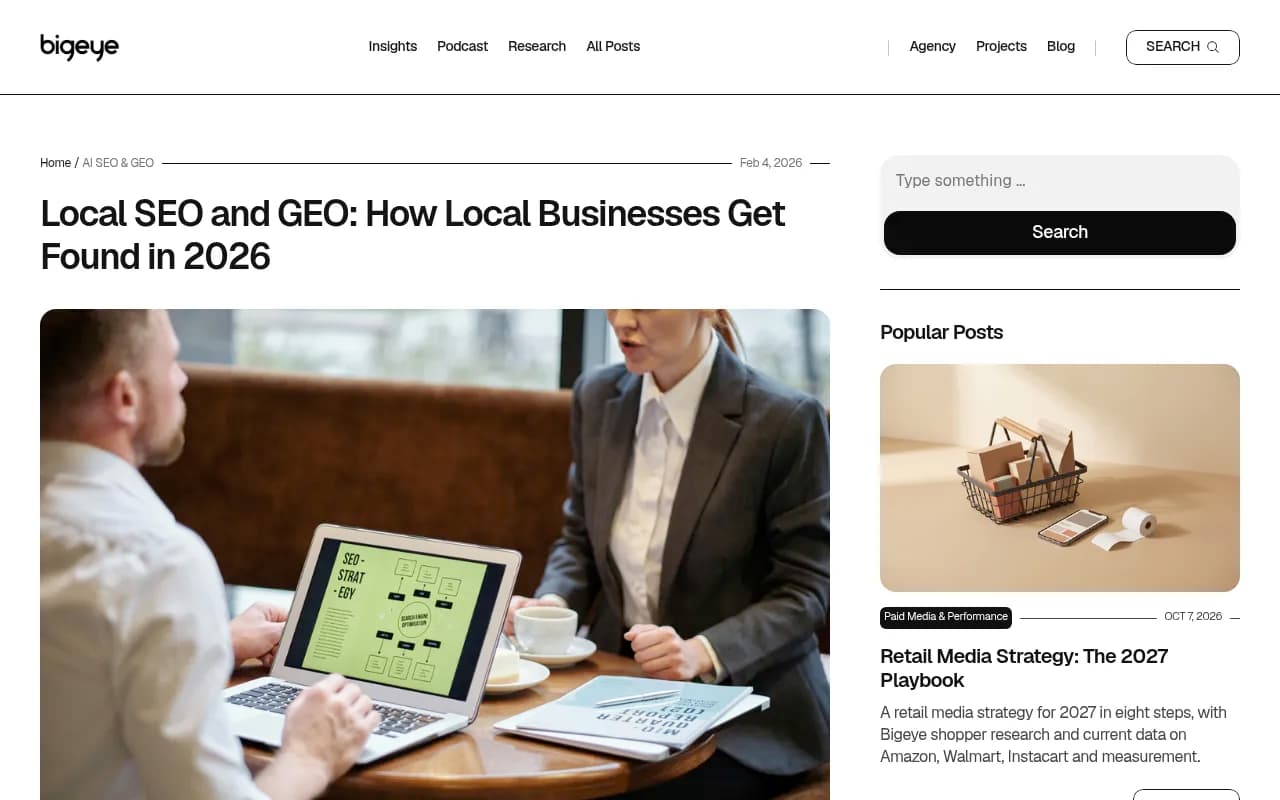
Big Eye Agency, citing local search data, says complete Google Business Profiles convert 3.2 times more often than incomplete listings. That is a conversion figure, not a ChatGPT figure, but a complete profile is cheap and everything else builds on it. The same source ties schema markup to 30 to 40% higher visibility in AI answers. Treat that as an unverified vendor claim. Schema is still worth doing, because it costs little.
Earn the third-party pages AI reads
With nearly half of ChatGPT responses citing 10 or more domains, you share every answer with many sites. Getting named on local listicles, chamber of commerce pages, and review sites is how you get into that crowd at all. A review profile with solid ratings helps too, given the SOCi finding that ChatGPT-recommended places averaged 4.3 stars.
Check that AI crawlers can actually read you
A surprising number of local sites block bots by accident through robots.txt or a CDN rule. Look at your server logs or use a crawler-log tool to confirm that OpenAI's and other AI bots reach your service pages. Promptwatch's crawler traffic data tracks verified AI crawler requests, which shows how much of that traffic is now normal.
Keep location pages specific
One thin "areas we serve" page listing 40 towns will not do much. Separate pages with real details work better: addresses, staff, local project examples, neighborhood-level FAQs, and photos. In a small town, a handful of strong pages may be enough. In a metro, you need to be more specific, by neighborhood or niche.
Setting targets without fake benchmarks
So, what is a good ChatGPT mention rate? My answer, after reading all of this:
- For generic local discovery prompts, expect low numbers. If the SOCi finding holds, single digits across a whole location set is normal, not a failure.
- A good rate is one that beats your top local competitors on the same prompt set, in the same city.
- Improvement over three months of consistent measurement is the target that is hard to argue with.
- Branded prompts (someone names you) should be much higher. If ChatGPT cannot find you when your name is in the question, that is a data or crawl problem, not a competition problem.
If you are reporting to a client or a boss, say plainly that no public city-size benchmark exists, show your own baseline, and commit to a trend. That is more credible than a made-up table, and when someone later publishes a real one, you will have data to compare it against.
Common mistakes
- Borrowing B2B numbers (like the 27.6% ChatGPT mention rate) for local businesses.
- Changing prompt wording between months, then blaming the model for the swings.
- Testing from a single location and assuming it represents the city.
- Counting mentions only, ignoring whether your domain was cited.
- Treating one run of one prompt as a result.
If the agency side of this is where you need help, 1001 SEO Media works on local SEO and AI search visibility, and you can reach the team at [email protected]. For free reading first, the AI rank tracking directory is a good place to compare tools.
The bottom line
There is no official ChatGPT mention rate benchmark by city size in 2026. What exists is a handful of loosely sourced local figures, one of which suggests ChatGPT is about 30 times pickier than Google's map pack, and a B2B report that does not transfer. Build a fixed prompt set, split your cities into tiers, measure competitors alongside yourself, and track the trend monthly. After a quarter, you will have a benchmark worth quoting.