Key takeaways
- Finseo.ai starts at €84/month (Starter) and runs to €479/month (Growth), with Enterprise custom-quoted; agencies pay €349-599/month with a 6-month minimum term.
- The pitch is breadth: GEO tracking across up to 11 models, AI-generated content scored for citation likelihood before publishing, 200+ integrations, and a post-purchase attribution survey that tries to connect AI visibility to actual revenue.
- Review signal is thin and mixed. G2 has only 3 reviews (5.0/5, too small a sample to trust), while an AppSumo review pool and at least one third-party roundup report frustration with the UI and pricing opacity.
- Dedicated AI visibility specialists (Peec AI, LLM Pulse, Profound) often beat Finseo on depth in one category, while broader GEO platforms like Promptwatch beat it on the execution side, crawler logs, and multi-channel citation data.
- Bottom line: Finseo makes sense if you want one vendor handling AI visibility, content generation, and integrations, and you're fine with German data residency and a somewhat busy interface. It's a weaker pick if you need deep citation analytics or a lower cost per tracked prompt.
What Finseo.ai actually is
Finseo GmbH is a German company founded in 2025, based in Gaildorf, Baden-Württemberg, with data hosted in Frankfurt under EU residency rules. Founders David Mühlenweg (CEO) and Maurice Marinelli (CMO) built it as a GEO platform rather than a bolt-on SEO feature: AI visibility tracking, AEO-optimized content generation pulled from a company's own Notion, Google Drive, or Slack content, AI crawler analytics, and a revenue attribution layer that tries to tie AI answers back to actual customers.
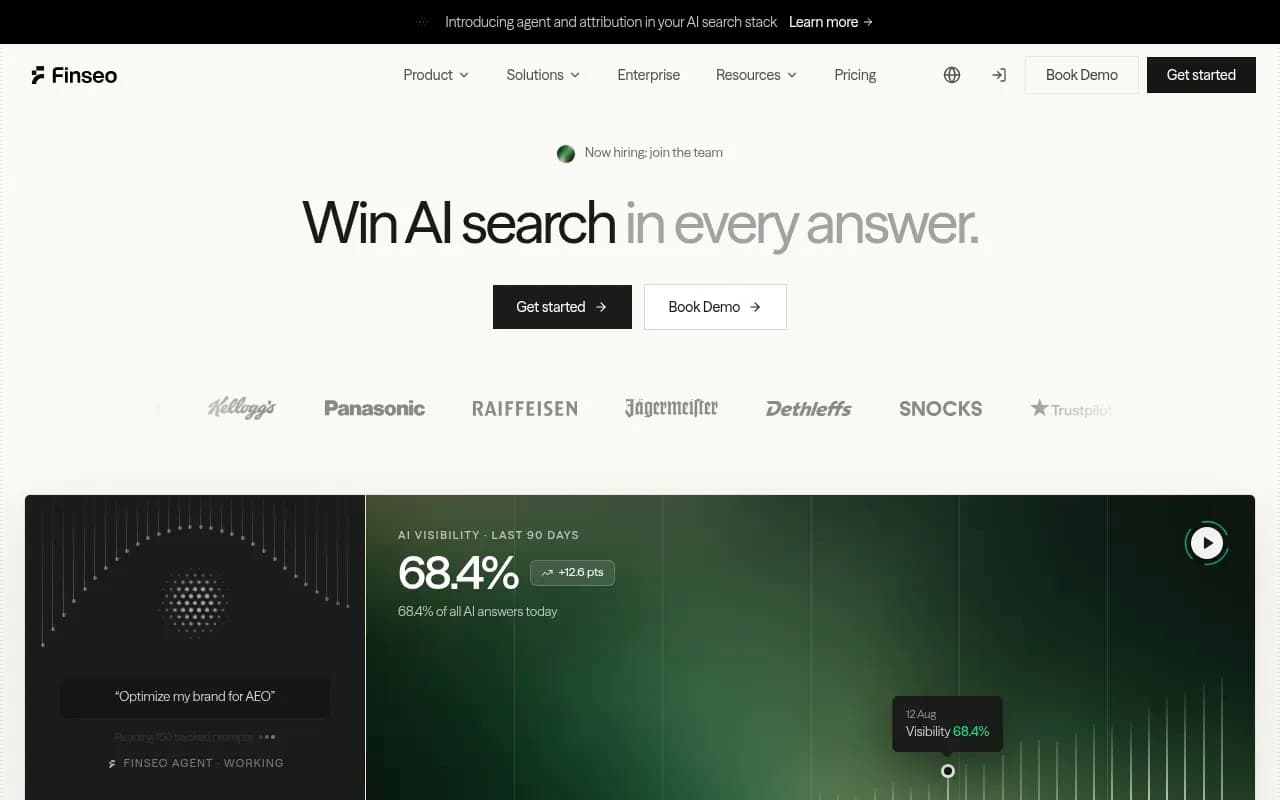
That's a wider net than most competitors cast. Peec AI and LLM Pulse, for instance, are built around tracking and citation analysis first, with content tools as an afterthought or absent entirely. Finseo treats content generation and attribution as core pillars, not add-ons, which is the reason its marketing leans so hard on "200+ integrations" and customer logos like Kellogg's, Lidl, and Panasonic.
The company also recently launched an Attribution Agent, announced on LinkedIn, aimed at closing the loop between "we got cited" and "did that citation drive a sale." It's an ambitious feature for a company still early in its growth curve (GetLatka estimates roughly $220K ARR for 2025), and whether it holds up at scale for enterprise customers is a fair open question.
Pricing: what you'll actually pay in 2026
Finseo's live pricing page shows four brand tiers and three agency tiers. Worth flagging upfront: at least two older third-party sources (ColdIQ, ecom-tools.de) cite different tier names and prices ("Creator €99, Business €189") that no longer match the current site. Pricing has clearly moved at least once in the last year, so double-check the live page before you commit.
| Plan | Monthly | Yearly (effective) | Tracked prompts | AI answers/mo | Models | Projects |
|---|---|---|---|---|---|---|
| Starter | €84 | €70 | 50 | ~4,500 | 3 | 1 |
| Business | €210 | €175 | 150 | ~13,500 | 3 | 1 |
| Growth | €479 | €399 | 350 | ~31,500 | 3 | 5 |
| Enterprise | Custom | Custom | Custom | Custom | Up to 11 | Unlimited |
Agency pricing starts at €349/month (Solo, 5 client projects) and €599/month (Studio, 10 projects), both with a 6-month minimum commitment, plus volume discounts on additional projects.
Here's the part that matters most for the cost-benefit math: Finseo's Starter and Business tiers only track 3 of its 10+ supported models. To get Claude, Grok, DeepSeek, or regional models like Naver or Qwen, you're paying for Growth or negotiating Enterprise. Compare that to Profound, where even the Growth plan at $399/month covers three engines, or Peec AI, where add-on models cost €30-140/month each on top of the base plan — a structure that's arguably just as annoying, but at least transparent about the trade-off.
How it stacks up against specialist tools
The honest comparison isn't Finseo vs. nothing, it's Finseo vs. the narrower tools that do one piece of this job better.
| Tool | Starting price | Models tracked | Content generation | Best for |
|---|---|---|---|---|
| Finseo.ai | €84/mo | 3 (up to 11 on Enterprise) | Yes, citation-scored drafts | One vendor for tracking + content + attribution |
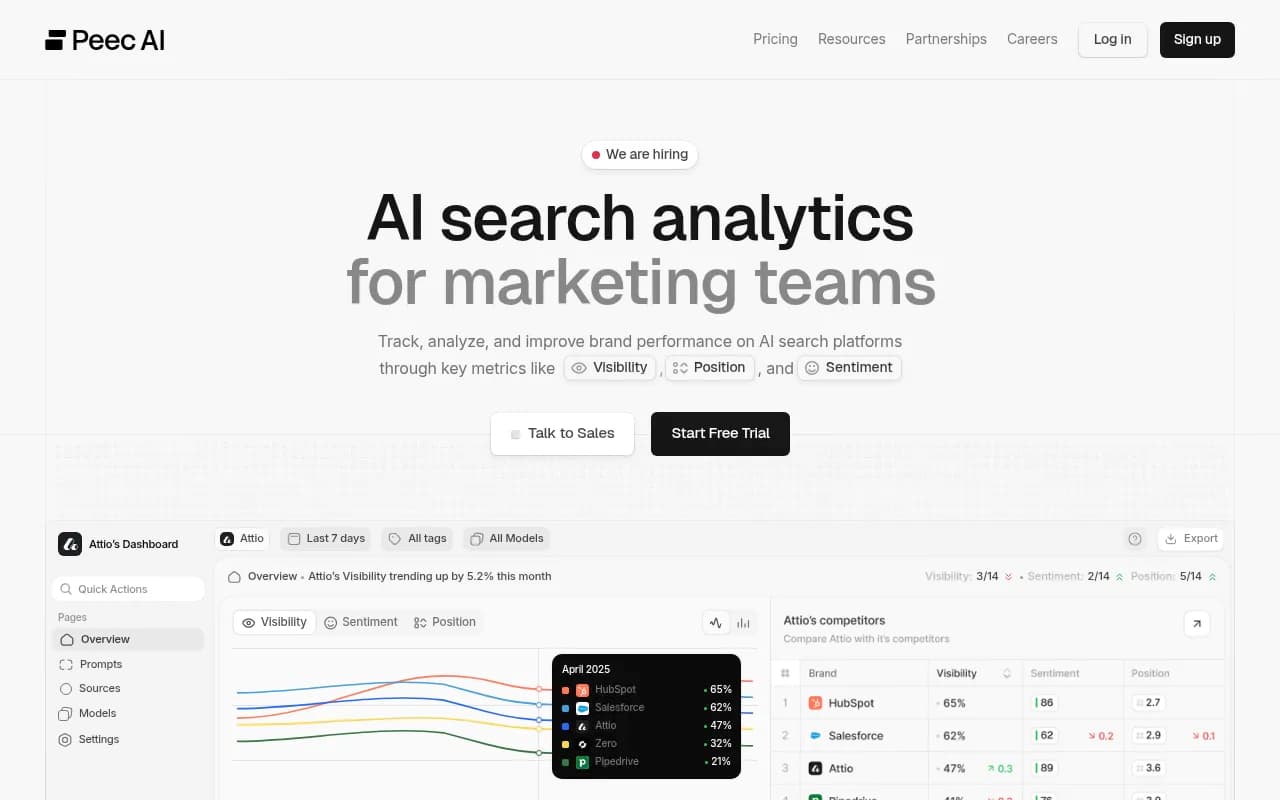
| Peec AI | ~€82/mo (annual) | 3 of 6 (add-ons extra) | No | Citation gap analysis, granular source vs. citation data |
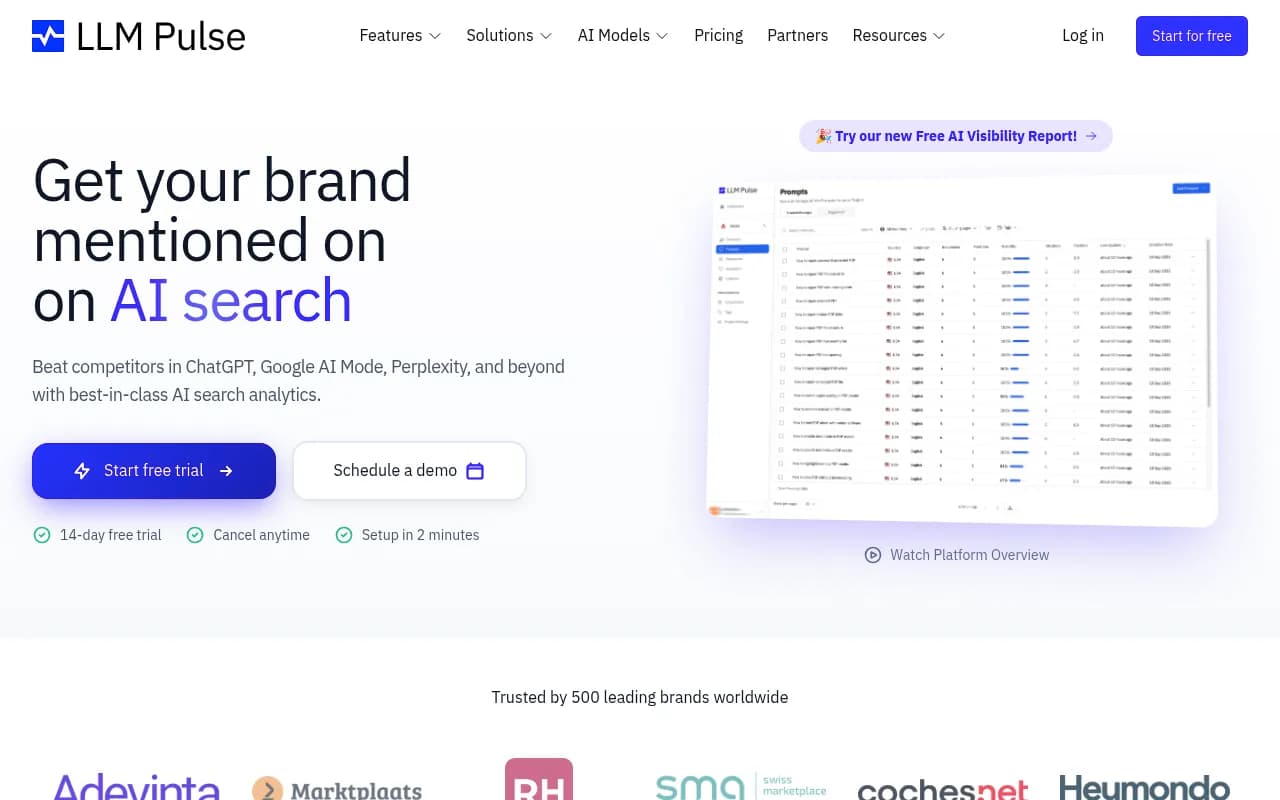
| LLM Pulse | €49/mo | 5 standard | No | Transparent self-serve pricing, lowest cost per prompt | [tool:profound] [tool:profound-ai] | Profound | $99/mo (Starter, ChatGPT only) | Up to 10 on Enterprise | No | Enterprise-grade depth, SOC 2, 4.6/5 on G2 (322 reviews) |
| Semrush AI Toolkit | $99/mo add-on | 3 (ChatGPT, AI Mode, Perplexity) | Limited | Teams already inside Semrush who want AI bolted on |

| Promptwatch | $95/mo (Essential) | 12+ including Grok, DeepSeek, Copilot | Yes, agentic content + CMS publishing | Full-stack visibility, crawler logs, and automated GEO content |
A few things jump out. LLM Pulse is roughly half Finseo's Starter price for more baseline models. Profound and Peec AI both publish real, substantial G2 review histories, something Finseo can't currently match (more on that below). And if what you actually want is a platform that goes from "here's why you're invisible" to "here's the fixed page, published to your CMS," that's closer to what Promptwatch does, with AI crawler logs showing exactly which bots hit your site and where they stalled, Reddit and YouTube citation tracking that most competitors skip entirely, and Content Agents that draft and publish GEO-optimized pages on a schedule rather than just flagging gaps.
The content angle: does Finseo's approach match what's actually getting cited?
Finseo's core bet is that AI-generated content, scored for "likelihood of being cited" before it goes live, is worth paying for. That's a reasonable bet, but the data on what actually gets cited by AI engines is more nuanced than "write content and score it."
Promptwatch's citation-type tracking for August 2026 shows product pages still lead ChatGPT citations at roughly 28.7% for the month, but How-Tos nearly doubled their share, from 4.3% in week one to 9.1% in the last nine days, and documentation-style content rose from 3.3% to 8.2% over the same stretch. Meanwhile social post citations collapsed from 4.4% to under 1% right after August 14, the same day Reddit's citation share in ChatGPT fell off a cliff, dropping from roughly 4% to 0.5% (see Promptwatch's Reddit citation data).
The practical read: content tools, Finseo included, need to be steering brands toward how-tos, documentation, and comparison content, not social-first tactics that are visibly losing ground. It's worth asking any GEO vendor, during a demo or trial, which content types their system is actually recommending you produce, and whether that recommendation has shifted in the last few months.
One more data point worth knowing before you assume you need to "out-rank" giant domains to get cited: in August 2026, mid-authority domains (DR 46-75) captured nearly half of all ChatGPT citations, while the very top tier (DR 91-100) saw its share fall from about 7% to roughly 3% over the same month. Low-authority sites (DR 0-30) still picked up about 14% of citations. That's genuinely good news for smaller brands paying for any GEO tool, Finseo or otherwise, because it means focused, well-targeted content can compete without a decade of domain authority behind it.
Reputation check: what reviewers actually say
This is the part of the Finseo story that doesn't show up on the pricing page. G2 lists only 3 reviews for Finseo.ai, averaging 5.0/5, but G2 itself flags that sample size as too small to generate a reliable "buying insight" score. One third-party roundup (ScopeSite, March 2026) reports a much rougher 2.7/5 average and notes that pricing isn't published without a demo. An AppSumo review titled "They shouldn't have launched this yet" (2.8/5 across 4 reviews) complains about UI overflow issues and pages that feel "too busy."
On the other side, a G2 reviewer quoted in a separate roundup called setup "very easy" and said it helped make their site "more discoverable on AI platforms like ChatGPT." So the picture is genuinely mixed, and there's no large, independent review base to lean on either way. I'd treat any single glowing testimonial or single harsh complaint with equal suspicion until the review count climbs into the dozens, at minimum.
Compare that to Profound's 4.6/5 across 322 G2 reviews, which is a large enough sample to actually mean something. That gap in review depth is itself a data point: Finseo is newer and smaller, and buyers should price that uncertainty into the decision, not just the monthly invoice.
Who should actually consider Finseo
Finseo makes sense if:
- You want one platform for AI visibility tracking, content generation, and attribution, and you're not interested in stitching together three separate tools.
- German or EU data residency is a hard requirement for your compliance team.
- You're already leaning toward a managed-service arrangement where a vendor's team runs prompt strategy and content production for you (available at the Enterprise tier).
- The integration list (Shopify, Webflow, HubSpot, Salesforce, n8n, and 200+ others) genuinely matches your existing stack and would save real setup time.
Finseo is probably not the right fit if:
- You need deep, granular citation data (source vs. citation distinctions, per-competitor sentiment) as your primary use case. Peec AI and Profound go deeper here.
- Budget is tight and you want more tracked prompts per euro. LLM Pulse and Otterly both undercut Finseo's Starter tier significantly.
- You want AI crawler log analysis, Reddit/YouTube citation tracking, or ChatGPT Shopping monitoring as core features rather than afterthoughts. That's closer to Promptwatch's territory.
- You're uneasy about committing to a vendor with only a handful of public reviews and a still-small revenue base.
The bigger picture
Finseo isn't a bad product, it's a young one with an ambitious scope, priced fairly in line with the category (the broader AI visibility market averages around $337/month according to Rankability's benchmark across 30+ tools). Its biggest risk isn't the feature set, it's the review base: three G2 reviews and a handful of conflicting third-party ratings just aren't enough data to confirm the product holds up at scale, especially against competitors like Profound with hundreds of reviews and venture backing to match.
If your main problem is "we don't know where we stand in AI search," a leaner specialist will usually answer that question for less money. If your problem is "we know we're invisible and need help actually fixing it, at scale, with the crawler and citation data to prove what's working," that's the gap a platform like Promptwatch is built to close, with agentic content generation, CMS publishing, and Unified Actions turning visibility data into a prioritized to-do list rather than just a dashboard. Either way, run the trial before you sign a 6-month agency contract or commit to Finseo's annual plan. For a broader look at where these platforms sit relative to each other, the GEO software directory at bestgeosoftware.com is a reasonable starting point for narrowing the field.