Key takeaways
- In healthcare, travel and automotive, ChatGPT cites third-party intermediaries (government bodies, booking sites, marketplaces) more than brand sites. Software is the exception, where vendor docs and help centers lead.
- Citation shares are small and scattered. The top software domain earns 1.2% and the top travel domain 0.78%. Healthcare (NIH at 5.46%) and automotive (Autotrader at 5%) are far more concentrated.
- Your winning move depends on the vertical: link to primary research in healthcare, keep listings accurate in travel and automotive, and publish crawlable docs in software.
- Review profiles (G2, Capterra, Tripadvisor, DealerRater, Doctify) are cheap to fix and show up in every report.
- Measure by tracking citations per page and AI crawler access, not just mentions.
Why look at most cited sites lists at all
Most AI visibility advice is generic. "Write helpful content." "Build authority." Fine, but it doesn't tell a hotel chain, a SaaS vendor and a dealer group what to do on Monday morning.
Promptwatch's industry citation reports are more useful because they show who actually gets cited. Promptwatch publishes them as part of its Promptwatch Data research, built on organic ChatGPT prompts. Read four of them side by side and a pattern shows up: the winners are usually not the brands. They are the sites that sit between the brand and the buyer.
One caveat before the numbers. The report windows differ. Healthcare covers Sep 9 to Oct 8, 2026 (30 days), travel and software cover Sep 28 to Oct 4 (7 days), and automotive covers August 2026 (31 days). Percentages are shares of all citations in that vertical, and the charts only show the top 17 to 31 domains. So compare patterns, not exact figures across industries.
The four reports at a glance
| Industry | Period | Top source | Dominant source type | What it means |
|---|---|---|---|---|
| Healthcare | Sep 9 to Oct 8, 2026 | NIH, 5.46% | Government and public health, 7.06% | Authority and primary research win |
| Travel | Sep 28 to Oct 4, 2026 | Skyscanner, 0.78% | Booking and search, 2.42% | Listings and deal sites win |
| Software | Sep 28 to Oct 4, 2026 | GitHub, 1.2% | Docs and help centers, 2.64% | Your own docs win |
| Automotive | Aug 2026 | Autotrader, 5% | Marketplaces, 14.65% | Marketplaces and review sites win |
The sections below take each one in turn. If you only care about one vertical, skip ahead.
Healthcare: cite the sources ChatGPT already trusts
The healthcare report is the most lopsided. NIH leads at 5.46% of all healthcare citations, spread across six nih.gov subdomains. PubMed Central takes 2.38% and PubMed 2.33%. NIH alone earns more than the FDA, NHS, CMS and SAMHSA combined.
The FDA is next at 1.76% (including its drug database), then the NHS at 1.1%. The top non-government site is the American Society of Plastic Surgeons at 0.64%, followed by the American Academy of Dermatology at 0.54%. Mayo Clinic (0.49%) and Cleveland Clinic (0.4%) are the only two hospitals in the chart. Boots is the only pharmacy at 0.28%, and Doctify and WebMD sit at 0.23% each as the only review and directory sites.
By source type, the 20 sites earn 15.54% of healthcare citations together. Government and public health bodies take 7.06%, medical associations 1.39%, hospitals and clinics 0.89%, and reviews and directories just 0.46%.
Here is what I would take from it.
Back claims with primary research
If your page says a treatment works, link to the PubMed or PubMed Central study behind it. ChatGPT clearly favors those domains, and a page that points to them looks like part of that ecosystem rather than a marketing page competing with it.
Match official guidance
Make sure your pages agree with FDA, CDC, NHS and NICE guidance, and link to it. A clinic page that contradicts the NHS is a poor candidate for citation. A page that restates it clearly, with local detail the NHS doesn't have, has a chance.
Work with medical associations
This is the surprising one. The AAD and ASPS together earn 1.18%, more than Mayo Clinic and Cleveland Clinic combined. If you are a specialist practice or a device company, getting your content referenced by your specialty association may be worth more than a big hospital partnership.
Don't ignore directory profiles
Doctify and WebMD are small (0.23% each) but they are the only directories in the top 20. Complete profiles cost almost nothing.
Travel: be accurate where bookings happen
The travel report is the opposite of healthcare. Shares are tiny and spread out. Skyscanner leads at 0.78% (skyscanner.net and .com combined). Going.com, a flight-deal service, takes 0.52% and beats Tripadvisor at 0.49%. Kayak has 0.37%, Airbnb and Reddit 0.27% each, and Expedia 0.13%, level with Lonely Planet and Time Out.
The 17 sites together earn 4.18% of travel citations. Booking and search sites take 2.42%, reviews and advice (Tripadvisor, Trustpilot, Which?) 0.86%, guides and reference 0.37%, Reddit 0.27%, tours 0.16%.
The practical lessons:
- Keep listings on Skyscanner, Kayak, Airbnb and Expedia accurate. ChatGPT is citing these as proof of price and availability.
- Collect reviews on Tripadvisor and Trustpilot, and aim for Which? coverage if you operate in the UK.
- Get featured in guides like Lonely Planet and Time Out.
- Watch fare and deal sites in your market. Going beating Tripadvisor is a reminder that niche sources can outrank famous ones.
A related note on Reddit. It shows up here at 0.27%, but Promptwatch's data shows reddit.com's share of ChatGPT citations collapsed from about 4% to 0.5% on August 14, 2026. Don't build a travel strategy around it.
Software: your docs are your best asset
Software is the one vertical where brands themselves do well. In the software report, GitHub leads at 1.2%, learn.microsoft.com follows at 0.98%, and G2 is third at 0.73%. AWS docs (0.41%) and Google Cloud docs (0.35%) come next, ahead of Gartner (0.34%) and Capterra (0.32%). Intercom (0.28%) and Zapier (0.24%) are the most cited of the other vendors.
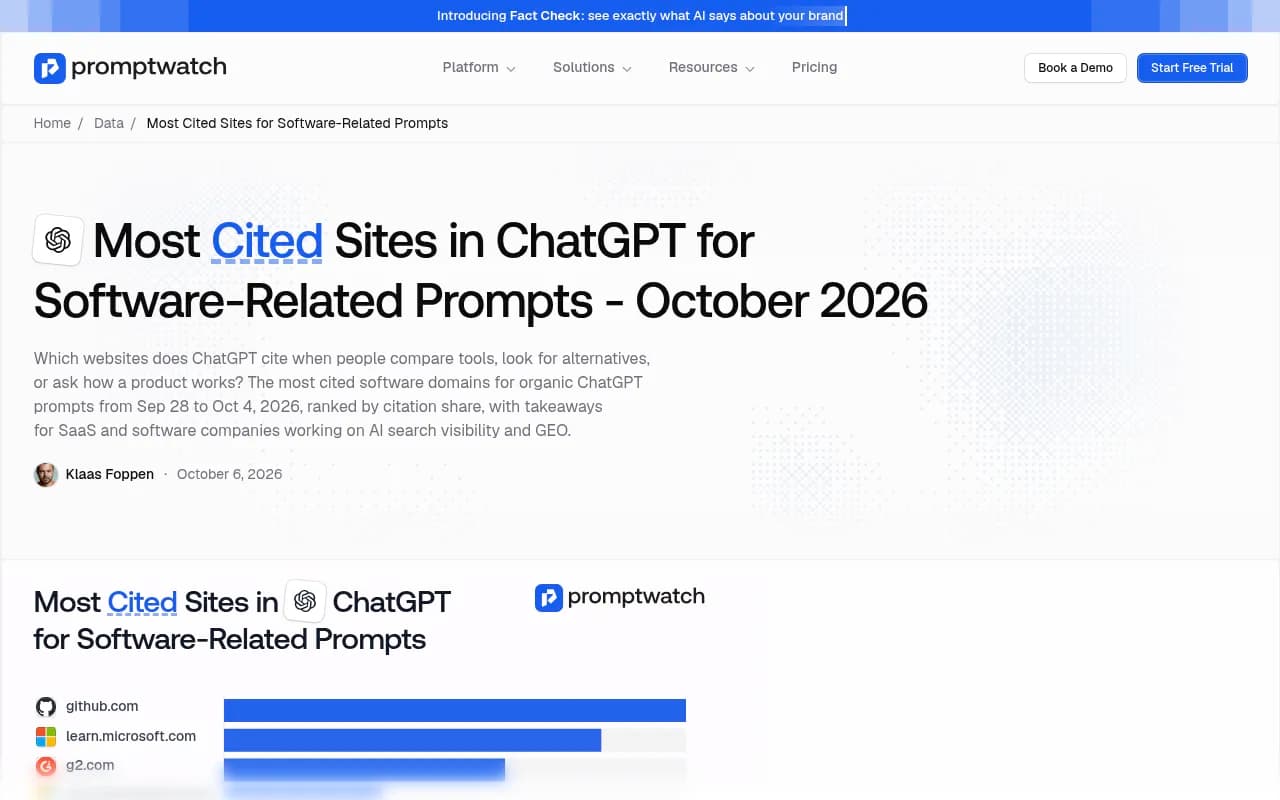
By source type, the 23 sites earn 7.89% together. Docs and help centers are the largest group at 2.64%, ahead of vendor sites at 2.01%, review sites and analysts at 1.57%, GitHub at 1.2% and app stores at 0.47%. Vendor pages and docs together earn 4.65%, about three times what review sites and analysts earn.
So for a SaaS company:
- Publish documentation and help pages that ChatGPT can crawl. Gated or JavaScript-only docs are invisible.
- Treat your own site as the main citation source, then still cover review sites. G2, Gartner, Capterra and Software Advice together earn 1.57%, more than any single vendor including Microsoft.
- Keep G2 and Capterra profiles complete and current.
Checking crawl access is the first thing to rule out. Promptwatch's AI crawler logs show whether GPTBot and OAI-SearchBot actually reach your docs, which separates an access problem from a content problem.
Automotive: marketplaces beat manufacturers
The automotive report is the bluntest. Autotrader earns 5% and Cars.com 4.6%. Chevrolet.com ranks 4th at 2.62% and is the only manufacturer in the top 8. Reddit is 9th at 1.34%. Even a single UK dealer group, birchwoodgroup.co.uk, makes the 31-domain list at 0.28%.
Seven of the top eight domains are marketplaces or research and review sites. Marketplaces and listings take 14.65%, reviews and research 12.62%, together 27.27%. Manufacturer sites get 7.92%, and community, dealerships, and service and finance sites share 2.12%.
What to do:
- Keep inventory, pricing, specs and dealer details accurate on the big marketplaces.
- Maintain complete profiles on DealerRater, Birdeye and BBB.
- Build a stable page for every model and trim, with clear headings and structured specs covering pricing, ownership costs and local availability.
- Don't overlook local dealer pages. The Birchwood result suggests local pages can earn citations where national ones don't.
The cross-industry pattern
Put the four together and a few things stand out.
- Intermediaries beat brands in three of four verticals. Marketplaces, booking sites, government bodies and review sites collect most of the citations.
- Concentration varies a lot. Healthcare and automotive have clear leaders. Software and travel are fragmented, which means smaller players have a real shot.
- Review and directory profiles appear everywhere, usually at small shares, and they are the cheapest thing to fix.
- Format matters too. Promptwatch's data shows product pages are the most cited content type in ChatGPT at 22.4% (Sep 28 to Oct 4, 2026), and landing pages and docs stay cited longest while news loses half its pages within 36 days. Evergreen, structured pages win over time.
- Almost half of ChatGPT responses cite 10 or more unique domains, so there are many slots. You don't need to beat Autotrader, you need to be one of the ten.
There is also a mid-authority angle. Promptwatch found sites with domain rank 46 to 75 earned almost half of ChatGPT citations in August 2026, while DR 91 to 100 fell to about 3%. Being a giant isn't required.
A practical playbook
Step 1: Map your vertical's real source list
Before writing anything, find which domains ChatGPT cites for your prompts. The reports above give you a head start, but your own prompts and markets matter. Use a tool that tracks real ChatGPT answers and their citations. The directories at bestgeosoftware.com list options.
Step 2: Fix third-party profiles first
Audit every listing, review profile and directory entry in your vertical. Accurate prices, specs, hours and descriptions. This takes days, not months, and it feeds the sources that already win.
Step 3: Make your own pages citable
One stable page per product, model, treatment or destination. Clear headings, structured specs, dated updates, links out to authoritative sources. Make sure AI crawlers can read it.
Step 4: Close content gaps
Compare the prompts buyers ask with the pages you have. Promptwatch's content gap analysis and Content Agent do this and publish to WordPress, Webflow or Framer, then track whether the new page gets crawled and cited.

Step 5: Measure citations, not just mentions
A mention without a citation usually means a crawlability or content problem. Track citation rank, self-citation rate and AI-referred visits together. Promptwatch's Visibility Score and citation metrics explain how to read them.
Tools worth knowing for this work
| Tool | Useful for | Note |
|---|---|---|
| Promptwatch | Tracking citations, crawler logs, content gaps and publishing | End-to-end, acts on the data |
| Otterly.AI | Basic AI visibility tracking | Monitoring only |
| Peec AI | Prompt monitoring | No optimization layer |
| Profound | Enterprise AI visibility | Higher price point |
| Trustpilot | Review profile for travel and consumer brands | Source ChatGPT cites |
| Birdeye | Reputation management for dealers and clinics | Covers DealerRater-style profiles |
| Yext | Listings for multi-location brands | Keeps data consistent |



For a broader view of how engines choose sources, Similarweb's write-up on how AI chooses citations is a decent companion. Note that ChatGPT, Perplexity and Claude retrieve differently, so a page cited in one may not appear in another.
What I would not do
Don't chase Reddit in ChatGPT after the August drop. Don't assume a high domain rank saves you. Don't generalize one vertical's shares to another, because the windows and concentration differ. And don't treat these lists as fixed: they are snapshots of a week or a month, and they move.
Bottom line
Winning a spot in a most cited sites list is mostly about being present where ChatGPT already looks. In healthcare that means primary research and associations. In travel and automotive it means accurate listings and strong review profiles. In software it means docs that crawlers can read. Start with the third-party profiles you can fix this week, then build citable pages on your own site. If you want to see how you currently show up, Promptwatch's free AI visibility report is a no-login starting point.