Key takeaways
- Claude and Claude Code should be tracked as two separate answer surfaces. In Profound's July 2026 sample, they shared only about 20% of brand mentions on identical prompts.
- Claude searched the web in about 93% of responses, Claude Code in 13%. Claude is a citation and third-party-source problem. Claude Code is closer to a documentation, pricing-page and training-data problem.
- Mentions, citations and crawler visits are three different measurements. Claude Code rarely shows citations, so you often need server or CDN logs to see what it reads.
- Start with separate prompt panels, separate reports, and a baseline of Anthropic user agents in your logs. Test content changes rather than assuming they work.
Why one "Claude" line in your report is a mistake
Most teams I talk to have a single row labeled "Claude" in their AI visibility dashboard. That row hides a real split. A marketer researching software in the Claude app and a developer asking Claude Code to pick a library are using different products with different retrieval habits, even though the same model family sits underneath.
Profound published a study on August 24, 2026 that put numbers on this. Between July 13 and July 23, 2026 it ran 1,724 prompts across 11 categories on both products with web search enabled, producing 24,135 responses. Search Engine Journal covered the findings and flagged the caveats. More on those below.
What the data actually shows
| Metric (Profound, July 2026) | Claude | Claude Code |
|---|---|---|
| Responses that used web search | ~93% | ~13% |
| Average brands per response | 5.2 | 6.6 |
| Mean response length (words) | 459 | 322 |
| Responses with a list | 56% | 94% |
| Responses with a table | 11% | 54% |
| Brand overlap on the same prompt | ~20% | ~20% |
| Brand overlap between two runs of the same product | ~50% | ~40% |
Two things stand out to me.
First, Claude Code searches far less but still names more brands per answer. So the gap is not "one product knows fewer brands." It is that the shortlist is built differently. For coding prompts, Claude leaned toward code editors and IDEs among the top 15 brands, while Claude Code leaned toward code-quality and workflow tools.
Second, repeat runs inside one product agreed with each other more than the two products agreed with each other. If you appear in Claude and vanish in Claude Code, that is probably not noise.
What each agent reads on your site
Profound also looked at the top 1,000 pages each agent visited from July 18 to August 18, 2026:
- About three-quarters of Claude Code's visits went to documentation, informational and pricing pages. For Claude, it was 5%.
- About 60% of Claude's visits went to robots.txt, sitemaps and home pages. For Claude Code, it was 4%.
Profound reads this as Claude exploring what a site contains, while Claude Code goes after specific facts on page types it already expects to find.
Read the caveats before you act
This is vendor research, and Profound sells AI visibility tracking. It is observational. Page types were labeled by an LLM (gpt-4.1-mini), and Search Engine Journal notes the report does not describe human review or explain how the two agents' traffic was separated. The authors recommend clear technical and pricing facts on pages Claude Code visits, but they did not test whether that raises mentions. Treat the direction as credible and the exact percentages as approximate.
Two different problems
Claude: a third-party footprint problem
Because Claude searches on most responses, what it says about you depends heavily on the pages it retrieves. Omnia, another vendor, analyzed roughly 500,000 Claude citations from May 26 to June 8, 2026 and found that only 6.7% pointed to a brand's own domain. About 93% came from third-party sources. That is one vendor's dataset about Claude, not Claude Code, but it matches the intuition: Claude's picture of your brand is mostly built from the editorial web.
Practical consequences:
- Absent from Claude usually means too little reliable third-party coverage.
- Present but described wrong usually means the sources it cites are outdated or inaccurate.
- A low own-domain citation rate is normal. Do not treat it as a defect to fix by publishing more on your own blog.
Claude Code: a documentation and training-data problem
Claude Code searched the web in only 13% of Profound's responses, so most recommendations come from what the model already knows, plus whatever the agent fetches when it does look. When it does fetch, it goes to docs, pricing and informational pages. Profound's suggested fixes:
- Keep documentation and pricing pages current and machine-readable.
- State specific, extractable facts. "Supports Python 3.10-3.13, Node.js 20+, and Go 1.22+" beats "works with your existing stack."
- Use question-shaped headings such as "How do I authenticate API requests?" with the answer directly underneath.
Other research points the same way for coding agents generally. Armature's sessions found Claude Code, Codex and Cursor picked the same tool only 42% of the time, and that mentions and selections differ: PayPal was mentioned 139 times and never selected. Promptwatch summarizes this in its guide to coding agent visibility. The lesson is to track whether you are recommended, not only whether you are named.
How to set up tracking for both
Step 1: build two prompt panels
Do not reuse one list. Write the Claude panel around research and comparison questions a buyer would ask ("best project management software for agencies"). Write the Claude Code panel around tasks a developer would hand to an agent ("add authentication to this Node app, which service should I use?"). If your product is not developer-facing, a small Claude Code panel is fine. Monitor first and scale effort only if usage in your market is real.
Step 2: record mentions, position and selection
For each response, log whether you were mentioned, where you landed among the brands, and whether the agent actually chose you or just listed you. Run each prompt several times. Profound's data shows even one product is only about 40-50% consistent from run to run, so a single check tells you almost nothing.
Step 3: track citations separately from mentions
Claude can recommend you from memory without linking to you, or cite your page and recommend a competitor. Keep three layers apart: mentions, cited pages, and the quality of those pages. Claude Code rarely shows citations at all, which is why the next step matters.
Step 4: use server logs for what the agents read
If Claude Code rarely cites, your logs are the only direct evidence of what it fetched. Promptwatch Data's report on Claude citation crawler visits says Claude's citation crawler went from about 0.04% of tracked AI citation crawler traffic in mid-December 2025 to several thousand visits a day by mid-April 2026, and notes it may visit cited pages when someone asks Claude a question or uses Claude Code. The same report advises:
- Check that Claude-User and ClaudeBot are not blocked in robots.txt or by CDN or WAF bot rules.
- Baseline Anthropic user agents in your logs and review them monthly.
For broader context, Promptwatch's AI crawler traffic data shows OpenAI at 79.8% of verified AI crawler requests in the week of August 31 to September 6, 2026, so Claude is still a secondary channel in volume. Only IP-verified requests count there, which matters because user agents are easy to spoof.
Step 5: change one thing, then re-measure
Pick a few documentation or pricing pages, rewrite them with explicit facts and question-shaped headings, then rerun the Claude Code panel two to four weeks later. For Claude, place editorial coverage on domains it already cites for your category and watch citation frequency over a similar window. Nobody has published proof that these changes move mentions, so your own before-and-after is the evidence.
Tools that can help
I could not verify which platforms break out Claude Code separately from Claude, so check this with any vendor before you buy. Here is how the options I know fit the two problems.
| Need | Tool type | Examples |
|---|---|---|
| Claude and other chat surfaces, mentions and citations | AI visibility platform | Promptwatch, Profound, SE Visible, Omnia |
| Coding agent recommendations | Platform with coding agent tracking | Promptwatch (Claude Code, Codex, OpenCode) |
| Which AI bots hit your site | Crawler logs | Promptwatch Agent Analytics, raw CDN logs |
| Budget monitoring | Lightweight trackers | Otterly.AI, Peec AI |
Promptwatch tracks Claude through its API model coverage and tracks Claude Code, Codex and OpenCode as coding agents, and its AI crawler logs cover Claude-User, ClaudeBot and Claude-SearchBot. That combination of mention tracking and IP-verified logs is what you need for the two-problem split.

Profound, the vendor behind the study, is an enterprise option for the same job.
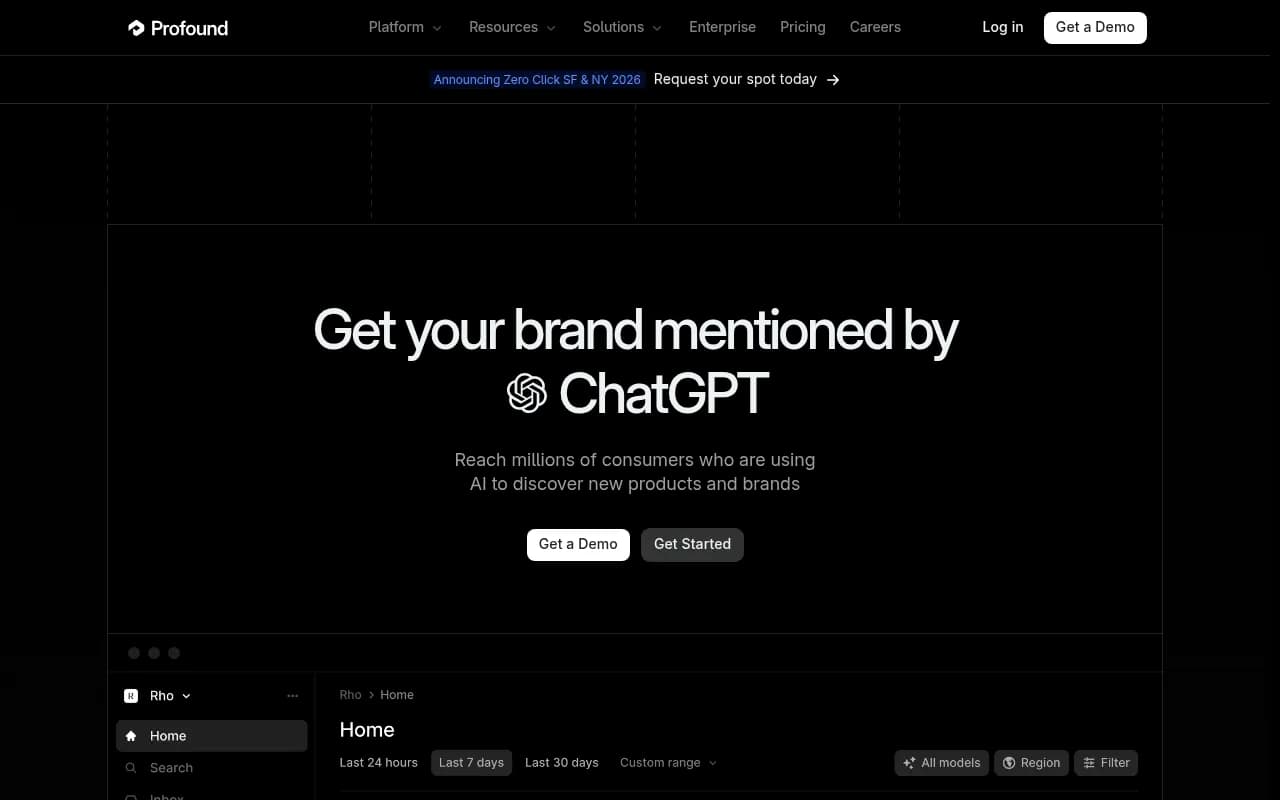
SE Visible from SE Ranking separates mentions from citations and shows which pages Claude cites when it searches.
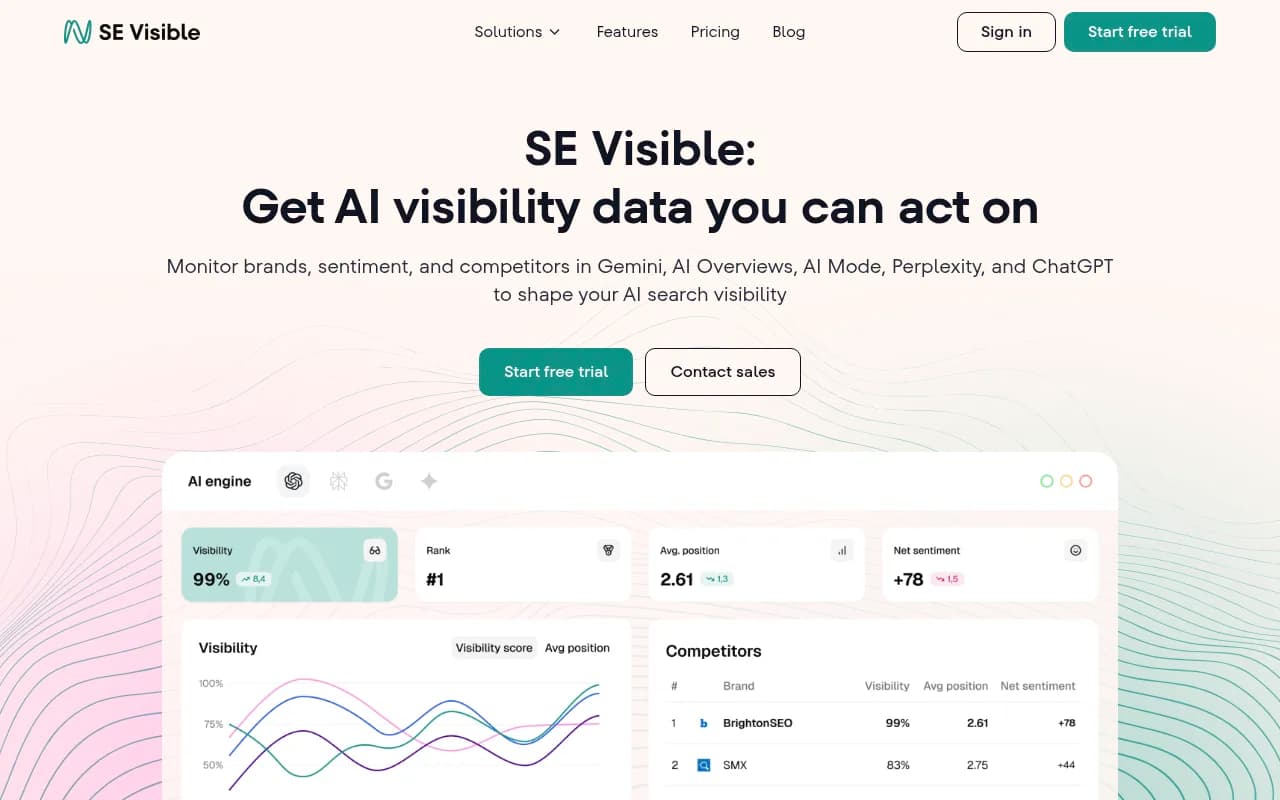
Omnia focuses on citation sources in Claude, which suits the third-party footprint problem.
If you want a more detailed list, the directory at bestgeosoftware.com compares GEO platforms.
The DIY route
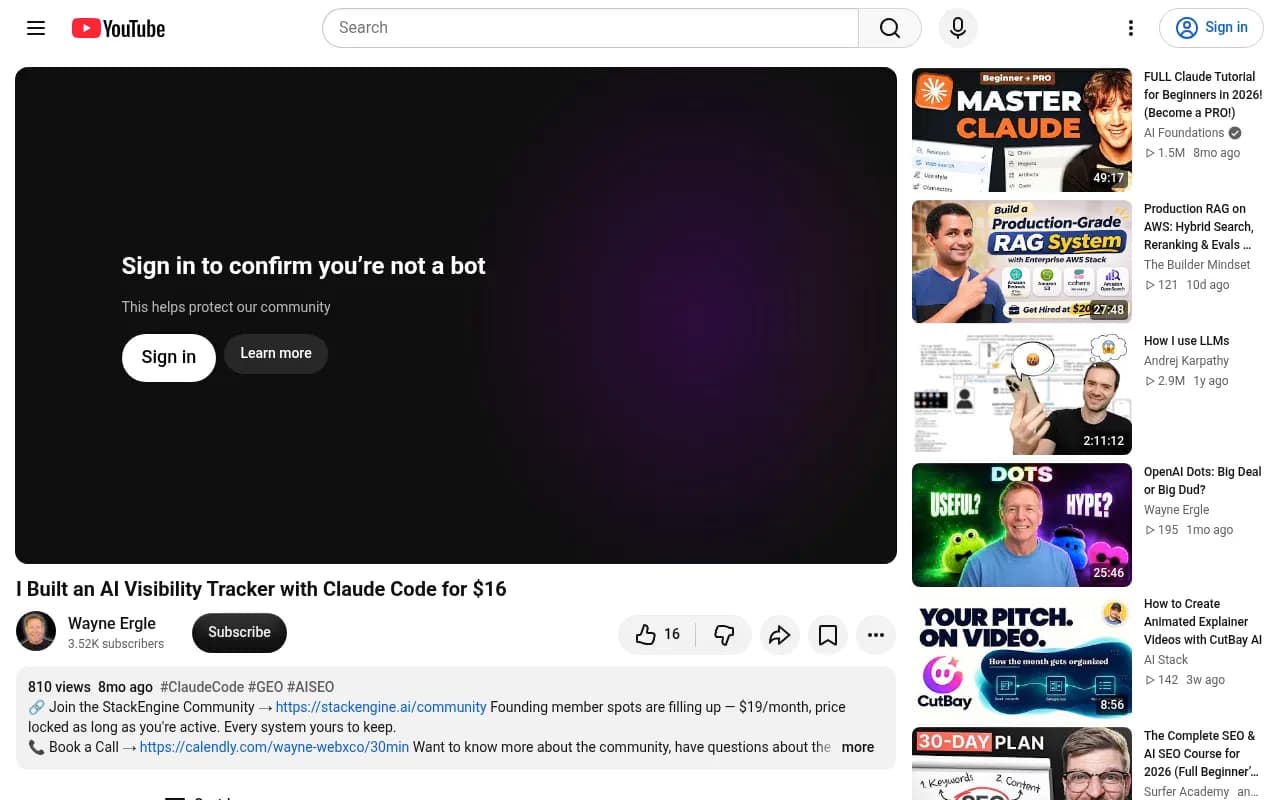
Some people build their own. One creator built a tracker with Claude Code and DataForSEO for about $16 that queries ChatGPT, Perplexity, Claude and Gemini and produces citation gap briefs. It works for a small prompt set, but note it queries Claude, not Claude Code, and you will own the maintenance.
A practical reporting layout
One dashboard, two sections:
- Claude: mention rate, average position, share versus named competitors, top cited domains, sentiment and accuracy of the claims it makes about you.
- Claude Code: mention rate, selection rate, which competitors are chosen instead, and crawler hits on docs and pricing pages.
Assign owners. Claude problems usually belong to PR and content partnerships. Claude Code problems belong to docs and developer relations. That ownership split is the most useful result of separating the two.
FAQ
Should every brand optimize docs for Claude Code?
No. If your buyers rarely use coding assistants, monitor first. If they do, docs and pricing clarity are cheap to improve and useful for humans anyway.
Is Claude Code traffic visible in analytics?
Often only in server or CDN logs, since it rarely produces citation clicks. Verify user agents against published IP ranges before trusting them.
Can I trust the 20% overlap number?
Use it as a signal, not a constant. It comes from one vendor's sample over ten days, and the methodology has gaps. Run your own panel to see your own overlap.
Bottom line
Same model family does not mean same visibility. Split Claude and Claude Code in your reporting, give each its own prompts and owner, add log monitoring for the agent that rarely cites, and test changes before declaring victory.