Key takeaways
- Build one locked prompt set (about 20 to 30 prompts) and run it through every tool you trial, over the same date window and on the same engines.
- A single prompt, or a single run, cannot tell you whether a result is repeatable or accidental. Repeat runs and compare ranges, not snapshots.
- Score tools on more than mention counts: measure accuracy against hand-checked answers, citation capture, run-to-run stability, and whether the tool tells you what to fix.
- Engines cite different numbers of sources, so compare tools engine by engine rather than on one blended number.
- The cheapest tool that explains why you are missing usually beats the most expensive dashboard.
Why most tool comparisons are unfair
I have seen a lot of AI visibility trials that end with a confident decision and no real evidence behind it. Someone signs up for three tools, each tool gets seeded with different prompts, one has been collecting for two weeks and another for two days, and the winner is whichever dashboard looks nicest.
That is not a test. It is a vibe check.
The IOD guide to choosing an AI visibility tool lists why a single manual prompt misleads you:
- Small phrasing changes shift the answer, even when intent is the same.
- Different engines surface different sources for identical questions.
- The same prompt can return different answers over time or by location.
- Answers can vary with user history.
- Citations can show up once and vanish on the next run.
The same logic applies when you compare tools. If the inputs differ, the outputs are not comparable. A fair test removes every variable except the tool.
The fair test in one paragraph
Write one prompt set. Freeze it. Run it through every tool on the same engines, in the same country and language, across the same date window. Repeat the run several times. Hand-check a sample of the answers against the real AI interfaces. Score each tool on a fixed rubric. Pick the one that wins on the criteria you weighted before you saw any results.
The rest of this guide is the detail behind that paragraph.
Step 1: write a prompt set you can defend
Aiken House suggests about 20 prompts your real buyers ask, covering category questions, comparisons, "best for" questions, and problem questions. That is a good floor. I would go to 30 if you have more than one product line or persona.
A workable split for 30 prompts:
| Prompt type | Count | Example pattern |
|---|---|---|
| Category discovery | 8 | "best [category] tools for [use case]" |
| Comparison | 6 | "[your brand] vs [competitor]" |
| Best for / persona | 6 | "best [category] for [role or company size]" |
| Problem-led | 6 | "how do I fix [problem your product solves]" |
| Branded | 4 | "is [your brand] worth it", "[your brand] pricing" |
Two rules matter more than the exact numbers.
- Write prompts before you open any tool. If you build the set inside a vendor's prompt suggester, you are testing their suggestions, not your market.
- Keep phrasing natural and fixed. Do not tweak wording mid-test. Promptwatch's ChatGPT query fanout data shows that average fanout query length dropped from about 117 characters in early December to about 53 characters in April, so phrasing that matched last quarter's behavior may already be stale. Freeze the set for the duration of the trial, then revisit it afterward.
Tag each prompt with an intent label and a priority (high, medium, low). You will use these when scoring.
Step 2: lock the variables
Write down these settings and apply them identically in every tool:
- Engines: pick the same list for every tool. If a tool does not cover one, record that as a gap rather than silently dropping the engine.
- Country, language, and city if relevant.
- Date window: start every trial on the same day and run the same number of days.
- Frequency: daily is the baseline. Strategi's point that a small prompt set run once a day gives direction at best is fair, so treat a daily cadence as the minimum and note which tools can go faster.
- Brand and competitor list: identical names, aliases, and domains. Tools handle brand-name matching differently, especially when your name is also a common word.
Why the engine list matters
Citation slot counts are not the same across engines. According to Promptwatch's average sources per response data, ChatGPT cites about 5 sources per web-search answer, Google AI Overviews about 10, and Perplexity almost exactly 10 every day. Copilot swung from under 2 to nearly 17 within a few weeks.
That has two consequences for your test:
- Never compare a blended citation number across tools that weight engines differently.
- Judge Copilot on monthly trends, not weekly snapshots. Perplexity is steadier, so Promptwatch suggests it works as a test bench: changes in citation pickup there are more likely to reflect content changes than engine noise.
Step 3: understand what each tool actually collects
Before you compare numbers, find out how each tool gets its answers. This is where tools differ most, and it explains most disagreements in results.
- Real interface collection versus API calls. User-facing answers and citations can differ from API output, especially for engines with live search.
- Sampling depth. How many times does the tool run each prompt per day?
- Raw answer access. Can you read the full response and the source list, or only a score?
- Location handling. Does the tool actually answer from your target country?
Write these answers into a one-page sheet per tool. If a vendor cannot tell you how collection works, that is a result in itself.
Step 4: run it more than once
One run proves nothing. AI answers vary, and the IOD guide is right that manual testing cannot separate a repeatable result from an accidental one. Your test needs repetition built in.
A simple protocol:
- Run the full prompt set in every tool daily for at least 14 days.
- For each tool, calculate your visibility for each prompt on each day.
- Look at the spread, not just the average. A tool that reports 40% one day and 12% the next on the same prompts is telling you something about its sampling, or about the engine.
- Keep the engine-level view. A tool that looks stable on Perplexity and chaotic on Copilot may be accurately reflecting each engine.
If budget forbids parallel trials, stagger them but keep the prompt set and engines identical, and note that the date window differs. That weakens the test, so say so in your write-up.
Step 5: hand-check a sample
Aiken House's advice to spot-check answers by hand is the part most teams skip. Do it anyway.
Pick 10 prompts from your set, stratified across intent types. For each one, open the real AI interface for each engine, in the right country, and record:
- Whether your brand was mentioned.
- Which brands were mentioned, and in what order.
- Which URLs were cited.
Then compare against what each tool recorded for the same prompt and day. Because answers vary, you will not get perfect matches. You are looking for systematic problems: a tool that never sees citations you can see, misses brand mentions inside long answers, or reports engines it does not really query.
Score agreement as a simple percentage per tool.
Step 6: build the scoring rubric before you see results
Weight criteria in advance so you cannot rationalize a favorite afterward. Here is a starting rubric. Adjust the weights to your situation.
| Criterion | What to measure | Suggested weight |
|---|---|---|
| Accuracy | Agreement with hand-checked answers | 25% |
| Engine coverage | Share of your required engines covered via real interfaces | 15% |
| Stability | Run-to-run variance on the same prompts | 15% |
| Citation depth | Source URLs, citation position, third-party sources | 15% |
| Diagnosis | Does it show why you are absent (crawler access, content gaps, source types)? | 15% |
| Action | Does it tell you or help you do something about it? | 10% |
| Cost per usable response | Price divided by responses you actually get at your cadence | 5% |
Score each tool 1 to 5 per criterion, multiply by weight, add up. Keep the raw notes. The score is a conversation starter, not a verdict.
Metrics worth normalizing
Tools define visibility differently. Do not compare their headline scores directly. Instead, compute your own from exported raw data:
- Mention rate: share of responses that name your brand.
- Share of voice: your mentions as a share of all tracked brand mentions.
- Citation rate: share of responses that cite one of your domains.
- Average position: where you land among brands named in the answer.
If a tool cannot export raw responses, that limits how fair your comparison can be. The Supermetrics guide on measuring AI search visibility is a useful reference for pairing tool data with Search Console and GA4, and it notes that Search Console's generative AI reports, announced in June 2026, carry impressions but no click or query data. Treat those as a sanity check on direction, not a scoring input.
Step 7: pick the candidates
You do not need to trial 15 tools. Pick four to six that cover different categories so the test shows you the real tradeoffs.
| Category | What it does well | Candidates to consider |
|---|---|---|
| End-to-end AI visibility and optimization | Monitoring plus crawler logs, content gaps, and content creation | Promptwatch |
| Enterprise monitoring | Deep tracking and reporting at higher price points | Profound, Scrunch |
| Lightweight trackers | Cheap prompt monitoring | Otterly.AI, Peec AI |
| SEO suites with AI add-ons | Fits an existing SEO stack | Semrush, Ahrefs Brand Radar |
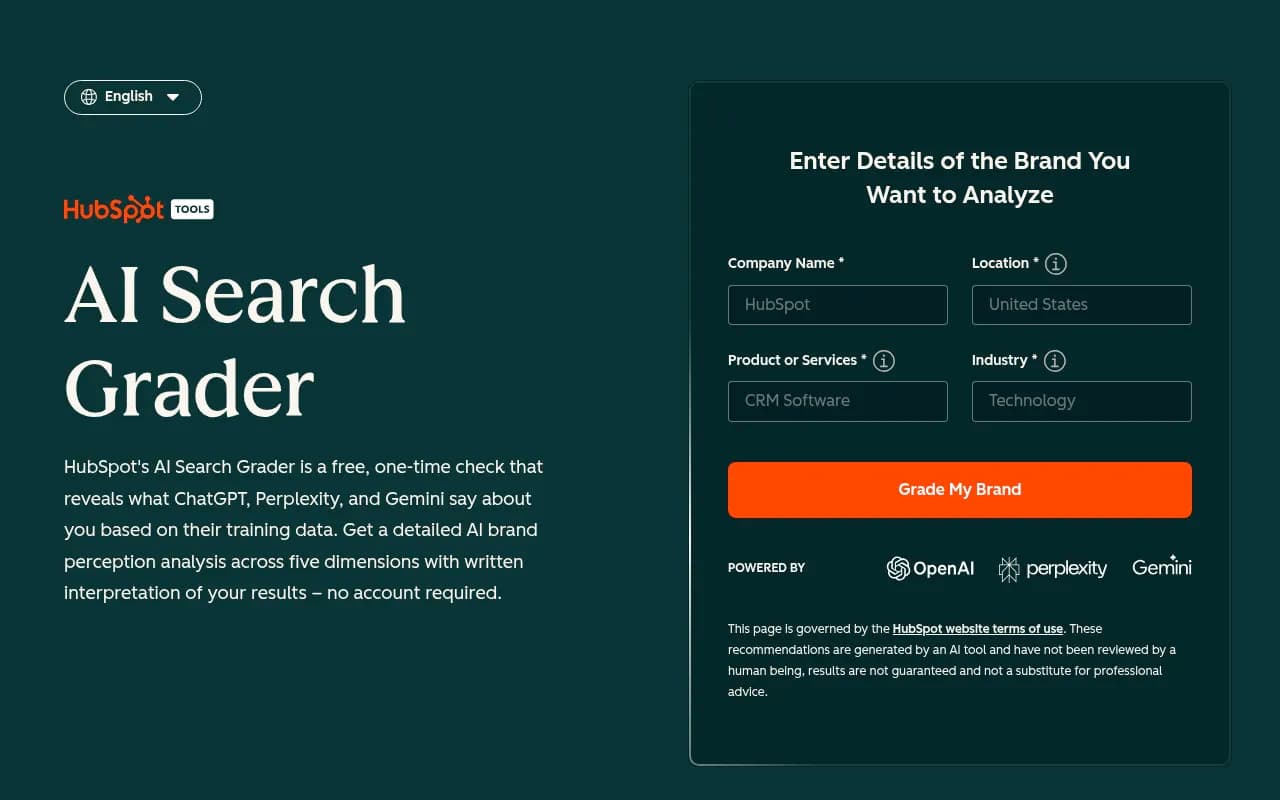
| Free checkers | Quick one-off sanity checks | Amplitude AI Visibility, HubSpot AI Search Grader |
A few notes on each.
Promptwatch is the one I would put in the test if you care about what happens after the diagnosis. It tracks real interfaces across ChatGPT, Google AI Overviews, AI Mode, Gemini, Perplexity, Copilot and others, and it adds IP-verified AI crawler logs, citation analysis, and a content agent that writes and publishes against the gaps. That matters in a fair test because it lets you check the Diagnosis and Action criteria, which pure trackers cannot score on. Pricing starts at $95/month (Essential) and the 7-day free trial on monthly billing is enough for a short test; confirm current plans at promptwatch.com/pricing.

Profound is a strong monitoring product that sits at a higher price point, which matters when you compute cost per usable response.

Scrunch is another monitoring-focused platform worth including if you are comparing enterprise options.
Otterly.AI is a cheap, simple tracker. Include it as the floor: if a basic tracker gives you what you need, that is useful to know.

Peec AI is similar in spirit, monitoring without the optimization layer.

Semrush and Ahrefs Brand Radar are the natural picks if your team already lives in those suites. Check whether prompt sets are fixed or customizable, since that directly affects whether you can run your own set.
For free sanity checks, Amplitude AI Visibility and HubSpot AI Search Grader give a quick read. They are single-snapshot tools, so use them to gut-check your hand results rather than as full contenders.

If you want to browse beyond this shortlist, the GEO software directory at bestgeosoftware.com lists far more options by category. And if a head-to-head helps frame your shortlist, Promptwatch publishes comparison pages such as Promptwatch vs Profound and a side-by-side GEO platform comparison.
Step 8: test diagnosis, not just measurement
This is the criterion most trials ignore, and it is the one that decides whether the tool earns its fee.
Pick three prompts where you are clearly missing and ask each tool the same questions:
- Which pages of mine does AI cite, and which does it ignore?
- Can AI crawlers actually read my pages? Are there errors?
- Which third-party sources get cited instead of me?
- What content is missing on my site for this prompt?
Some tools answer none of these. Some answer one or two. Tools with crawler log data can separate an access problem from a content problem, which changes the fix entirely. If a tool just reports a lower score and stops, it has told you what you already knew from the screenshot your CMO forwarded.
You can also check crawler access for free before you spend anything. Promptwatch's Agentic Readiness Check and AI Crawler URL Inspector show which AI bots can read your site.
Step 9: compute cost per usable response
Sticker prices mislead. A $29 plan with 25 prompts at weekly cadence is not comparable to a $95 plan with 50 prompts tracked daily.
For each tool, calculate:
- Responses per month at the cadence you need.
- Whether your full prompt set fits in the plan.
- Whether the engines you need are included or add-ons.
- What you lose below a certain tier (crawler logs, content tools, exports).
Then divide monthly cost by usable responses. Do this after the trial, using what you actually collected.
Common mistakes to avoid
Letting the vendor pick your prompts
Prompt suggesters are useful for expanding a set later. They are a bad way to start a fair test.
Comparing one blended score
Tools weight engines, position, and sentiment differently. A 62 in one tool and a 48 in another say nothing. Recompute from exports.
Testing for two days
Short windows hide variance. Two weeks is the minimum I would trust, and a month is better for noisy engines like Copilot.
Ignoring location
If you sell in multiple markets, run the same set per country. A tool that answers from the wrong location will quietly poison your results.
Skipping the manual check
A tool can look great on a dashboard and disagree with reality. Ten hand-checked prompts take an hour.
A simple trial timeline
| Day | Task |
|---|---|
| 1 to 2 | Write and freeze the prompt set, engines, locations, and rubric |
| 3 | Configure every tool with the identical setup |
| 4 to 17 | Collect data daily; log any tool outages or setup changes |
| 18 | Hand-check 10 prompts across engines |
| 19 | Test diagnosis on three missing-visibility prompts |
| 20 | Export raw data, recompute metrics, apply the rubric |
| 21 | Review with stakeholders and decide |
What to do after you pick a winner
The test tells you which tool measures best for your situation. It does not move your visibility. Aiken House puts it well: pick the cheapest tool that shows you why you are missing, then spend the rest of your budget on the content and mentions that move the answers.
Keep your frozen prompt set as a benchmark. Re-run it quarterly against the tool you chose, and add new prompts in a separate, clearly labeled batch so you never break comparability with your baseline.
If you want a broader look at how citation patterns differ by industry or content type while you plan content, Promptwatch Data publishes regularly updated research drawn from its citation dataset, which is a handy way to sanity-check your own findings.
Final checklist
- One prompt set, written by you, frozen for the test.
- Same engines, locations, languages, brands, and dates in every tool.
- At least 14 days of daily data, with spread reported alongside averages.
- Ten prompts hand-checked in real interfaces.
- A weighted rubric agreed before results arrive.
- Raw exports used to recompute mention rate, share of voice, citation rate, and position.
- A diagnosis test on prompts where you are missing.
- Cost per usable response, calculated from the trial.
Run it that way and you will end up with a decision you can explain to anyone who asks why you chose it.