Key takeaways
- Most AI search visibility platforms are monitoring dashboards -- they show you where you're invisible but don't help you fix it
- The most important distinction to make before buying: do you need tracking only, or do you need tracking plus content optimization?
- Model coverage, prompt methodology, and whether the tool uses real user-interface data (not just API calls) vary wildly between platforms
- Crawler logs and page-level citation tracking are rare features that matter more than most buyers realize
- Price alone is a poor proxy for capability -- some expensive tools have major gaps, and some affordable ones punch above their weight
The pitch sounds identical across every platform in this category. "Track your brand in ChatGPT, Perplexity, Gemini, and more." "See how you compare to competitors." "Optimize for AI search."
But spend an hour actually evaluating these tools side by side, and the differences become stark. Some platforms run prompts through APIs and call it a day. Others track what real users actually see in AI interfaces -- which can be completely different. Some stop at showing you a dashboard. Others help you create the content that closes the gap.
This guide gives you a practical framework for choosing between them, with specific criteria that actually matter.
Why this category is so confusing right now
The AI search visibility space is genuinely new. Most of these platforms launched in 2024 or 2025, which means they're still figuring out what they are. Some started as brand monitoring tools and bolted on AI tracking. Others were built from scratch for this problem. A few are traditional SEO platforms adding a "GEO" tab to stay relevant.
That origin story matters because it shapes what the tool is actually good at. A brand monitoring tool repurposed for AI visibility will probably be strong on sentiment and weak on content optimization. A traditional SEO platform adding AI features will probably have great keyword data but shallow prompt tracking.
The other complicating factor: AI search is non-deterministic. Ask ChatGPT the same question twice and you might get two different answers with different citations. This means any platform claiming to give you a "definitive" ranking is simplifying the reality. Good platforms acknowledge this and use statistical sampling across many prompt runs. Bad ones show you a single data point and present it as truth.
The core question: monitoring vs. optimization
Before you look at any specific platform, answer this question: do you need to understand your current AI visibility, or do you need to improve it?
Most platforms on the market are monitoring tools. They're dashboards. They tell you your brand appeared in 34% of relevant AI responses last month, up from 28% the month before. That's useful context, but it doesn't tell you what to do next.
A smaller number of platforms are optimization tools. They don't just show you the gap -- they help you close it. That means content gap analysis (which specific topics are AI models answering where your brand isn't cited?), content generation grounded in real prompt data, and tracking that connects new content to actual citation improvements.
If you're in the early stages of understanding AI visibility, a monitoring-only tool might be fine for now. If you're past that and want to actually move the needle, you need a platform that goes further.
Promptwatch is the clearest example of the optimization approach -- it runs what it calls an "action loop": find gaps, generate content, track results. Most competitors stop at step one.

Eight criteria that actually separate good platforms from mediocre ones
1. How they collect data (API vs. real UI)
This is the most underappreciated technical difference in the category.
Some platforms query AI models through their APIs. It's fast, cheap, and scalable. The problem: API responses don't always match what users see in the actual ChatGPT, Perplexity, or Gemini interface. Shopping recommendations, citation carousels, and featured sources can differ significantly between the API and the live product.
Platforms that monitor real user-facing interfaces capture what your actual customers see. This is harder to build and more expensive to run, but the data is more accurate for brands that care about real-world visibility.
Ask any vendor: "Are you querying the API or the live user interface?" The answer tells you a lot.
2. Model coverage
The obvious question is how many AI models the platform covers. But coverage claims are often misleading -- a platform might list 10 models but only actively track 3 of them with any depth.
What you actually want to know:
- Which models are tracked with real prompt data vs. estimated/inferred?
- Does the platform track Google AI Overviews separately from Gemini? (They behave differently)
- Is there coverage for newer models like Grok, DeepSeek, and Meta AI, or just the big three?
For most brands, ChatGPT, Perplexity, and Google AI Overviews drive the most traffic. But if your audience skews technical or international, coverage of Claude, DeepSeek, and regional models matters more.
3. Prompt methodology
How a platform handles prompts determines the quality of everything else.
The basic approach: you enter a list of prompts you want to track, and the tool runs them on a schedule. Simple, but it puts the burden on you to know which prompts matter -- and most teams don't.
Better platforms give you prompt suggestions based on your category, competitor analysis, and actual search volume data. The best ones show you prompt difficulty scores and volume estimates so you can prioritize high-value, winnable queries instead of guessing.
Query fan-outs are another feature worth asking about. When a user asks "what's the best project management tool for remote teams," AI models often branch that into sub-queries before generating an answer. Platforms that track these fan-outs give you a more complete picture of how AI models think about your category.
4. Content gap analysis
This is where monitoring tools and optimization tools diverge most sharply.
A monitoring tool tells you your competitor appears in 60% of relevant AI responses and you appear in 20%. An optimization tool tells you which specific prompts your competitor is winning, what content is being cited in those responses, and what's missing from your site that would let you compete.
Content gap analysis -- mapping your existing content against AI responses to find specific holes -- is the bridge between data and action. Without it, you know you have a problem but not how to fix it.
5. Crawler logs and page-level tracking
Most platforms track brand mentions at the domain level. Fewer track which specific pages on your site are being cited, and fewer still show you when AI crawlers visit your site and what they do when they get there.
Crawler logs matter because they let you diagnose indexing problems. If ChatGPT's crawler visits a page but never cites it, that's a signal about content quality or structure. If it never visits a page at all, that's a different problem. Without this data, you're optimizing blind.
Page-level citation tracking also lets you measure the impact of new content over time -- you can see the timeline from publish to crawl to first citation, which is the only way to know if your optimization efforts are actually working.
6. Offsite citation tracking
Your AI visibility isn't just about your own website. AI models cite Reddit threads, YouTube videos, third-party review sites, and industry publications. If a competitor is dominating AI responses because they're mentioned in 15 high-authority listicles and you're not, you need to know that.
Platforms that track offsite citations give you a fuller picture of the competitive landscape and point you toward distribution opportunities you'd otherwise miss.
7. Reporting and integrations
For agencies managing multiple clients, white-label reporting and multi-site management are non-negotiable. For in-house teams, the question is whether the platform integrates with your existing stack -- Google Search Console, Looker Studio, your CMS.
API access matters if you want to build custom dashboards or pipe data into your own reporting. Some platforms offer this at higher tiers; others don't offer it at all.
8. Pricing structure and what's actually included
Pricing in this category ranges from about $50/month for basic monitoring to several thousand per month for enterprise platforms. But the price tiers often hide what's actually included.
Key things to check:
- How many prompts are included? (Prompt limits are the main constraint on most plans)
- Is content generation included, or is it a separate add-on?
- Are crawler logs available on the base plan or only on enterprise?
- What's the per-site limit?
A $99/month plan with 50 prompts and content generation might be more valuable than a $300/month plan with 200 prompts and no optimization features, depending on what you need.
Platform comparison
Here's how eight of the most commonly evaluated platforms stack up across these criteria:
| Platform | Data source | Model coverage | Content generation | Crawler logs | Offsite tracking | Starting price |
|---|---|---|---|---|---|---|
| Promptwatch | Real UI + API | 10+ models | Yes (Content Agents) | Yes | Yes | $99/mo |
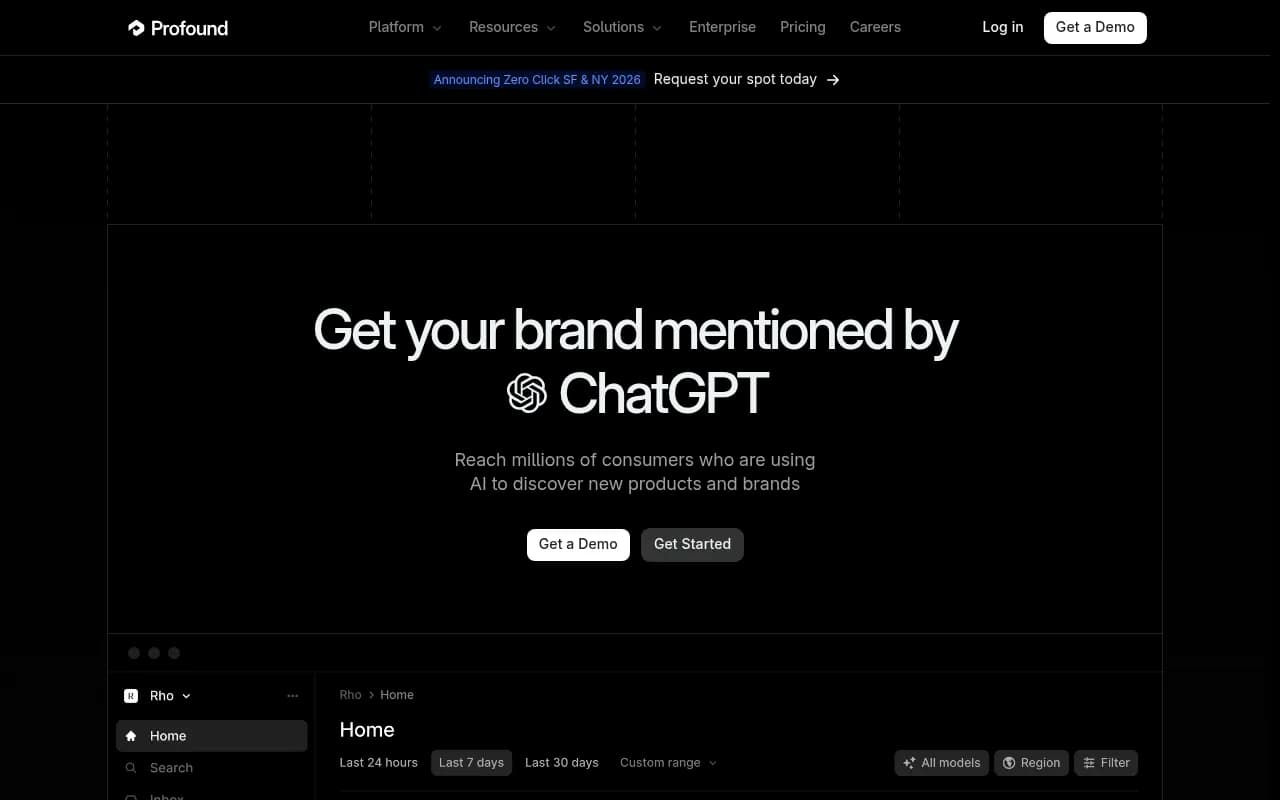
| Profound | API | 8+ models | No | No | Limited | ~$500/mo |
| Otterly.AI | API | 5 models | No | No | No | ~$49/mo |
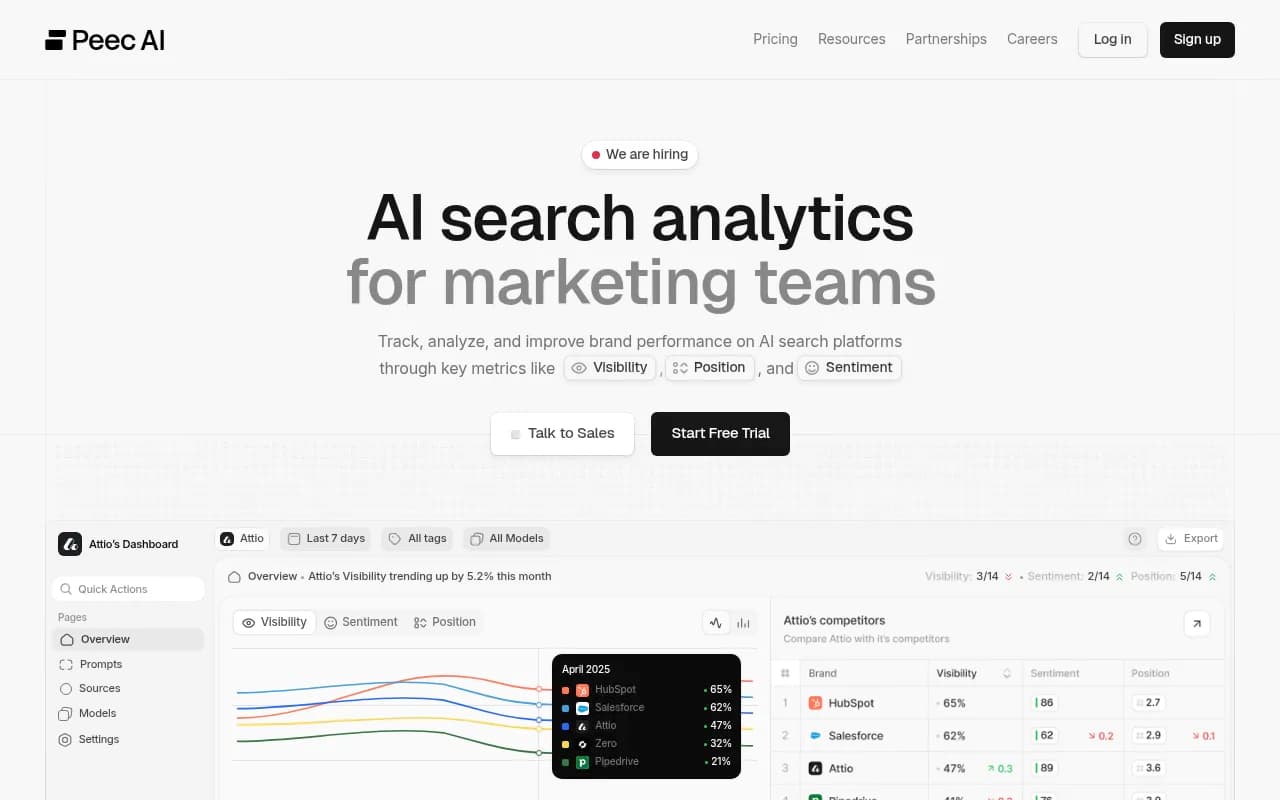
| Peec.ai | API | 5 models | No | No | No | ~$79/mo |
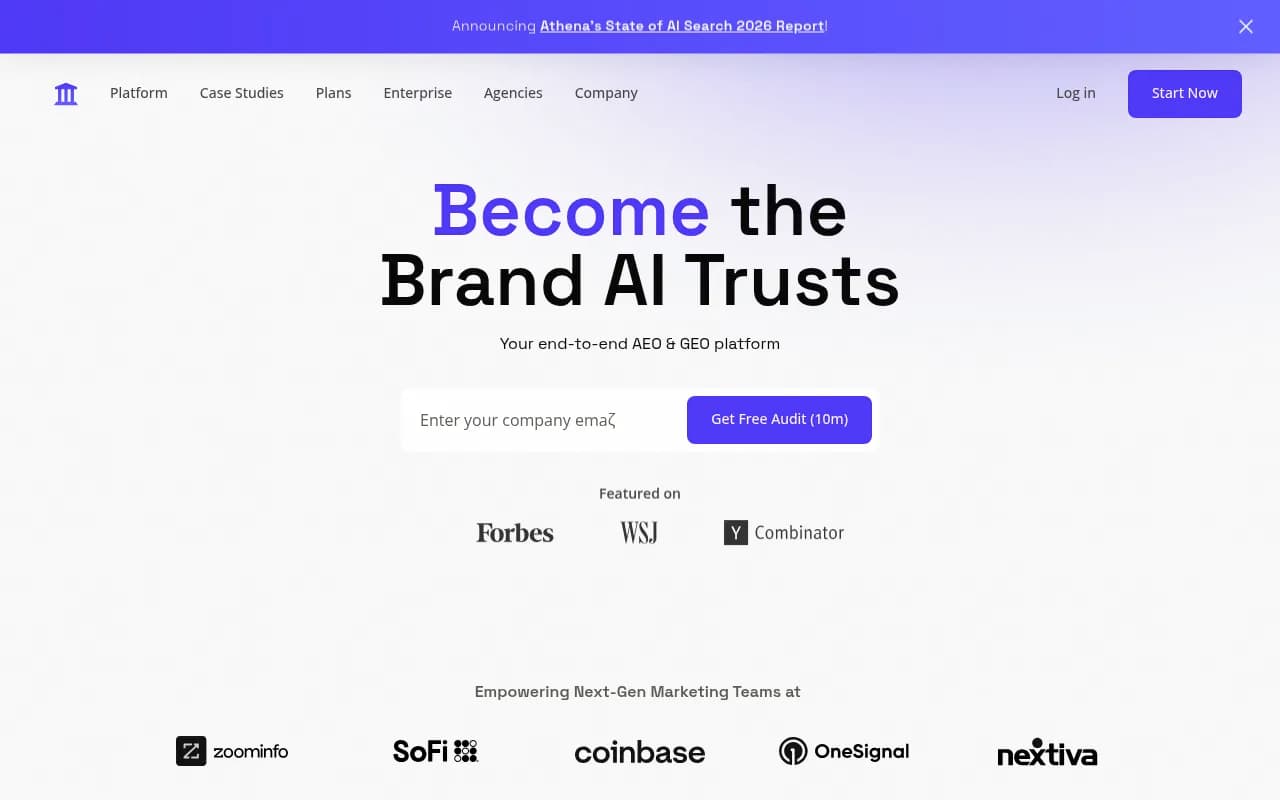
| AthenaHQ | API | 6+ models | No | No | No | ~$299/mo |
| Scrunch | API | 6 models | Limited | No | No | ~$299/mo |
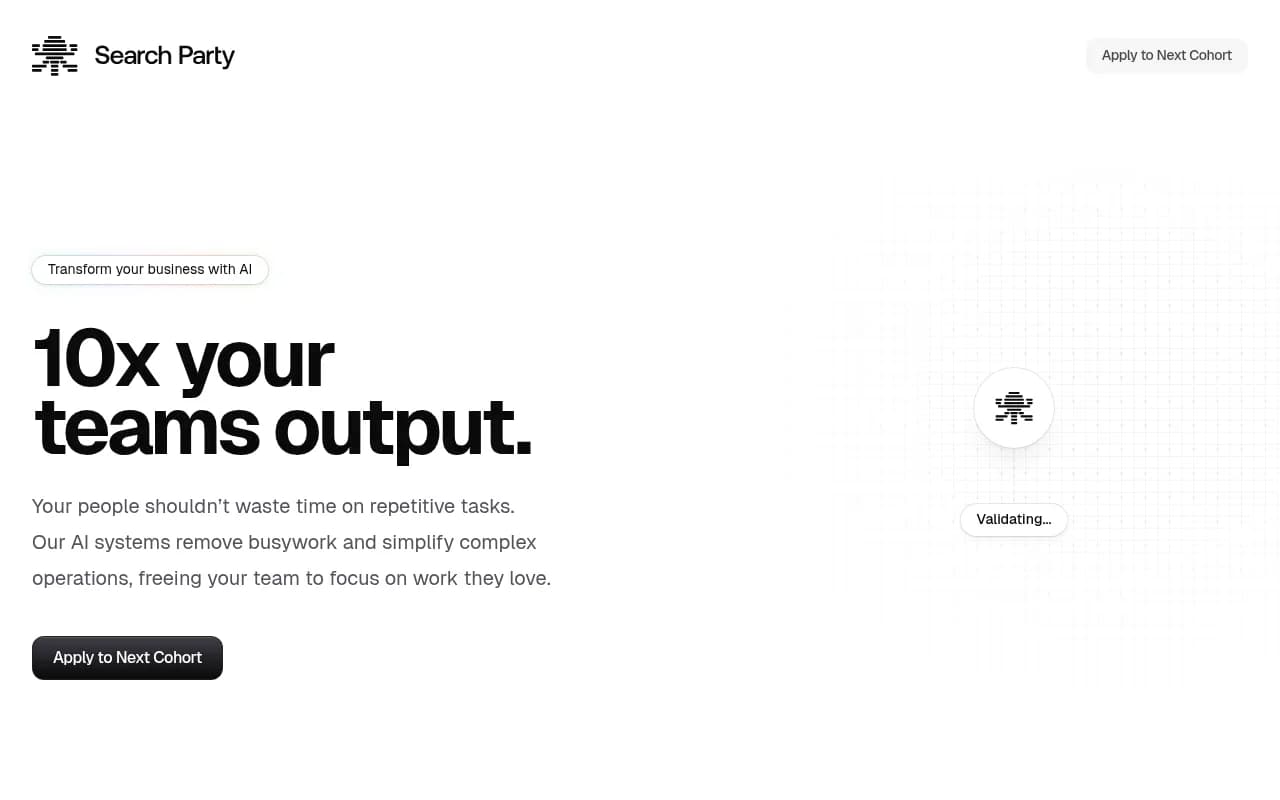
| Search Party | Mixed | 5+ models | No | No | No | Custom |
| Ahrefs Brand Radar | API | 4 models | No | No | No | Included with Ahrefs |

Search Party
A few notes on this table: "real UI" data collection is genuinely rare. Most platforms use API calls because it's cheaper and faster to build. Promptwatch's approach of tracking actual user-facing interfaces is one of the meaningful technical differentiators in the category. Content generation is also rare -- the vast majority of platforms are pure monitoring dashboards.
How to match your situation to the right tool
If you're just getting started with AI visibility
You probably don't need the most expensive or feature-rich platform. Start with something that gives you a clear baseline: which prompts matter in your category, where your brand currently appears, and how you compare to two or three key competitors.
Otterly.AI or Peec.ai work for this. They're affordable, relatively easy to set up, and give you enough data to understand the problem. The limitation is that you'll quickly outgrow them if you want to actually improve your visibility.
If you're a mid-size brand that wants to take action
This is where the monitoring-only tools start to feel frustrating. You can see you're losing to competitors in AI responses, but the platform doesn't tell you what to do about it.
You want a platform that combines prompt tracking with content gap analysis and ideally some form of content generation or briefs. Promptwatch's Professional plan ($249/month) covers this well -- you get 150 prompts, crawler logs, and 15 AI-generated articles per month grounded in real prompt data.
If you're an agency managing multiple clients
Multi-site management, white-label reporting, and API access become the priority. You need to be able to show clients clear before/after data and generate reports without manual work.
Promptwatch has agency and custom enterprise pricing. Search Party is also agency-oriented, though it has less depth on prompt metrics and no content gap analysis.
If you're an enterprise brand
At enterprise scale, the questions shift to data security, custom integrations, SLA guarantees, and the ability to track hundreds of prompts across multiple markets and languages.
Profound and Evertune are often evaluated at this level. Both have strong feature sets and higher price points. Neither tracks Reddit or YouTube as influence signals, and neither has ChatGPT Shopping tracking -- gaps that matter if your brand sells consumer products.
The non-determinism problem (and why it matters for evaluation)
One thing that rarely comes up in vendor demos: AI search is probabilistic. The same prompt can return different answers with different citations on consecutive runs. This isn't a bug -- it's how language models work.
This creates a real measurement challenge. A platform that runs each prompt once and reports the result is giving you a single data point from a distribution. A platform that runs each prompt many times and reports an average is giving you something much more reliable.
When evaluating any platform, ask: "How many times do you run each prompt before reporting results?" If the answer is once or twice, treat the data as directional rather than precise. If the answer is 10+ runs with statistical confidence intervals, you're getting something you can actually trust.
Questions to ask in any vendor demo
Before signing up for any platform, run through these:
- Do you query the live user interface or the API? For which models?
- How many prompt runs do you use per query before reporting results?
- Can you show me a content gap analysis for my actual domain, not a demo account?
- Do you have crawler logs? What AI crawlers do you track?
- What's the timeline from when I publish new content to when I'd expect to see it reflected in my visibility scores?
- How do you handle multi-language and multi-region tracking?
- What does your content generation actually produce -- full articles, briefs, or outlines?
- Can I see the API documentation?
The answers will tell you more than any feature checklist.
One thing most buyers get wrong
The tendency is to evaluate these platforms like traditional SEO tools -- by prompt count, model count, and price per feature. But the more useful frame is: what does this platform help me do that I couldn't do before?
If the answer is "it shows me a dashboard," that's monitoring. If the answer is "it shows me exactly which content to create, helps me create it, and then tracks whether it worked," that's optimization.
Most platforms in this category are dashboards. A few are actually optimization platforms. The difference in outcome over six months is significant.
The platforms worth serious evaluation in 2026 are the ones that close the loop -- from identifying gaps to creating content to tracking whether that content gets cited. That's a harder product to build, which is why most vendors haven't built it. But it's the only version of this tool that actually moves the metric your CMO is going to ask about.