Key takeaways
- A single user prompt triggers 8-12 parallel sub-queries inside AI search engines -- and those sub-queries change when models update, which can erase your visibility without any warning
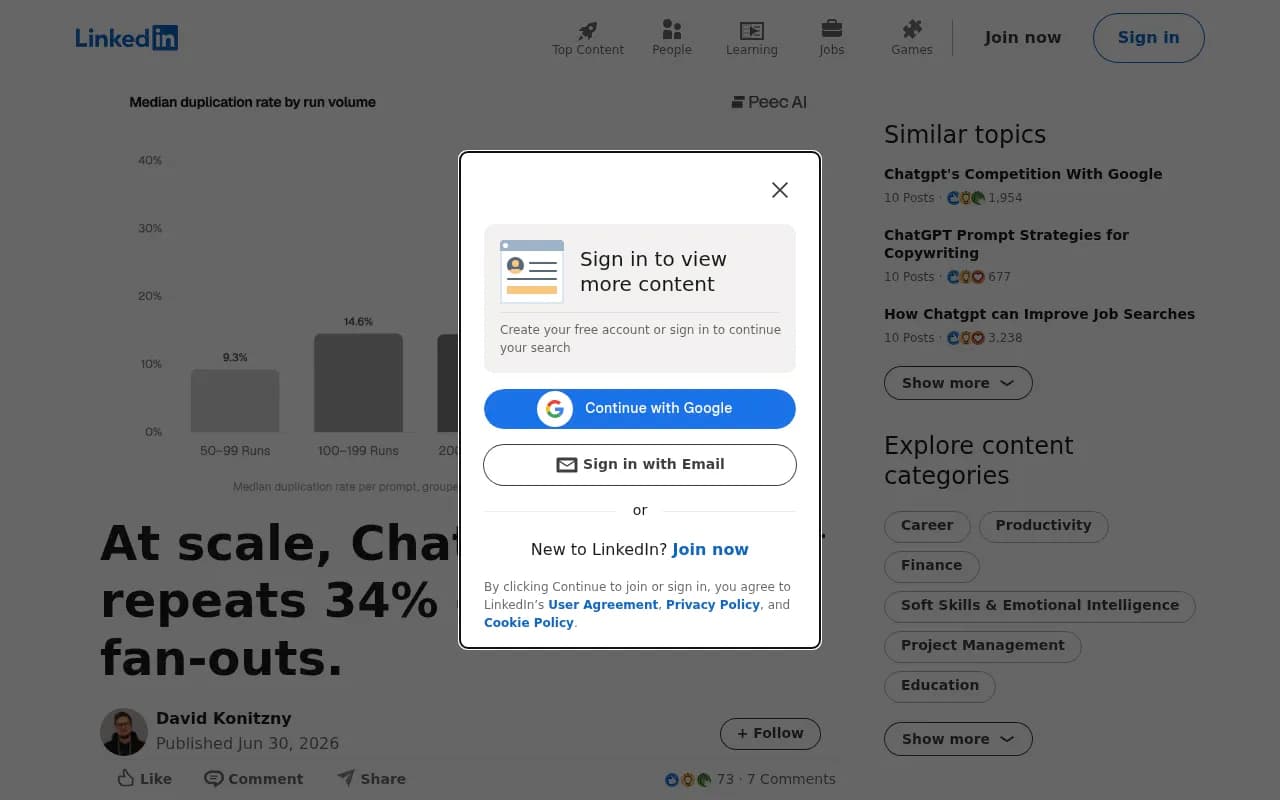
- At scale, ChatGPT repeats only 34% of its query fan-outs exactly, meaning 66% of sub-queries shift over time -- your content needs topical depth, not just keyword coverage
- 68% of pages cited in AI Overviews are NOT in the top 10 organic results, so traditional SEO rankings are a poor proxy for AI visibility
- The sub-queries AI fires tend to cluster around specific intents: recency ("2025/2026"), price anchoring ("cost", "pricing"), social proof ("reviews", "Reddit"), and risk signals ("limitations", "complaints")
- Tracking which sub-queries your brand appears in -- and which it doesn't -- is now a core part of any content strategy
What query fan-out actually is (and why it matters more than you think)
Most people think of AI search as a smarter version of Google: you type a question, the model looks it up, you get an answer. That mental model is wrong, and the gap between that model and reality is exactly where content strategies fall apart.
When you ask ChatGPT "best project management tools for remote teams," it doesn't retrieve results for that phrase. It fires a cluster of parallel sub-queries simultaneously -- something like "top project management software 2026," "remote team collaboration features comparison," "project management tool pricing," "enterprise vs SMB project management," and "project management software reviews Reddit." It reads those results, reconciles them, and synthesizes a single answer.
That process is called query fan-out (sometimes written as query fanout or query decomposition). According to research analyzing 72,000+ AI-generated queries across 8,700+ prompts, a single user question routinely triggers 8-10 parallel sub-queries before an answer comes back. Some queries fan out to 12 or more.
The end user sees none of this. They just see the answer. But your brand either made it through that gauntlet of sub-queries or it didn't.
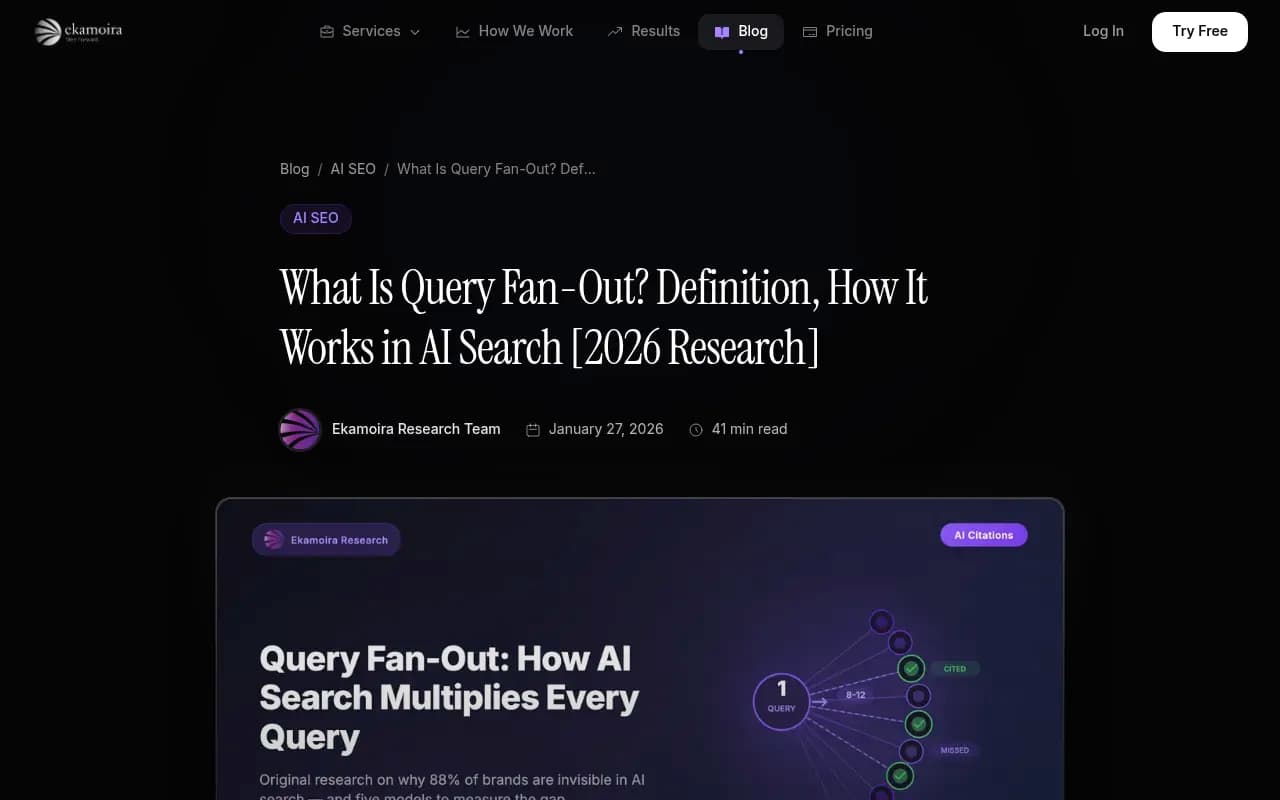
Here's the number that should stop you cold: a December 2025 Surfer SEO study analyzing 173,902 URLs found that 68% of pages cited in AI Overviews were NOT in the top 10 organic results. Two decades of SEO logic -- rank well, get seen -- breaks down almost completely in AI search. Query fan-out is the main reason why.
How fan-out sub-queries are structured
Not all sub-queries are created equal. The research shows they cluster into recognizable intent categories, and understanding those categories is the first step to covering them.
When you look at what AI models actually search for behind the scenes, a few patterns repeat consistently:
Recency signals. The current year appears in roughly 6-13% of all fan-outs depending on the model and topic. AI models are actively trying to time-stamp their answers. If your content doesn't signal freshness -- through publication dates, updated statistics, or explicit year references -- you're invisible to this sub-query class.
Price anchoring. Terms like "free," "pricing," "cost," and "how much" appear in the top n-grams across fan-outs. The model wants to give users a price range. If your content doesn't address cost directly, you won't show up when the model is building that part of its answer.
Social proof and consensus. "Reviews," "Reddit," "complaints," and "user feedback" are common sub-query qualifiers. The model is cross-checking its answer against community opinion. This is why Reddit threads and third-party review sites punch above their weight in AI citations.
Risk and limitation signals. "Pros and cons," "limitations," "alternatives," and "complaints" appear regularly. The model is doing due diligence before recommending something. Brands that only publish promotional content and never address drawbacks get filtered out of this sub-query category entirely.
Comparison queries. "vs," "alternative," "compared to," and "difference between" are extremely common. If you don't have comparison content, you're missing a significant slice of fan-out coverage.
What happens when the model updates
This is where things get genuinely disruptive. Query fan-out patterns are not static -- they shift when models update, and those shifts can be dramatic and fast.
A detailed analysis of 8.7 million ChatGPT query fan-out runs found that at scale (1,000+ runs of the same prompt), only 34% of sub-queries are exact repeats. The platform average across the full dataset sits at 17.2%. That number rises the longer you track, which means there is a stable core of recurring sub-queries -- but it's smaller than most people assume, and it's surrounded by a much larger cloud of variable sub-queries that shift constantly.
One documented example: Reddit suddenly appeared in 1.6% of ChatGPT fan-outs, then dropped 52% within two weeks after what appeared to be a template rollout and rollback. That's not a gradual drift. That's a hard switch that would have made Reddit-heavy content strategies briefly very effective, then suddenly much less so.
What does a model update actually change in fan-out behavior? A few things:
- The number of sub-queries per prompt (fan-out depth) can increase or decrease
- The intent categories that get prioritized can shift (more recency queries, fewer comparison queries, etc.)
- The sources the model trusts for each sub-query category can change
- New sub-query types can appear that didn't exist in the previous version
The practical implication: if your content strategy was built around a specific set of sub-queries that worked six months ago, you may be optimizing for a pattern that no longer exists.
Why 73% of fan-out queries change with every search
Beyond model updates, there's a more fundamental instability: even without any update, 73% of fan-out queries change between individual searches of the same prompt. The AI doesn't run the exact same sub-queries every time.
This sounds alarming, but it's actually manageable once you understand it. The variation isn't random -- it's sampling from a probability distribution of plausible sub-queries. The stable 34% core represents the sub-queries that appear in nearly every run. The variable 66% represents sub-queries that appear sometimes, depending on context, phrasing, and model state.
The strategic implication is clear: optimizing for a single set of sub-queries is fragile. Optimizing for topical depth -- covering a topic from enough angles that you're relevant to a wide range of sub-queries -- is robust.
Think of it this way. If your content only answers the exact question a user asks, you're betting on a specific sub-query appearing in every fan-out. If your content covers the topic comprehensively -- pricing, comparisons, use cases, limitations, user feedback, recent updates -- you're relevant to many sub-queries, and your visibility is much less sensitive to fan-out variation.
How fan-out frequency varies by industry
Not every topic fans out equally. Research shows that fan-out depth and frequency vary significantly by vertical:
- High-consideration purchases (software, financial products, healthcare) tend to trigger deeper fan-outs with more comparison and review sub-queries
- Informational queries fan out differently than transactional ones
- Local and time-sensitive queries have higher rates of recency sub-queries
- Product categories with strong Reddit communities see more social proof sub-queries
This matters for prioritization. If you're in a high-consideration category, your content strategy needs to cover more sub-query types than a brand in a simpler category. The bar for AI visibility is higher, but so is the reward -- these are the categories where AI recommendations most directly influence purchase decisions.
The Reciprocal Rank Fusion factor
Understanding why sub-query coverage matters requires understanding how AI models combine results from multiple sub-queries. ChatGPT uses a Reciprocal Rank Fusion (RRF) algorithm to merge results from parallel sub-queries into a single ranked list before generating its answer.
RRF rewards content that appears across multiple sub-queries, not just content that ranks highly for one. A page that shows up as the third result for five different sub-queries will typically outperform a page that ranks first for one sub-query but doesn't appear in the others.
This is a fundamental shift from traditional SEO logic, where ranking first for the exact query is the goal. In AI search, consistent presence across the sub-query cluster matters more than dominance on any single sub-query. Breadth of coverage beats depth of optimization for a single phrase.
What this means for your content strategy
The practical implications break down into a few concrete changes:
Cover the sub-query categories, not just the main query
For any topic you want to be visible for, map out the sub-query categories it's likely to trigger: recency, pricing, comparison, social proof, limitations, use cases. Then check whether your content actually addresses each of those angles. Most content strategies have obvious gaps -- usually around pricing (brands don't want to publish it), limitations (brands don't want to admit them), and comparisons (brands don't want to mention competitors).
Those gaps are exactly where AI models go looking when they can't find what they need on your site.
Build for topical authority, not keyword density
Because fan-out queries are often highly specific and 95% of them show zero monthly search volume in traditional keyword tools, keyword-based content planning misses most of the target. The goal is to be the most comprehensive, trustworthy source on a topic -- not to rank for a specific phrase.
This means publishing content at multiple levels of specificity: broad overview pieces, detailed comparison pages, pricing breakdowns, use-case guides, FAQ content, and honest limitation discussions. Each piece covers different sub-query territory.
Tools like Promptwatch can show you the specific sub-queries AI models are firing for your brand's prompts, grouped by topic -- so you can see exactly which angles you're covering and which you're missing, rather than guessing.

Treat freshness as a structural requirement
Since the current year appears in 6-13% of all fan-outs, freshness signals are not optional. This doesn't mean rewriting everything constantly -- it means building freshness into your content architecture. Publication dates, "last updated" timestamps, annual review cycles for key pages, and explicit references to current year data all help.
Monitor fan-out changes, not just rankings
Traditional rank tracking tells you where you appear in Google's organic results. It tells you almost nothing about AI visibility. When a model update shifts fan-out patterns, your traditional rankings might not change at all, but your AI visibility can drop significantly.
The right thing to track is which sub-queries your content appears in, how that changes over time, and what new sub-query patterns emerge after model updates. Platforms built for this kind of tracking -- like Promptwatch or tools like Peec AI -- give you visibility into fan-out behavior that traditional SEO tools simply don't capture.

Don't ignore offsite signals
AI models cross-check their answers against community sources. Reddit threads, YouTube reviews, third-party comparison sites, and industry publications all feed into fan-out sub-queries. Your content strategy needs to include a plan for offsite presence -- not just your own website.
This is uncomfortable for brands that want to control their narrative, but the data is clear: AI models actively look for social proof and third-party validation. If you only exist on your own site, you're invisible to a significant portion of the sub-query cluster.
Practical tools for tracking and responding to fan-out changes
Given how quickly fan-out patterns can shift, you need some kind of systematic monitoring rather than periodic manual checks.
Here's a comparison of approaches:
| Approach | What it catches | What it misses | Best for |
|---|---|---|---|
| Traditional rank tracking | Organic position changes | AI sub-query shifts, fan-out changes | Traditional SEO only |
| AI visibility monitoring (basic) | Whether your brand appears in AI answers | Which sub-queries you're missing, why | Early-stage AI visibility |
| Fan-out specific tracking | Sub-query patterns, repetition rates, changes over time | Offsite citation sources | Understanding AI behavior |
| Full GEO platform (e.g. Promptwatch) | Sub-queries, gaps, offsite citations, content recommendations, crawler behavior | Nothing major | Brands serious about AI visibility |
For teams that want to go deeper on content gap analysis specifically, MarketMuse and Surfer SEO are useful for topical coverage mapping, even if they weren't built specifically for fan-out optimization.
For AI-specific tracking, Wellows focuses on AI citation analytics and is worth looking at if you want visibility into how fan-out changes affect your citation rates over time.
The update cycle problem
One thing worth being direct about: there's no way to fully insulate yourself from model updates. When OpenAI ships a new version of ChatGPT, or Google updates AI Mode's query decomposition logic, fan-out patterns can change in ways that are impossible to predict in advance.
What you can do is reduce your exposure. A content strategy built on topical depth -- covering a subject from many angles rather than optimizing for specific sub-queries -- is inherently more resilient. When the model rewires its sub-queries, you're still relevant to the new pattern because you've covered the topic comprehensively.
A content strategy built on narrow keyword optimization is fragile. You're betting that the specific sub-queries you've optimized for will survive the next update. That's a bet with poor odds.
The 85SIXTY research puts it well: the AI isn't taking anyone's word for it. It double-checks, compares notes, and looks for recent signals before it feels comfortable answering. Your job is to be the source that survives that cross-examination -- not just once, but across every version of the model that runs it.
Where to start
If you're rethinking your content strategy in light of fan-out behavior, the most useful first step is an audit of your current content against the major sub-query categories. For your most important topics, ask:
- Do you have content that addresses pricing and cost?
- Do you have comparison content that mentions alternatives?
- Do you have content that acknowledges limitations or trade-offs?
- Do you have content that references recent data or is explicitly dated?
- Do you have any presence on third-party sites that AI models treat as social proof?
Most brands will find gaps in at least three of those five categories. Those gaps are where AI models go looking when they can't find what they need on your site -- and where your competitors get cited instead.
Fan-out isn't going away. If anything, as models get better at decomposing complex queries, the number of sub-queries per prompt will likely increase. The brands that build for topical depth now will have a structural advantage that compounds over time.