Key takeaways
- Run a full check of your whole prompt set monthly. Check your top 10 to 20 prompts weekly, or every two weeks if your category is calm.
- Switch to weekly for roughly 4 to 6 weeks after a launch, rebrand, or competitor move, then drop back.
- Collect often, interpret on a slower rhythm. A single day's answer is noise; a weekly average is a signal.
- Platforms change behavior overnight. Check model release dates before blaming your own content for a dip.
- Technical access (robots.txt, CDN, rendering) gets checked after every material site release, not on a calendar.
Why there is no single right answer
Every article on this topic lands in roughly the same place: monthly as a floor, weekly when something is happening. I agree with that, but the reasoning matters more than the number, because it tells you when to break the rule.
AI answers are written fresh each time. Ask ChatGPT, Gemini, or Perplexity the same question twice and the wording, the brands named, and the cited pages can all change. So looking too rarely means a launch can go sideways, or a competitor can take your slot, for weeks without you noticing. Looking too often without a reason gives you a pile of single answers and a team that reacts to every wobble.
The fix is to match frequency to the decision you are trying to make:
- A baseline needs repetition.
- A fix needs a before and after.
- A steady month needs a trend.
What changes fast enough to justify checking
Two things drive cadence: how fast the platforms move, and how fast your own situation moves.
Platforms can change overnight
Promptwatch Data has tracked a few abrupt shifts this year. When GPT-5.3 rolled out on March 4, 2026, the average number of sources cited per search-enabled ChatGPT response fell from about 6.4 to roughly 4.7-4.9 by late March, around 27% fewer citation slots. It happened within a day, hit GPT-5.3, GPT-5.4, and GPT-5-Mini together, and had not recovered a month later. Details are in Promptwatch's ChatGPT citation drop report.
Reddit is another example. Its share of ChatGPT citations held at about 3.83% from July 18 to August 7, 2026, then fell below 1% on August 14. In Google AI Mode it drifted down more gradually, from 2.22% to 1.54% over the period, and in AI Overviews from 2.37% to 2.10%. The write-up is in Promptwatch's report on Reddit citations dropping in ChatGPT, which also notes a data-collection issue can't be fully ruled out.
The lesson for cadence: abrupt changes (ChatGPT) need weekly or even daily trend checks to catch. Gradual drifts (Google surfaces) show up in rolling monthly trends. You need both views.
It also means a dip in your visibility is not always your fault. Track citations per response over time so you can separate "we lost ground" from "the platform cites fewer sources overall."
Your content decays on a schedule
Promptwatch's content half-life data tracked every page ChatGPT cited on July 6, 2026 for 90 days. News decays fastest: about half of cited news pages were gone after 36 days, and almost a quarter were never cited again after day zero. Landing pages and docs lasted longest, with 78% and 76% still cited after 30 days. Product pages, reviews, and how-tos reach their half-life after roughly 74 to 77 days. See the ChatGPT content half-life report.
My inference, not Promptwatch's claim: a launch that leans on press coverage fades in about five weeks, which fits a 4 to 6 week weekly-check window after launch. Landing pages and docs stick around, so the durable asset is accurate pricing, features, and positioning on those pages.
The cadence, by situation
| Situation | How often | What to look at |
|---|---|---|
| First baseline | Twice in two weeks, same prompts | Which answers name you, which pages get cited, who appears instead |
| Steady state, full prompt set | Monthly | Trends by engine and topic, not single answers |
| Steady state, top 10 to 20 prompts | Weekly or every two weeks | Brand presence, description accuracy, new competitors |
| Launch or rebrand | Weekly for about a month | Whether answers use your new name, facts, and pages |
| Competitor move or sudden drop | Within days, then weekly until it settles | Which page replaced yours, and whether a model update explains it |
| Crisis or negative coverage | Daily to weekly | Sentiment and the specific claims AI repeats |
| After you publish or fix a page | Once live, then again 3 to 4 weeks later | Whether the target answer now cites that exact URL |
| Robots.txt, CDN, or rendering change | After every material release | Whether AI crawlers can still read the pages |
| Quarterly | Every 3 months | Strategy, pipeline context, whether the prompt set still matches buyers |
The table blends the cadence advice published by AI Brand Report, Xtrusio, Prizvox, and HubSpot's AEO team. They differ on details (Xtrusio says top 10 every two weeks, Prizvox says weekly for priority prompts) but the shape is the same.
Weekly, monthly, quarterly: what each one is for
Weekly checks (15 to 30 minutes)
This is a smoke test, not an analysis.
- Run your 10 highest-priority prompts across ChatGPT and Perplexity at minimum.
- Look for a change in whether you are named, and in how you are described.
- Flag any competitor that was not there last week.
- Do not act on one answer. Prizvox makes the same point: a weekly result should rest on repeated runs or a stable sampling method before it triggers work.
Monthly reviews (2 to 4 hours by hand, far less automated)
This is where decisions get made.
- Compare visibility, share of voice, and sentiment against last month.
- Review which pages are cited and which competitors displaced you.
- Line up changes against known model release dates. The Toolsolved guide makes a good point: even if you check daily, you still want a monthly rollup asking what changed over 30 days.
- Update the action list, and drop items that did not move anything.
A small caution: a ten-minute monthly check with a fixed query set beats a yearly deep dive, as the Launch at Dawn guide puts it. If the full audit feels heavy, shrink it rather than skip it.
Quarterly reviews
Use these for strategy. Are the prompts still the ones your buyers use? Are you tracking the right engines and countries? Quarterly alone is too slow as a monitoring rhythm, since a competitor's press feature can shape answers for three months before you see it. As a planning rhythm it is fine. Branviz notes that established companies in steady markets can rely on quarterly reviews for long-term trends, though it still recommends monthly for anyone growing.
Collect daily, interpret weekly
HubSpot's guidance on AEO prompt tracking is the cleanest framing I have seen: collect daily where the tool supports it, interpret weekly, use monthly reviews for experiment results, and quarterly for pipeline context. The reason is sample size. One prompt gets one answer per engine per day, so across three engines you have 21 answers a week. A single day is a small sample, so wait for weekly averages before judging a launch.
The practical consequence: if you only check by hand once a week, you are looking at one draw from a noisy distribution. That is fine for spotting a gross change (you vanished, or a new brand appeared), but poor for judging whether a content experiment worked. For that, you want repeated runs.
Build the baseline first
Before picking any cadence, establish where you stand.
- Pick 20 to 50 questions your buyers really ask, across informational, commercial, and competitor-comparison intent.
- Run them in every engine that matters to you.
- Run the same set again about a week later.
- Keep the ones where you appear both times as real signal, and treat the ones that flip as unstable.
One run is a snapshot. Two runs show you which results are steady and which move on their own. Every later check compares against this.
Tools that make the cadence sustainable
Manual checking works for a baseline and for a small prompt set. Past that, you want a tool that runs prompts on a schedule and keeps the history.
Promptwatch is the one I would look at first if you want the whole loop rather than a dashboard. It runs prompts daily on every plan, and on Business and Agency Scale plans a monitor can run every 12, 6, or 1 hours, which suits launch windows. Brand Narrative pulls out the individual claims AI makes about you, so you can see whether the new positioning has landed. On the technical side, its AI crawler logs cover the after-every-release check. Plans start at $95/mo for Essential, with a 7-day free trial on monthly billing; confirm current pricing at promptwatch.com/pricing.

Other options in the catalog sit at different points on the price and depth curve:



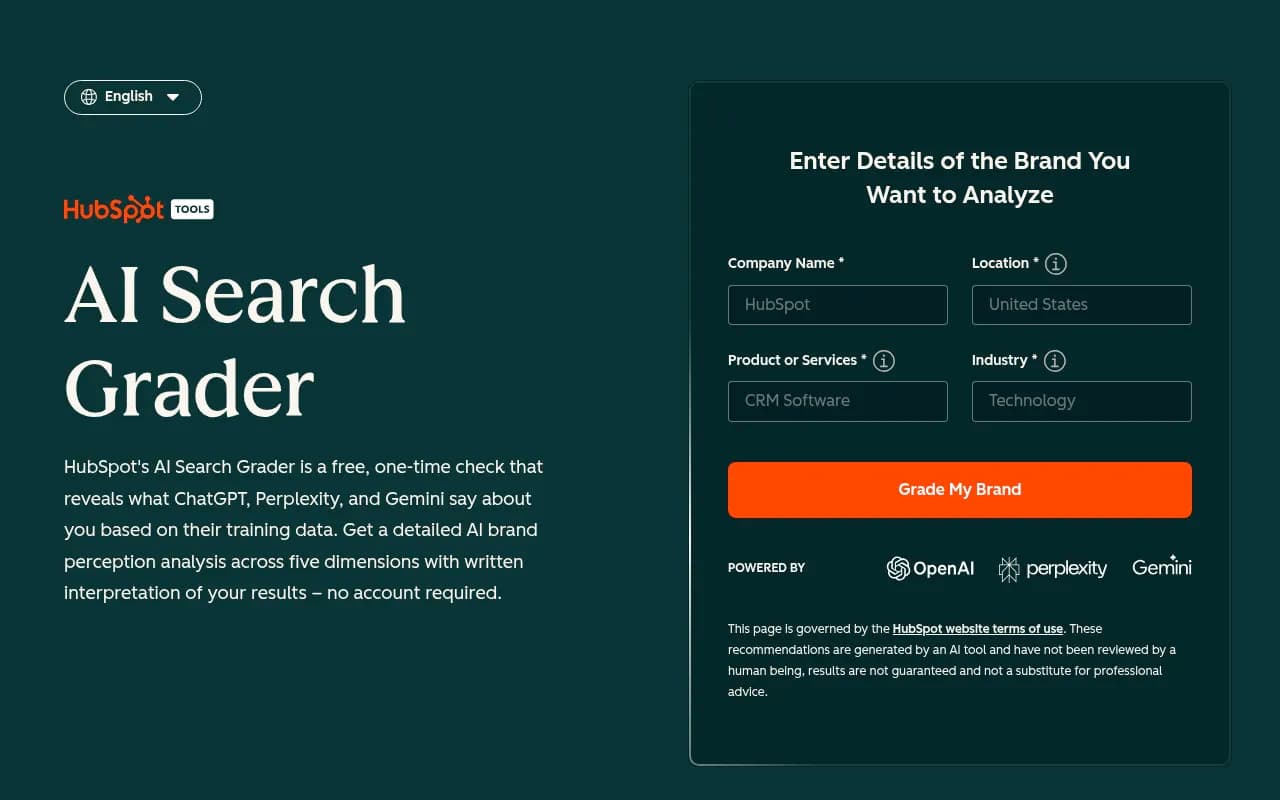
For free spot checks while you establish a baseline, a one-off grader is enough.
If you are still comparing options, the GEO software directory at bestgeosoftware.com lists many more.
| Need | Tool type | Examples |
|---|---|---|
| Quick one-off baseline | Free graders | HubSpot AI Search Grader, Promptwatch free AI visibility report |
| Scheduled prompt tracking | Monitoring tools | Otterly.AI, Peec AI |
| Tracking plus fixes, crawler logs, content | End-to-end platform | Promptwatch |
| Enterprise monitoring | Enterprise platforms | Profound |
| Social listening beyond AI | Brand monitoring | Brand24, Meltwater |
Brand24 and Meltwater are worth a mention for a different reason. Traditional social sentiment tools track how perception moves across weekly and monthly views and after launches, and they cover the human conversation that AI later learns from.
A cadence you can copy
Here is a workable default for a mid-size team.
- Week 1 to 2: baseline, two runs on 20 to 50 prompts.
- Every week: top 10 prompts, 15 to 30 minutes, one owner.
- Every month: full set, trend review, action list refresh, model-release cross-check.
- Every quarter: reset the prompt set, review engines and markets.
- After each launch or rebrand: weekly full review for about a month, then back to normal.
- After each site release touching robots.txt, CDN, or rendering: crawler access check.
- After publishing or fixing a page: recheck 3 to 4 weeks later to see if the target answer cites the exact URL.
If you are agency-side or short on hours, the same structure works with a tool doing the collection and a human doing the monthly interpretation. Teams that would rather hand off the whole thing can look at a specialist; 1001 SEO Media runs this kind of monitoring and GEO work for clients.
Common mistakes
- Reacting to one answer. Wait for a pattern.
- Changing the prompt set mid-stream without noting it, which makes month-over-month comparisons meaningless.
- Blaming content for a drop that coincides with a model release.
- Checking only ChatGPT. Engines behave differently, and ChatGPT moved overnight where Google surfaces drifted.
- Treating a launch week as the finish line. The news coverage fades within weeks, so the real test is five or six weeks out.
Bottom line
Start monthly, move to weekly for a month around anything big, and use automation to collect more often than you interpret. Then add event triggers for technical changes and model releases. If you can only do one thing this week, run your top 10 prompts twice and write down the results.