Key takeaways
- AI visibility reporting is now a standard client deliverable at forward-thinking agencies, covering metrics like share of voice, citation frequency, and prompt coverage across ChatGPT, Perplexity, Gemini, and other models
- The best agency reports go beyond "you appeared X times" -- they show which prompts competitors are winning, which content gaps exist, and what actions to take next
- Clients increasingly expect monthly AI visibility dashboards alongside traditional SEO reports, and agencies that can't provide them are losing retainers to ones that can
- The reporting stack typically combines a dedicated AI visibility platform, crawler log analysis, and traffic attribution to close the loop between AI mentions and actual revenue
- Agencies using platforms with built-in content generation (not just monitoring) are delivering faster results and retaining clients longer
Something shifted in agency-client conversations around late 2025. Clients stopped asking "how are we ranking on Google?" as their first question and started asking "are we showing up in ChatGPT?" or "what does Perplexity say about us?"
That's not a small change. It's a complete reframe of what visibility means -- and it's forced agencies to rethink how they structure reporting from the ground up.
This guide covers how agencies are actually doing it in 2026: what goes into an AI visibility report, how to structure it for clients who are new to the concept, what tools are powering the work, and where the gaps still are.
Why traditional SEO reporting falls short for AI search
A traditional monthly SEO report covers keyword rankings, organic traffic, backlinks, and maybe some Core Web Vitals. It's backward-looking and traffic-focused. That model made sense when Google's ten blue links were the primary destination.
AI search works differently. When someone asks ChatGPT "what's the best project management tool for remote teams?" they get a synthesized answer with maybe two or three brand mentions. There's no rank 1 through 10. There's cited and not cited.
That means the metrics agencies have been reporting for years -- position 1-3 rates, click-through rates, impressions -- don't capture what's actually happening. A client could be ranking #1 on Google for a keyword and completely absent from every AI model's answer to the same question. That's a real business problem, and a standard SEO report won't surface it.
Agencies that recognized this early started building a parallel reporting layer. The ones that waited are now scrambling to catch up.
The core metrics in an AI visibility report
Before getting into structure and format, it's worth being clear about what you're actually measuring. The terminology is still settling across the industry, but most agencies are converging on a similar set of core metrics.
Share of voice in AI responses
This is the percentage of relevant AI-generated answers that mention your client's brand, compared to competitors. If you're tracking 100 prompts in your client's category and the brand appears in 23 of them, their share of voice is 23%. Competitors might be at 41% and 18%. That gap is the story.
Share of voice is the headline number most clients want to see first. It's intuitive, it benchmarks against competition, and it moves over time as you do the work.
Citation frequency and source attribution
Which specific pages on the client's site are being cited? How often? By which AI models? This is more granular than share of voice and more actionable. If a single blog post is getting cited 40 times a month by Perplexity but nothing else on the site is, that tells you something about what content format is working and where to invest next.
Prompt coverage
How many of the relevant prompts in the client's category does the brand appear in? If there are 200 meaningful prompts in the space and the client shows up in 35, their prompt coverage is 17.5%. This metric is useful for showing progress over time and for prioritizing which content gaps to close first.
Sentiment and framing
When the brand does appear, how is it described? Is it recommended, mentioned neutrally, or flagged with caveats? Some platforms now score sentiment at the mention level. This matters because appearing in an AI answer isn't always positive -- being cited as "expensive but not worth it" is worse than not appearing at all.
AI-driven traffic attribution
Ultimately, clients want to know if AI visibility translates to real visits and revenue. This is still the hardest part of the stack to get right, but it's increasingly possible through server log analysis, UTM tracking, and Google Search Console integration. Agencies that can connect AI mentions to actual traffic are in a much stronger position than those reporting vanity metrics.
How agencies are structuring the actual report
There's no single standard format yet, but a pattern is emerging across agencies that have been doing this for 6-12 months. Here's how most of them are organizing their client deliverables.
Section 1: Executive summary (1 page)
This is what the client's CMO reads. It covers:
- Overall AI visibility score or share of voice vs. last period
- Top 2-3 wins (new citations, improved sentiment, new prompts covered)
- Top 2-3 gaps or risks (competitor gains, prompts where the brand is absent)
- One recommended action for the next 30 days
Keep it tight. Clients who are new to AI visibility don't need a tutorial in every report -- they need to know if things are getting better or worse and what you're doing about it.
Section 2: Share of voice dashboard
A visual breakdown of the client vs. their top 3-5 competitors across the prompt set. Most agencies present this as a bar chart or heatmap showing which brand appears most often for which prompt categories.
This section answers the question clients ask most: "How do we compare to competitors?" Having a clear visual answer to that question every month is one of the main reasons clients stay on retainer.
Section 3: Prompt-level breakdown
A table showing individual prompts, which brands appeared, and what the AI said. This is the most granular section and the most useful for the agency's internal team. It shows exactly where the client is winning, where they're losing, and what the AI models are actually saying.
Some agencies include the verbatim AI responses for key prompts. Others summarize. Either way, this section is where the strategic conversation happens -- "why is Competitor X appearing here and we're not?" is a question this section should answer.
Section 4: Content gap analysis
Which prompts is the client not appearing in that they should be? What content exists on competitors' sites that doesn't exist on the client's? This section is where monitoring turns into action.
A good content gap analysis doesn't just list missing topics -- it prioritizes them by prompt volume and competitive difficulty. "You're missing coverage of X, which gets an estimated Y queries per month and your top competitor ranks for it" is a much more useful finding than a generic list of content ideas.
Section 5: Citation and source analysis
Which pages are being cited? Which external sources (Reddit threads, YouTube videos, third-party articles) are influencing AI answers in the client's category? This section helps clients understand that AI visibility isn't just about their own website -- it's about the broader information ecosystem.
Section 6: AI crawler activity
Which AI crawlers have visited the site? Which pages did they read? Were there any errors or crawl blocks? This is a newer section that most agencies are still figuring out, but it's increasingly important. If Perplexity's crawler can't access a key page, that's a fixable technical problem -- but you have to know about it first.
Section 7: Traffic attribution (where available)
The connection between AI visibility and actual traffic. Even partial data here -- "we can see AI-referred sessions increased 18% this month" -- is valuable for justifying the program to budget holders.
The reporting stack agencies are using
Most agencies aren't building this reporting from scratch. They're combining a primary AI visibility platform with a few supporting tools.
Promptwatch is one of the more complete options for agencies that want to go beyond monitoring. The platform covers tracking across 10+ AI models, crawler log analysis, prompt volume and difficulty scoring, and a built-in content generation tool that creates articles grounded in citation data. For agencies that need to show clients not just where they're invisible but what to do about it, that combination matters.

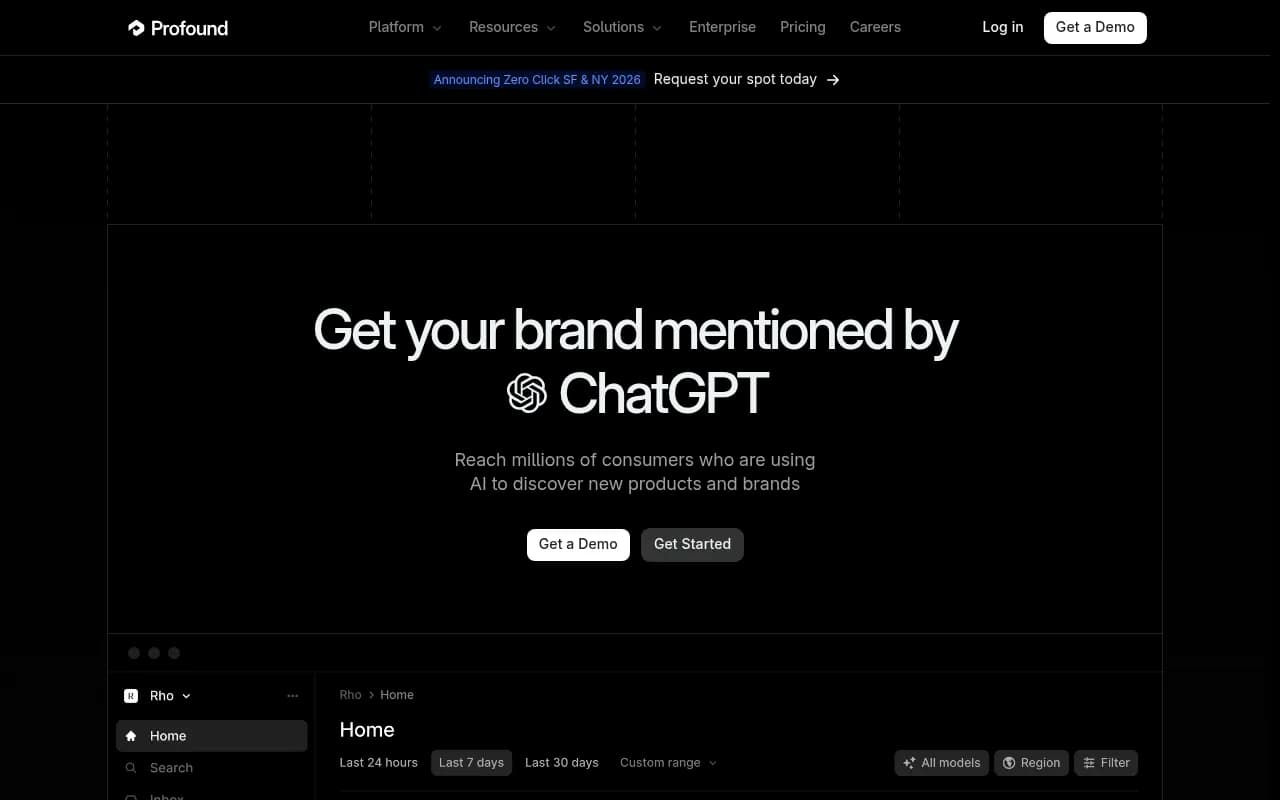
For agencies focused on enterprise clients, Profound AI has a dedicated agency mode with pitch environments and multi-brand management.
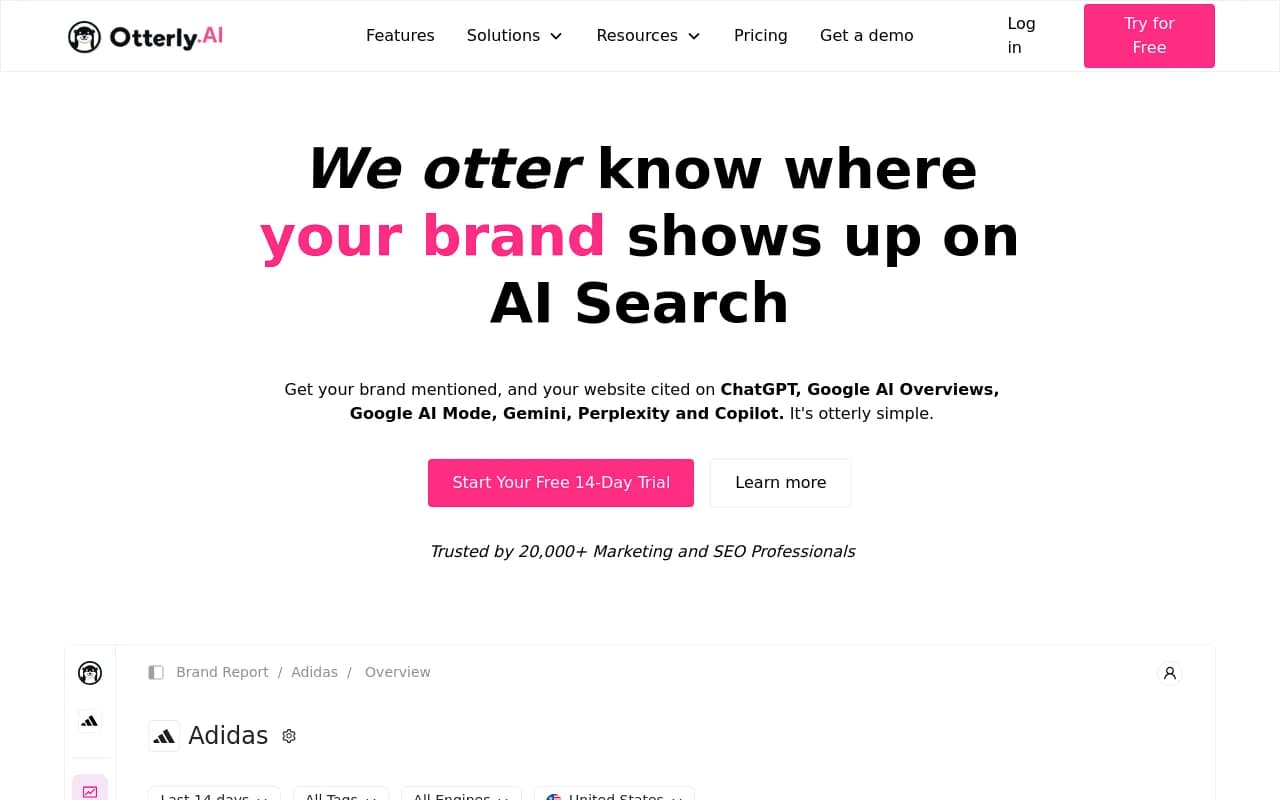
Scrunch AI and Otterly.AI are lighter-weight options that work well for agencies just starting to add AI visibility to their service mix.
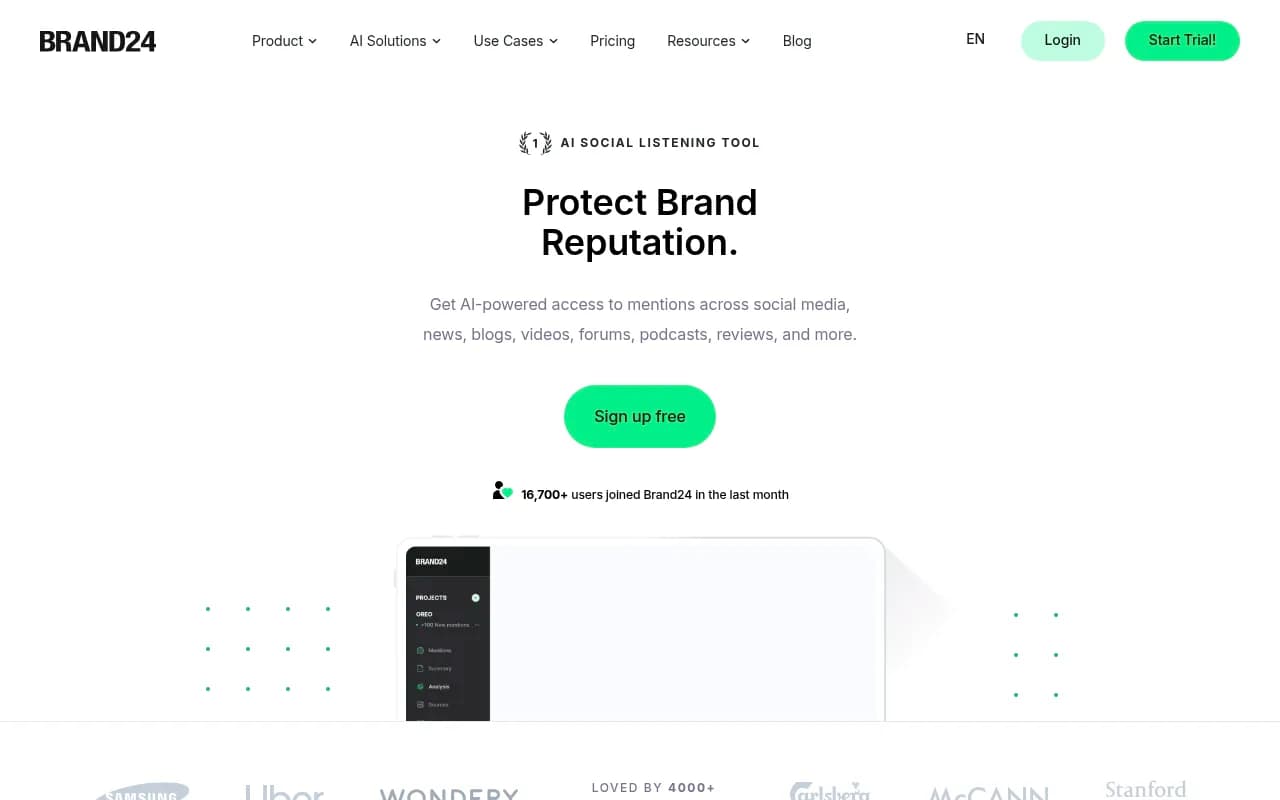
For brand mention tracking that complements AI visibility data, Brand24 is useful for capturing the broader conversation happening across social and web that influences what AI models learn.
Here's a quick comparison of how these platforms stack up for agency use cases:
| Platform | Multi-client management | Content generation | Crawler logs | Traffic attribution | Prompt volume data |
|---|---|---|---|---|---|
| Promptwatch | Yes | Yes (built-in AI writer) | Yes | Yes (GSC + logs) | Yes |
| Profound AI | Yes (agency mode) | Limited | No | No | Yes |
| Scrunch AI | Yes | No | No | No | No |
| Otterly.AI | Basic | No | No | No | No |
| Brand24 | Yes | No | No | No | No |
The onboarding challenge: setting baselines fast
One thing agencies consistently get wrong in the early months of an AI visibility engagement is taking too long to establish a baseline. Clients want to see movement. If you spend the first 60 days just setting up tracking and gathering data, you're burning goodwill.
The agencies doing this well run a rapid baseline audit in week one: pull share of voice across the top 50-100 prompts in the client's category, identify the 3-5 competitors to track, and surface the 5-10 highest-priority content gaps. That gives you something to show in the first report and a clear action plan for the first 90 days.
According to one analysis from Wellows, marketing agencies average around 27% annual client churn, and early-stage relationships are where a lot of that churn is decided. Showing a client a clear picture of their AI visibility -- and a concrete plan to improve it -- in the first two weeks is one of the most effective retention moves an agency can make.
What clients actually want to see
There's a gap between what agencies think clients want and what clients actually respond to. A few things that consistently land well:
Competitor comparisons. Clients are far more motivated by "Competitor X is appearing in 40% of relevant AI answers and you're at 12%" than by abstract visibility scores. Competitive framing creates urgency.
Specific AI responses. Showing a client the actual text that ChatGPT or Perplexity returns when someone asks about their category is more compelling than any chart. It makes the problem concrete and personal.
Progress over time. Even small improvements feel meaningful when they're tracked. A client who went from 12% to 19% share of voice in 60 days is a client who renews.
Clear next actions. Every report should end with a specific recommendation. "We're going to publish three articles targeting these prompts next month" is more reassuring than "we're continuing to monitor the situation."
Common mistakes agencies are making
A few patterns that come up repeatedly when agencies struggle with AI visibility reporting:
Reporting on too many metrics at once. It's tempting to show everything the platform can measure. Resist this. Clients who are new to AI visibility get overwhelmed by a 20-metric dashboard. Start with share of voice and prompt coverage, then add complexity as the client gets comfortable.
Treating AI visibility as a separate silo. The best agencies are integrating AI visibility data with their existing SEO and content reporting. A client shouldn't have to read two separate reports to understand their overall search presence.
Monitoring without acting. This is the biggest one. Plenty of agencies have set up tracking and are faithfully reporting numbers every month without actually doing anything to move them. AI visibility improves when you create content that AI models want to cite. Tracking without content creation is a slow way to lose a client.
Ignoring non-website sources. AI models don't just cite brand websites. They cite Reddit threads, YouTube videos, third-party review sites, and industry publications. Agencies that only optimize the client's own site are missing a significant part of the picture.
Building AI visibility into your agency's service offering
For agencies that are still figuring out how to package this, a few practical notes:
Most agencies are positioning AI visibility as either an add-on to existing SEO retainers or as a standalone "AI search" service. The add-on model is easier to sell because it doesn't require clients to understand a new category -- it's just "we're also tracking how you appear in AI search now." The standalone model commands higher fees but requires more client education.
Pricing varies widely. Agencies running AI visibility as an add-on are typically charging $500-$1,500/month on top of existing retainers. Standalone AI search programs run $2,000-$8,000/month depending on scope, number of prompts tracked, and content production included.
The agencies growing fastest in this space are the ones that can show results quickly. That means having a platform that does more than monitor -- it needs to help you identify what content to create and then actually create it. The monitoring-only approach is becoming a commodity. The value is in the optimization loop: find the gaps, fix them, show the results.
Putting it together
AI visibility reporting is still young enough that there's no industry standard format, which is actually an opportunity for agencies. The ones that develop a clear, repeatable reporting structure now -- and can show clients a coherent story about their AI search presence -- will have a real advantage over the next two years.
The core of a good AI visibility report is simple: where are you, where are your competitors, what's missing, and what are we doing about it? Everything else is detail. Clients who understand that story will keep paying for the service. Clients who get a dashboard full of numbers without a narrative will eventually wonder what they're paying for.
The agencies winning right now are the ones treating AI visibility as an optimization discipline, not a monitoring service.