Key Takeaways
- Only two of these three tools clearly track agent visits on your own site: Promptwatch (IP-verified crawler logs) and DarkVisitors, which has been renamed Known Agents.
- Gauge is an AI answer visibility and content platform. I found no server-log crawler analytics on its pricing page, so verify that with them before buying it for this job.
- DarkVisitors is the cheapest way in: a free tier with 100K events a month and a $29/mo Startup plan, plus an auto-updating robots.txt.
- Promptwatch connects the visit to what happens next: whether the page gets cited, and whether it sends traffic and conversions.
- If you only want to know which bots hit your site, start with DarkVisitors. If you want to know whether those visits turn into citations and revenue, you need a platform that joins the data.
What "tracking AI agent visits" actually means
The phrase covers three different things, and tools tend to do only one or two of them.
- Crawler and agent hits on your server. GPTBot, ClaudeBot, PerplexityBot and ChatGPT-User fetching your pages. This is the raw log layer.
- Citations in AI answers. Whether ChatGPT, Gemini or Perplexity actually name your brand or link your page. A crawl is not a citation.
- Human visits that come from AI. People clicking a link in an AI answer and landing on your site.
Most confusion in this category comes from tools that do number 2 being described as if they did number 1. Keep the three separate when you evaluate anything below.
A quick note on naming: DarkVisitors has been renamed Known Agents (knownagents.com). Older articles, plugins and the WordPress listing still say Dark Visitors, so you will see both. I use DarkVisitors below because that is what most people still search for.
The short comparison
| Gauge | Promptwatch | DarkVisitors (Known Agents) | |
|---|---|---|---|
| Core job | AI answer visibility plus content engine | AI visibility, crawler logs, content and traffic in one loop | Bot and agent analytics, robots.txt control |
| Server-side agent visit logs | Not found on pricing page, verify | Yes, IP-verified | Yes, via plugin or events |
| Citation tracking | Yes | Yes | No |
| AI-referred visitor analytics | GA4 integration | Built in | Analytics events |
| Starting price | $599/mo (Growth) | $95/mo (Essential) | Free, then $29/mo |
| Free option | Free plan only on the separate Gauge Agents product | 7-day free trial and free AI visibility report | Free tier, 100K events/mo |
| Best for | Teams that want tracking tied to content output | Teams that want to see and fix the whole path | Anyone who needs bot visibility cheaply |
Prices come from each vendor's pricing page as I read them. Confirm before you buy, since they change.
DarkVisitors (Known Agents): the dedicated bot tracker
DarkVisitors is the most single-minded of the three. It tracks, controls and optimizes for AI agents and bots, and it generates a robots.txt that updates automatically as new agents appear. That second part is underrated. Keeping a robots.txt current against hundreds of crawlers by hand is a chore nobody keeps up with.
The WordPress plugin is the usual way in. It is rated 4.8/5 on WordPress, and its listing makes the pitch bluntly: "You have 40% more visitors than you think." Treat that as marketing, but the underlying point holds, because standard analytics scripts miss most bots. There is also a Discourse plugin, which requires a Known Agents signup.
Pricing and limits
| Plan | Price | Projects | Events per month |
|---|---|---|---|
| Free | $0 | 1 | 100K |
| Startup | $29/mo | 3 | 1M |
| Growth | $299/mo | 10 | 10M |
| Enterprise | Custom | Unlimited | Usage-based |
Pricing is event-based and counts analytics events plus agent identification events, so a busy site can burn through the free tier quickly. Gating matters too. CSV export, bad-bot blocking, the agent identification API and team members start at Startup. The Reporting API is Enterprise only. MCP access and automatic robots.txt are on every plan, including Free.
Where it stops
DarkVisitors tells you who visited. It does not tell you whether any of those visits led to your brand being named in an answer, and it does not write or fix anything. That is not a flaw, it is scope. But a spike in GPTBot hits is not good news by itself. Training crawls and answer-time fetches look similar in a log and mean very different things for you.
Promptwatch: crawler logs joined to citations and traffic
Promptwatch is an AI visibility and GEO platform, and the crawler logs are one part of a larger loop rather than the whole product. Its AI crawler logs record IP-verified visits from GPTBot, OAI-SearchBot, ChatGPT-User, ClaudeBot, Claude-User, PerplexityBot, Perplexity-User, Meta-WebIndexer and others. Each visit is checked against the operator's published IP ranges, so spoofed user agents are filtered out. That matters more than it sounds, because fake "GPTBot" traffic is common.

For each page you also see errors the crawler hit, with plain-language explanations, and a crawl-to-citation path with a citation rate per page. That lets you tell an access problem (the bot never read the page) from a content problem (it read it and still did not cite it). Setup runs through Cloudflare, Vercel, Fastly, CloudFront, Netlify, Akamai, raw server logs or the WordPress plugin.
The visitor analytics side then covers the third kind of tracking: AI-referred traffic and conversions from ChatGPT, Perplexity, Gemini, Claude, Copilot and more. One detail worth knowing: ChatGPT stopped sending a referrer on October 8, 2026, so Promptwatch has an optional setting that counts visits tagged utm_source=chatgpt.com as ChatGPT traffic.
What the data shows
Promptwatch Data's report on which AI crawlers visit the open web covers verified requests from June 8 to September 6, 2026. OpenAI made up 79.8% of requests in the week of August 31 to September 6, down from 94.8% in the week of June 8 to 14. The report spans OpenAI, Anthropic, Google, Perplexity and Mistral, and counts only requests whose IP matches the operator's published ranges.
The practical advice from that report is simple. Compare your own logs with the overall mix. If a provider is large in the mix but near zero in your logs, you are probably blocked or unreachable for it. Check robots.txt, CDN and WAF rules for every provider. Separately, the Meta-WebIndexer report found it went from about 2% to nearly 38% of tracked crawler requests between mid-July and August 9, 2026, which is the kind of shift you would miss without watching logs.
Pricing
Essential is $95/mo, Professional is $245/mo and Business is $579/mo. Crawler logs are not on Essential. They start on Professional with 25M crawler logs, and Business has 100M. Agency plans (Kick-off $199, Growth $399, Scale $799) include crawler logs too. Check promptwatch.com/pricing for current numbers. There is a 7-day free trial on monthly billing and a free AI visibility report.
Where it is heavier than you need
If all you want is a list of bots that hit a WordPress blog, Promptwatch is more platform than the job requires. You pay for prompt tracking, content tools and analytics you may not use. The trade is that the crawler data is not stranded in a separate tab.
Gauge: strong on answers and content, unclear on agent visits
I want to be careful here, because the research did not turn up what the question implies. Gauge describes itself as an AI answer visibility platform with a content engine. Its pricing page lists Growth at $599/mo with 600 daily prompts (54,000 answers a month) across ChatGPT, Google AI Mode and Microsoft Copilot, plus 18 articles a month, 3 seats, and integrations with GA4, Search Console and DataForSEO. Enterprise is custom and adds Google AI Overviews, Gemini and Perplexity.
What I did not find is a server-log crawler analytics feature. Gauge's own comparison content refers to "AI Traffic" and a 9-criteria health score, and says it covers the same ground as Profound's Agent Analytics. I could not verify what AI Traffic measures or whether it reads server logs. If agent visit tracking is your main reason for buying, ask Gauge directly for a demo of that exact view, with your own site connected.
There is also a separate product, Gauge Agents, which evaluates coding agents (Agent Experience and Agent Preference) for developer tools. It has a free hosted plan and paid plans from $499/mo, plus an open-source CLI. That is about how coding agents perceive a developer product, not about bots crawling your marketing site, so do not confuse the two.
Gauge's strengths are real, though. It tracks citation rate and mention rate separately, which is a useful distinction because models often cite a page and drop the brand name from the answer text. If your problem is "what do AI engines say about us, and what do we publish next," it is a legitimate option.
Head to head by job
| If you want to... | Best fit | Why |
|---|---|---|
| See which bots hit your site for free | DarkVisitors | Free tier, 100K events, plugin install |
| Keep robots.txt current automatically | DarkVisitors | Auto-updating file on every plan |
| Prove spoofed bots are excluded | Promptwatch | IP verification against operator ranges |
| Know whether a crawled page got cited | Promptwatch | Crawl-to-citation path per page |
| Measure traffic and conversions from AI | Promptwatch | Built-in visitor analytics |
| Track citations and write content in one tool | Gauge or Promptwatch | Both pair monitoring with content output |
| Evaluate how coding agents see a dev tool | Gauge Agents | Separate product built for it |
How to choose
You have a small site and no budget
Install DarkVisitors on the free tier. You will learn quickly which agents visit and whether your robots.txt is doing what you think. Upgrade to Startup at $29/mo when you need CSV export or bad-bot blocking.
You need to connect visits to outcomes
This is where a platform earns its price. A crawl log alone cannot tell you whether the page was cited, and a citation tracker alone cannot tell you whether the bot could even read the page. Promptwatch puts both next to visitor analytics, and Search Insights overlays Google and Bing data so you can ask which pages rank but never get cited. For a wider view of the category, the GEO software directory lists other platforms.
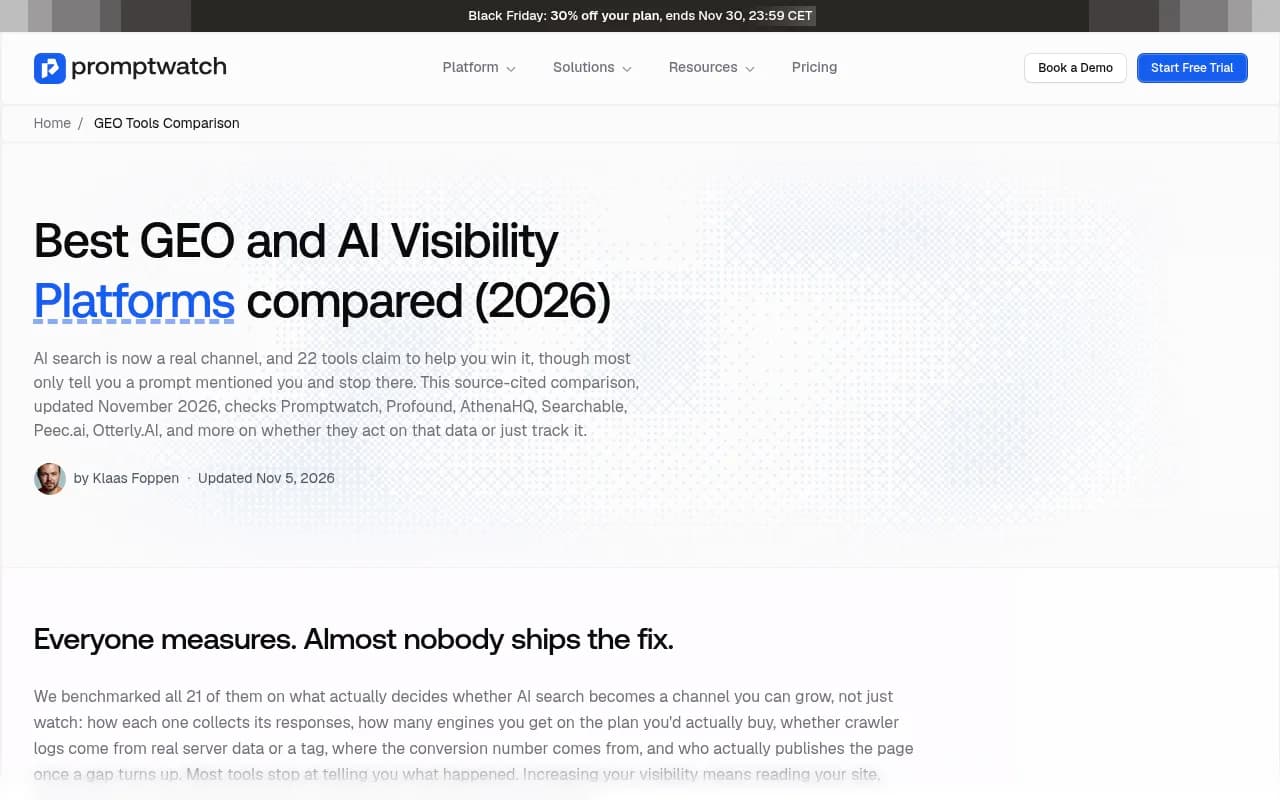
The table above comes from Promptwatch's own comparison, so read it as a vendor's view. It is still useful for seeing which tools put crawler logs on every plan versus a higher tier.
You mainly care about what AI says, and you publish a lot
Gauge fits if you want tracking tied to article production and can live with three platforms on Growth. Budget for $599/mo and confirm the agent-visit question first.
A sensible setup for most teams
Use more than one tool when the jobs differ. A common pairing is DarkVisitors for cheap, broad bot visibility and a visibility platform for the citation and revenue side. If you consolidate, make sure the crawler data is IP-verified, otherwise your "AI traffic" number includes impostors.
Whatever you pick, do three things first:
- Check robots.txt, CDN and WAF rules for every AI provider, not just OpenAI.
- Separate training crawlers from answer-time fetchers when you read logs.
- Keep citations and visits as different metrics. A bot reading your page is an access fact, not a ranking result.
One more caution on scale. Across 118,671 sites running Ahrefs Web Analytics, AI assistants sent 0.46% of traffic in October 2026, against 24.74% from Google. Agent visits are growing, but human referrals from AI are still small for most sites, so do not expect the numbers to justify a big spend by themselves.
Verdict
For pure agent-visit tracking, DarkVisitors is the cheapest and simplest. For tracking visits and also knowing whether they pay off, Promptwatch is the stronger pick because the logs are verified and connected to citations and conversions. Gauge is a capable answer-visibility and content tool, but on the evidence I could find it is not the one to buy for agent visit logs. Test that claim with a demo before you spend $599 on it.
If you want a second opinion on the strategy side, 1001 SEO Media helps brands set up GEO measurement and act on what the logs show.