Key takeaways
- Finseo and Surfer SEO both started as content tools and bolted on AI visibility tracking; Promptwatch was built for AI visibility first, with content generation as a downstream action, not the main event
- Surfer's Content Score is still one of the better NLP-based drafting tools on the market, but it measures relevance to the Google SERP, not whether AI engines actually cite you
- Finseo is priced aggressively (Starter at 70 EUR/mo billed yearly) and covers nine AI models, but it has almost no independent reviews yet and its own pricing page disagrees with third-party write-ups
- Promptwatch Data shows ChatGPT cites roughly half the sources Google AI Overviews does per answer, meaning "write more content" is not the same strategy as "get one of five scarce citation slots"
- If your actual problem is "we don't know if AI mentions us," a visibility-first platform beats a writing tool with a visibility tab bolted on
Three tools, three starting points
Here's the confusing part about shopping for "AI SEO" tools in 2026: almost every vendor now claims to do the same three things, tracking, content, and AI visibility. Finseo calls itself an AI Visibility Platform. Surfer rebranded parts of itself around AI search and content scoring. Promptwatch calls itself an AI Search Visibility and GEO platform. Read the homepages back to back and they start to blur.
But they didn't start in the same place, and that still shows in what each tool is actually good at.
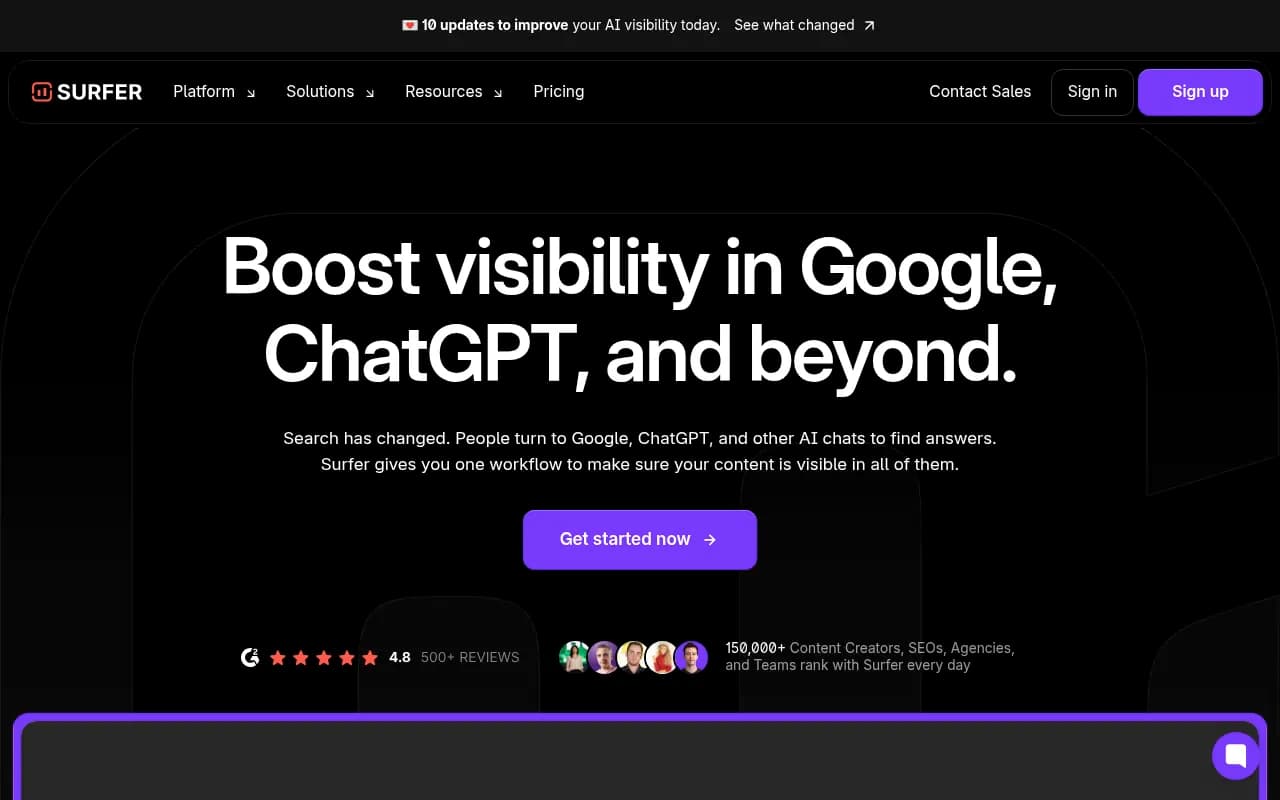
Surfer SEO began as a content optimization tool, arguably the best-known one. Its Content Editor scores your draft against the top-ranking pages for a keyword, using around 500 on-page signals, and tells you which terms to add. It's a genuinely useful writing companion. AI visibility tracking got added later, tier-gated behind the Standard plan and above.
Finseo came from the opposite direction, marketing itself from day one as AI visibility tracking, with content generation added as a feature inside the same dashboard. It tracks nine model families (ChatGPT, Claude, Gemini, Perplexity, Grok, Copilot, DeepSeek, Mistral, Google AI) and shows you which sources those models cite when they mention your category.
Promptwatch is built as an end-to-end visibility and GEO platform. It doesn't market itself as a writing tool that happens to track AI mentions. It tracks the mentions, shows you the crawler logs and citation trends behind them, and then uses Content Agents to publish content that closes the gaps it finds. The order of operations matters: visibility data drives the content, not the other way around.
That order of operations is the whole decision. If you buy a content tool hoping it solves an AI visibility problem, you'll get a nicer article and the same zero mentions. If you buy a visibility tool hoping it writes your content for you, some can (Promptwatch's Content Agents do), but most just hand you a dashboard of bad news with no way to act on it.
What each tool is actually built to do
Surfer SEO: content optimization first, AI tracking second
Surfer's core mechanic hasn't changed much in years, and that's not a knock. You give it a keyword, it pulls the top-ranking pages, extracts an NLP-derived list of "Terms to Use," and scores your draft in real time as you write or edit. Auto-Optimize and Coverage Booster can insert missing terms for you. It's fast, it's legible to non-SEOs, and a generation of content teams learned to write for Google with Surfer open in a second tab.
The catch, and independent reviewers have flagged this directly: Surfer's own Content Score doesn't always track with actual rankings. SearchEngineWatch found a page ranking #1 in Google with a Content Score of only 15-29, and noted that padding an article with roughly 300 extra words boosted its score by 29 points regardless of whether the words added any value. Google doesn't grade pages using Surfer's dashboard, and neither does ChatGPT.
The AI Tracker, now bundled as part of Surfer's broader "AI Search Analytics" push, checks visibility across ChatGPT, Perplexity, Google AI Mode, AI Overviews, and Gemini, but it's tier-gated. You need the Pro plan (roughly $182/mo billed annually) or above to get daily refresh and the full model set; Standard only gives you weekly ChatGPT checks on 25 prompts. That same SearchEngineWatch review found the AI visibility module returned zero mentions for their own brand in one test, which is either a sign the brand genuinely has no AI presence, or a sign the tracking still has gaps. Worth verifying against a second tool before you trust it as your only source of truth.
Finseo: cheap, broad model coverage, thin track record
Finseo's pitch is straightforward: track nine AI model families, show which sources they cite for your category (its homepage example shows Nike's top cited source being reddit.com at a 42% share), and generate content backed by "expert data" with a visible content score. Starter plans run 70-84 EUR/mo, which undercuts most of the category.
What's missing is a track record. As of this writing, Finseo has only three reviews on G2, one of which simply says it's "significantly cheaper than others." That's not a red flag on its own, tools are allowed to be new, but it means you're taking the vendor's word for feature depth rather than relying on a pile of independent verification. It's also worth noting that Finseo's own pricing page and third-party write-ups (like ColdIQ's) don't fully agree on plan names or costs, which suggests the pricing structure is still being iterated on. If you're evaluating Finseo, check finseo.ai/pricing directly before you commit to a plan based on a blog post.
Promptwatch: visibility data that turns into action, not just a dashboard
Promptwatch tracks the same core set of engines (ChatGPT, Claude, Gemini, Perplexity, Grok, Meta Llama, DeepSeek, Mistral, Copilot, Google AI Overviews and AI Mode) but the differentiator isn't the model count, it's what happens after you see the data. Crawler log analytics (Agent Analytics) show you when ChatGPTBot, ClaudeBot, PerplexityBot and 400+ other crawlers actually hit your pages, what they read, and where they error out. Citation trend data classifies every citation into 22 content types and 20 source types, so you can see whether it's your how-to guides or your product pages winning slots. Content Gap Analysis then maps your content against what's actually being cited, and Content Agents can write and publish the missing piece straight to Webflow, Framer, or WordPress.

That's the meaningful gap versus Finseo and Surfer: both of those tools show you a visibility number. Promptwatch shows you the number, the crawler behavior behind it, the citation-type breakdown, and then closes the loop with content that's built from what's actually getting cited, not a generic keyword brief. It's rated 4.7/5 on G2 across 1,840+ customers including Yelp, Duolingo, and Rabobank, which gives it more independent validation than Finseo currently has.
Why "write more content" isn't automatically the answer
Here's something that Promptwatch's own research data makes uncomfortably clear: the citation math is not the same across engines, and that changes what "optimize for AI" should even mean.
According to Promptwatch's average sources per response data, ChatGPT typically cites around five sources per web-search-triggered response, roughly half of Google AI Overviews' count of about ten. Perplexity sits close to ten as well, consistently, while Microsoft Copilot swings wildly, sometimes under two sources, sometimes nearly seventeen, and has recently settled at the low end. That means the citation slots you're fighting for on ChatGPT are roughly twice as scarce as the ones on AI Overviews. A content tool that just tells you to add more words to rank on Google doesn't tell you anything about that scarcity.
It also matters what kind of content is winning those scarce slots right now. Promptwatch's ChatGPT citation types data for August 2026 shows product pages leading at roughly 28.7% of citations but slipping through the month, while how-to content more than doubled, from 4.3% to 9.1%, and documentation nearly tripled, from 3.3% to 8.2%. If your content strategy is still built around Surfer-style keyword-density scoring for blog posts, you're optimizing for a format mix that's actively losing ground in ChatGPT citations right now.
And domain authority matters less than most SEOs assume. Promptwatch's citation share by domain rank data found mid-authority domains (DR 46-75) earned almost half of all ChatGPT citations in August 2026, while top-tier DR91-100 sites fell from about 7% to just 3% of citations over the same month. If you've been assuming you need Forbes-level authority to get cited, that's not what the data shows.
None of this is a knock on content optimization tools existing, it's a case for pairing content scoring with actual citation data rather than assuming one implies the other.
Side-by-side comparison
| Surfer SEO | Finseo | Promptwatch | |
|---|---|---|---|
| Core strength | NLP content scoring vs SERP | Low-cost, broad model tracking | End-to-end visibility + agentic content |
| AI models tracked | Up to 5 (Pro tier+) | 9 model families | 12+ engines, including AI Mode, Claude Code |
| Crawler log analytics | No | No | Yes (Agent Analytics, 400+ bots) |
| Content generation | Yes, editor-based scoring | Yes, content score + sources | Yes, Content Agents with CMS publishing |
| Citation type breakdown | Limited | Limited | 22 content types, 20 source types |
| Independent reviews | Mixed (inconsistent scoring flagged) | Very few (3 on G2) | 4.7/5 on G2, 1,840+ customers |
| Entry price | ~$49-99/mo | ~70-84 EUR/mo | Essential at $95/mo |
| Best for | Writers optimizing for Google rank | Budget-conscious AI mention tracking | Teams that need visibility data AND a fix |
So which one do you actually need?
Pick based on the actual bottleneck, not the feature list.
If your content genuinely isn't ranking on Google and you need a fast, legible way to tell writers what's missing from a draft, Surfer's Content Editor still does that job well. Just don't mistake a high Content Score for AI citation potential, they're not the same signal, and the independent review data backs that up.
If your budget is tight and you mainly want a cheap way to see whether ChatGPT or Gemini mention your brand at all, Finseo's price point is hard to argue with. Just go in knowing you're an early adopter of a platform with a thin public track record, and verify pricing directly rather than trusting a third-party recap.
If the real question is "why aren't we showing up in AI search, and what do we do about it," that's a different problem than either tool solves well. You need the crawler logs to see if AI bots are even reading your pages correctly, the citation-type data to know what format is winning right now, and a way to turn that into published content without a six-week content ops cycle. That's the gap Promptwatch is built to close, and it's the one most "AI visibility" add-ons, regardless of vendor, still leave open.
If you want to see where any of these platforms sit relative to two dozen other options before you commit, the GEO software directory at bestgeosoftware.com is a reasonable next stop, and agenticseotools.com is worth a look if what you actually want is the agentic, does-the-work-for-you category rather than another dashboard.