Key takeaways
- Finseo combines AI visibility tracking (ChatGPT, Claude, Gemini, Perplexity, and others), a GEO/AIO content audit, bot analytics, and AI-generated content publishing in one tool, priced from €84/mo for 50 tracked prompts up to custom Enterprise plans
- Its AI writing feature drafts articles from real tracked prompts and scores them for citation likelihood before publishing, which is a genuinely different workflow than a generic AI writer bolted onto a keyword tool
- Finseo is not a full technical SEO suite. It's explicitly built for AI search visibility and bot tracking, not general audits, backlink analysis, or CRM-style marketing automation
- Third-party review volume is thin (3 reviews on G2 as of this writing), so quality claims about the writing output rest mostly on Finseo's own case studies and word of mouth
- Whether it's "enough" depends on what else your stack already covers. Teams with a solid technical SEO tool already in place will get more out of Finseo than teams expecting it to replace everything
What Finseo actually is
Finseo is a German company (founded 2025, based in Gaildorf) that built an AI search visibility platform and then bolted an AI content engine onto it. That ordering matters. A lot of AI writing tools added "AI visibility tracking" as a feature once GEO became a buzzword. Finseo went the other direction: it started by tracking how brands show up across ChatGPT, Claude, Gemini, Perplexity, Copilot, Grok, DeepSeek, and Mistral, then built the writing tool to close the gaps that tracking exposed.
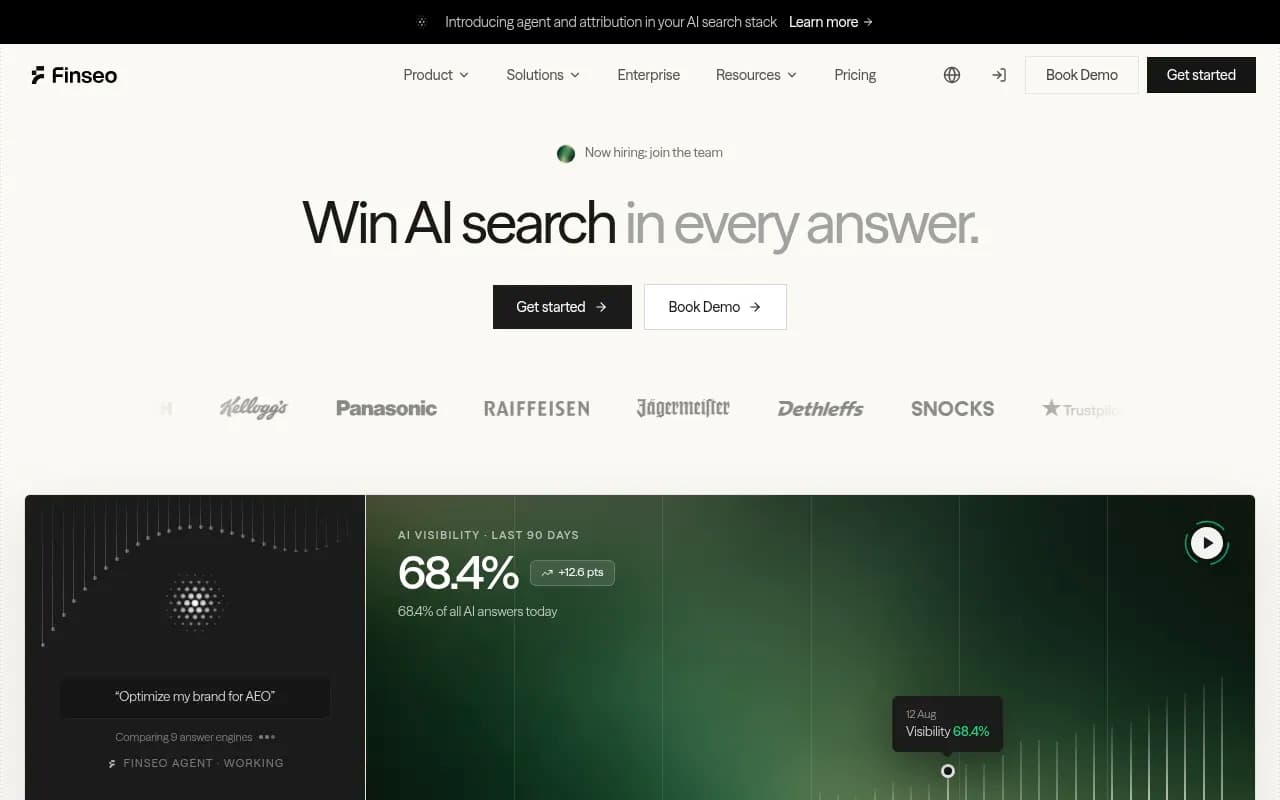
The company counts Kellogg's, Panasonic, Lidl, Würth, Jägermeister, and Trustpilot among its 500+ customers, most concentrated in the DACH region and broader Europe. Case studies cite visibility gains like HolzLand's +53.4 percentage points and Laserhub's +26.7 points, though these are self-reported and not independently audited.
The two halves of Finseo: tracking and writing
AI visibility tracking
Finseo tracks a set number of prompts (50 to 350+ depending on plan) across up to three AI models concurrently on standard plans, or up to 11 on Enterprise. It updates daily and reports a visibility percentage, similar to a share-of-voice metric but for AI answers instead of search rankings.
What differentiates it from a pure tracker is the bot analytics layer. Finseo can connect to your Cloudflare setup or ingest server logs to show exactly which AI crawlers (GPTBot, ClaudeBot, PerplexityBot, and others) are hitting your site, what status codes they get, and which URLs they crawl most. The logic behind this feature is straightforward: a page no crawler can reach cannot be cited. That's a real, operational point. Our own data on AI crawler traffic shows OpenAI's crawlers went from 94.8% of verified AI crawler requests in June 2026 down to 79.8% by early September, meaning Anthropic, Google, Perplexity, and Mistral crawlers are taking a growing slice of the pie. A robots.txt rule that quietly blocked one bot a year ago might now be cutting you off from a meaningfully larger share of AI discovery than it used to.
AI writing and the GEO audit
The writing side generates AEO-optimized articles, comparisons, and guides based on the actual prompts Finseo is tracking for your brand, pulling source material from connected tools like Notion, Google Drive, and Slack. Every draft gets scored for citation likelihood before it goes anywhere, and it can publish straight to Shopify, WordPress, Webflow, Framer, Shopware, or WooCommerce.
The GEO/AIO audit is arguably the more useful half for teams that already have writers. It checks whether AI models can even read your content (a real gotcha: if your page only renders after JavaScript executes, most AI crawlers never see it), matches unverified claims against credible sources, and spits out ready-to-paste schema markup.
Is the AI writing actually good enough?
Here's where I have to be honest about the limits of what's publicly verifiable. Finseo's G2 profile has three reviews. Three. One reviewer says "finseo does it all" for writing and keyword research, which is nice to hear but is one data point, not a pattern. There's no independent benchmark comparing Finseo's article output against dedicated content optimization tools like Surfer SEO or Clearscope.
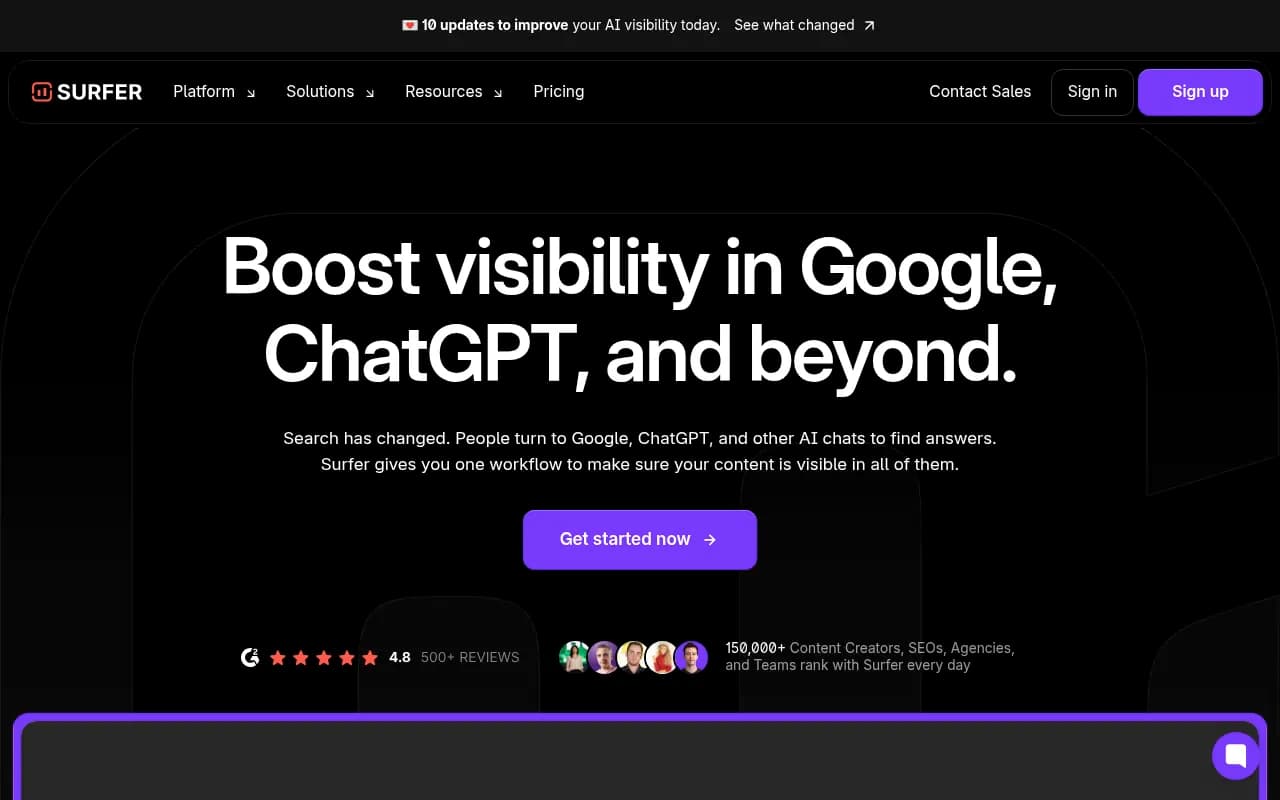
SurferStack's review from ColdIQ makes an important distinction worth repeating: Finseo "is not meant for general SEO audits or CRM management, it focuses solely on AI-driven search visibility and bot tracking, not broad marketing automation." That's Finseo's own positioning, essentially, and it's the honest read. If you're expecting Finseo's writing tool to replace a mature content optimization workflow built around Surfer, Clearscope, or MarketMuse, that's probably the wrong expectation.
What Finseo's writing tool does have going for it that a generic AI writer doesn't: it's grounded in the same tracked prompts feeding the visibility dashboard, so content ideas come from queries you already know your brand is losing on, not guesswork.
Why keyword research alone doesn't cut it for AI search anymore
This is the bigger question buried in the headline, and it applies to any tool, not just Finseo. Traditional keyword research tells you what people type into a search box. AI search doesn't work off a single query anymore. When someone asks ChatGPT or Google AI Mode a question, the engine fans that query out into multiple sub-searches behind the scenes, then stitches together an answer from a handful of retrieved sources.
Our data on average sources per response makes the scale of the problem clear. ChatGPT typically cites around 5 sources per answer, roughly half of a traditional 10-link Google results page. Perplexity and Google AI Overviews both cite closer to 10. Microsoft Copilot has swung wildly, from under 2 sources to nearly 17 within weeks, which tells you Microsoft is still figuring out its own attribution model. Whatever the number, it's a small shortlist. Getting your keyword targeting right doesn't guarantee a seat at that table; getting your content structured so a specific passage can be lifted and cited does.
This is also why domain authority matters less than most SEO teams assume. Our citation share by domain rank data from August 2026 shows mid-authority domains (DR 46-75) earned nearly half of all ChatGPT Search citations, while the very top tier (DR 91-100) fell from about 7% to roughly 3% over the same period. A well-structured page from a mid-tier site beats a vague, broad page from a high-authority domain more often than SEO teams expect.
What content formats are actually winning
If your AI writing tool is still churning out generic "ultimate guide" listicles, you're optimizing for a format that's losing ground. Our ChatGPT citation types data from August 2026 shows product pages holding the largest share at 28.7%, but how-to content more than doubled across the month, from 4.3% in week one to 9.1% by month's end, putting it roughly level with listicles. Documentation-style pages rose from 3.3% to 8.2%. Meanwhile, social posts collapsed from 4.4% to under 1% after August 14, the same day Reddit's citation share in ChatGPT dropped from about 4% to 0.5% almost overnight, a shift confirmed in our Reddit citation report.
The practical read: if your content strategy leans on broad guides or hopes UGC-style mentions carry weight, that bet is getting weaker. Tight, specific how-to and comparison content is gaining.
Finseo pricing breakdown
| Plan | Monthly (EUR) | Tracked prompts | Models concurrently | Projects | Best for |
|---|---|---|---|---|---|
| Starter | €84 | 50 | 3 | 1 | Solo operators testing AI visibility |
| Business | €210 | 150 | 3 | 1 | Small SEO teams wanting bot analytics and content generation |
| Growth | €479 | 350 | 3 | 5 | Agencies or multi-brand teams |
| Enterprise | Custom | Custom | up to 11 | Unlimited | Large orgs needing Slack support and custom model coverage |
Articles cost 500 agent credits each on the Business plan's 7,500 monthly credits, which works out to roughly 15 articles a month, or you can spend those credits on crawlability checks instead (35 credits each). Team seats are unlimited on every plan, which is a nice touch compared to per-seat pricing elsewhere in this category.
How Finseo compares to the rest of the field
| Tool | Starting price | AI writing | Crawler/bot logs | Reddit/YouTube tracking | Best fit |
|---|---|---|---|---|---|
| Finseo | €84/mo | Yes, prompt-grounded | Yes | No | Teams wanting tracking + writing in one tool |
| Peec AI | $95/mo | No | No | No | Clean monitoring dashboard, no content |
| Otterly.AI | $29/mo | No | No | No | Budget-conscious monitoring only |
| Semrush AI Visibility Toolkit | $99/mo | No | No | No | Teams already inside Semrush |
| Promptwatch | $95/mo | Yes, with Content Agents and CMS publishing | Yes, plus crawl-to-citation path | Yes | Teams wanting the full stack: tracking, crawler logs, Reddit/YouTube, automated content, and Agent Chat |
This is where the "is it enough" question gets sharper. Finseo covers tracking, a GEO audit, bot analytics, and AI writing, which is a genuinely broad feature set for the price. But it's missing dedicated Reddit and YouTube citation tracking, ChatGPT Shopping monitoring, and an Ads Radar for sponsored AI placements, channels that are increasingly part of how brands get discovered in AI answers.
Promptwatch covers that wider stack: crawler logs with a citation rate per page, content gap analysis with git-diff-style update suggestions, Reddit and YouTube citation reports, ChatGPT Shopping and Ads Radar, and an Agent Chat you can ask questions of directly. It's used by over 1,840 brands and agencies including Duolingo, Yelp, and Typeform, and is rated 4.7/5 on G2 based on a much larger review base than Finseo's current three.

So, is Finseo enough on its own?
For a small team that wants one dashboard covering "are we visible in AI search" and "can we generate content to fix the gaps," Finseo is a reasonable starting point, especially at the Business tier price point. It's clearly not trying to be everything. It skips traditional technical SEO audits, backlink analysis, and general marketing automation on purpose, staying focused on AI visibility and bot tracking.
Where I'd push back on relying on it exclusively: the writing quality claims are still largely unverified by independent reviewers, and it's missing coverage of Reddit, YouTube, and shopping-related AI surfaces that are demonstrably part of how people discover brands through AI now. If your team already runs Surfer SEO or Clearscope for content optimization and just needs the AI visibility layer, pairing Finseo's tracking with your existing content stack might make more sense than using its writer end to end.
For teams evaluating the wider category before committing, the GEO software directory at bestgeosoftware.com is worth a look, and 1001 SEO Media can help if you'd rather have a team run the GEO and content strategy rather than manage another dashboard yourself.