Key takeaways
- BrightEdge found 2.3% of brand mentions in Google AI Overviews skewed negative versus 1.6% in ChatGPT, so AI Overviews were 44% more likely to go negative (mid-January to February 2026 data). Google disputed the methodology.
- The engines go negative for different reasons. AI Overviews lean toward news and controversy. ChatGPT leans toward product evaluation and "is it worth it?" questions.
- On overlapping negative prompts, the two engines flagged different brands 73% of the time, so tracking one engine gives you half the picture.
- Source mix explains a lot. Promptwatch Data shows social platforms are 13.16% of AI Overviews citations and 0.64% of ChatGPT citations (Oct 11 to Nov 9, 2026).
- Monitor each engine separately, then fix the specific pages and third-party sources each one leans on.
Why tone is a real brand problem now
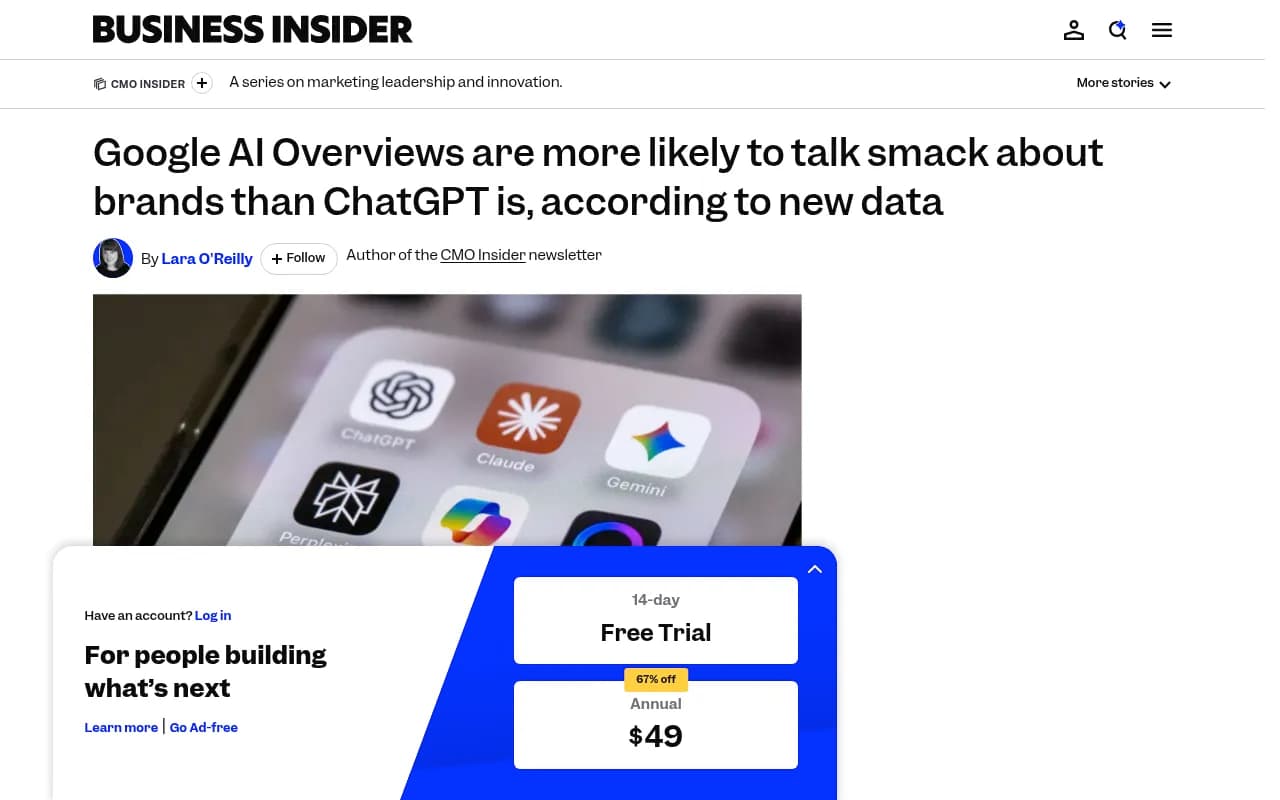
Classic search showed ten blue links and let the reader form an opinion. AI answers form the opinion for them. BrightEdge CEO Jim Yu put it plainly to Business Insider: AI "has an opinion," and that "fundamentally changes marketing."
Most of what these engines say about brands is fine. The majority of mentions BrightEdge observed were positive or neutral. The issue is scale. A 1.6% or 2.3% negative rate across hundreds of millions of prompts still reaches a lot of people, and it tends to land at moments when someone is forming a shortlist.
This guide compares the two engines, explains the mechanics behind the difference, and gives you a monitoring and fix workflow. One caveat up front: the sentiment figures here come from BrightEdge, a third party, and Google's spokesperson called the report "a flawed methodology to make sensational claims" and noted the gap is under one percentage point. I treat the numbers as directional, not gospel. The patterns in why each engine goes negative are more useful than the headline percentage.
What the BrightEdge data says
BrightEdge analyzed hundreds of millions of prompts using its AI Catalyst product, with a deeper cut across Apparel, Electronics, and Education.
| Engine | Positive | Neutral | Negative |
|---|---|---|---|
| Google AI Overviews | 49.9% | 47.7% | 2.3% |
| ChatGPT | 43.9% | 54.4% | 1.6% |
Two things stand out. First, ChatGPT is more neutral. It mentions plenty of brands but takes fewer editorial positions, good or bad. Second, Google's positive-to-negative ratio is roughly 21:1 against ChatGPT's 27:1. Both are friendly overall. Google is simply more willing to say something critical when it does take a position.
Two editorial personalities
The more interesting finding is the trigger pattern. When only one engine went negative on a query:
- Google AI Overviews was 4.5x more likely than ChatGPT to go negative on news and controversy: lawsuits, boycotts, data breaches, regulatory actions, recalls.
- ChatGPT was 3x more likely than Google to go negative on product evaluation: compatibility gaps, missing features, "is it worth it?" assessments.
BrightEdge's analogy: Google acts like an investigative reporter, ChatGPT like a product advisor. A retailer could get dinged in AI Overviews over a lawsuit story, and in ChatGPT because it does not accept a certain payment method. Same brand, different problem.
Common triggers across both engines
| Negative sentiment trigger | Share |
|---|---|
| Brand controversies and legal issues | 32% |
| Product limitations and compatibility | 21% |
| Safety and recalls | 17% |
| Service failures and outages | 11% |
| Price and value criticism | 8% |
| Competitive comparisons | 3% |
Source: BrightEdge AI Catalyst, February 2026, as reported by Business Insider. One bucket in the published chart (9%) had no readable label, so I have left it out.
The funnel stage matters
Google's negativity is concentrated early. About 85% of negative AI Overviews appeared on informational queries. ChatGPT also skews informational (68.5%), but it shows far more negativity at the consideration stage: 19.4% versus Google's 1.5%. The Martech Edge write-up of the study summarizes it as ChatGPT criticizing brands "at a far more critical moment: right before customers make a purchase."
Put simply, Google shapes first impressions during research. ChatGPT can nudge a decision when someone is comparing options.
Disagreement is the norm
On prompts where both engines went negative, they disagreed on which brand to flag 73% of the time. About 1.4% of brand-mention prompts also showed mixed sentiment, with one answer praising one brand and criticizing another. That is the engine acting as an evaluator, which classic SERPs never did.
Why the tone differs
BrightEdge reports the what. The why comes from how each engine gets its material.
Retrieval architecture
Google AI Overviews pull from Google's own search index, so recent news, forum threads, and critical coverage that already ranks are fair game. That fits the controversy skew: a fresh lawsuit story is exactly what a live index surfaces. A Google spokesperson made the same point, saying AI Overviews "are based on web content, and reflect what sources on the web say about a topic."
ChatGPT leans more on what it learned in training, with search used on a subset of queries. Third-party analyses put ChatGPT search activation at roughly a third of queries in early 2026, though I would treat that number loosely. Training-heavy answers are more stable and more neutral, which matches the 54.4% neutral figure. They also lag. Old negative stories can persist, and BrightEdge's Yu noted that even dated negative news and past customer feedback can influence responses.
Source mix
This is where Promptwatch Data gives a concrete, first-party angle. Promptwatch tracks citations across engines, and its social media citations report for Oct 11 to Nov 9, 2026 shows how different the source pools are:
| Engine | Social platforms' share of citations | Biggest social source |
|---|---|---|
| Google AI Overviews | 13.16% | YouTube, 6.71% |
| Perplexity | 1.94% | Reddit, 0.82% |
| ChatGPT | 0.64% | Reddit, 0.40% |
AI Overviews cites social media about 20 times as often as ChatGPT. The earlier October snapshot (Sep 28 to Oct 4, 2026) had the same shape: 12.2% versus 0.46%. If an engine reads customer complaints, video reviews, and forum threads, it will repeat what people say there. If it mostly reads brand pages, docs, and listicles, it will sound more measured.
That last point is what Promptwatch's content type report shows for ChatGPT (Sep 28 to Oct 4, 2026). Product pages are 22.4% of citations and landing pages 16.8%, so about 39% of citations point at pages describing what a company sells. For branded prompts like "is HubSpot good for startups," reviews jump to 5.6%, more than three times their share across all prompts, and social posts reach 3.0%. So when a user names your brand in ChatGPT, the answer is built largely from your own pages plus reviews. That is why ChatGPT's criticism tends to be about product facts: the evidence it reads is product-shaped.
Freshness and decay
AI Overviews reward recency, and Yu says as much: "AI loves to find the most recent information." On the ChatGPT side, Promptwatch's content half-life data shows news losing half its cited pages within about 36 days, while landing pages and docs last longer. A news-driven negative story fades faster in ChatGPT than a negative claim sitting on a durable product or review page.
Side-by-side comparison
| Factor | Google AI Overviews | ChatGPT |
|---|---|---|
| Negative mention rate (BrightEdge) | 2.3% | 1.6% |
| Typical trigger | Controversy, news, recalls | Product limits, value questions |
| Funnel stage of negativity | Mostly early research (85%) | Research plus more consideration (19.4%) |
| Social share of citations | 13.16% | 0.64% |
| Evidence it leans on | Live index, news, YouTube, forums | Brand pages, reviews, training data |
| Neutral share | 47.7% | 54.4% |
| Main reputation risk | A news cycle you cannot control | A factual gap or weakness on your own pages |
How to monitor tone on both engines
A single sentiment dashboard is not enough, because the two engines disagree about which brand to flag. Track them separately, with these habits:
- Separate branded from non-branded prompts. "Is [brand] worth it" and "best tools for X" produce different tones.
- Cover the funnel. Run informational, consideration, and comparison prompts, since the engines diverge by stage.
- Record the claim, not only the score. "Expensive for small teams" is actionable. "Sentiment 41" is not.
- Repeat observations. One response is an anecdote. Track over weeks.
- Log market and language. A monitor fixed to one country keeps results clean.
- Note the source behind each criticism. That tells you whether to fix your page, answer a Reddit thread, or earn a better review.
Tools in this space include Promptwatch, which collects answers from the real ChatGPT and Google AI Overviews interfaces and breaks sentiment out by prompt, topic, and competitor. Its Brand Narrative feature pulls out the individual claims AI makes about you and files them under themes like Pricing, Features, and Reputation. Fact Check lets you mark a claim inaccurate and then finds the pages on your site that state it, on Business plans and above. Pricing starts at $95/month for Essential, with a 7-day free trial; confirm current plans at promptwatch.com/pricing.

Other options worth a look if you are shortlisting:


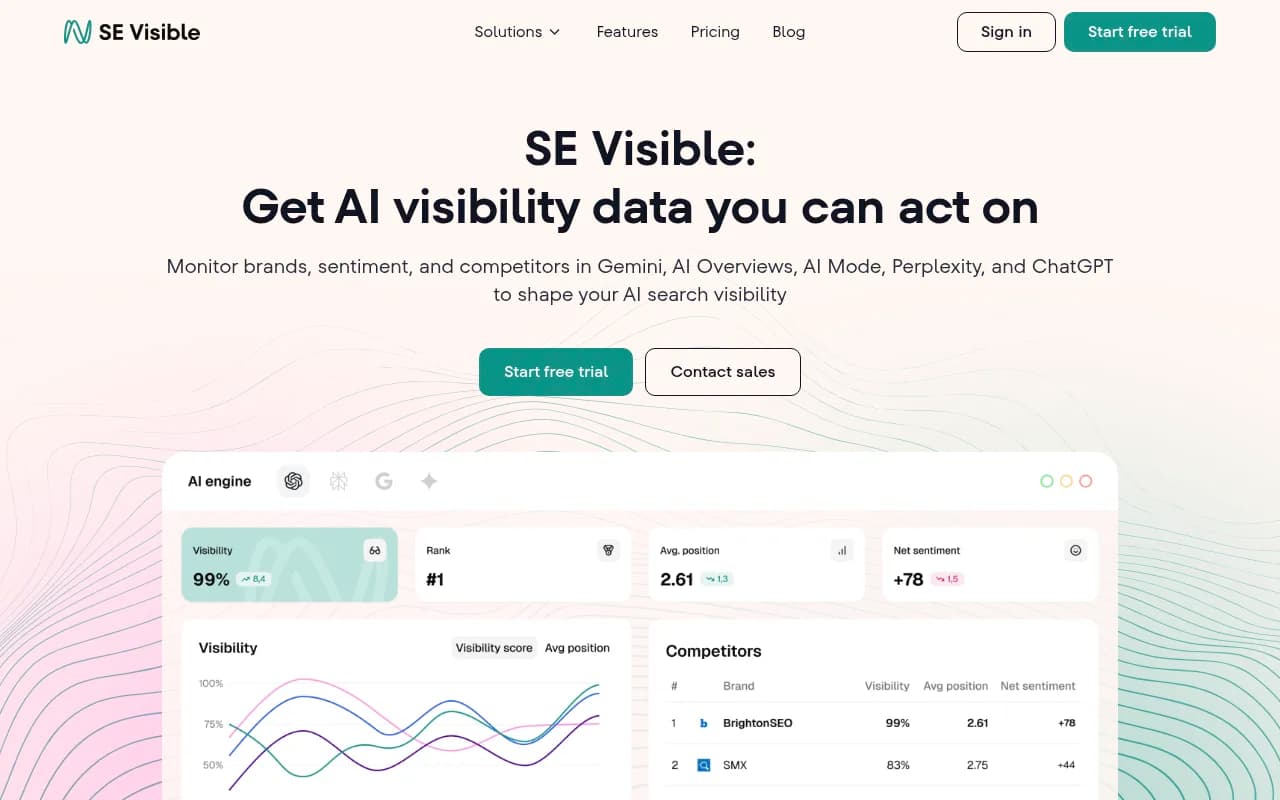
BrightEdge is the source of the sentiment study and an enterprise SEO platform. Profound is an enterprise-priced monitoring tool. Peec AI is a lighter prompt tracker. SE Visible tracks visibility and sentiment. If you want a wider list, the GEO software directory covers the category.
What to do about it
If Google AI Overviews is your tone problem
- Find the source. AI Overviews often quote recent news, forums, and video. Look at which URLs it cites when it criticizes you.
- Put YouTube first. Promptwatch's report recommends YouTube as the priority for Google, since it is 6.71% of AI Overviews citations, more than the other six social platforms combined (6.45%).
- Publish your own account of any controversy, recall, or outage on a crawlable, dated page. You cannot remove the news story, but you can give the engine a current primary source.
- Keep a steady cadence of new content. Recency is part of what gets cited.
If ChatGPT is your tone problem
- Audit product and landing pages for the weaknesses ChatGPT repeats: compatibility, missing features, pricing clarity. Since these pages are the core of what ChatGPT cites, a vague page invites a negative inference.
- Publish an FAQ that answers the "does it support X" and "is it worth it" questions directly. Promptwatch's report recommends owning the branded answer this way.
- Collect reviews on the sites trusted in your category. Reviews carry more weight on branded prompts.
- Do not count on social posts to move ChatGPT. At 0.64% of citations, they barely register.
If it is both
Start with the shared triggers. BrightEdge says controversy and legal issues are the top cause (32%) on both platforms, followed by product limitations (21%). Yu's advice is to analyze the sources the engines cite and work backward, rather than doing "a bunch of Reddit" for its own sake.
Crawler access is worth a check too. If AI bots cannot read your corrected pages, nothing improves. Promptwatch's AI crawler logs show which bots hit which pages and where they fail.
Common mistakes
- Treating the 44% figure as a law of nature. It comes from one vendor's dataset, Google disputes it, and the absolute gap is under a percentage point.
- Assuming a good score on one engine carries over. With a 73% disagreement rate on which brand gets flagged, it does not.
- Monitoring only transactional prompts. Most negativity appears at the informational stage, when opinions form.
- Reading a mention as an endorsement. Being named is different from being recommended, and a mention can be critical.
- Fixing sentiment without fixing the cause. If a review site or video is the source, rewriting your homepage will not move the answer.
A simple 30-day plan
| Week | Task |
|---|---|
| 1 | Build 30 to 50 prompts across informational, consideration, and branded intent. Run them on both engines. |
| 2 | Tag every negative or mixed answer by trigger (controversy, product, price, outage) and by cited source. |
| 3 | Fix owned pages, add the FAQ, and queue review and video work for the sources each engine leans on. |
| 4 | Re-run the prompts, compare against week 1, and note which claims moved. |
For a free first look at how ChatGPT, Gemini, and Perplexity talk about your brand, Promptwatch offers a free AI visibility report. Teams comparing engines in more depth can also read the Promptwatch Data hub.
Bottom line
Google AI Overviews acts like a news desk and ChatGPT like a product advisor. One reacts to what the web is saying this week, the other to what your product pages and reviews say about what you sell. The rates are low and the methodology is contested, but the patterns hold up against how each engine sources its answers. Track them separately, trace every criticism to its source, and fix that source.