Key takeaways
- A brand perception audit for AI search asks three things: does the answer name you, does it describe you accurately, and which sources shaped that description.
- One page is enough if you fix the structure: prompt set, visibility score, claim accuracy, source map, and an action list.
- Run each prompt type across many prompts. A single prompt tells you very little, and brand-specific prompts rely on only a handful of cited domains.
- Free graders give you a quick baseline, but they read training data. Live-search tracking is what shows citations changing.
- Re-audit every quarter, and treat the first audit as a benchmark rather than a verdict.
What a brand perception audit means in AI search
A classic brand audit looks at logos, messaging and social presence. An AI perception audit asks a narrower question: when a buyer asks ChatGPT, Gemini or Perplexity about your category or your name, what comes back?
There are two layers. The first is visibility: are you named at all? The second is perception: how are you described, in what tone, next to which competitors, and are the claims true? A brand can be highly visible and still be described as expensive, outdated or missing a feature it shipped two years ago.
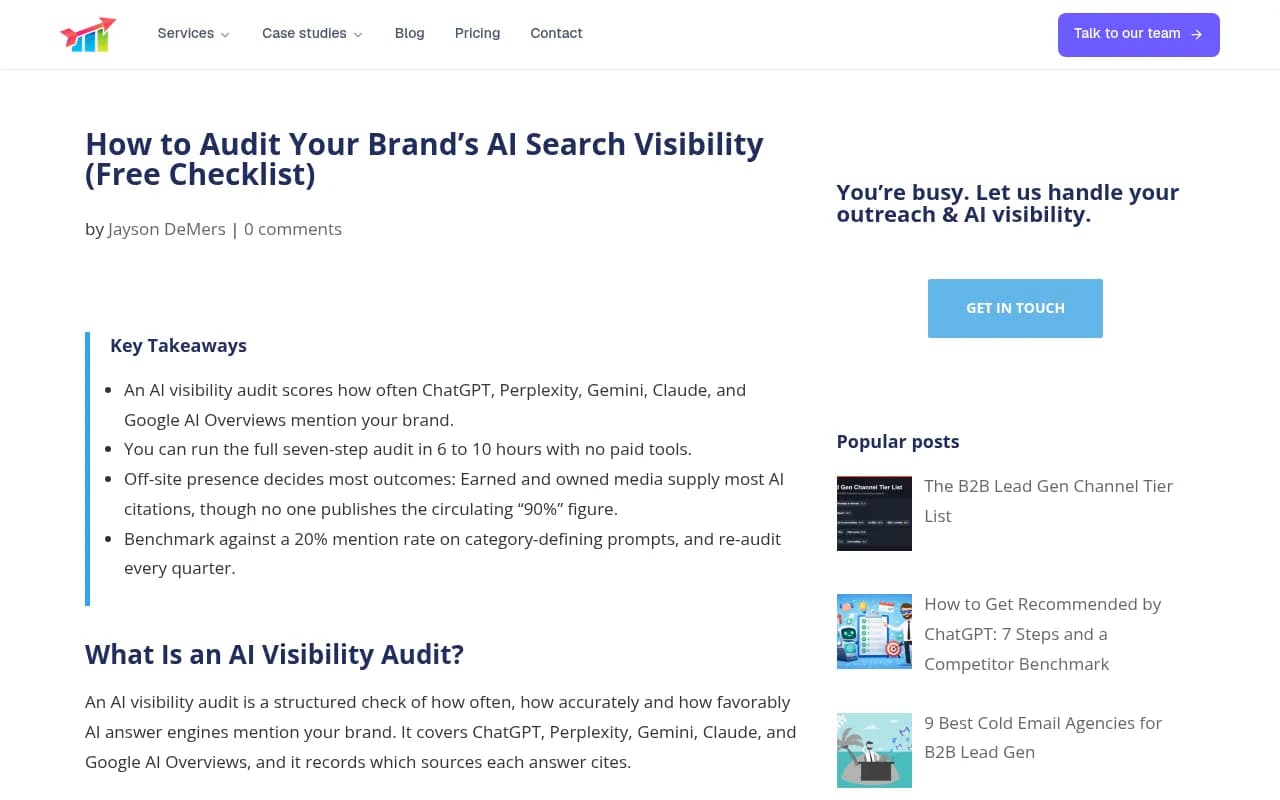
That second layer is why this audit is different from a plain AI visibility check. The outreachbloom 7-step framework defines an AI visibility audit as a check of how often, how accurately and how favorably answer engines mention you. I like that wording because "accurately" and "favorably" are the parts most teams skip.
The one-page template
The goal is a single page you can paste into a doc, a slide or a spreadsheet tab and hand to a stakeholder. Here is the layout I use. Copy it.
Section 1: scope block
Fill this in at the top so the report can be repeated next quarter.
Brand: ____________   Audit date: ________   Auditor: ________
Markets / languages: ____________
Engines tested: ChatGPT / Gemini / Perplexity / AI Overviews / Claude
Prompt count: ___ organic, ___ brand-specific, ___ competitor comparison
Competitors tracked: ____________
Section 2: visibility scorecard
Score every prompt response using a simple three-state scale. Outreachbloom's framework uses Absent, Mentioned and Recommended, and it works well in a spreadsheet.
| State | What the answer does | Score |
|---|---|---|
| Absent | Names competitors, never you | 0 |
| Mentioned | Names you in passing or in a list (log your position) | 1 |
| Recommended | Names you as the fit for the buyer's stated need | 2 |
Then report three numbers on the page: mention rate (share of prompts scoring 1 or 2), recommendation rate (share scoring 2), and average list position when mentioned. Outreachbloom suggests a 20% mention rate on category-defining prompts as a starting benchmark. That is one vendor's rule of thumb, not verified data, so treat it as a rough target and compare against your own competitors instead.
Section 3: perception block
This is the part that makes it a perception audit. For each engine, write down the recurring claims the answers make about you. Group them under four themes: pricing, features, support and reputation. Then mark each claim as accurate, inaccurate or outdated.
| Theme | Claim AI makes | Engines saying it | Accurate? | Source it seems to come from |
|---|---|---|---|---|
| Pricing | "Affordable for small teams" | ChatGPT, Gemini | Yes | Own pricing page |
| Features | "Lacks a mobile app" | Perplexity | No (shipped 2025) | Old review article |
| Reputation | "Mixed support reviews" | ChatGPT | Partly | Review site |
Also add a one-line sentiment read per engine: positive, neutral or negative. Keep it blunt.
Section 4: source map
List the five to ten domains that show up most often in the answers about you. Mark each as owned (your site), earned (press, reviews, comparisons) or social (Reddit, YouTube, LinkedIn). This block usually produces the most useful surprises, because the page shaping your perception is rarely the one you would guess.
Section 5: action list
Finish with five to seven actions, each with an owner and a date. Examples: fix the outdated feature claim on your own site, request a correction from the review site that carries the wrong claim, publish a comparison page where you are absent, or pitch the listicles that already get cited.
Choosing the prompt set
The prompt set decides whether the audit is worth anything. Three types matter, and Promptwatch Data shows why they behave differently.
- Organic prompts, with no brand named: "best project management tool for agencies."
- Brand-specific prompts: "is [Brand] good for small teams," "is [Brand] trustworthy."
- Competitor comparison prompts: "[Brand] vs [Competitor]."
According to Promptwatch's data on unique domains per ChatGPT response (Sep 28 to Oct 4, 2026), 52.5% of organic prompt responses cite 10 or more domains, while for brand-specific prompts the most common count is just 5 domains. That matters for your audit. On brand-specific prompts, a handful of sources, usually your site, review sites and forums, heavily shape how ChatGPT describes you. So the perception block deserves most of your attention there.
The same report's advice is worth following: track your position in the answer and how you are described, not only whether you are cited, and run each prompt type across many prompts. Twenty to thirty prompts per type is a sensible starting size for a manual audit. Fewer than ten and you are reading tea leaves.
For personas, rewrite the same prompts the way different buyers would ask them. A CFO and a developer ask for the same product very differently, and the answers can differ.
Running the audit step by step
- Build the prompt list and freeze it, so next quarter is comparable.
- Run each prompt in a clean session on each engine, with web search on where the engine offers it. Log the full answer and the cited sources.
- Score visibility using the three-state scale.
- Pull the claims about your brand into the perception table.
- Fact-check each claim against your own site and product.
- Build the source map from the citations.
- Write the action list and date the next audit.
Expect 6 to 10 hours by hand, which is the range outreachbloom estimates for its free version. That is fine once. By the second quarter you will want automation.
A caution on consistency
AI answers vary run to run, and engines differ in how many sources they show. Promptwatch's average sources per response data puts ChatGPT at about 5 sources per web-search answer, Google AI Overviews at about 10, and Perplexity at almost exactly 10, steady day after day. Copilot swung from under 2 to nearly 17 within a few weeks. So judge Copilot on monthly trends, and use Perplexity as your stable test bench when you check whether a change moved anything.
Where the perception comes from
Once you have the source map, compare it with what the data says about each engine, because the fix depends on the engine.
| Engine | Social share of citations (Oct 11 to Nov 9, 2026) | What it means for your audit |
|---|---|---|
| Google AI Overviews | 13.16% | Check YouTube and Facebook presence |
| Perplexity | 1.94% | Check Reddit and LinkedIn |
| ChatGPT | 0.64% | Own site and third-party guides dominate |
These figures come from Promptwatch's November 2026 social citation report. Within AI Overviews, YouTube made up 6.71% of citations. For ChatGPT, Reddit was only 0.40%. The practical reading: if the audit shows ChatGPT describing you wrongly, hunting through Reddit threads is probably the wrong first move. Look at your own pages and the comparison articles and listicles it cites instead. For Google audiences, video matters more than most teams assume.
Free tools for a quick baseline
Before doing the manual work, you can get a rough read in a few minutes.
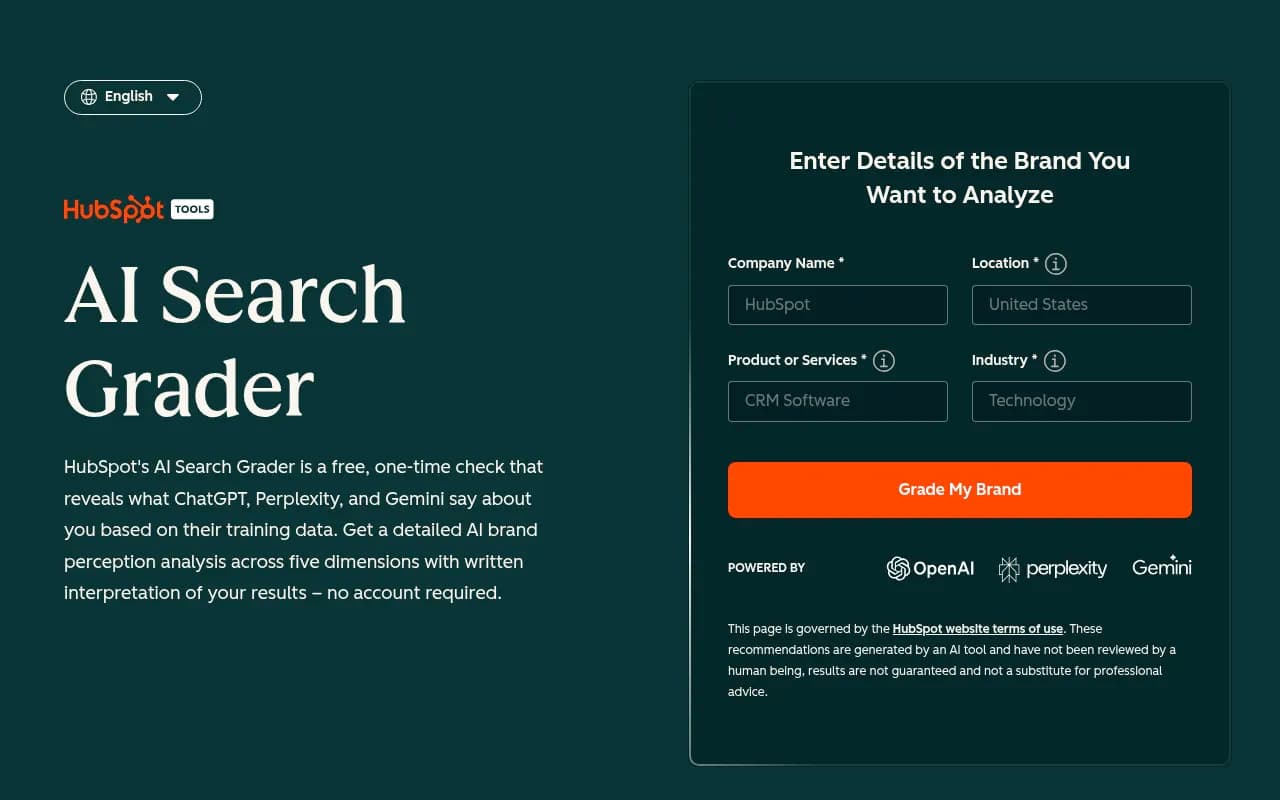
HubSpot's AI Search Grader is free, needs no account, and uses OpenAI, Perplexity and Gemini to report on five dimensions of brand perception. Two limits: it reflects the models' training data rather than live search citations, and HubSpot says the output is AI-generated and not human-reviewed. Good for a first impression, not a final report.
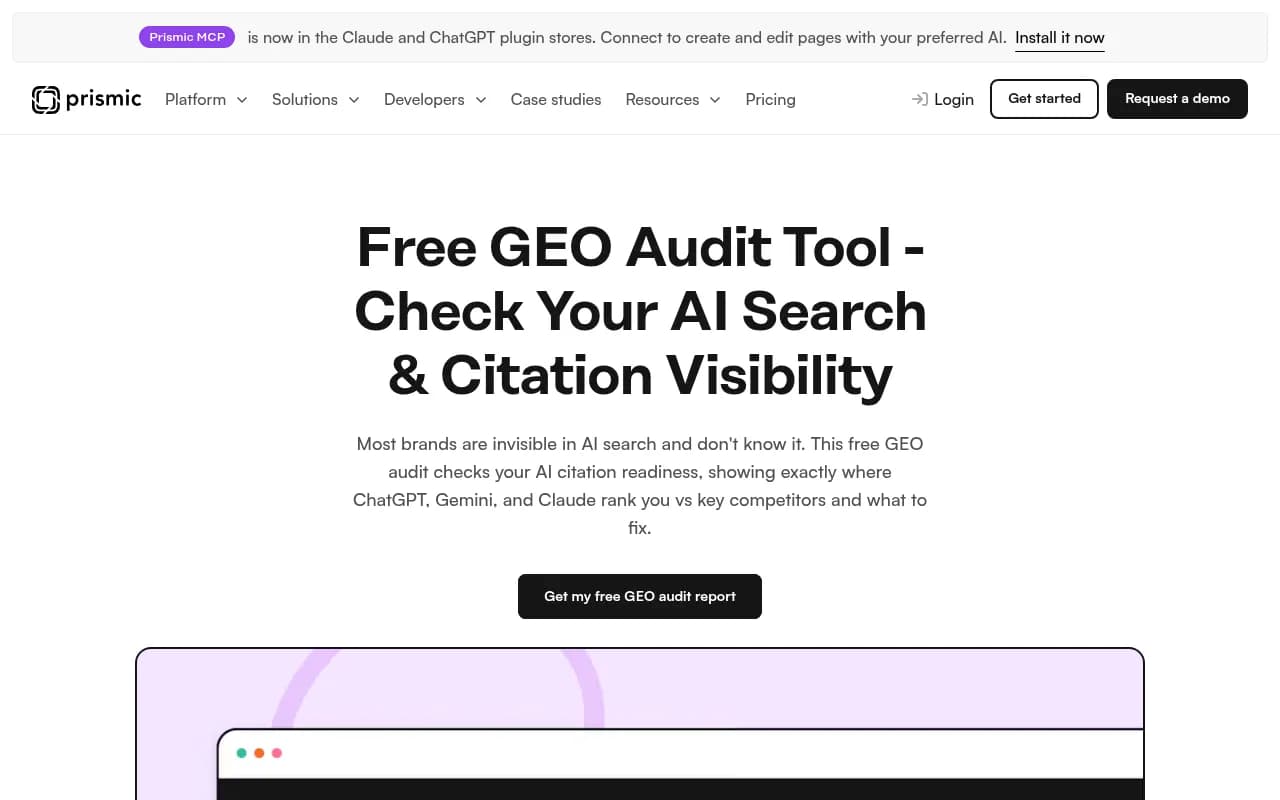
Other free one-off checks in the catalog include Prismic's GEO audit and AnswerGist.


Treat these as a spot check. Run two or three, compare the outputs, and notice where they disagree. Disagreement between tools usually means the underlying answers are unstable, which is itself a finding.
Moving from a spreadsheet to ongoing tracking
The manual template has a ceiling. You can only sample so many prompts, you cannot see how citations shift week to week, and fact-checking claims by hand does not scale past a few dozen.
This is where a platform earns its keep. Promptwatch covers the whole audit loop: it collects answers from the real interfaces of ChatGPT, Gemini, Perplexity, Google AI Overviews and others, scores visibility and sentiment, and its Brand Narrative feature pulls out the individual claims AI makes about you and groups them under themes like pricing, features and support. Fact Check, on Business and higher plans, lets you mark a claim inaccurate and then finds the pages on your site that state it or its opposite. That maps directly onto Section 3 of the template. Pricing starts at $95 per month for Essential, so confirm current plans at promptwatch.com/pricing. There is a 7-day free trial on monthly billing, and a free AI visibility report if you want a baseline first.

Other trackers worth a look for the monitoring half of the job:
| Tool | Positioning | Notes |
|---|---|---|
| Promptwatch | Tracking plus content and crawler data | Brand Narrative, Fact Check, content agents |
| Otterly.AI | Affordable tracking | Monitoring focus |
| Peec AI | Monitoring | No optimization layer |
| Profound | Enterprise visibility | Higher price points |
| Scrunch | Monitor and optimize assistants | Monitoring-heavy |
| LLMClicks | Visibility tracking | Includes hallucination detection |



For a wider survey, the GEO software directory at bestgeosoftware.com lists many more options. If you want side-by-side detail, Promptwatch publishes a comparison of GEO platforms.
Turning findings into a roadmap
An audit that ends in a PDF changes nothing. Sort your findings into four buckets and work them in this order.
- Inaccurate claims. These are the cheapest wins. Correct your own pages first, then contact third-party sites carrying the wrong information.
- Absent on high-intent prompts. Build or update the pages AI would cite: comparison pages, product pages, documentation. Promptwatch's content type data shows product pages are the most cited type in ChatGPT at 22.4% of citations (Sep 28 to Oct 4, 2026), followed by landing pages and listicles.
- Weak sentiment. Trace it to the source map. Usually two or three review or forum pages carry the negative framing.
- Source gaps. If competitors appear on listicles and you do not, that is outreach work, not content work.
Also check that AI crawlers can actually read your site. If the pages you want cited are blocked or erroring, no amount of rewriting helps. Promptwatch's free Agentic Readiness Check tests which AI crawlers can reach you.
If you would rather hand the program to specialists, an agency that does both SEO and generative engine optimization can run it for you. 1001 SEO Media is the agency behind this site, and it uses Promptwatch for its own AI visibility work.
Reporting cadence and what to compare
Re-run the audit quarterly with the same frozen prompt set, and add new prompts in a separate column so you do not break the trend line. Between audits, a weekly check on a smaller set of prompts catches sudden changes, like the shifts in ChatGPT's citation behavior that Promptwatch Data documented in August 2026, when reddit.com's share of ChatGPT citations fell from about 4% to 0.5% in a single day. If your perception depended on a Reddit thread, an overnight change like that can reshuffle your answers.
For each audit, show three comparisons on the one-pager: this quarter against last, you against your two closest competitors, and each engine against the others. Keep commentary to two sentences per section. If the report needs a second page, the template has grown too complicated.
Common mistakes
- Testing only prompts that name your brand. You will look great and learn nothing about category discovery.
- Reading one answer as truth. Sample many prompts and treat results as rates.
- Ignoring accuracy. A high mention rate with wrong claims is a problem, not a win.
- Skipping the source map. Without it the action list is guesswork.
- Changing the prompt set every quarter, which makes trends meaningless.
Final checklist
Before you send the page, confirm that the scope block is filled, every prompt has a logged score, every recurring claim has an accuracy mark, the source map has at least five domains, and the action list has owners and dates. Then book the next audit while the details are fresh.