Key takeaways
- Birdeye Search AI and Yext Scout are built for multi-location brands. Both measure AI visibility per location and connect findings to listings, reviews and local content.
- Promptwatch is not a per-location tool. It tracks by prompt and website, and it goes deeper on citations, crawler logs, AI traffic and content creation.
- Neither Birdeye nor Yext publishes pricing for these products. Promptwatch lists prices publicly, from $95/month on its pricing page.
- Most of what Birdeye says about Yext comes from Birdeye's own comparison pages, so treat the head-to-head claims as vendor claims.
- The right choice depends on one question: is your problem 500 locations with inconsistent data, or one brand that AI engines ignore?
Why local AI visibility is its own problem
Ask ChatGPT for the best urgent care near you and it does not answer for a brand. It answers for a specific clinic at a specific address, built from listings, reviews, maps data and whatever else it can find. A chain with 400 locations has 400 separate chances to be recommended or skipped.
That is why a general AI visibility tracker often falls short for franchises, retail chains, healthcare groups and banks. Knowing that your brand appears in 30% of answers tells you little when location 212 is invisible and location 213 is fine.
The three platforms here come at the problem from different directions. Two grew out of local listings and reputation management. One grew out of AI search analytics. This guide sorts out which is which, and where each one falls short.
One caveat before we start. Several sources behind this comparison are vendor-published. Birdeye's "Yext Scout alternatives" and "best AI search visibility tools" articles rank Birdeye first, as you would expect. Yext's own page describes Scout in its own favorable terms. I have flagged where claims are unverified.
The three platforms at a glance
| Birdeye Search AI | Yext Scout | Promptwatch | |
|---|---|---|---|
| Core origin | Reviews and reputation, now an agentic marketing platform | Listings and knowledge graph | AI search visibility and GEO |
| Unit of tracking | Brand and individual location | Brand and individual location | Prompt and website |
| Engines (per vendor) | ChatGPT, Gemini, Perplexity, AI Overviews, AI Mode, Claude, Grok | Google Search, Maps, AI Overviews, ChatGPT, Gemini, Claude, Perplexity | ChatGPT, AI Overviews, AI Mode, Gemini, Perplexity, Copilot, Claude, Grok and more, from real UIs |
| Executes fixes | Agents update listings, reviews, local pages | Agents update listings, business info, reviews, social, content | Content Agent writes and publishes, Action Board prioritizes work |
| Crawler logs | Not mentioned in sources | Not mentioned in sources | Yes, IP-verified |
| Pricing | Custom, based on queries, locations and LLMs | Not public, demo only | Public, from $95/month |
| Best for | 100 to 10,000+ locations | Teams already on Yext | Brands needing citation, traffic and content depth |
Birdeye Search AI
Birdeye started with reviews and customer messaging and added listings, social and now AI search. Its Search AI module sends customer-configured queries to the selected LLMs and measures visibility from the responses. It reports on brand and location-level visibility, rankings, citations and sentiment.
What it does well
The pitch is the link between measurement and operational data. If an AI engine skips a location, Birdeye can point at the likely cause: a stale listing, thin reviews, a weak local page. Its agents then work on those things across locations. Birdeye says it serves 200,000+ locations and targets brands with 100 to 10,000+ locations.
A company that already runs its review requests and listings through Birdeye gets the visibility layer on top of data it already holds. That is a real advantage.
Where to be careful
Birdeye admits it is best suited to multi-location and enterprise brands, so a single-location business is likely to find it more than it needs. Pricing is custom, which means a sales call before you learn the cost. And a third-party comparison from Alchemer notes that usability and platform stability complaints show up as programs scale. That is one competitor's summary of customer feedback, so test it in a trial rather than taking it as fact.
Yext Scout
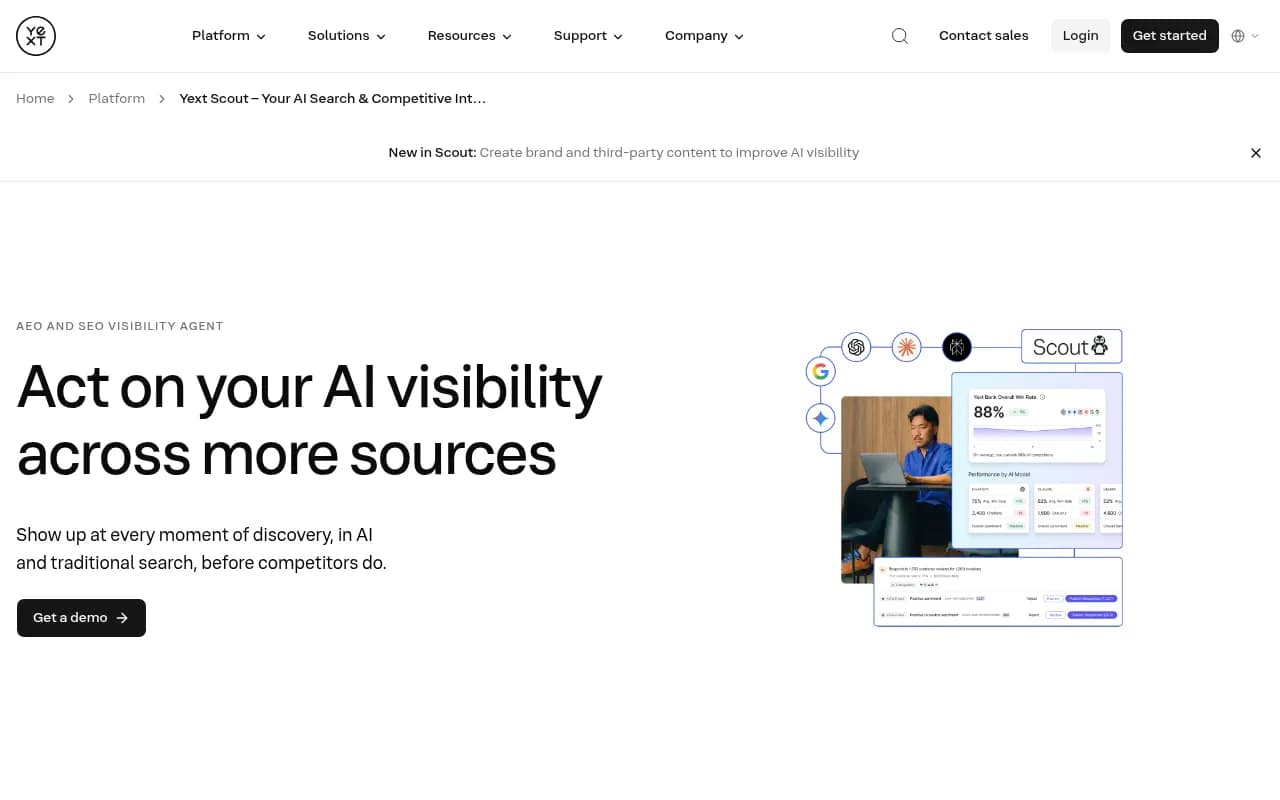
Yext was built around keeping business information accurate everywhere customers search. Scout is its AEO and SEO visibility agent, layered on that listings foundation.
What it does well
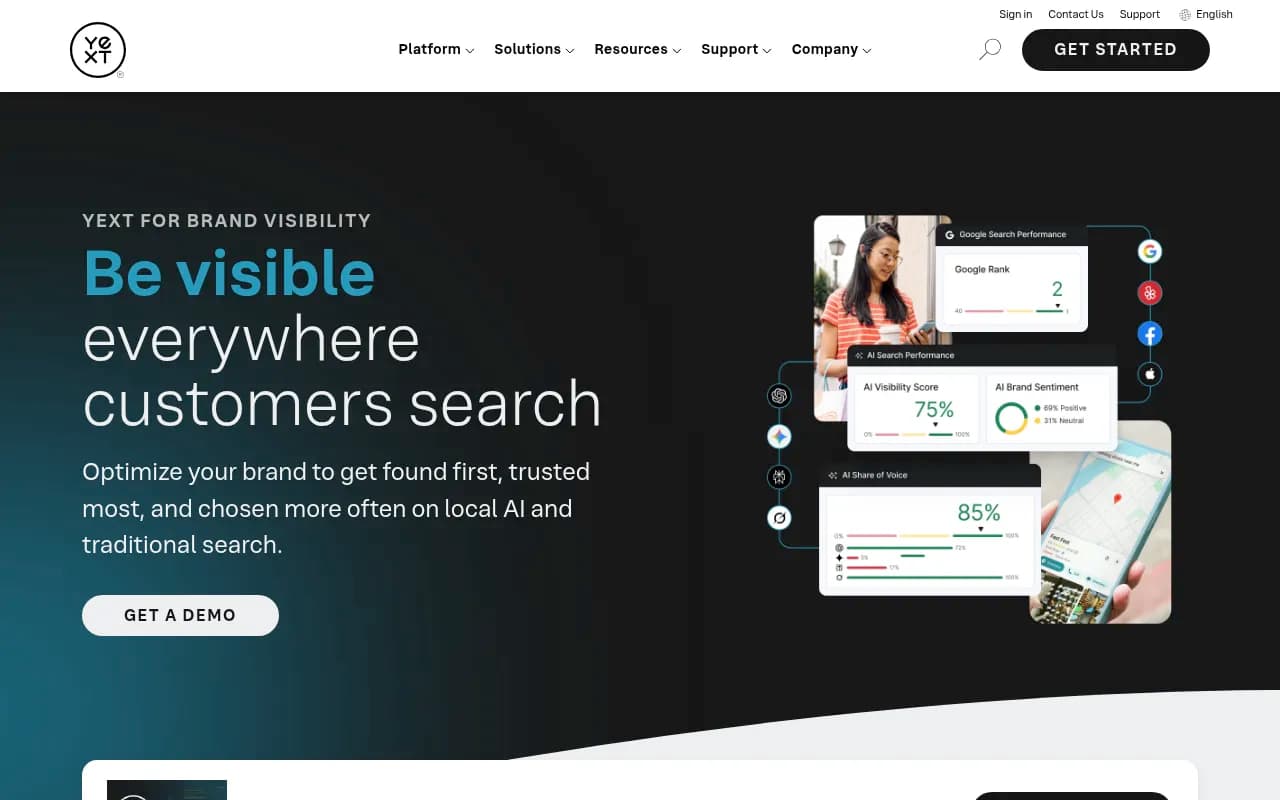
Per Yext's page, Scout tracks Google Search, Google Maps and Google AI Overviews, plus ChatGPT, Gemini, Claude and Perplexity. It benchmarks head-to-head win rates against your 20 closest competitors for both brand-level and high-intent local searches. It also includes sentiment themes (for example "long wait times"), citation tracking, a mobile app showing win rate by location, and data access via MCP or API. Its Action Center lets agents update listings, correct business info, respond to reviews and manage social content while the team stays in control.
Yext states a scale of 12M+ locations and names customers including MidFirst Bank, Beltone and Sorbet. The mix of Google Maps and Search with AI engines in one Visibility Score is useful if local pack performance still drives most of your revenue.
Where to be careful
Birdeye argues that Scout's hybrid focus dilutes an AI-first strategy, since it blends traditional Google rankings with AI results. That is Birdeye's framing. For many local businesses the blend is a feature, because Google Maps is still where much of local discovery happens. Birdeye's article also lists Grok for Scout, which Yext's own page does not. Trust the Yext page. Pricing is not public, and Scout is most natural for teams already on the Yext Knowledge Graph.
Promptwatch
Promptwatch is a different kind of tool. It is an AI search visibility and GEO platform that tracks how brands appear in ChatGPT, Google AI Overviews, AI Mode, Gemini, Perplexity, Copilot, Claude, Grok and others, using the real user interfaces rather than only APIs.

What it does well
Promptwatch goes where the local-first tools mostly do not. It has IP-verified AI crawler logs showing which bots read which pages and what errors they hit. It has visitor analytics for AI-referred traffic and conversions. Citation analysis shows which pages, Reddit threads, YouTube videos and LinkedIn posts get cited. Prompt volumes, difficulty scores and query fan-outs help you pick what to target. Then the Content Agent writes and publishes to WordPress, Webflow or Framer, and tracks whether the pages get crawled and cited.
It also checks whether your fixes worked, which monitoring-only tools skip. Crisp, for example, reported 2x higher conversion from AI traffic than from traditional channels.
Where it does not fit
Be honest about this one. Promptwatch tracks by prompt and website, not by individual location, and it is not built to manage 100+ locations, listings or review responses. In the research behind this guide I could not confirm location-level tracking beyond country, state and city targeting on higher plans. If your core need is "show me which of my 600 storefronts is invisible and fix its Google Business Profile," Promptwatch is not that tool.
Pricing is public. The official page says paid plans start from $95/month. Third-party listings show slightly different figures (for example $99, $249 and $579), probably reflecting monthly versus annual billing, so confirm on promptwatch.com/pricing.
| Plan | Price (verify on site) | Prompts | Notes |
|---|---|---|---|
| Essential | From $95/mo | 50 | 1 project, all AI models, site audit, 7-day trial |
| Professional | From $245/mo | 150 | 2 projects, content articles, Knowledge Base |
| Business | $579/mo | 350 | 5 projects, Content Agent, state/city tracking |
| Agencies | From $199/mo | Unlimited | 10 seats, client portal |
Why each engine needs separate measurement
Local brands often treat "AI search" as one channel. It is not. Promptwatch Data's average sources per response report (across ChatGPT, Gemini, Perplexity, Claude and AI Overviews) found ChatGPT cites about 5 sources per web-search answer, while Google AI Overviews and Perplexity cite about 10. That report is dated September 2025, so check it for newer figures.
The practical takeaway for a local brand is that ChatGPT has roughly half the citation slots, so each one is more contested. A location that wins on AI Overviews can still be absent from ChatGPT. Whichever platform you choose, look at results per engine, not a blended score.
Vertical matters too. In Promptwatch's ChatGPT healthcare citation data (Sep 9 to Oct 8, 2026), government and public health sites earned almost half of citations. In automotive (August 2026), marketplaces like Autotrader and Cars.com outranked every car brand. For a dealership or clinic group, that means third-party sources, not your own site, often decide who gets named. Tools that show which sources AI cites are valuable here.
Head-to-head: what matters for local teams
| Need | Birdeye Search AI | Yext Scout | Promptwatch |
|---|---|---|---|
| Per-location visibility | Yes | Yes | Not designed for it |
| Google Maps and local pack | Via listings and local data | Yes, tracked directly | No |
| Fixing listings and business data | Yes, agents | Yes, agents | No |
| Review requests and responses | Yes, core strength | Yes, secondary | No |
| Competitor benchmarking | Yes | Win rates vs 20 competitors | Yes, share of voice and heatmaps |
| AI crawler logs | Not mentioned | Not mentioned | Yes |
| AI traffic attribution | Not mentioned | Not mentioned | Yes |
| Content creation and publishing | Local pages | Brand and third-party content (new) | Content Agent with CMS publishing |
| Reddit, YouTube, LinkedIn citations | Not mentioned | Not mentioned | Yes |
| Public pricing | No | No | Yes |
Which one should you pick?
Choose Birdeye Search AI if
You run 100+ locations, you care most about reviews and reputation, and you want AI visibility sitting next to review automation and listings. It is also the natural pick if Birdeye is already your reputation platform.
Choose Yext Scout if
Your data already lives in the Yext Knowledge Graph, or Google Maps and local search still matter as much as AI answers for you. The combined Visibility Score and the win rate benchmarks against 20 competitors suit leadership reporting well.
Choose Promptwatch if
You are one brand, a regional business with a few locations, an agency, or an enterprise whose question is "why does ChatGPT not cite us, and what do we publish to fix it?" The crawler logs and traffic analytics answer why, and the Content Agent handles the fix. Note the logs and analytics help with local pages too, since a blocked AI crawler hurts a store locator as much as a blog.
Consider using two
These are not mutually exclusive. A franchise brand could run Birdeye or Yext for location data and a tool like Promptwatch at the brand level for content and citations. That costs more, so only do it if both problems are real.
Other options worth a look
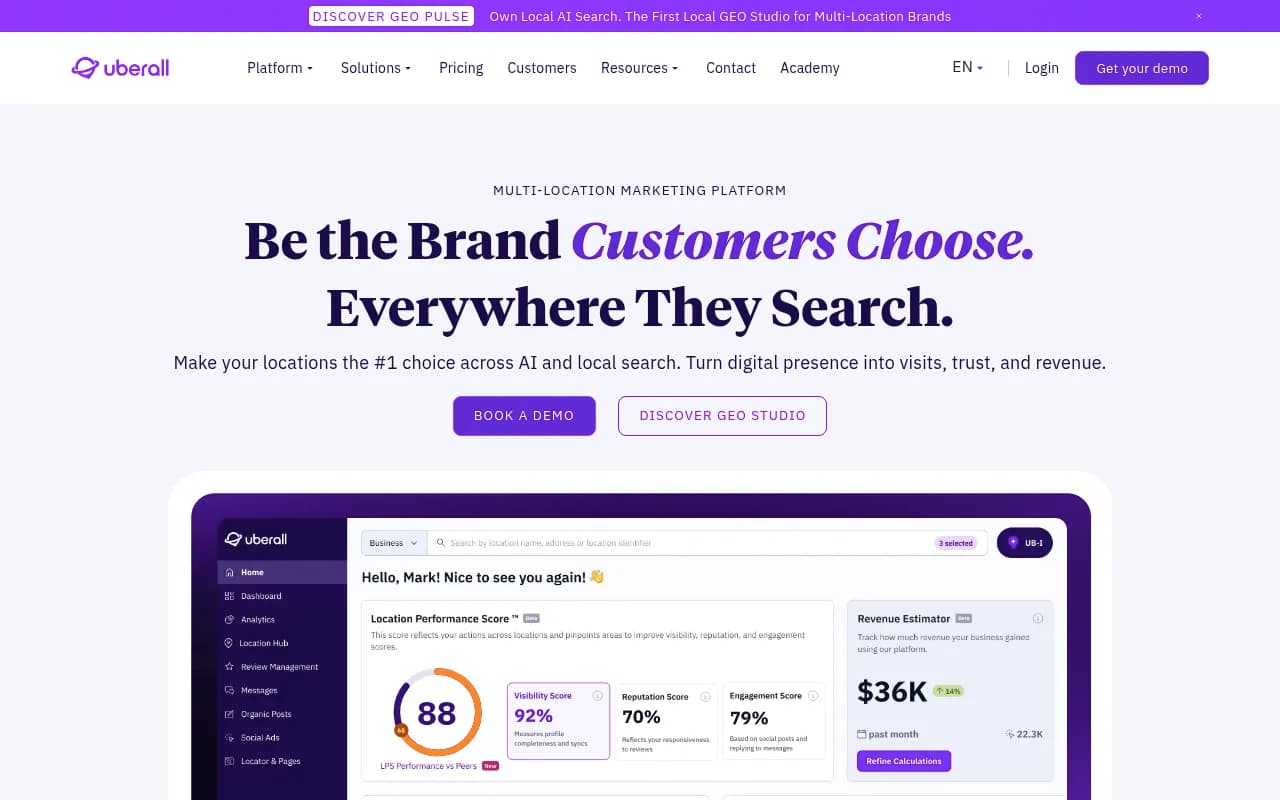
If none of these fits, the field is wide. For local data and reputation, Synup, Uberall, Chatmeter and Reputation.com cover similar ground to Birdeye and Yext. For AI-visibility-only monitoring, Otterly.AI and Peec AI are cheaper, simpler trackers. Otterly's listed plans run from $29/month for 15 prompts to $489/month for 400 prompts, per its own comparison page.

For a broader look at GEO tools, the directory at bestgeosoftware.com lists many more.
How to run a fair trial
- Pick 20 to 30 prompts real customers use, such as "best dentist near me" and "urgent care open now in [city]." Include branded and unbranded versions.
- Choose five locations: two strong, two weak, one new. Compare how each tool scores them.
- Ask each vendor to show the cited sources behind a location's score, not just the score.
- Test the fix loop. Pick one visibility gap and see how long the tool takes to propose, execute and verify a change.
- Get written pricing for your location count and query volume. Custom pricing varies a lot between sales calls.
Bottom line
Birdeye and Yext are location management platforms that added AI visibility. Promptwatch is an AI visibility platform that does not manage locations. Match the tool to the layer where your problem sits: location data, or AI citations and content. Verify every price and engine list directly with the vendor before you sign, since both Birdeye and Yext keep pricing private and change features often.