Summary
- Long-tail queries dominate AI search: Over 70% of AI search queries are conversational and question-based, not short keywords. Traditional rank trackers miss this entirely.
- Zero-click is the new normal: Most AI searches end without a click. Success means being cited in the answer, not ranking #1 in a list.
- No single tool does it all: The best approach combines visibility tracking (Promptwatch, Nightwatch), prompt research (SE Ranking, Peasy), and content optimization (Relixir, Scrunch).
- Fresh data infrastructure matters: Many budget trackers broke when Google deprecated the num=100 parameter in late 2025. Verified data sources are now essential.
- AI visibility ≠ SEO rankings: You can rank #1 on Google and still be invisible in ChatGPT. These are separate channels that require separate tracking.
Why long-tail AI search queries matter in 2026
If you've been tracking "best project management software" and wondering why your traffic doesn't match your rankings, here's what changed: people stopped searching like that.
They're asking ChatGPT "what's a good project management tool for a remote team of 8 with Slack integration" or telling Perplexity "I need something cheaper than Asana but more visual than Trello." These are long-tail queries—specific, conversational, often phrased as questions. And they make up the majority of AI search volume in 2026.
Traditional keyword trackers can't help you here. They're built around fixed keywords and SERP positions. AI search doesn't work that way. There are no positions. There's just the answer—and whether your brand is mentioned in it.
Long-tail queries are where buying decisions happen. Someone searching "project management software" is browsing. Someone asking "best project management tool for agencies under $50/month with time tracking" is ready to buy. If you're not visible in that second query, you've lost the sale before you knew it existed.
This guide walks through the tools that actually track long-tail AI search visibility—what they do, what they cost, and which ones are worth your time.
What makes a good long-tail AI search tracking tool
A good tool for tracking long-tail AI queries needs to do three things:
1. Monitor conversational queries, not just keywords
Long-tail queries are sentences, not words. "Best CRM for real estate agents in Florida" is a long-tail query. "CRM software" is not. The tool needs to track how AI models respond to full questions and prompts, not just keyword variations.
2. Track citations and mentions, not rankings
There's no #1 position in an AI answer. Either you're mentioned or you're not. The tool should show you where your brand appears in AI responses, how often, and in what context. Bonus if it tracks sentiment—being called "expensive" is different from being called "best for enterprise."
3. Help you find the queries you're missing
The real value isn't tracking the prompts you already know about. It's discovering the long-tail queries your competitors are visible for but you're not. Answer gap analysis is the difference between monitoring and optimization.
Most tools do one of these well. A few do all three. Let's look at the best options.
The best tools for tracking long-tail AI search queries
1. Promptwatch — Full-stack AI visibility platform
Promptwatch is the only platform that closes the loop between tracking and optimization. It shows you which long-tail queries you're missing, generates content to fill those gaps, and tracks the results.

What makes it good for long-tail tracking:
- Answer Gap Analysis shows exactly which prompts competitors are visible for but you're not. This is the core feature that separates Promptwatch from monitoring-only tools.
- Prompt Intelligence gives you volume estimates and difficulty scores for each query, plus query fan-outs that show how one prompt branches into sub-queries. You can prioritize high-value, winnable long-tail prompts instead of guessing.
- AI Content Generator creates articles, listicles, and comparisons grounded in real citation data (880M+ citations analyzed). It's built to rank in AI search, not just traditional SEO.
- Page-level tracking shows which specific pages are being cited by which AI models, how often, and in what context.
- AI Crawler Logs reveal which pages ChatGPT, Claude, Perplexity, and other AI models are reading on your site—and which ones they're ignoring.
Coverage: ChatGPT, Perplexity, Google AI Overviews, Claude, Gemini, Meta AI, DeepSeek, Grok, Mistral, Copilot
Pricing: Essential $99/mo (1 site, 50 prompts), Professional $249/mo (2 sites, 150 prompts, crawler logs), Business $579/mo (5 sites, 350 prompts). Free trial available.
Best for: Brands that want to actually improve their AI visibility, not just track it. If you're serious about long-tail AI search, this is the platform to start with.
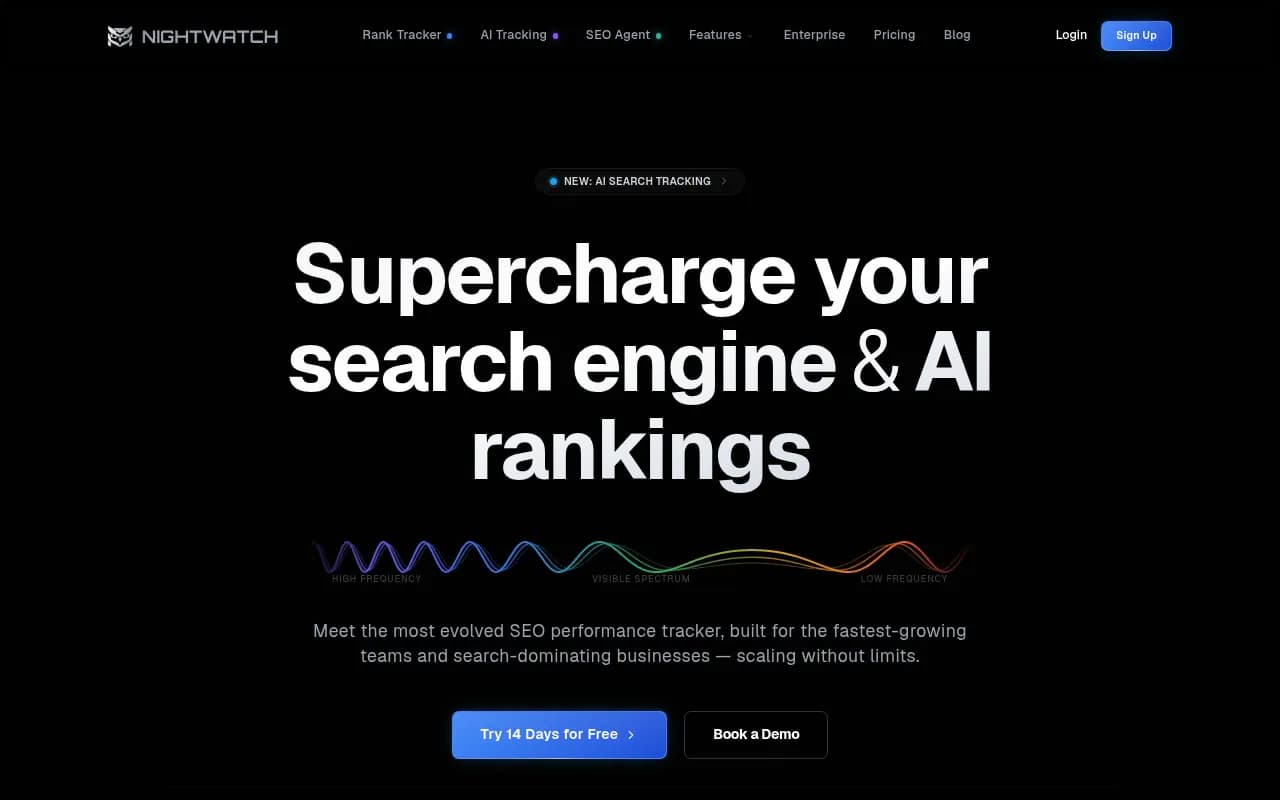
2. Nightwatch — AI search monitoring for marketers
Nightwatch is a solid monitoring tool that tracks your brand across AI search engines with daily updates and clear reporting. It's more affordable than enterprise platforms but still covers the major AI models.
What it does well:
- Tracks brand mentions across ChatGPT, Perplexity, Google AI Overviews, and other AI models
- Daily ranking updates with historical data
- Clean interface that's easy to navigate
- Looker Studio integration for custom reporting
What it doesn't do:
- No answer gap analysis—you have to manually input the prompts you want to track
- No content generation or optimization features
- Limited prompt intelligence (no volume estimates or difficulty scores)
Coverage: ChatGPT, Perplexity, Google AI Overviews, Claude, Gemini
Pricing: Starts around $39/mo for basic plans. Custom pricing for enterprise.
Best for: Marketing teams that want straightforward AI search monitoring without the complexity of a full optimization platform.
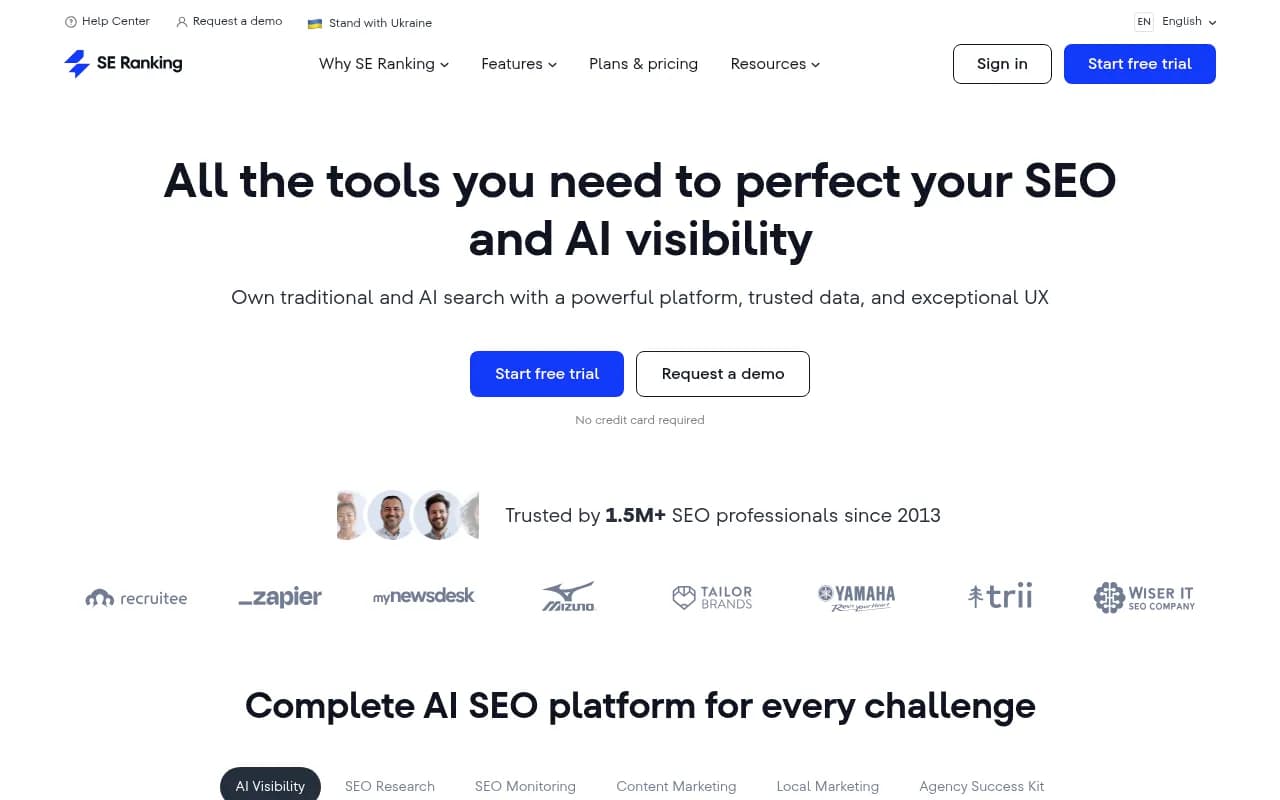
3. SE Ranking (SE Visible) — Strategic AI visibility tracking
SE Ranking's AI visibility module (SE Visible) takes a strategic approach: it focuses on high-level visibility trends and sentiment analysis rather than granular prompt tracking.
What it does well:
- Tracks brand visibility and sentiment across AI search engines
- Shows how your brand is being described by AI models (positive, neutral, negative)
- Integrates with SE Ranking's broader SEO toolkit
- Good for executive reporting and high-level visibility trends
What it doesn't do:
- Not built for long-tail query discovery—it's more about brand monitoring
- Limited prompt-level detail
- No content generation or gap analysis
Coverage: ChatGPT, Perplexity, Google AI Overviews, Claude, Gemini
Pricing: Part of SE Ranking's broader platform. Plans start around $65/mo.
Best for: Brands that want to track overall AI visibility and sentiment as part of a broader SEO strategy.
4. Peasy — Real-time AI search performance tracking
Peasy is a lightweight tool focused on real-time tracking of AI search performance. It's fast, simple, and affordable—but limited in scope.
What it does well:
- Real-time tracking of brand mentions in AI search
- Simple interface with minimal learning curve
- Affordable pricing for small teams
What it doesn't do:
- No prompt research or gap analysis
- Limited AI model coverage
- No optimization or content generation features
Coverage: ChatGPT, Perplexity, Google AI Overviews
Pricing: Starts around $49/mo.
Best for: Small businesses or solo marketers who want basic AI search monitoring without the complexity of enterprise platforms.
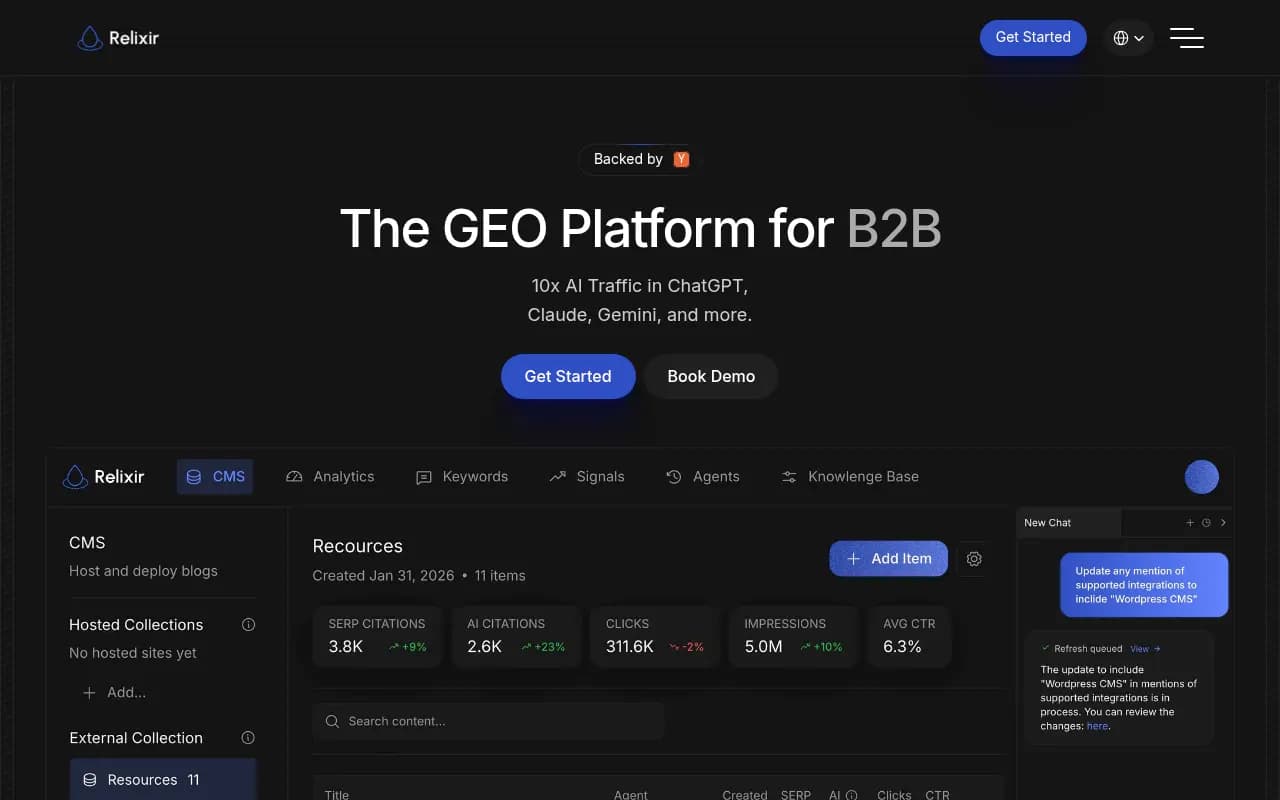
5. Relixir — All-in-one GEO platform with AI content generation
Relixir combines AI visibility tracking with content generation and optimization. It's similar to Promptwatch in approach but with a different feature set and pricing model.
What it does well:
- AI content generation grounded in visibility data
- Tracks brand mentions across multiple AI models
- Optimization recommendations based on competitor analysis
What it doesn't do:
- Less granular prompt intelligence compared to Promptwatch
- No AI crawler logs
- Limited query fan-out analysis
Coverage: ChatGPT, Perplexity, Google AI Overviews, Claude, Gemini
Pricing: Custom pricing. Typically starts around $299/mo.
Best for: Brands that want an all-in-one GEO platform with content generation but don't need the depth of Promptwatch's prompt intelligence.
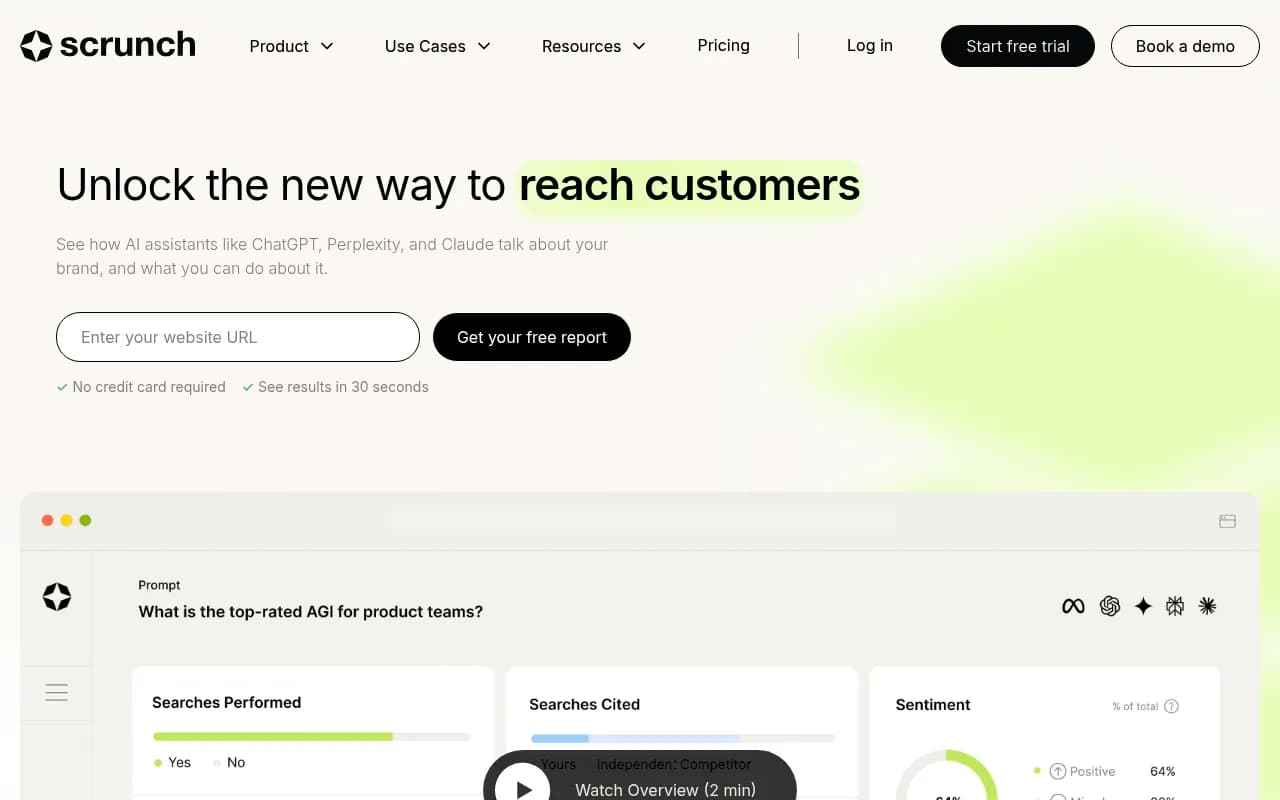
6. Scrunch — Monitor and optimize AI assistant visibility
Scrunch focuses on tracking how AI assistants like ChatGPT and Claude describe your brand, with a strong emphasis on sentiment and competitive positioning.
What it does well:
- Detailed sentiment analysis of brand mentions
- Competitive benchmarking across AI models
- Tracks how your brand is positioned relative to competitors
What it doesn't do:
- No content generation
- Limited prompt discovery features
- Higher price point than some alternatives
Coverage: ChatGPT, Claude, Perplexity, Google AI Overviews
Pricing: Custom pricing. Typically starts around $399/mo.
Best for: Brands that care deeply about how they're being described in AI answers, not just whether they're mentioned.
Comparison table: Long-tail AI search tracking tools
| Tool | Answer gap analysis | Prompt intelligence | Content generation | AI crawler logs | Starting price |
|---|---|---|---|---|---|
| Promptwatch | Yes | Yes (volume, difficulty, fan-outs) | Yes | Yes | $99/mo |
| Nightwatch | No | Limited | No | No | $39/mo |
| SE Ranking | No | Limited | No | No | $65/mo |
| Peasy | No | No | No | No | $49/mo |
| Relixir | Yes | Limited | Yes | No | $299/mo |
| Scrunch | Limited | Limited | No | No | $399/mo |
How to choose the right tool for your needs
If you're just starting with AI search tracking: Start with Nightwatch or Peasy. They're affordable, simple, and give you a baseline understanding of where you're visible (or not) in AI search. Once you understand the landscape, upgrade to a platform with optimization features.
If you want to actually improve your AI visibility: Use Promptwatch. It's the only platform that shows you what's missing (answer gap analysis), helps you create content to fill those gaps (AI content generator), and tracks the results (page-level citations). This is the action loop that actually moves the needle.
If you care about brand sentiment: Scrunch or SE Ranking. Both focus on how your brand is being described, not just whether it's mentioned. This matters if you're in a competitive category where positioning is everything.
If you're on a tight budget: Nightwatch or Peasy. Both offer basic AI search monitoring at affordable prices. You won't get optimization features, but you'll at least know where you stand.
If you're an enterprise brand: Promptwatch (Business or Enterprise plan) or Relixir. Both offer multi-site tracking, advanced features, and the infrastructure to handle large-scale monitoring and optimization.
The hybrid stack approach
Most brands end up using a combination of tools:
- Intelligence layer (Promptwatch or SE Ranking): Track overall visibility, discover gaps, prioritize prompts
- Optimization layer (Promptwatch or Relixir): Generate and optimize content for AI search
- Performance layer (Nightwatch or Peasy): Monitor daily changes and track results
This isn't necessary for everyone, but if you're serious about AI search, the hybrid stack gives you the best of all worlds: strategic intelligence, tactical optimization, and real-time monitoring.
What to track: Long-tail query types that matter
Not all long-tail queries are created equal. Here are the types that drive the most value:
Comparison queries "Best X vs Y for [specific use case]" — e.g. "Slack vs Teams for remote startups"
Problem-solution queries "How do I [solve specific problem] with [constraint]" — e.g. "How do I track time without switching apps"
Buyer intent queries "Best [category] for [specific need] under [budget]" — e.g. "Best CRM for real estate under $100/month"
Feature-specific queries "[Category] with [specific feature] that integrates with [tool]" — e.g. "Email tool with A/B testing that integrates with Salesforce"
Local + category queries "Best [category] in [location] for [use case]" — e.g. "Best coworking space in Austin for developers"
These are the queries where AI search excels—and where traditional SEO often fails. If your tool can't track these types of prompts, it's not built for long-tail AI search.
Common mistakes when tracking long-tail AI queries
Mistake 1: Tracking too many prompts You don't need to track 10,000 prompts. Start with 50-100 high-value queries where you want to be visible. Use prompt intelligence (volume, difficulty) to prioritize.
Mistake 2: Ignoring query fan-outs One prompt often branches into multiple sub-queries. "Best CRM" might fan out into "Best CRM for real estate," "Best CRM for small business," "Best CRM with email automation," etc. Track the fan-outs, not just the root query.
Mistake 3: Tracking without optimizing Monitoring is useless if you don't act on the data. If you're not creating content to fill the gaps, you're just watching your competitors win.
Mistake 4: Treating AI search like SEO AI search is a different channel. You can rank #1 on Google and be invisible in ChatGPT. Track them separately.
Mistake 5: Ignoring AI crawler logs If AI models aren't crawling your site, they can't cite it. Check your crawler logs (Promptwatch has this built in) to see which pages AI engines are reading—and which ones they're ignoring.
The future of long-tail AI search tracking
AI search is still early. The tools are improving fast, but there are gaps:
What's coming:
- Better attribution: connecting AI visibility to actual revenue
- Cross-model tracking: understanding how visibility in ChatGPT affects visibility in Claude
- Predictive prompts: AI models that predict which long-tail queries will become popular before they spike
- Automated optimization: tools that automatically generate and publish content based on gap analysis
What's still missing:
- Standardized metrics: there's no agreed-upon "AI search visibility score" yet
- Historical data: most tools only have 6-12 months of data
- Multi-language support: most tools focus on English
The tools in this guide are the best available in 2026, but expect rapid evolution. The winners will be the platforms that close the loop between tracking and optimization—showing you what's missing and helping you fix it.
Final thoughts
Long-tail AI search queries are where the real value is. They're specific, high-intent, and often ignored by competitors who are still optimizing for short keywords.
The tools that track these queries fall into two camps: monitoring-only dashboards (Nightwatch, Peasy, SE Ranking) and optimization platforms (Promptwatch, Relixir). Most brands start with monitoring and upgrade to optimization once they realize that tracking without action doesn't move the needle.
If you're serious about AI search visibility, start with Promptwatch. It's the only platform that shows you what's missing, helps you create content to fill those gaps, and tracks the results. For most brands, that action loop is the difference between watching competitors win and actually competing.
The rest of the tools in this guide are solid for specific use cases—budget monitoring, sentiment tracking, real-time alerts—but they won't help you improve your visibility. They'll just show you where you're losing.