Summary
- Semrush offers AI search visibility features, but they're add-ons to a traditional SEO platform -- and Adobe's acquisition raises questions about future pricing
- Specialized AI visibility tools like Promptwatch, Profound, and Peec AI focus entirely on tracking and optimizing how your brand appears in ChatGPT, Claude, Perplexity, and Google AI Overviews
- Traditional SEO alternatives like Ahrefs and SE Ranking are strong for keyword research and backlinks, but lack deep AI search monitoring
- The right tool depends on your needs: pure SEO work, AI visibility tracking, or both
In November 2025, Adobe acquired Semrush. The immediate result: a new "Semrush One" plan starting at $199/month that bundles basic SEO and GEO features. That's just the beginning. Adobe's history suggests enterprise-focused pricing is coming, and brands are already looking for alternatives.
The bigger issue isn't just cost. Semrush is fundamentally a traditional SEO platform that added AI search visibility as an afterthought. If you're trying to track how ChatGPT, Claude, Perplexity, or Google AI Overviews cite your brand, you're using a tool built for a different era.
AI search is not a feature. It's a new channel. And in 2026, you need tools purpose-built for it.
Why Semrush falls short for AI search visibility
Semrush is excellent at what it was designed for: keyword research, backlink analysis, technical SEO audits, and rank tracking for traditional search engines. But AI search visibility requires a different approach.
Here's what Semrush doesn't do well:
Fixed prompt sets: Semrush's AI search tracking uses a fixed set of prompts. You can't customize them to match how your actual customers ask questions. That means you're monitoring generic queries, not the high-intent prompts that drive your business.
No content gap analysis: You can see if you're mentioned in AI responses, but Semrush won't tell you which topics competitors are visible for that you're missing entirely. You're left guessing what content to create.
No AI traffic attribution: Semrush doesn't connect AI visibility to actual traffic or revenue. You can track mentions, but you can't prove ROI or understand which AI citations drive clicks.
Limited AI model coverage: Semrush tracks Google AI Overviews and a handful of other models, but misses key platforms like DeepSeek, Grok, and Meta AI. If your audience uses those tools, you're blind.
No crawler logs: You can't see when ChatGPT, Claude, or Perplexity's crawlers visit your site, what pages they read, or what errors they encounter. That makes it impossible to fix indexing issues.
Semrush's AI features feel like a checkbox addition to justify the price increase. They're not bad, but they're not built for brands that take AI search seriously.
What to look for in a Semrush alternative
Before jumping to a specific tool, figure out what you actually need. Not every alternative solves the same problem.
For traditional SEO: If you're primarily doing keyword research, backlink analysis, and rank tracking for Google/Bing, tools like Ahrefs, SE Ranking, and Moz are strong Semrush alternatives. They're cheaper, easier to use, and cover the same core features.
For AI search visibility: If you need to track and optimize how your brand appears in ChatGPT, Claude, Perplexity, and Google AI Overviews, you need a specialized AI visibility platform. These tools monitor AI responses, analyze citation patterns, identify content gaps, and help you optimize for generative search.
For both: Some platforms try to do both traditional SEO and AI visibility. SE Ranking and Semrush itself fall into this category. The risk: you end up with a tool that's mediocre at both instead of excellent at one.
Here's what matters for AI search visibility specifically:
- Multi-model coverage: At minimum, track ChatGPT, Claude, Perplexity, Gemini, and Google AI Overviews. Bonus points for DeepSeek, Grok, Meta AI, and Copilot.
- Custom prompts: You need to monitor the exact questions your customers ask, not a generic list of keywords.
- Content gap analysis: The tool should show you which prompts competitors rank for that you don't, and what content you're missing.
- Citation tracking: See which pages, domains, and sources AI models cite. Understand why competitors get mentioned and you don't.
- AI crawler logs: Real-time logs of AI crawlers visiting your site. Know what they're reading and fix indexing issues.
- Traffic attribution: Connect AI visibility to actual traffic and revenue. Prove ROI.
If a tool doesn't have these features, it's a monitoring dashboard, not an optimization platform.
Best Semrush alternatives for AI search visibility
Promptwatch: Best overall for AI search optimization
Promptwatch is the only AI visibility platform rated as a "Leader" across all categories in a 2026 comparison of 12 GEO tools. The difference: most competitors show you data but leave you stuck. Promptwatch shows you what's missing, then helps you fix it.

The core workflow is simple. First, Answer Gap Analysis shows exactly which prompts competitors are visible for but you're not. You see the specific content your website is missing -- the topics, angles, and questions AI models want answers to but can't find on your site.
Second, the built-in AI writing agent generates articles, listicles, and comparisons grounded in real citation data (880M+ citations analyzed), prompt volumes, persona targeting, and competitor analysis. This isn't generic SEO filler. It's content engineered to get cited by ChatGPT, Claude, and Perplexity.
Third, you track the results. Page-level tracking shows exactly which pages are being cited, how often, and by which models. Close the loop with traffic attribution (code snippet, GSC integration, or server log analysis) to connect visibility to revenue.
Prompwatch monitors 10 AI models: ChatGPT, Perplexity, Google AI Overviews, Google AI Mode, Claude, Gemini, Meta/Llama, DeepSeek, Grok, Mistral, and Copilot. It also tracks ChatGPT Shopping recommendations, Reddit discussions that influence AI responses, and YouTube videos that get cited.
AI Crawler Logs show real-time activity from AI crawlers hitting your website -- which pages they read, errors they encounter, how often they return. This is critical for fixing indexing issues. Most competitors lack this entirely.
Prompt Intelligence provides volume estimates and difficulty scores for each prompt, plus query fan-outs that show how one prompt branches into sub-queries. Prioritize high-value, winnable prompts instead of guessing.
Pricing: Essential $99/mo (1 site, 50 prompts, 5 articles), Professional $249/mo (2 sites, 150 prompts, 15 articles, crawler logs, state/city tracking), Business $579/mo (5 sites, 350 prompts, 30 articles). Agency and enterprise plans available. Free trial included.
Best for: Brands that want to take action, not just monitor. If you need content gap analysis, AI content generation, and optimization tools -- not just a dashboard -- Promptwatch is the clear choice.
Profound: Best for enterprise brands
Profound is built for large organizations with complex needs. It offers strong multi-model coverage, detailed citation analysis, and enterprise-grade reporting. The platform tracks ChatGPT, Claude, Perplexity, Gemini, and Google AI Overviews.
Profound excels at competitive analysis. You can see exactly which sources AI models cite for each prompt, compare your visibility vs competitors across models, and identify patterns in citation behavior. The interface is polished and the data is reliable.
What's missing: content gap analysis and AI content generation. Profound shows you the data but doesn't help you create the content you need to improve. It's a monitoring tool, not an optimization platform.
Pricing is higher than most alternatives, starting around $500/mo for basic plans. Enterprise plans are custom.
Best for: Large brands that need detailed reporting and competitive analysis, and have content teams that can act on the insights independently.
Peec AI: Best for global brands
Peec AI supports 115+ languages and tracks AI responses across multiple regions. If you operate in non-English markets, Peec AI is one of the few tools that can monitor AI visibility at scale.
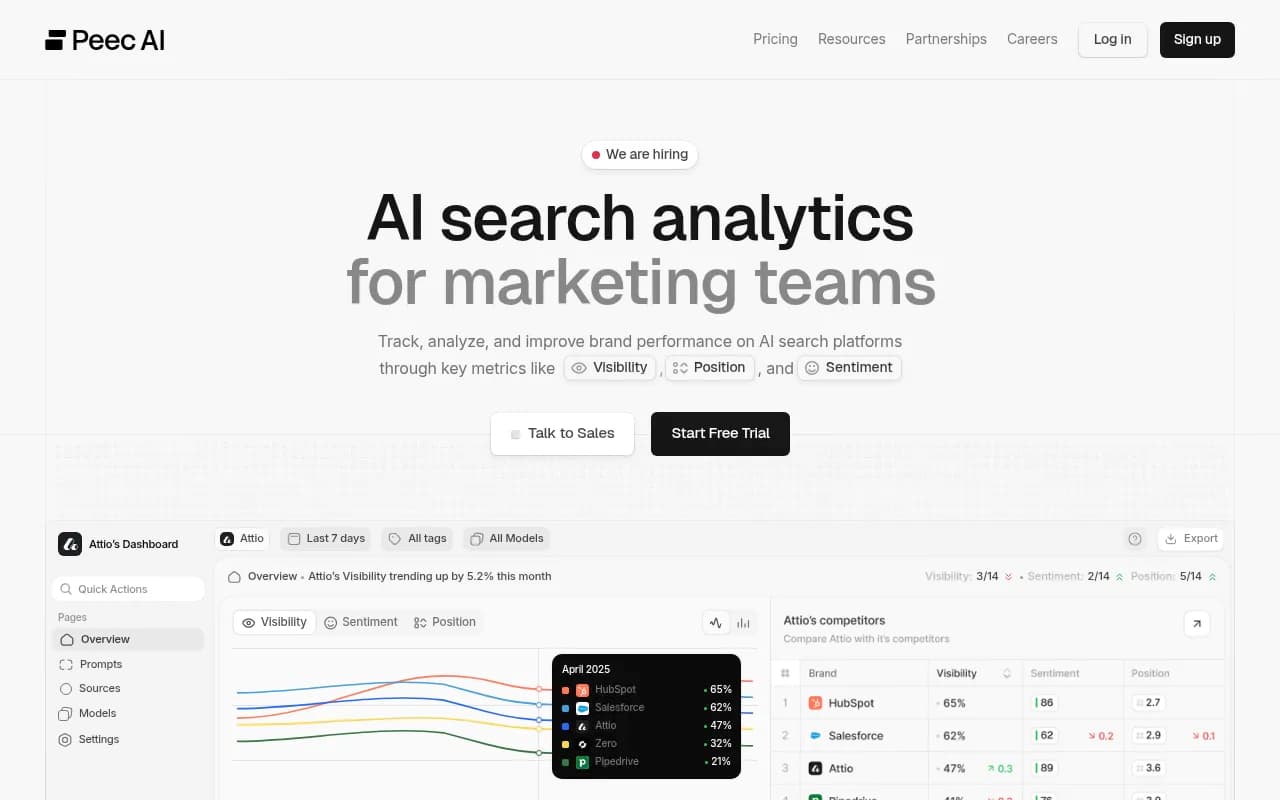
The platform covers ChatGPT, Claude, Perplexity, Gemini, and Google AI Overviews. You can customize prompts, track citations, and compare visibility across models. The multi-language support is genuinely strong -- not just machine-translated prompts, but native monitoring in each language.
Peec AI also offers sentiment analysis and brand mention tracking, which is useful for reputation management.
What's missing: AI crawler logs, traffic attribution, and content generation. Like Profound, Peec AI is a monitoring tool, not an optimization platform.
Pricing starts around $300/mo for basic plans. Enterprise pricing is custom.
Best for: Global brands that need multi-language AI visibility tracking.
Otterly.AI: Best budget option
Otterly.AI is one of the most affordable AI visibility tools, starting at $49/mo. It tracks ChatGPT, Perplexity, and Google AI Overviews. The interface is simple and the data is accurate.

You can monitor brand mentions, track citations, and compare visibility vs competitors. Otterly.AI also offers basic prompt tracking and sentiment analysis.
What's missing: almost everything beyond monitoring. No AI crawler logs, no content gap analysis, no traffic attribution, no content generation. Otterly.AI shows you the data but doesn't help you act on it.
Best for: Small businesses or solo marketers who need basic AI visibility tracking on a tight budget.
SE Ranking: Best for combined SEO + AI visibility
SE Ranking is a traditional SEO platform that added AI visibility features in 2025. It covers keyword research, backlink analysis, rank tracking, and site audits -- plus AI search monitoring for ChatGPT, Perplexity, and Google AI Overviews.
The AI visibility features are basic but functional. You can track brand mentions, monitor citations, and compare visibility vs competitors. SE Ranking also offers AI-powered content suggestions and keyword clustering.
What's missing: deep AI visibility features like crawler logs, content gap analysis, and traffic attribution. SE Ranking's AI tools feel like an add-on, not a core feature.
Pricing starts at $65/mo for the Essential plan (includes basic AI tracking). Pro and Business plans are $119/mo and $259/mo.
Best for: Brands that need traditional SEO tools and basic AI visibility tracking in one platform.
Athena HQ: Best for brand monitoring
Athena HQ focuses on brand monitoring across 8+ AI search engines. It tracks mentions, sentiment, and citation patterns. The platform is designed for reputation management and competitive intelligence.
Athena HQ excels at showing you when and how your brand is mentioned in AI responses. You can set up alerts for specific keywords, track sentiment over time, and compare your brand vs competitors.
What's missing: content optimization tools. Athena HQ is purely a monitoring platform. It won't help you create content or improve your AI visibility.
Pricing is custom, typically starting around $400/mo for small teams.
Best for: Brands that need reputation monitoring and competitive intelligence in AI search.
Traditional SEO alternatives to Semrush
If you're primarily doing traditional SEO work -- keyword research, backlink analysis, rank tracking -- these tools are strong Semrush alternatives. They don't focus on AI search visibility, but they're excellent at what they do.
Ahrefs: Best for backlink analysis
Ahrefs has the largest backlink index in the industry (over 40 trillion links). It's the gold standard for backlink analysis, competitor research, and content gap analysis.
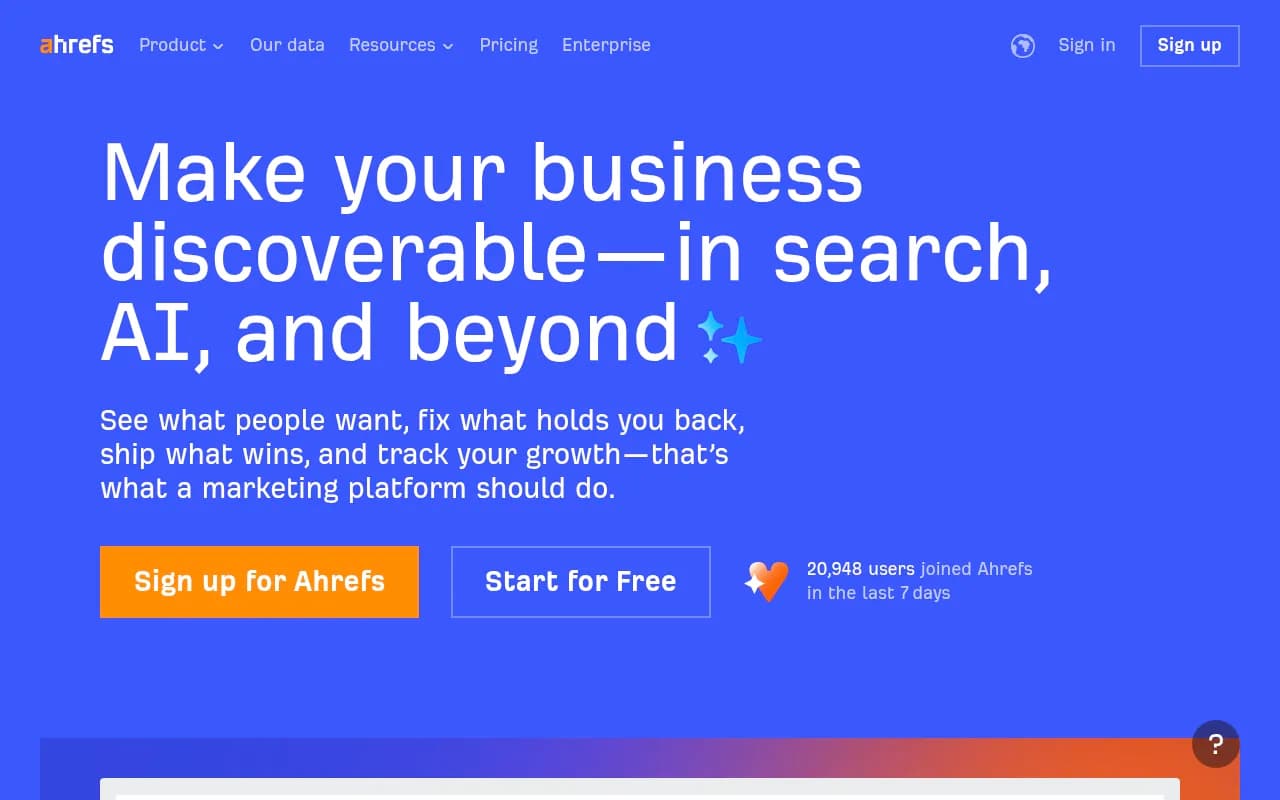
Ahrefs also offers keyword research, rank tracking, and site audits. The interface is clean and the data is reliable. Ahrefs Brand Radar (launched in 2025) tracks brand mentions in Google AI Overviews, but it uses fixed prompts and lacks deep AI visibility features.
Pricing starts at $129/mo for the Lite plan. Standard is $249/mo, Advanced is $449/mo, Enterprise is $14,990/year.
Best for: SEO teams that prioritize backlink analysis and competitor research.
Moz: Best for beginners
Moz is the most beginner-friendly SEO platform. It offers keyword research, rank tracking, site audits, and backlink analysis. The interface is simple and the learning resources are excellent.
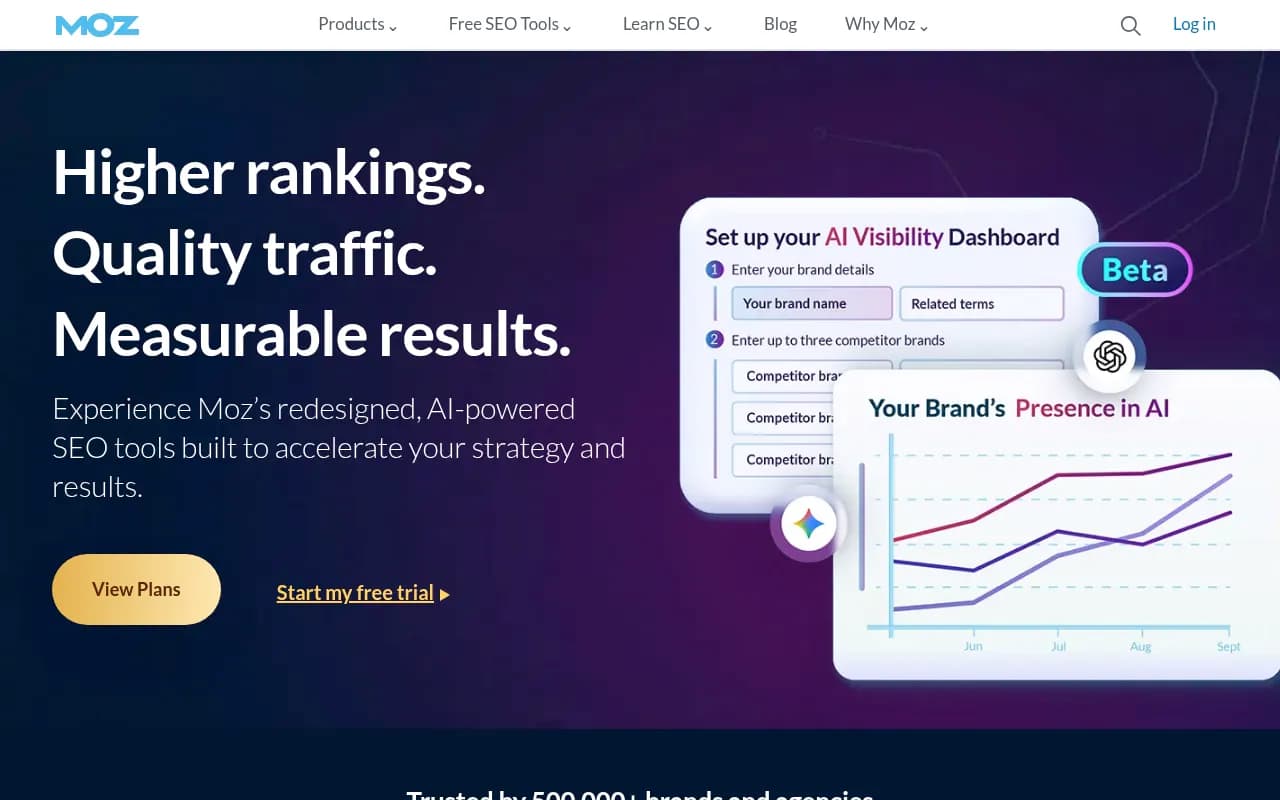
Moz's Domain Authority metric is widely used in the SEO industry. The platform also offers local SEO tools and on-page optimization suggestions.
What's missing: AI search visibility tracking. Moz has no AI-specific features.
Pricing starts at $49/mo for the Starter plan. Standard is $99/mo, Medium is $179/mo, Large is $299/mo.
Best for: Small businesses and beginners who need simple, reliable SEO tools.
Comparison table: AI visibility platforms
| Tool | AI models tracked | Content gap analysis | AI content generation | Crawler logs | Traffic attribution | Starting price |
|---|---|---|---|---|---|---|
| Promptwatch | 10 (ChatGPT, Claude, Perplexity, Gemini, DeepSeek, Grok, Meta AI, Mistral, Copilot, Google AIO) | Yes | Yes | Yes | Yes | $99/mo |
| Profound | 5 (ChatGPT, Claude, Perplexity, Gemini, Google AIO) | No | No | No | No | ~$500/mo |
| Peec AI | 5 (ChatGPT, Claude, Perplexity, Gemini, Google AIO) | No | No | No | No | ~$300/mo |
| Otterly.AI | 3 (ChatGPT, Perplexity, Google AIO) | No | No | No | No | $49/mo |
| SE Ranking | 3 (ChatGPT, Perplexity, Google AIO) | No | No | No | No | $65/mo |
| Athena HQ | 8+ | No | No | No | No | ~$400/mo |
Comparison table: Traditional SEO platforms
| Tool | Keyword research | Backlink analysis | Rank tracking | Site audits | AI visibility | Starting price |
|---|---|---|---|---|---|---|
| Semrush | Yes | Yes | Yes | Yes | Limited (add-on) | $139/mo |
| Ahrefs | Yes | Yes | Yes | Yes | Basic (Brand Radar) | $129/mo |
| SE Ranking | Yes | Yes | Yes | Yes | Basic | $65/mo |
| Moz | Yes | Yes | Yes | Yes | No | $49/mo |
How to choose the right tool
Start by asking what you're actually trying to do.
If you need traditional SEO: Go with Ahrefs (best backlink data), SE Ranking (best value), or Moz (easiest to use). These tools are cheaper than Semrush and cover the same core features.
If you need AI search visibility: Go with a specialized AI visibility platform. Promptwatch is the best overall choice because it's the only tool that combines monitoring, content gap analysis, AI content generation, and optimization in one platform. Profound and Peec AI are strong alternatives if you need enterprise features or multi-language support.
If you need both: SE Ranking is the best hybrid option. It covers traditional SEO and basic AI visibility in one platform. The AI features are limited, but they're functional.
If you're on a tight budget: Otterly.AI ($49/mo) for AI visibility, Moz ($49/mo) for traditional SEO.
One more thing: don't assume you need an all-in-one tool. Most brands are better off using a specialized AI visibility platform (like Promptwatch) plus a traditional SEO tool (like Ahrefs) instead of trying to find one tool that does both poorly.
What Adobe's acquisition means for Semrush users
Adobe acquired Semrush in November 2025. The immediate result: a new "Semrush One" plan at $199/mo that bundles basic SEO and GEO features. That's a 43% price increase over Semrush's previous entry-level plan ($139/mo).
Adobe's history suggests more changes are coming. Adobe's other products (Creative Cloud, Experience Cloud, Marketo) are priced for enterprise budgets, not small businesses. Expect Semrush's pricing to move in that direction.
The bigger concern: Adobe's focus. Adobe is a design and marketing automation company, not an SEO company. Semrush's product roadmap will likely shift toward integration with Adobe's ecosystem (Marketo, Analytics, Experience Manager) instead of innovation in SEO and AI search.
If you're a Semrush user, now is a good time to evaluate alternatives. The tool you're using today may not be the tool you're using in 12 months.
Final thoughts
Semrush is a solid traditional SEO platform, but it's not built for AI search visibility. If you're serious about tracking and optimizing how your brand appears in ChatGPT, Claude, Perplexity, and Google AI Overviews, you need a specialized tool.
Promptwatch is the best overall choice. It's the only platform that combines monitoring, content gap analysis, AI content generation, and optimization in one workflow. Most competitors stop at monitoring -- they show you the data but leave you stuck. Promptwatch shows you what's missing, then helps you fix it.
For traditional SEO work, Ahrefs and SE Ranking are strong Semrush alternatives. They're cheaper, easier to use, and cover the same core features.
The key insight: AI search is not a feature. It's a new channel. And in 2026, you need tools purpose-built for it.