Summary
- GEO is no longer optional: With Gartner predicting a 25% drop in traditional search volume by 2026, brands need dedicated tools to monitor and optimize their visibility in AI search engines like ChatGPT, Perplexity, Claude, and Google AI Overviews
- Most platforms are monitoring-only: The majority of GEO tools show you where you appear in AI responses but leave you stuck -- they don't help you fix gaps or create optimized content
- Action-oriented platforms win: The best GEO tools combine visibility tracking with content gap analysis, AI-powered content generation, and optimization workflows that actually improve your citations
- Pricing ranges from $49 to $500+/month: Budget tools offer basic tracking, mid-tier platforms add competitor analysis and prompt intelligence, and enterprise solutions include custom workflows and API access
- Choose based on your workflow: If you just need to monitor brand mentions, a simple tracker works. If you want to actually rank higher in AI search, look for platforms with content creation and optimization features built in.
What is GEO and why it matters in 2026
Generative Engine Optimization is the practice of structuring content so AI models can identify, trust, and cite your brand as a primary source. Unlike traditional SEO (which targets keyword rankings on Google) or AEO (which optimizes for voice assistants and featured snippets), GEO focuses on influencing the narrative AI engines generate when users ask questions.
The shift is real. Google's AI Overviews now reach over 2 billion monthly users. ChatGPT serves 800 million users each week. Perplexity processes hundreds of millions of queries monthly. People are asking AI for recommendations, comparisons, and buying advice -- and if your brand isn't cited in those responses, you're invisible.
Here's the problem: most brands have no idea how AI engines perceive them. They don't know which prompts trigger their competitors but not them. They don't know which pages AI crawlers are reading (or ignoring). They don't know if their content is structured in a way that AI models can parse and cite.
That's where GEO tools come in. They monitor your brand's visibility across AI search engines, identify content gaps, and help you optimize for citations. Some platforms stop at monitoring. Others go further and help you actually fix the gaps.
How GEO tools differ from traditional SEO platforms
Traditional SEO tools like Semrush, Ahrefs, and Moz were built for a world where rankings and backlinks mattered most. GEO tools operate in a different paradigm:
| Traditional SEO Tools | GEO Platforms |
|---|---|
| Track keyword rankings on Google | Track brand citations in AI responses |
| Analyze backlinks and domain authority | Analyze which sources AI models cite |
| Optimize for crawlers (Googlebot) | Optimize for AI crawlers (GPTBot, ClaudeBot, PerplexityBot) |
| Focus on on-page signals (title tags, meta descriptions) | Focus on semantic structure, entity recognition, and citation-worthy content |
| Measure success with traffic and rankings | Measure success with citation rates, share of voice in AI, and prompt coverage |
Some traditional SEO platforms are adding GEO features (Semrush has AI Overviews tracking, Ahrefs launched Brand Radar), but they're bolt-ons. Purpose-built GEO platforms are designed from the ground up to solve the AI visibility problem.
The GEO platform landscape: monitoring vs optimization
The GEO tool market splits into two camps:
Monitoring-only platforms show you where your brand appears (or doesn't appear) in AI responses. They track citations, sentiment, and share of voice across ChatGPT, Perplexity, Claude, and other engines. Examples: Otterly.AI, Peec.ai, Mentions.so, LLMrefs, Airefs.
These tools answer the question: "How visible am I in AI search?" They're useful for tracking progress and benchmarking against competitors. But they don't help you fix the gaps. You see the data, then you're on your own to figure out what content to create or how to optimize.
Optimization platforms go beyond monitoring. They identify content gaps (which prompts competitors rank for but you don't), help you create citation-worthy content, and track the results. Examples: Promptwatch, Profound, Relixir, Writesonic.

These platforms answer the question: "How do I get cited more often?" They close the loop between visibility data and action. You see where you're invisible, generate optimized content to fill the gaps, and track how your citation rates improve.
Most brands need an optimization platform, not just a monitoring dashboard. Knowing you're invisible doesn't help unless you can do something about it.
Key features to look for in a GEO platform
Not all GEO tools are created equal. Here's what separates the useful platforms from the noise:
1. Multi-engine coverage The best platforms monitor at least 5-8 AI engines: ChatGPT, Perplexity, Claude, Gemini, Google AI Overviews, Copilot, and emerging models like DeepSeek and Grok. Single-engine trackers miss the full picture.
2. Prompt intelligence Volume estimates and difficulty scores for each prompt help you prioritize. Some platforms (like Promptwatch) also show query fan-outs -- how one prompt branches into sub-queries -- so you can map the full landscape of what people are asking.
3. Content gap analysis The platform should show you which prompts competitors are cited for but you're not. This is the single most valuable feature for optimization. Without it, you're guessing what content to create.
4. Citation and source analysis See exactly which pages, Reddit threads, YouTube videos, and domains AI models cite in their responses. This tells you where to publish and what to optimize.
5. AI crawler logs Real-time logs of AI crawlers (GPTBot, ClaudeBot, PerplexityBot) hitting your website. Which pages are they reading? How often do they return? Are they encountering errors? Most competitors lack this entirely.
6. Content generation or optimization tools The best platforms help you create content that ranks in AI search. This could be an AI writing agent (like Promptwatch's), content briefs based on citation data, or optimization recommendations for existing pages.
7. Competitor benchmarking Compare your AI visibility vs competitors across engines and prompts. Heatmaps and share-of-voice charts make it easy to see who's winning and where.
8. Multi-language and multi-region support If you operate globally, you need to monitor AI responses in multiple languages and regions. Some platforms (like Peec.ai) specialize in this.
9. Traffic attribution Connect AI visibility to actual traffic and revenue. This could be a code snippet, Google Search Console integration, or server log analysis. Without attribution, you can't prove ROI.
10. API and integrations Export data to Looker Studio, connect to your CMS, or build custom workflows. Enterprise teams need flexibility.
Top GEO platforms reviewed
Here's a breakdown of the leading platforms, organized by use case and capability.
Best all-around GEO platform: Promptwatch
Promptwatch is the only platform rated as a "Leader" across all categories in a 2026 comparison of 12 GEO tools. The core difference: it's built around the action loop -- find gaps, create content, track results.
What makes it different: Most competitors are monitoring-only dashboards. Promptwatch shows you what's missing (Answer Gap Analysis reveals which prompts competitors rank for but you don't), then helps you fix it (built-in AI writing agent generates articles grounded in 880M+ citations analyzed). You see your visibility scores improve as AI models start citing your new content.
Key features:
- Monitors 10 AI engines: ChatGPT, Perplexity, Google AI Overviews, Claude, Gemini, Meta AI, DeepSeek, Grok, Mistral, Copilot
- AI crawler logs (real-time tracking of GPTBot, ClaudeBot, PerplexityBot hitting your site)
- Content gap analysis with prompt volumes and difficulty scores
- AI content generation agent (creates articles, listicles, comparisons optimized for citations)
- Citation and source analysis (880M+ citations processed)
- Reddit and YouTube insights (surface discussions that influence AI recommendations)
- ChatGPT Shopping tracking (monitor product recommendations)
- Competitor heatmaps and share-of-voice analysis
- Multi-language and multi-region support
- Traffic attribution (code snippet, GSC integration, server logs)
- Looker Studio integration and API access
Pricing: Essential $99/mo (1 site, 50 prompts, 5 articles), Professional $249/mo (2 sites, 150 prompts, 15 articles, crawler logs), Business $579/mo (5 sites, 350 prompts, 30 articles). Free trial available.
Best for: Marketing teams, SEO teams, agencies, and brands that want to actually improve their AI visibility, not just monitor it.
Best for enterprise brands: Profound
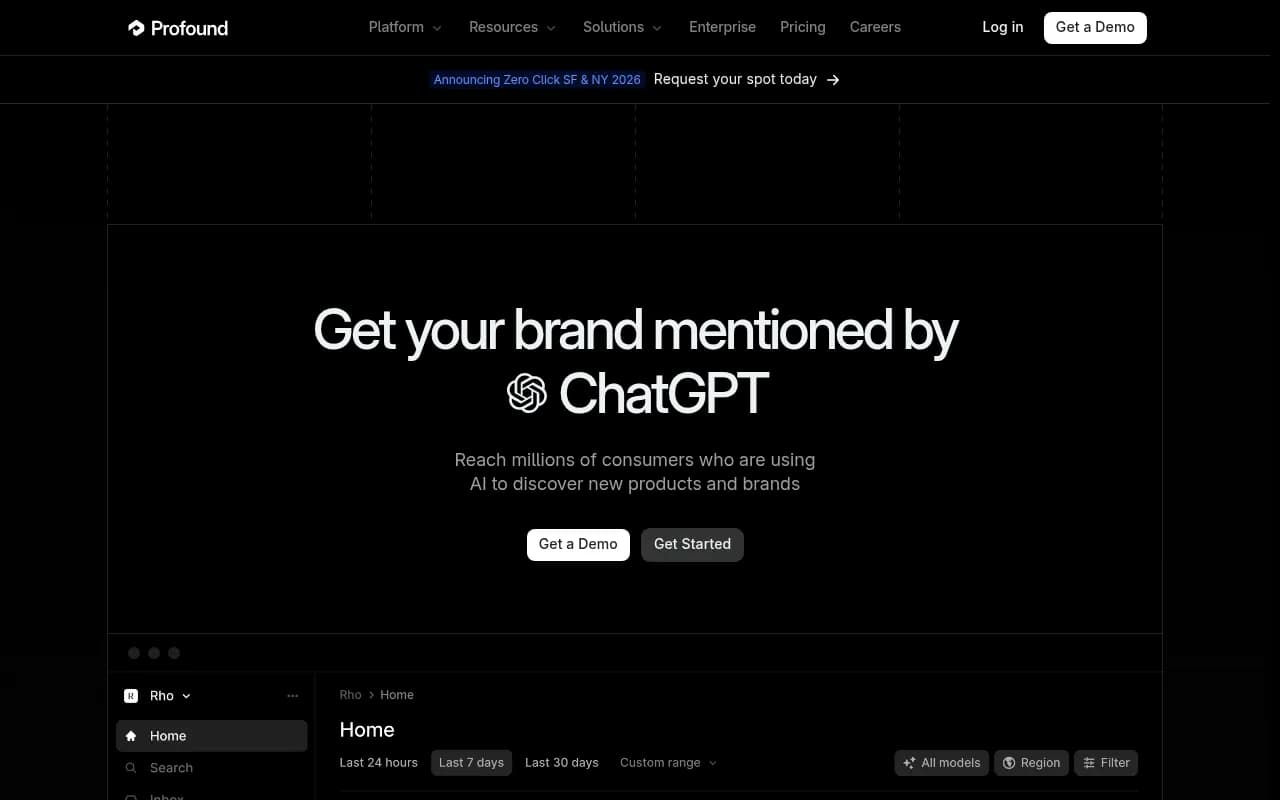
Profound is built for large organizations competing in zero-click environments. Strong feature set with custom workflows and white-glove onboarding, but higher price point ($500+/mo).
Standout features: Enterprise-grade reporting, custom prompt sets, dedicated account management. Lacks Reddit tracking and ChatGPT Shopping monitoring.
Best for: Fortune 500 brands with dedicated GEO budgets.
Best budget option: Otterly.AI

Otterly.AI is the most affordable entry point ($49/mo starting price). Basic monitoring across major AI engines, but no content gap analysis, no crawler logs, and no content generation.
Standout features: Simple dashboard, easy setup, good for tracking brand mentions.
Best for: Small businesses that just need to monitor AI visibility without optimization features.
Best for multi-language tracking: Peec.ai
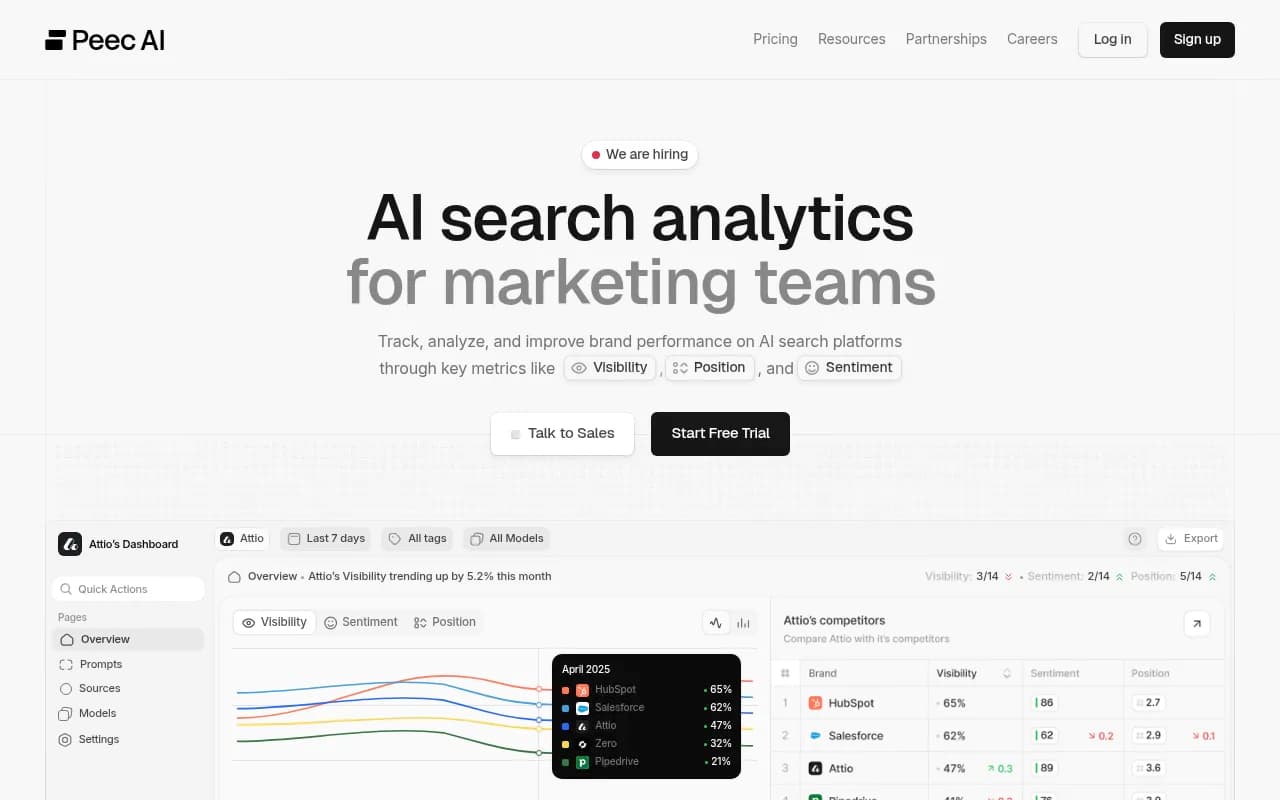
Peec.ai specializes in multi-language and multi-region monitoring. Track how your brand appears in AI responses across dozens of languages and countries.
Standout features: Prompt organization, competitor source analysis, daily tracking. Lacks content generation and crawler logs.
Best for: Global brands operating in multiple markets.
Best for content teams: Writesonic
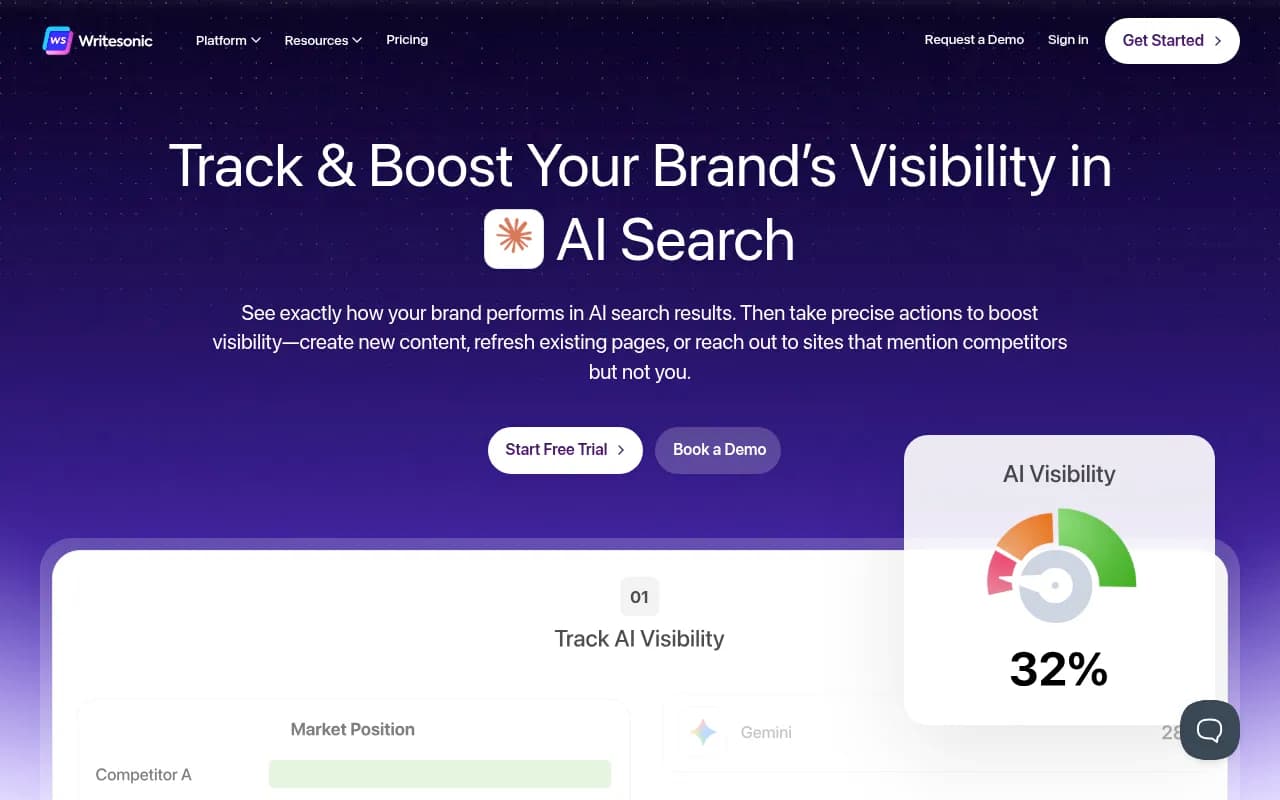
Writesonic combines AI visibility tracking with content creation tools. The Action Center highlights citation gaps, and the platform helps you generate optimized content to fill them.
Standout features: AI crawler analytics, prompt monitoring, content generation. Less robust than Promptwatch on citation analysis and Reddit/YouTube insights.
Best for: Marketing teams that want an all-in-one content and visibility platform.
Best for ecommerce: Athena HQ
Athena HQ offers Shopify integration and tracks how products appear in AI shopping recommendations. Prompt volume tracking and GEO scoring included.
Standout features: Ecommerce focus, product-level tracking. Lacks content generation and crawler logs.
Best for: Online retailers and DTC brands.
Best for agencies: Search Party
Search Party
Search Party is an AI implementation partner that builds custom automation systems for agencies. More consultative than software-focused.
Standout features: Custom workflows, white-label reporting. Limited self-service features.
Best for: Agencies managing GEO for multiple clients.
Traditional SEO platforms adding GEO features
Several established SEO tools are adding AI visibility tracking:
Semrush: Monitors AI Overviews and ChatGPT responses, but uses fixed prompts (you can't customize). No content gap analysis or crawler logs.
Ahrefs Brand Radar: Tracks brand mentions in AI search. Fixed prompts, no traffic attribution, limited optimization features.
BrightEdge: Enterprise SEO platform with AI visibility tracking. Strong for large organizations already using BrightEdge, but expensive and not purpose-built for GEO.
These platforms are useful if you're already a customer and want basic AI monitoring. For serious GEO work, purpose-built platforms offer more depth.
GEO platform comparison table
| Platform | AI Engines | Content Gap Analysis | Crawler Logs | Content Generation | Reddit/YouTube | Pricing (starting) |
|---|---|---|---|---|---|---|
| Promptwatch | 10 | Yes | Yes | Yes | Yes | $99/mo |
| Profound | 8+ | Yes | No | Limited | No | $500+/mo |
| Otterly.AI | 6+ | No | No | No | No | $49/mo |
| Peec.ai | 8+ | Limited | No | No | No | $299/mo |
| Writesonic | 6+ | Yes | Yes | Yes | No | $49/mo |
| Athena HQ | 8+ | Limited | No | No | No | $295/mo |
| Search Party | Custom | Custom | No | No | No | Custom |
| Semrush | 2 | No | No | No | No | Included |
| Ahrefs Brand Radar | 2 | No | No | No | No | Included |
| BrightEdge | 4+ | Limited | No | No | No | Enterprise |
How to choose the right GEO platform for your team
Here's a decision framework based on your goals and resources:
If you just need to monitor brand mentions: Otterly.AI, Mentions.so, or LLMrefs. Simple dashboards, low cost, no optimization features.
If you want to improve your AI visibility: Promptwatch, Writesonic, or Relixir. These platforms help you identify gaps and create optimized content, not just track data.
If you operate globally: Peec.ai for multi-language tracking, or Promptwatch for multi-region support with content generation.
If you're an ecommerce brand: Athena HQ for Shopify integration and product-level tracking, or Promptwatch for ChatGPT Shopping monitoring.
If you're an agency: Search Party for custom workflows, or Promptwatch for self-service tools with API access.
If you're already using Semrush or Ahrefs: Try their built-in AI tracking features first. If you need more depth, add a purpose-built GEO platform.
If you're an enterprise brand: Profound for white-glove service, or Promptwatch Business/Enterprise for advanced features and API access.
What a GEO workflow actually looks like
Here's how brands are using GEO platforms in practice:
Step 1: Baseline audit Run your brand and competitors through the platform. See where you appear (and don't appear) in AI responses. Identify your current citation rate and share of voice.
Step 2: Prompt research Use the platform's prompt intelligence to find high-value, winnable queries. Look for prompts with decent volume, low difficulty, and competitor gaps.
Step 3: Content gap analysis See which prompts competitors are cited for but you're not. The platform should show you the specific topics, angles, and questions AI models want answers to but can't find on your site.
Step 4: Content creation If your platform has a content generation agent (like Promptwatch), use it to create articles, listicles, and comparisons grounded in citation data. If not, write the content manually based on the gaps you identified.
Step 5: Optimization Structure your content for AI: clear headings, concise answers, entity-rich language, structured data where appropriate. Check your AI crawler logs to confirm crawlers are reading the new pages.
Step 6: Track results Monitor your visibility scores over time. See which pages are being cited, how often, and by which models. Connect visibility to traffic using attribution tools.
Step 7: Iterate Double down on what works. If certain content types or topics drive more citations, create more of them. If competitors are pulling ahead on specific prompts, analyze their content and adjust.
This cycle -- find gaps, generate content, track results -- is what separates optimization platforms from monitoring dashboards. Most brands skip steps 3-5 because their tools don't support them.
Common mistakes brands make with GEO
Mistake 1: Treating GEO like traditional SEO Keyword stuffing and backlink building don't work in AI search. AI models care about semantic relevance, entity recognition, and citation-worthy content. Structure and clarity matter more than keyword density.
Mistake 2: Only monitoring, never optimizing Tracking your visibility is useful, but it doesn't improve your visibility. You need to close the loop with content creation and optimization.
Mistake 3: Ignoring AI crawler logs If AI crawlers aren't reading your pages (or encountering errors), your content won't get cited. Check your crawler logs regularly and fix indexing issues.
Mistake 4: Focusing only on ChatGPT ChatGPT is the biggest player, but Perplexity, Claude, Gemini, and Google AI Overviews all have significant user bases. Monitor across engines.
Mistake 5: Not tracking Reddit and YouTube AI models cite Reddit threads and YouTube videos heavily. If your competitors are active on these platforms and you're not, you're at a disadvantage.
Mistake 6: Skipping traffic attribution Without connecting AI visibility to actual traffic and revenue, you can't prove ROI. Use a code snippet, GSC integration, or server log analysis to close the loop.
The future of GEO: what's coming in 2026 and beyond
The GEO platform market is still young. Here's what's on the horizon:
More AI engines to monitor: As new models launch (DeepSeek, Grok, regional LLMs), platforms will expand coverage. Expect 15+ engines by 2027.
Deeper Reddit and YouTube integration: AI models cite these platforms heavily. GEO tools will surface more discussions and help brands participate strategically.
Real-time optimization: Platforms will move from "track and report" to "detect and fix" -- automatically suggesting content updates or generating new articles when gaps appear.
Persona-based tracking: Monitor AI responses for different user personas (e.g. "small business owner looking for CRM" vs "enterprise IT buyer evaluating security"). Promptwatch already supports this.
Voice and video search: As AI search expands to voice assistants and video platforms, GEO tools will track visibility in these channels.
Tighter CMS integration: Expect plugins for WordPress, Webflow, and other platforms that optimize content for AI search as you write.
AI-to-AI optimization: Platforms will use AI agents to automatically rewrite content for better citation rates -- a feedback loop where AI optimizes content for other AI models.
Final thoughts: GEO is no longer optional
Traditional search is shrinking. AI search is growing. Brands that wait to build GEO capability will find themselves invisible in the channels that matter most.
The good news: the tools exist. The bad news: most of them are monitoring-only dashboards that leave you stuck. If you want to actually improve your AI visibility, choose a platform that helps you take action -- identify gaps, create optimized content, and track the results.
Promptwatch is the only platform that closes the full loop. It shows you where you're invisible, helps you fix it with AI-generated content grounded in citation data, and tracks your progress across 10 AI engines. Free trial available.
Start with a baseline audit. See where your brand appears (and doesn't appear) in AI search. Then decide: do you want to just monitor the decline, or do you want to fix it?