Key takeaways
- Food and beverage shoppers ask AI engines dietary, ingredient and "best of" questions, and the answers often come from product pages, landing pages and roundups.
- Promptwatch's data for Sep 28 to Oct 4, 2026 shows product pages (22.4%) and landing pages (16.8%) take 39% of ChatGPT citations, so your own SKU pages matter most.
- You need three things from a tool: monitoring across engines, a way to see why AI cites who it cites, and a way to fix gaps. Many tools only do the first.
- No GEO tool checks whether a label claim like "gluten-free" is legally allowed. Someone on your team has to sign off every claim.
- Start with a free visibility check, then pick a platform based on your budget, markets and team size.
Why food and beverage is its own GEO problem
Most GEO advice is written for SaaS. Food is different. A shopper asks "best gluten-free, low-sugar snack brand" or "is this oat milk good for coffee", and the answer is built from ingredient lists, nutrition facts, reviews, retailer listings and roundup articles. Your brand wins or loses on how well those sources describe you.
Onely published a piece on GEO agencies for food and beverage ecommerce that makes a point I haven't seen elsewhere. It says none of the seven food and beverage GEO lists it opened mentions the food law behind label claims such as gluten-free or low sugar. Onely sells GEO services, so read it with that bias in mind. Still, the point stands. If a tool or agency helps you win an answer that contains a regulated claim, someone has to own whether the claim is allowed in each market.
The Bluelinks agency list, published July 28, 2026, says leading agencies now optimize product pages, location details, menus, recipes, FAQs and company profiles. That is a decent checklist of surfaces, whichever tool you end up using.
What AI actually cites for food brands
Promptwatch Data has no food-specific breakdown, so treat this as a reasonable inference rather than a food finding. But the content-type numbers are clear. In Promptwatch's ChatGPT citation share by content type report (Sep 28 to Oct 4, 2026), the split looked like this:
| Content type | Share of ChatGPT citations |
|---|---|
| Product pages | 22.4% |
| Landing pages | 16.8% |
| Listicles | 13.6% |
| How-to guides | 8.7% |
| Documentation | 7.5% |
| General articles | 6.1% |
| Comparisons | 5.9% |
| News | 5.7% |
| FAQ pages | 3.3% |
| Reviews | 1.7% |
For commercial prompts like "best X for Y", product pages hit 26.0%, landing pages 20.6%, listicles 15.0% and comparisons 7.9%. Those four make up almost 70% of commercial citations. For branded prompts, reviews jump to 5.6%, more than three times their overall share.
What this means for a snack, drink or grocery brand:
- Product pages with full ingredients, nutrition, allergens, dietary claims, pack sizes and prices are the citation surface. Thin pages lose.
- Being listed in the "best of" roundups AI already cites for your category matters nearly as much as your own site.
- Reviews on trusted sites matter most when someone asks about you by name.
- News coverage fades fast. The content half-life report found news lost half its cited pages within 36 days, while landing pages and docs stayed cited longest. A launch press push is not a durable strategy.
- Almost half of ChatGPT responses cite 10 or more unique domains, per Promptwatch's unique domains report. You are competing for one slot among many, so retailer listings and third-party sites count.
What to look for in a GEO tool as a food or beverage brand
I would score tools on these points, roughly in order of importance.
- Real interface tracking. Answers in the live ChatGPT or AI Overviews interface can differ from API output, and shopping carousels only show up in the real UI.
- Citation visibility. You need to see which retailer pages, roundups, Reddit threads and review sites AI pulls from, not only whether your name appeared.
- Multi-market support. If you sell in several countries, you need monitors per country and language, because ingredient rules and product names differ.
- Shopping coverage. Product recommendations in ChatGPT shopping results are where a CPG brand actually gets picked.
- A path to action. A dashboard that says "you are at 4% share of voice" is not enough. Look for content gap analysis, content creation and publishing.
- Crawler logs. If AI bots cannot read your product pages, no amount of copy fixes it. Many retail sites are heavy on JavaScript and block bots by accident.
- Governance. Food copy is regulated. You want a review step before anything is published.
The best GEO tools for food and beverage brands in 2026
I have grouped these by what they are good at. I have not tested every tool listed, and pricing changes, so confirm on each vendor's site.
Promptwatch: monitoring plus the fix
Promptwatch is the one I would shortlist first for a brand that wants to act on the data rather than stare at it. It tracks ChatGPT, Gemini, Perplexity, Google AI Overviews, AI Mode, Copilot, Claude and others through the real interfaces, per country and language. For food brands the relevant pieces are ChatGPT Shopping tracking (which products AI recommends and which competitors it picks instead), Brand Narrative (the claims AI repeats about you, such as "too sweet" or "affordable"), and Fact Check on Business plans, which lets you mark a claim inaccurate and find the page teaching AI the wrong thing.
It also logs AI crawlers with IP verification, so you can tell an access problem from a content problem, and the Content Agent can write and publish pages to WordPress, Webflow or Framer with a review inbox so a human approves everything. That review step is what a regulated category needs.

Pricing at promptwatch.com/pricing: Essential $95/mo, Professional $245/mo, Business $579/mo. Shopping, the Content Agent, Fact Check and local targeting start at Business. There is a 7-day free trial on monthly billing, and a free AI visibility report if you want a baseline first. Agencies running several brands can look at the agency plans.
Enterprise monitoring platforms
If you are a large CPG group with procurement requirements, these are the names that come up.

Profound is a strong monitoring platform, priced at the enterprise end. See Promptwatch vs Profound for a side-by-side.
Scrunch monitors and optimizes how assistants describe a brand. Goodie AI, Bluefish AI and Evertune also target enterprise GEO.
Budget trackers
Smaller brands, a single founder-led label, or a team just testing the waters can start with simple trackers. They tell you whether you show up. They generally don't create content or read crawler logs.

Otterly.AI is among the cheaper options. Anagram's roundup lists it from $29/mo, but I haven't verified that figure.

Peec AI is monitoring-focused. Promptwatch vs Peec covers the gap. PromptScout and PromptRush are other low-cost entries in the catalog.
SEO suites with AI add-ons
If you already pay for one of these, check the AI module before buying something new. Expect fixed prompt sets and shallower AI data.
Structured data and listings
Food GEO leans on structured data (product, recipe, nutrition) and on location data for restaurants and retail.
Schema App manages structured data at scale, useful for large SKU catalogs. For multi-location restaurants and stores, listings tools matter.
Yext and Birdeye cover listings and reviews across locations. Malou, mentioned in a restaurant GEO checklist from its own blog, is a hospitality-specific option outside our catalog.
Comparison table
| Tool | Tracking | Shopping coverage | Crawler logs | Creates and publishes content | Best for |
|---|---|---|---|---|---|
| Promptwatch | Real UI, many engines | Yes (Business) | Yes | Yes (Business) | Brands that want to fix gaps |
| Profound | Yes | Not a focus | No | No | Large enterprises |
| Scrunch | Yes | Limited | Limited | Limited | Enterprise monitoring |
| Otterly.AI | Yes | No | No | No | Cheap baseline |
| Peec AI | Yes | No | No | No | Simple monitoring |
| Semrush, Ahrefs | Fixed prompt sets | No | No | No | Teams already on the suite |
| Schema App | None | Via markup | No | Structured data | Large SKU catalogs |
| Yext, Birdeye | Listings and reviews | No | No | No | Multi-location food service |
Capability claims for tools other than Promptwatch come from general positioning, so check each vendor before you buy.
A practical workflow for a food brand
Step 1: get a baseline
Run a free check first. Promptwatch's AI visibility report and tools like HubSpot AI Search Grader give a rough picture of how ChatGPT and others talk about you. Then build a prompt list around real shopper questions: dietary needs (vegan, gluten-free, keto), occasions, comparisons with named competitors, and "near me" queries if you run locations.
Step 2: check that bots can read your product pages
Use the Agentic Readiness Check or crawler logs to confirm AI bots reach your SKU pages. A fast e-commerce theme that renders ingredients only in JavaScript is a common culprit.
Step 3: rewrite product pages
Put ingredients, nutrition, allergens, certifications, size, price and a short plain-language description in the HTML. Add product schema. Add an FAQ block that answers the questions shoppers actually type.
Step 4: close roundup and review gaps
Find which listicles and review sites AI cites for your category, then pitch them or earn coverage. Check Promptwatch Data for how citation patterns shift. For example, social sources are uneven: Promptwatch's October 2026 social data shows ChatGPT got only 0.46% of citations from social platforms while AI Overviews got 12.2%. So a Reddit or YouTube push helps more on Google than in ChatGPT.
Step 5: put a claims gate in front of everything
This is the part no tool solves. Decide who approves each claim (gluten-free, low sugar, organic, high protein) for each market, and keep that sign-off in your content workflow. If you use an agent that publishes automatically, route output through a review inbox first.
Step 6: measure orders, not just mentions
Visibility scores are a means. Connect AI-referred visits and conversions to revenue. One caveat: ChatGPT stopped sending a referrer on October 8, 2026, so tag links with utm_source=chatgpt.com where you can.
Market context
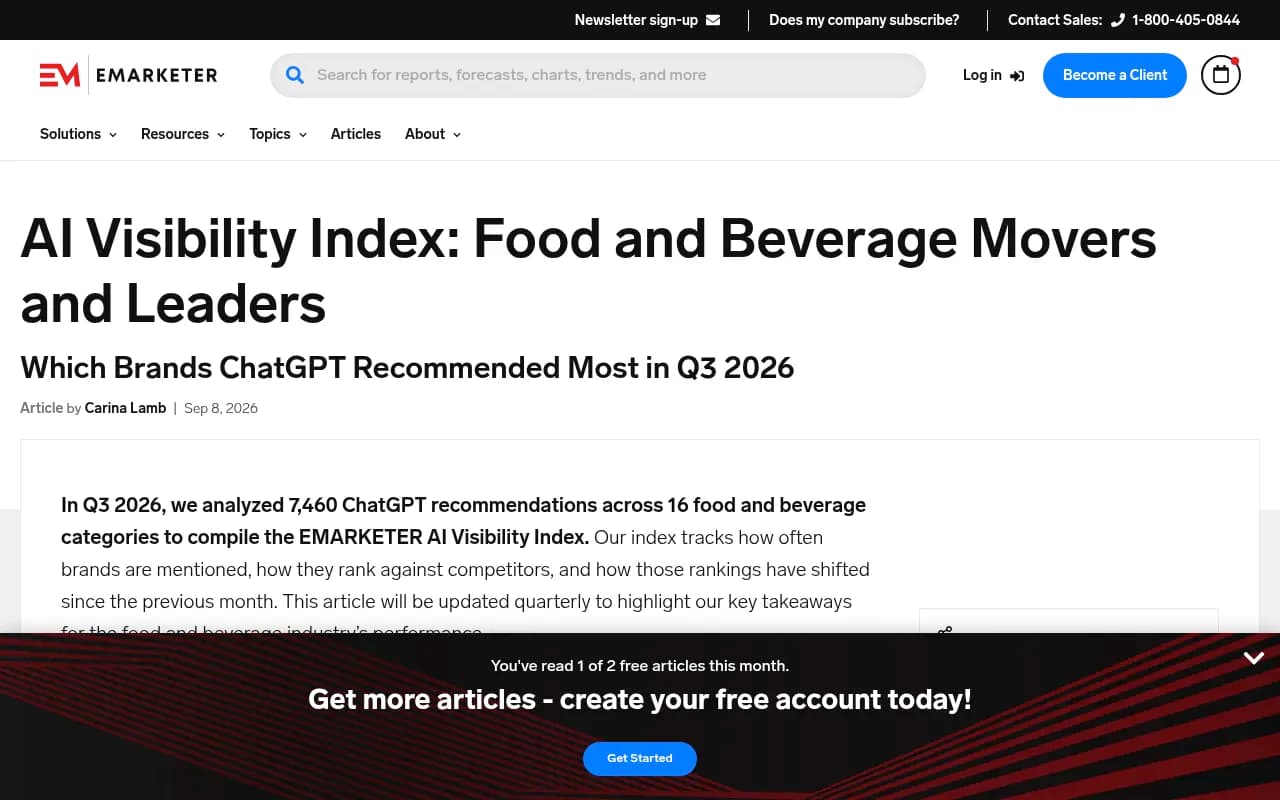
The eMarketer AI Visibility Index for food and beverage tracks which brands get mentioned most in AI recommendations. The snippet I could see showed Whole Foods Market and Quaker at 4% each, which tells you that even the leaders hold small shares. The category is wide open, so a mid-sized brand with good product pages can realistically move.
Should you hire an agency instead?
If your team has no SEO capacity, an agency may be faster. Onely's five checks are a good screen: does the agency work on dietary and ingredient questions, who signs off claims, does it cover each market's food rules and retailer listings, can it show food brand results measured in orders, and how does it price multi-country work. If you want an agency that pairs strategy with a GEO platform, 1001 SEO Media works with Promptwatch for AI visibility. For more options, browse the GEO software directory at bestgeosoftware.com.
Which tool should you pick?
- A single product line testing AI search: a free report, then a low-cost tracker.
- A DTC or CPG brand with a real catalog and a content team: a platform that tracks shopping and helps you publish, like Promptwatch Business.
- A global food group with strict procurement: shortlist enterprise platforms, and ask about security certifications and audit logs.
- A restaurant group or franchise: pair a GEO tracker with listings and review tools.
Whichever you choose, spend more time on the product pages and the claims process than on the dashboard. The tool shows you the gap. Your pages close it.