Key takeaways
- Cloud and DevOps buyers ask AI engines for tool shortlists, so a GEO tool for this category must track commercial prompts like "best Kubernetes cost tools", not just brand mentions.
- In Promptwatch Data's software report (Sep 28 to Oct 4, 2026), docs and help centers earned the largest citation share, with GitHub, G2 and vendor sites behind them. Docs and GitHub are the core of your GEO surface.
- Pick tools that show crawler access and citations per page, not only a visibility score. Many DevOps sites fail on rendering, robots rules or gated docs.
- Monitor-only tools are fine for a first benchmark. Once you know your gaps, you need something that helps you fix them.
- Most published GEO tool rankings are written by the vendors they rank. Trial two or three tools on your own prompts before committing.
Why cloud and DevOps vendors need a different GEO approach
Most GEO advice is written for consumer brands or generic SaaS. Cloud and DevOps vendors have a stranger problem. Your buyers are engineers and platform leads. They ask ChatGPT or Perplexity things like "best Terraform alternatives", "how to cut Kubernetes costs" or "Argo CD vs Flux", and the answers are built from documentation, GitHub repos, comparison articles and review sites far more than from your marketing homepage.
That changes what you measure and what you fix. According to Promptwatch Data's software citation report (Sep 28 to Oct 4, 2026), GitHub was the most cited software domain at 1.2% of software citations. learn.microsoft.com followed at 0.98%, then G2 at 0.73%. AWS docs got 0.41% and Google Cloud docs 0.35%. By source type, docs and help centers earned 2.64%, vendor sites 2.01%, and review sites and analysts 1.57% combined. Vendor sites and docs together earned about three times the share of review sites and analysts.
For a cloud or DevOps vendor that is good news and a warning. You control the sources AI likes most, but only if those sources are crawlable, current and written the way an engineer would ask the question.
What a GEO tool should do for a DevOps vendor
The basic GEO job is the same everywhere: mention tracking, citation tracking, sentiment and share of voice across engines like ChatGPT, Perplexity, Gemini, Copilot and Google AI Overviews. That is the floor. For this category I would add five requirements.
Prompts that match how engineers ask
Engineers write long, specific prompts: "best GitOps tool for multi-cluster EKS with SSO". Your tool needs to let you build prompt sets by persona (platform engineer, SRE, FinOps lead, CTO) and by intent (comparison, how-to, pricing). Fixed prompt lists from a generic template will miss most of this.
Citation detail at the page level
A visibility score tells you little. You want to know which of your docs pages, GitHub READMEs, blog posts or comparison pages get cited, which competitor pages get cited instead, and which third-party sites (G2, Gartner, Capterra, Reddit threads) shape the answer. Promptwatch Data also found that for commercial prompts such as "best X tools", product pages, landing pages, listicles and comparisons together make up almost 70% of citations, so those page types deserve the most attention. See the content type report for the breakdown.
AI crawler visibility
DevOps sites often have docs on a separate subdomain, behind a JavaScript framework, or behind a login wall. Any of these can quietly stop AI bots from reading your best content. Tools that show real crawler logs make this obvious. Tools that only query the engines can't tell you whether the problem is access or content.
Traffic and pipeline attribution
Technical buyers research in AI engines and then show up later as direct or branded traffic. You want at least visitor-level attribution for AI referrals, so you can argue for budget with something better than "we were mentioned more".
Some way to act on the findings
A dashboard that says you are invisible for "Kubernetes cost optimization" is not much use unless someone writes the page. Decide early whether you have the content capacity in-house or want the tool to help.
The best GEO tools for cloud and DevOps vendors
This is not a ranking of every tool on the market. These are the ones I would shortlist for this category, grouped by what they do best.
Promptwatch for end-to-end work
Promptwatch is the one I would start with for a vendor that wants to monitor, diagnose and fix. It tracks ChatGPT, Gemini, Claude, Perplexity, Google AI Overviews, Google AI Mode, Copilot and others from the real interfaces, and it also tracks coding agents (Codex, Claude Code and OpenCode), which matters if developers ask those tools which SDK, CLI or infrastructure product to use.

Three things fit this category well:
- AI crawler logs are IP-verified, so you can see whether GPTBot, ClaudeBot or PerplexityBot actually read your docs, and where they hit errors.
- Page-level citation tracking and content gap analysis show which prompts you lose and which competitor pages win them. The Content Agent can then draft and publish pages to WordPress, Webflow or Framer.
- Citation Trends classify sources into types, including directories like G2 and Capterra, so you can see how much of your category's answers come from review sites versus your own docs.
Pricing starts at $95/month (Essential) and the Content Agent, local targeting and faster-than-daily tracking start at Business ($579/month). Confirm current numbers at promptwatch.com/pricing. There is a 7-day free trial, and a free AI visibility report if you just want a first look.
Two caveats. The Content Agent only starts at Business, so smaller teams get monitoring and diagnostics first. And any tool this broad takes a week or two to set up properly, mostly because you have to build good prompts.
Profound and Bluefish for enterprise monitoring
If you are a large cloud vendor with a dedicated brand or analyst-relations team, Profound and Bluefish AI are the usual enterprise names. They have strong monitoring and reporting and suit procurement processes that prefer a recognized enterprise vendor.

The trade-off is price and scope. Profound's positioning is monitoring-heavy, and neither is where I would look for crawler logs tied to your docs. I would use them if the main job is executive reporting across many brands and regions.
Peec AI and Otterly.AI for a cheap first benchmark
If you have never measured AI visibility, a lightweight tracker is a sensible first step. Peec AI and Otterly.AI are simple, affordable monitors. Both stop at monitoring, so they will tell you where you stand but won't diagnose crawler issues or produce content.


Use these to get a baseline, then decide whether you need more. A Reddit test thread in the research notes recommended Otterly for a clean start and Peec for sources, but that is one user's anecdote, so run your own prompts.
Scrunch and AthenaHQ for monitoring plus some optimization
Scrunch and AthenaHQ sit in the middle: stronger than basic trackers, with some optimization guidance. They are worth a demo if you are comparing mid-market platforms.

Semrush and Ahrefs Brand Radar if you already live there
If your SEO team already runs on Semrush or Ahrefs, their AI visibility modules are the lowest-friction way to get a first view inside tools your team knows.
The limits are typical of SEO suites: prompt sets are more rigid, AI-specific depth is shallower, and there is no crawler-log or AI-traffic attribution at the level of dedicated platforms.
Enterprise SEO platforms with AI add-ons
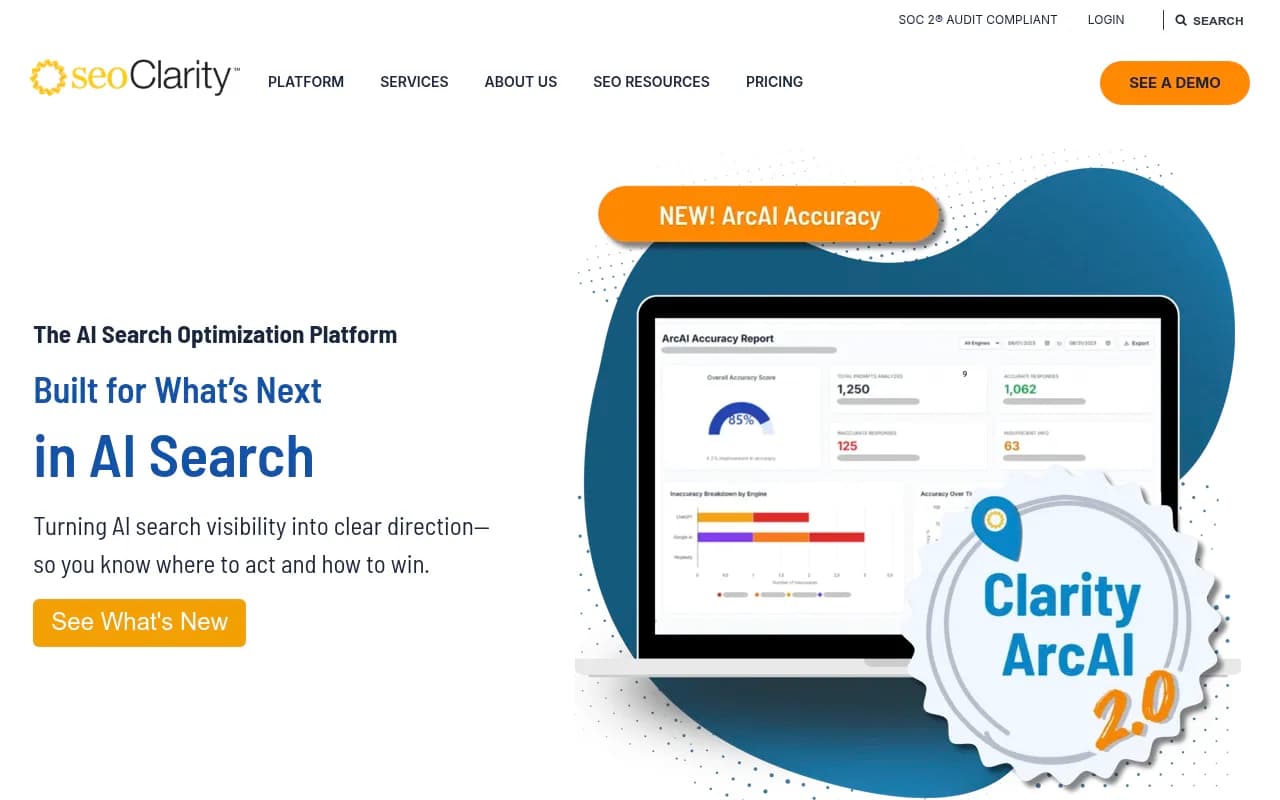
If you run a large docs-and-marketing site and already pay for BrightEdge, Conductor or seoClarity, check what their AI visibility modules cover before buying another tool.
Comparison table
| Tool | Best for | Crawler logs | Content creation | Coding agent tracking | Typical buyer |
|---|---|---|---|---|---|
| Promptwatch | Monitor, diagnose and fix in one place | Yes, IP-verified | Yes (Business and up) | Yes | Mid-market to enterprise vendors |
| Profound | Enterprise reporting | Not a focus | Limited | Not documented | Large brands |
| Peec AI | Cheap baseline monitoring | No | No | No | Small teams |
| Otterly.AI | Simple monitoring | No | No | No | Small teams |
| Scrunch | Monitoring with guidance | Limited | Some | Not documented | Mid-market |
| Semrush / Ahrefs Brand Radar | Teams already in the suite | No | Separate products | No | SEO teams |
Feature claims for competitors reflect their positioning at a high level. Check each vendor's current documentation before you buy.
Fix the sources AI actually cites
The tool is half the job. The other half is making sure the pages AI reads are worth citing. Based on the Promptwatch Data reports, here is where I would start.
Docs and help centers
Docs earned the largest source-type share in the software report. Keep them on crawlable URLs, server-rendered where possible, and not behind a login. Check robots.txt for AI bots, and use the free Agentic Readiness Check or robots.txt generator for AI to see what is blocked. A docs page that explains a concept in plain language beats one that only lists API parameters.
GitHub
GitHub was the single most cited software domain. Keep READMEs clear about what the project is, who it is for and how it compares to alternatives. A README that says "X is a Y for Z" is easier for a model to quote than a wall of badges.
Comparison and landing pages
For commercial prompts, product pages, landing pages, listicles and comparisons dominate. If you have no "X vs Y" or "best tools for Z" pages that you control, competitors and review sites will define the comparison for you. Landing pages and docs also last longest in ChatGPT's citations. Promptwatch's half-life data shows news pages lose half their citations in about 36 days, while landing pages and docs keep most of theirs for months. Invest in evergreen pages over announcement posts.
G2, Capterra and analyst profiles
Review sites and analysts earned about a third of what vendor sites and docs did, but they still matter, especially for branded and comparison prompts. Keep your G2 and Capterra profiles current, and make sure pricing and feature details match your own site. Contradictions between sources are how models end up saying wrong things about you.
How to choose: a short process
- Write 30 to 50 prompts that real buyers use, split by persona and intent. Include comparison prompts that name your top competitors.
- Run them in two or three tools on trial, in the engines your buyers use.
- Compare what each tool shows about the same prompts. Differences between tools are informative about their data collection.
- Check whether the tool tells you why you are missing: crawler errors, thin pages, or sources you don't control.
- Decide who will do the fixing. If nobody on the team has the time, favor tools that draft and publish content, or hire help.
Be skeptical of rankings. The research notes included a listing published by ziptie.ai that ranks itself first, and Olostep's guide openly says most articles on this topic come from the vendors they rank. That includes this one in a sense, so verify claims on your own prompts. For more options, the directory at bestgeosoftware.com lists GEO tools side by side.
Where an agency helps
Some DevOps vendors have strong engineers and almost no content ops. If that is you, an agency can run the prompt research, content and technical fixes while you keep the product roadmap. 1001 SEO Media works with Promptwatch as its AI visibility platform and offers GEO and technical SEO services with no long-term contracts. It is one option; interview a few.
Final take
For cloud and DevOps vendors, GEO mostly comes down to docs, GitHub and a few comparison pages that engineers can trust, plus the crawler access to make them readable. Start with a cheap baseline if you are unsure. If you already know you have gaps, pick a platform that shows crawler access and page-level citations and helps you ship the fixes, and shortlist Promptwatch alongside one or two others to test on your own prompts.