Key takeaways
- PR teams should judge GEO tools on three things: sentiment accuracy, mention tracking (linked and unlinked), and cited-source reports that show which outlets shape AI answers.
- The cited-sources report is the most useful PR feature. It tells you which publications and pages to pitch, not just whether you were named.
- Sentiment is often gated behind pricier plans. SE Visible and a PR-suite tool listed by Medialyst were both quoted with sentiment starting in the $399 to $499 per month range, so confirm current pricing before you budget.
- Monitoring-only tools tell you the problem exists. Platforms that also help you fix it (content, crawler logs, traffic attribution) save PR and SEO teams a lot of handoffs.
- Branded prompts behave differently from generic ones. ChatGPT leans on your own product and landing pages, plus reviews, so owned content and review sites matter.
Why PR teams care about GEO now
PR used to own a fairly clear job: get coverage, track coverage, report coverage. AI answers scramble that. A buyer asks ChatGPT or Perplexity for the best option in your category, and the response is stitched together from dozens of sources. You might be named without a link, framed with the wrong tone, or left out entirely because a competitor's review page happened to be easier to cite.
That is a communications problem as much as an SEO one. The questions PR teams ask are different from the ones SEO teams ask:
- What does AI say about us, and is the tone fair?
- Which outlets, review sites, and social platforms is it pulling that from?
- Where are we mentioned without a link?
- Are we losing ground to a specific competitor, and why?
Most GEO tools cover some of this. Few cover all of it. The rest of this guide sorts them by what they are actually good at.
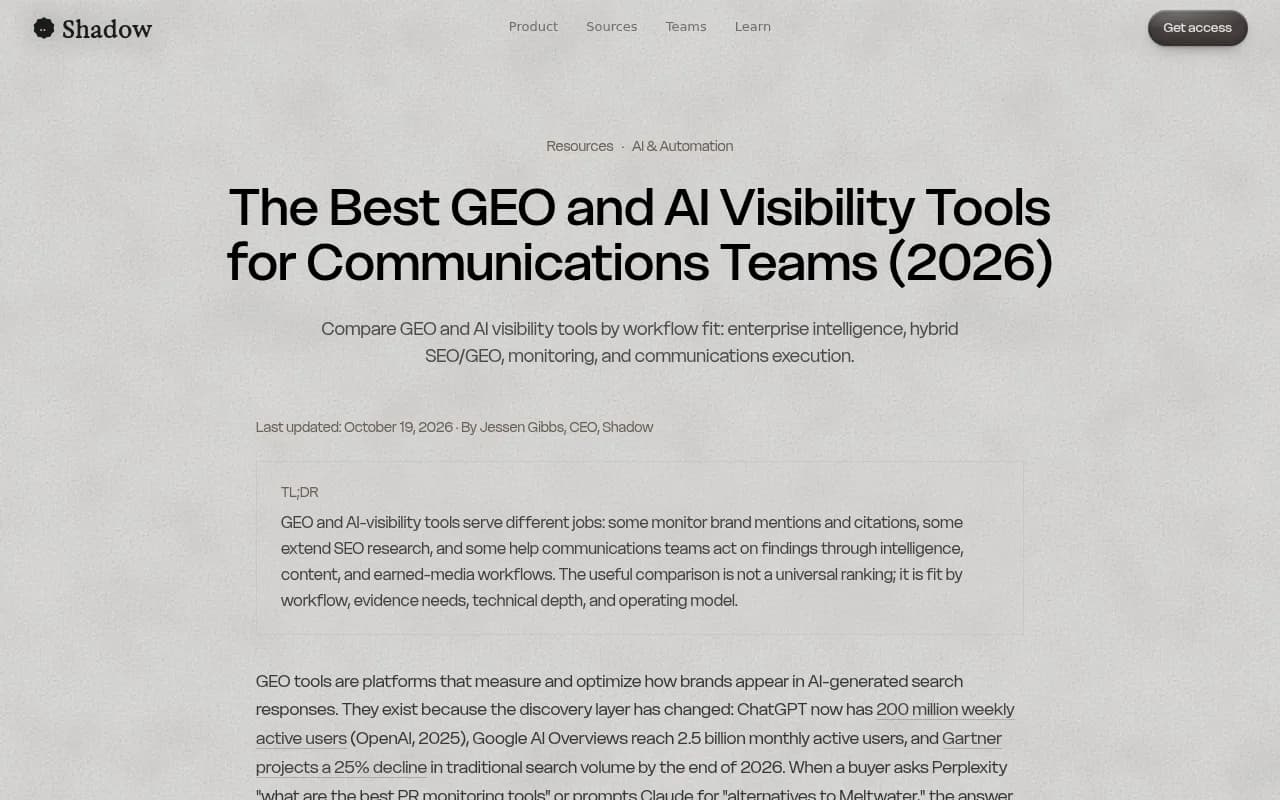
A caveat on that comparison: Shadow is a vendor that sells communications execution, so treat its framing as one perspective. The useful part is the idea of fitting a tool to workflow (monitoring, SEO extension, or execution) rather than hunting for a universal winner.
What PR teams should actually measure
Most GEO tools do four jobs: mention tracking, citation tracking, sentiment, and share of voice. For PR work, each has a specific angle.
Mentions, including unlinked ones
AI engines often name a brand with no link. A tool that only counts cited URLs will undercount you. Look for entity-level tracking and unlinked mention detection. Ahrefs Brand Radar is built around this kind of entity and brand association view, though it has no content or execution layer.
Sentiment
Sentiment at its simplest is positive, neutral, or negative per mention. That is fine for a dashboard, but it is blunt. One tool in the research notes breaks sentiment down by attribute, so pricing might read negative while features read positive and support reads neutral. That is far more actionable for a comms team than a single score.
Two things to test during a trial. First, check whether sentiment is per response, per brand, or per topic. Second, read a sample of the underlying answers yourself. Automated sentiment misreads hedged language more often than you would expect.
Cited sources
This is the one I would weigh most heavily. The Medialyst roundup makes the same point: for PR teams, the cited-sources report is the most useful part, because it shows which outlets and articles shape what AI says about a brand. It turns a vague "we are invisible" into a pitch list.
Share of voice
How often you appear compared with named competitors, ideally by topic, model, and country. Useful for board-level reporting. Less useful on its own for deciding what to do next.
Where AI actually gets its answers about your brand
Before you pick a tool, it helps to know what the tool should be surfacing. Promptwatch Data has useful first-party numbers here.
For branded prompts in ChatGPT (Sep 28 to Oct 4, 2026), product pages were 23.3% of citations and landing pages 22.8%, almost half combined. Reviews rose to 5.6%, more than three times their overall share. Social posts reached 3.0%, almost four times their overall share. FAQ pages were 4.8% and press releases 2.1%.
Two takeaways for PR. Press releases barely register on their own, so a distribution wire alone is not an AI strategy. And your own site plus trusted review platforms carry most of the weight on questions about your brand.
Social is where it gets uneven. In the same period, ChatGPT took only 0.46% of its citations from social platforms, while Google AI Overviews took 12.2%. Reddit's share of ChatGPT citations collapsed from about 4% to 0.5% on August 14, 2026. If your community-management plan assumed Reddit threads would feed ChatGPT answers, that assumption is dated. For AI Overviews, YouTube (4.28%) and Facebook (2.38%) now matter more than Reddit (2.15%). LinkedIn is ChatGPT's top social source at 0.3%, and it ties Reddit on Perplexity at 0.86%.
Finally, freshness. News pages lose half their ChatGPT citations in about five weeks, while landing pages and docs keep most of theirs for months. Earned coverage gives you a spike. Owned, durable pages give you a baseline.
The best GEO tools for brand and PR teams
Pricing below is directional. Several figures in published roundups conflict with each other, so verify on each vendor's site.
Promptwatch
Promptwatch is the one I would put first for teams that want to go from "what does AI say about us" to "fixed it." It monitors the real interfaces of ChatGPT, Google AI Overviews, AI Mode, Gemini, Perplexity, Copilot, Meta AI and others, then layers on the parts PR teams care about: per-response sentiment with trends and a weekly summary, competitor sentiment heatmaps by topic, and offsite mentions that catch your brand named on third-party pages without a link.

The source-tracking side is deeper than most. Dedicated reports cover Reddit, YouTube, and LinkedIn citations, and Citation Trends classify each citation by content type and source type, so you can see whether review sites, news, or your own pages carry your brand. Add IP-verified AI crawler logs and visitor analytics and you can tell whether a PR-driven citation actually sends traffic. Plans start with a free Explore tier (ChatGPT only), then Essential at $95 per month. Check promptwatch.com/pricing for current numbers.
The honest tradeoff: it is a broad platform, so a team that only wants a mention alert will not use half of it.
SE Visible
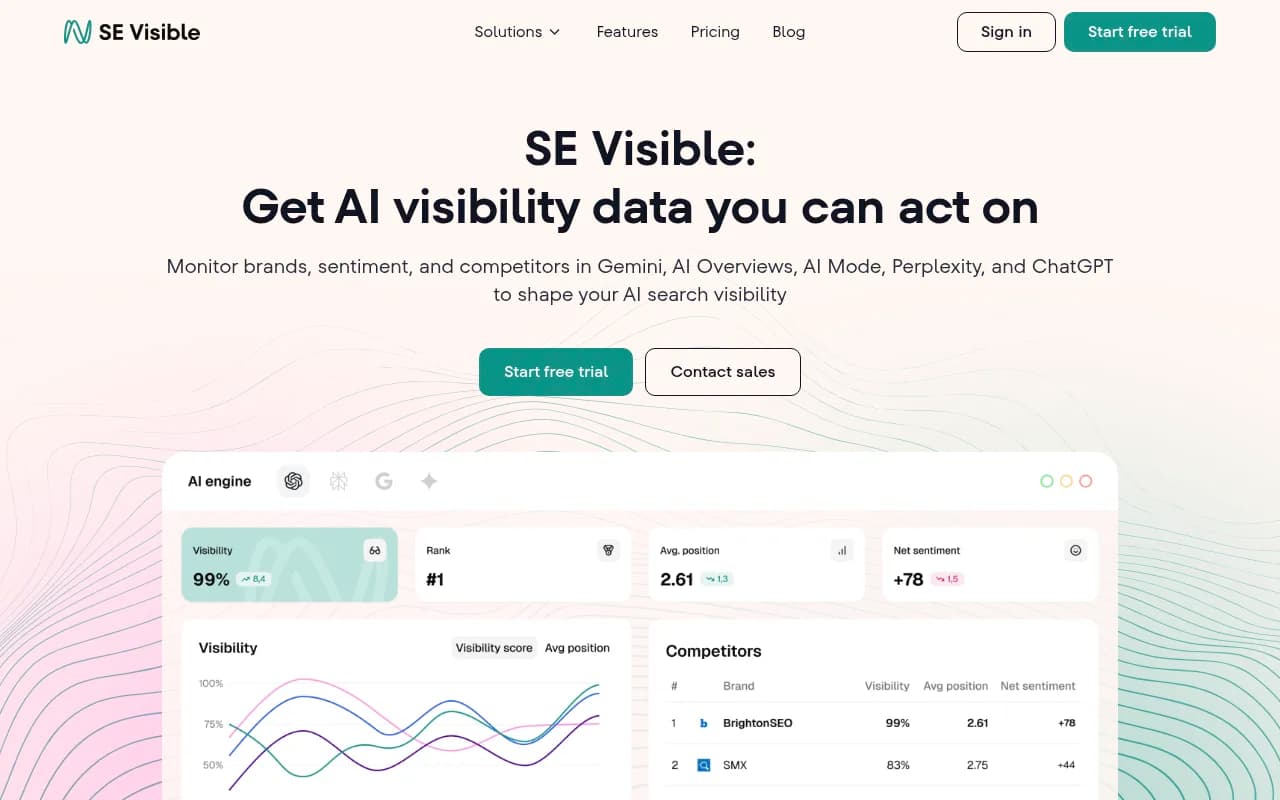
SE Visible, from SE Ranking, is aimed at CMOs, agencies, and PR and brand specialists. It reports a visibility score and a net sentiment score, with prompt and topic insights and competitor benchmarking across AI Overviews, AI Mode, Gemini, and ChatGPT. Entry pricing is around $99 per month with a 10-day trial, but its own review lists sentiment analysis starting at the $499 per month Growth plan. Read the plan matrix before assuming sentiment is included.
Ahrefs Brand Radar
Strong on entity graphing, unlinked mentions, and brand association across multiple models. It does not do content optimization or execution, so it works best as a perception tracker alongside other tools. If your team already lives in Ahrefs, the integration is convenient.

Profound
An enterprise-oriented monitoring platform with deep feature coverage and pricing to match. It suits large comms teams with budget and analysts to read the data. It lacks the Reddit tracking and agentic execution that some competitors include.

AthenaHQ
Good sentiment tracking, according to one roundup, but no built-in way to act on what it finds. Fine if you have a separate content team ready to respond.
Otterly.AI
Accessible entry-level monitoring: mention tracking, basic citation detection, and simple positive, neutral, negative sentiment across major platforms. A reasonable first purchase for a small team that wants to see whether the problem is real.

Peec AI
Clean AI search monitoring without the optimization layer. Good for reporting, thin on what to do next.

Meltwater
Not a GEO specialist, but many PR teams already run it for media and social monitoring. Pairing a traditional media intelligence suite with a dedicated GEO tool covers both the human-readable press and the machine-readable citations.
Brand24
Social listening across a large source set. Useful for the social side that feeds AI answers, particularly where Google AI Overviews pull from Facebook, YouTube, and Instagram.
Comparison table
| Tool | Sentiment | Unlinked or offsite mentions | Cited-source reporting | Helps you act on findings | Best for |
|---|---|---|---|---|---|
| Promptwatch | Per response, trends, competitor heatmaps | Yes (Offsite Mentions) | Deep, incl. Reddit, YouTube, LinkedIn | Yes (Content Agent, Action Board) | Teams that want to fix, not just watch |
| SE Visible | Net sentiment score | Limited | Prompt and topic level | Light | CMOs and agencies on a mid budget |
| Ahrefs Brand Radar | Brand association | Strong | Entity-focused | No | Perception tracking |
| Profound | Yes | Yes | Yes | Limited | Large enterprise comms |
| AthenaHQ | Good | Basic | Yes | No | Monitoring with separate content team |
| Otterly.AI | Basic three-way | Basic | Basic | No | Small teams starting out |
| Peec AI | Basic | Basic | Yes | No | Simple reporting |
| Meltwater | Strong for traditional media | Press and social | Not AI-specific | No | Existing media monitoring stack |
How to pick based on your team
Small in-house comms team
Start with a low-cost monitor like Otterly.AI or a free tier to confirm what AI says about you. Run the same 20 to 30 branded and category prompts weekly and keep the answers. If you find problems worth fixing, move up.
Mid-size brand team with SEO partners
You need sentiment plus cited sources plus something SEO can act on. Promptwatch or SE Visible fit here. The deciding factor is usually whether sentiment is on the plan you can afford.
Agencies and enterprise comms
Look at white-label reporting, multi-brand workspaces, and role-based access. Promptwatch has agency plans with branded client access. Profound and Bluefish are worth a look for large corporate programs. If you would rather hire than buy, 1001 SEO Media runs GEO and digital PR work for brands and uses Promptwatch for the measurement.
For more options by category, the AI rank tracking directory lists dozens of monitors you can compare side by side.
A simple PR workflow with a GEO tool
- Build a prompt set. Include branded prompts ("is [brand] any good"), competitor comparisons, and category questions your buyers ask.
- Run it across at least ChatGPT, Google AI Overviews, and Perplexity. Real-interface tracking matters, since user-facing answers can differ from API outputs.
- Read sentiment by topic. Flag anything negative on pricing, security, or support. Those are the answers that hurt deals.
- Open the cited-sources report. List the outlets and review sites AI relies on for your category.
- Split the list into owned pages you can fix this week and third-party pages you need to pitch.
- Re-run monthly. News-driven citations decay, so a one-off win will fade.
Mistakes to avoid
- Treating a single sentiment score as truth. Read samples.
- Counting only linked citations. Unlinked mentions still shape the answer.
- Chasing Reddit for ChatGPT visibility after the August drop.
- Assuming press releases carry weight. They are about 2% of branded citations.
- Ignoring review sites. Reviews are over three times more common in branded citations than in general ones.
- Buying on headline price without checking which plan unlocks sentiment.
Bottom line
Pick the tool that matches the work your team will actually do. If you only need to watch, a basic monitor is enough. If you need sentiment, source tracking, and a path to improving both, a platform that combines them will cost less in coordination than three separate subscriptions. Whatever you choose, make the cited-sources report the first thing you open each month. For broader research on what AI engines cite, Promptwatch's data hub is a good free reference.