Key takeaways
- Brandlight doesn't publish self-serve pricing; third-party estimates put entry around $199/mo with enterprise contracts running $4,000-$15,000+/mo after a mandatory sales call
- Mid-market brands rarely need Brandlight's SOC 2-heavy, multi-brand command center features, they need clean citation tracking, competitor share of voice, and a way to act on gaps
- Peec AI, Scrunch AI, AthenaHQ, and Promptwatch all land in the $95-$295/mo entry range and cover the same core engines (ChatGPT, Perplexity, Gemini, Google AI Overviews) without a sales call
- Promptwatch is the only one of these that goes past monitoring into content generation, AI crawler logs, and automated publishing, which matters because ChatGPT now cites product pages and how-tos far more than social posts
- Don't pay for "authority boosting" as a feature: Promptwatch's own data shows domains in the DR 46-75 range already take nearly half of ChatGPT's citations, so mid-authority brands are already in the game
Why mid-market brands keep bouncing off Brandlight
Brandlight is a real product. It tracks brand mentions across ChatGPT, Gemini, Perplexity, Copilot, and Grok, layers in sentiment and citation data, and runs technical health audits on top. Its customer list reads like a Fortune 500 roster: Volkswagen Group, LG, TD, Kimberly-Clark, Aetna, Estée Lauder, Humana. It's SOC 2 Type 2 compliant. The company raised a $30M Series A in February 2026 on top of a $5.75M seed, about $35.75M total for a company founded in October 2024. None of that is a knock against the product.
It's a knock against the buying process if you're not that kind of company. Brandlight doesn't publish pricing. Third-party trackers estimate entry around $199/mo, but the real number for anyone past a trial tier comes from a sales call, and enterprise deployments reportedly land in the $4,000 to $15,000+/mo range. If you're a mid-market brand with a marketing team of five, a $300K/year software budget doesn't exist, and a 45-minute discovery call before you can see a demo dashboard is friction you don't have time for.
The good news: you don't need Brandlight's enterprise polish to get real AI visibility data. The category has matured to the point where several tools cover the same engines, the same citation depth, and in some cases more optimization capability, for a fraction of the price and with a self-serve signup.
What mid-market brands actually need (and don't)
Before comparing tools, it's worth being honest about what's actually driving visibility in 2026, because some of Brandlight's feature set is solving for a problem that's shrinking.
Promptwatch's citation-type data for August 2026 shows product pages at 28.7% of ChatGPT citations, listicles at 10.1%, how-tos at 6.3%, with how-tos more than doubling over the month from 4.3% to 9.1%. Social posts, meanwhile, collapsed from 4.4% to under 1% after August 14, the same day Reddit's ChatGPT citation share cratered too (see Promptwatch's Reddit citation data). If a platform is selling you heavy Reddit or social monitoring as a headline feature, ask whether that's optimizing for a channel that's already fading.
The domain authority story matters even more for budget decisions. Domains ranked DR 46-60 took 22.6% of ChatGPT Search citations in August 2026, and DR 61-75 took another 23.4%, almost half of all citations combined. Meanwhile the very top tier, DR 91-100, fell from roughly 7% of citations in week one of August to just 3% by mid-month. That's the opposite of what you'd assume: you don't need Fortune-500-grade domain authority to get cited. Which undercuts the pitch that enterprise platforms sometimes lean on, that you're paying for "authority infrastructure." A mid-authority site with the right content structure competes fine.
Citation slots are also genuinely scarce and vary by engine. ChatGPT cites around five sources per web-search answer, about half a classic Google results page. Google AI Overviews cites roughly ten, and Perplexity is remarkably consistent at almost exactly ten sources per answer day after day. Microsoft Copilot is the wild card, swinging from under 2 to nearly 17 sources per response within a matter of weeks. This context matters when picking a tool: if you're mostly trying to win ChatGPT citations, every slot counts more, and you want a platform that shows you exactly which pages are getting cited and why, not just a sentiment score.
The alternatives, compared
| Tool | Entry price | Engines covered | What it's actually good at | Where it falls short |
|---|---|---|---|---|
| Promptwatch | $95/mo (Essential) | ChatGPT, Gemini, Claude, Perplexity, Grok, Copilot, AI Overviews, AI Mode, and more | Crawler logs, content gap analysis, automated CMS publishing, Reddit/YouTube citation tracking, ChatGPT Shopping | Higher tiers needed for state/city-level tracking |
| Peec AI | ~€70-89/mo (repriced Aug 2026, geo-priced) | ChatGPT, Perplexity, Gemini | Clean dashboards, strong for marketing teams that want polish without enterprise price | No crawler logs, no automated content generation |
| Scrunch AI | $250/mo flat | ChatGPT, Perplexity, AI Overviews, Copilot | Simple flat pricing, 5 competitors and 5 site audits included | Priced ~92% above category median per one pricing tracker; Enterprise needed for 9 LLMs |
| AthenaHQ | $295/mo (Starter) | 9 engines including Claude, Grok | Broad engine coverage out of the box, free Essential tier to start | API access is a paid add-on; single country/language on Starter |
| Otterly.AI | $189/mo (Standard) | ChatGPT base, Gemini/Claude as paid add-ons | Genuinely affordable entry at $29/mo Lite tier | Engine add-ons stack fast, a $189 plan becomes $357 with Claude and Gemini added |
| Brandlight (for reference) | ~$199/mo est., custom for most | ChatGPT, Gemini, Perplexity, Copilot, Grok | Multi-brand command center, sentiment depth, SOC 2 | No published pricing, sales-led onboarding, built for Fortune 500 budgets |
Promptwatch
Promptwatch is the pick if you want visibility data and a way to close the gaps without hiring a separate content team or briefing a separate writer. Most of the tools above stop at "here's where you're invisible." Promptwatch's Content Agents plan, write, and publish GEO-optimized articles directly to Webflow, Framer, or WordPress on a schedule you set, and Unified Actions turns citation and crawler data into a prioritized to-do list rather than a dashboard you have to interpret yourself.

That matters specifically for mid-market teams because you usually don't have five people dedicated to AI search. You have one or two people wearing several hats. The AI crawler logs (Agent Analytics) show exactly when ChatGPTBot, ClaudeBot, PerplexityBot, and 400+ other crawlers hit your site, what they read, and where they error out, which explains the "why" behind a visibility score instead of just reporting the score. Combined with citation trends classified across 22 content types and 20 source types, and Reddit/YouTube-specific citation reports that most competitors skip entirely, it's a fuller picture for roughly the same entry price as Scrunch or AthenaHQ.
Pricing starts at $95/mo for Essential (1 site, 50 prompts, all LLM tracking, MCP and API access), with Professional at $245/mo adding automated content generation and shopping insights. Both undercut Brandlight's estimated entry point while covering more engines and adding execution, not just monitoring.
Peec AI
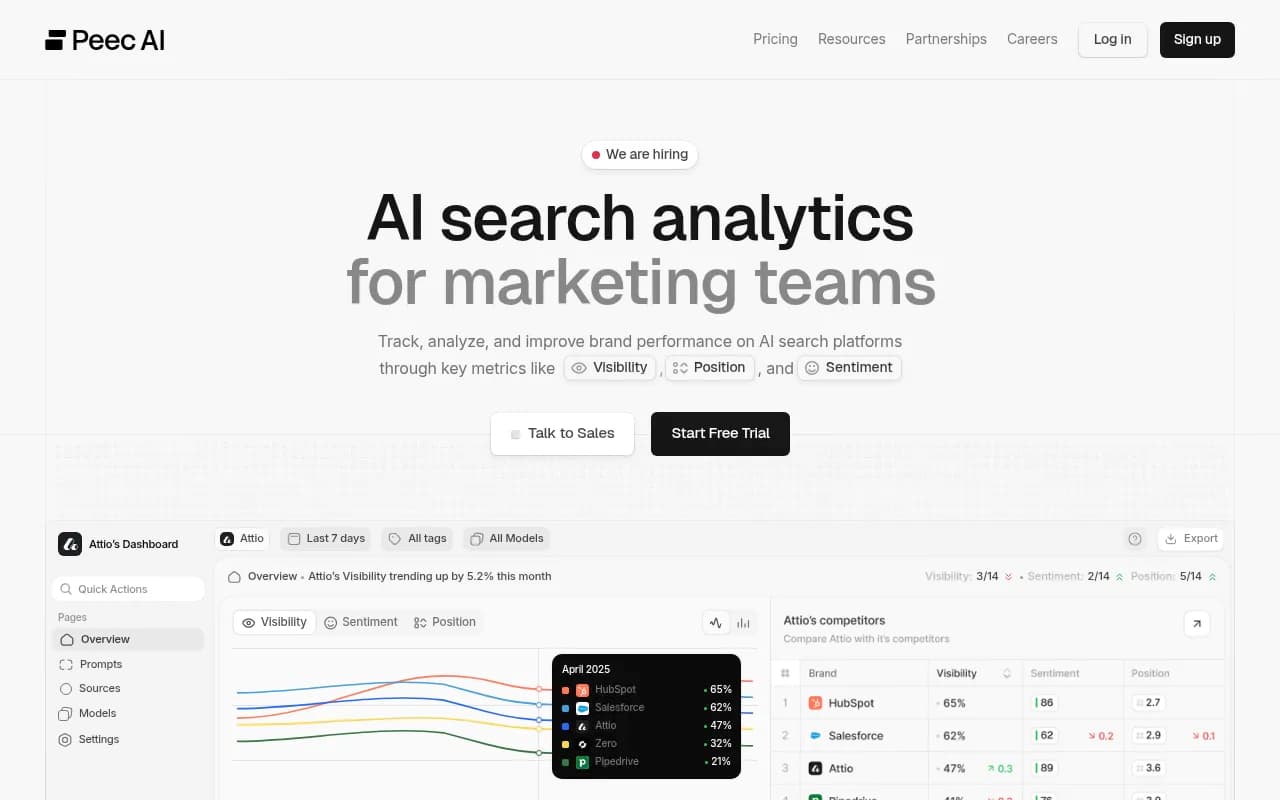
Peec AI restructured its pricing in August 2026, moving to geo-priced, annually billed EUR tiers (roughly €70-89/mo Starter, €180-245/mo Pro). It's the cleanest dashboard in this list if the primary audience is a marketing team that wants shareable share-of-voice charts without learning a complicated tool. It covers ChatGPT, Perplexity, and Gemini, which is enough for most mid-market brands, but it's a pure tracker: no crawler logs, no content generation, no automated fixes. You'll need a separate content workflow to act on what it finds.
Scrunch AI
Scrunch's $250/mo flat rate (same for brands or agencies) is refreshingly simple after wading through Brandlight's opacity. You get 125 prompts, 5,000 monthly responses, 5 competitors, and 4 LLMs (ChatGPT, Perplexity, Google AIO, Copilot) with 5 site audits included. The catch: one pricing tracker puts Scrunch about 92% above the category median of $85.50/mo, and jumping to 9 LLMs or API/CLI access requires the custom Enterprise tier, which is exactly the kind of sales-gated upgrade mid-market buyers are trying to escape by leaving Brandlight in the first place.
AthenaHQ
AthenaHQ's Starter plan at $295/mo covers 9 engines out of the box, including Claude and Grok, which is broader coverage than Peec AI or Scrunch offer at similar price points. There's also a free "Essential" tier with $25 of credit covering 5 models, useful for testing before you commit. The limitation is that API access is a paid add-on and Starter is single-country/single-language, so multi-market brands will hit a wall fast.
Otterly.AI
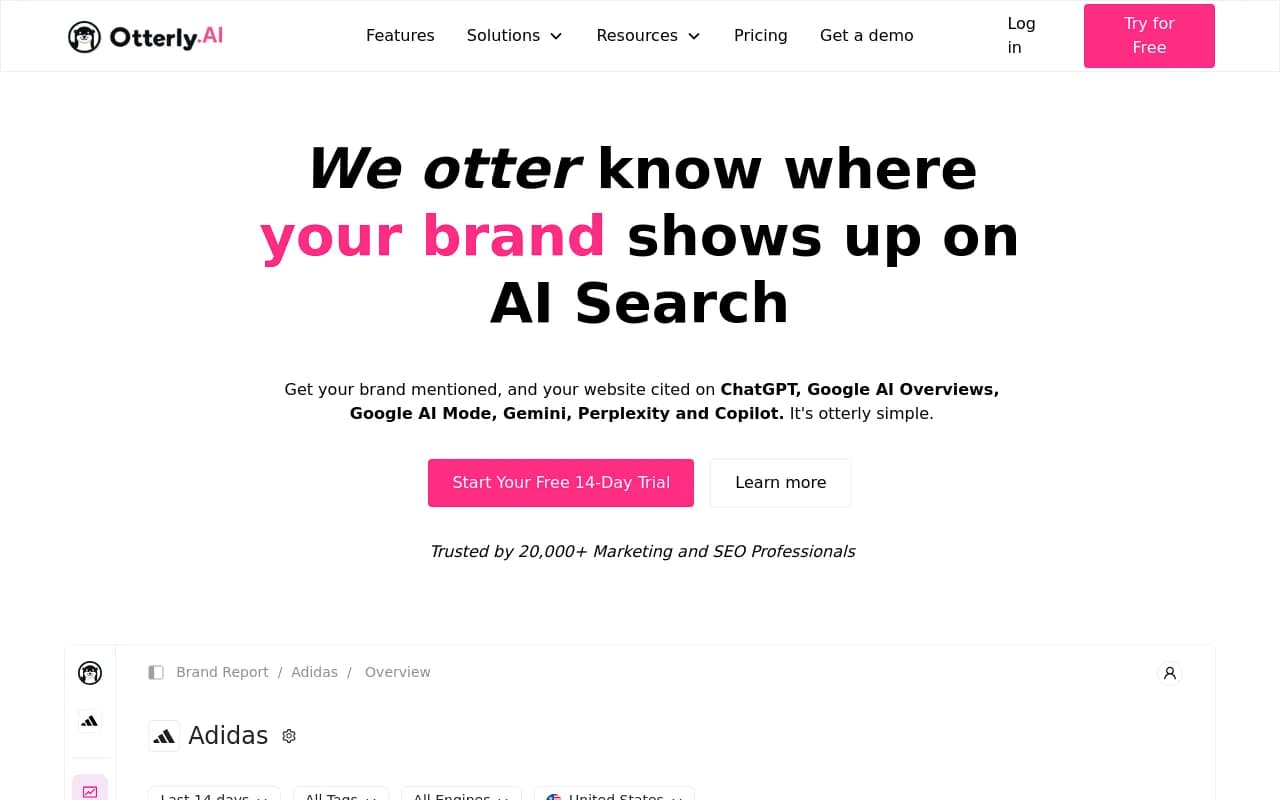
Otterly's Lite plan at $29/mo is the cheapest legitimate entry point in this whole category, and Standard at $189/mo adds Agent Analytics plus API and MCP access. The problem is the add-on structure: Google AI Mode, Gemini, and Claude are all priced separately on top of the base plan. A Standard subscription that looks like $189/mo becomes $357/mo once you add Claude and Gemini coverage, which erases a lot of the price advantage once you actually need multi-model tracking.
A decision framework
Rather than picking based on logo recognition, work through these questions:
How many engines do you actually need to track? If your customers are mostly asking ChatGPT and Google, Peec AI or Otterly's base tier covers it. If you need Claude and Grok too, AthenaHQ or Promptwatch cover more out of the box without forcing paid add-ons per engine.
Do you need to act on the data, or just see it? Pure trackers (Peec AI, Otterly, Scrunch) will tell you where you're missing. If you also want a system that generates and publishes the content to fix the gap, Promptwatch's Content Agents and Unified Actions are built specifically for that step.
How technical is your team? Crawler log access (which shows you exactly what AI bots are reading and where they fail) is a differentiator most of these platforms simply don't have. Promptwatch and Otterly's Standard tier both expose this; Peec AI and Scrunch don't.
What's your actual budget ceiling? If it's genuinely under $100/mo, Otterly Lite or Promptwatch's Essential plan are the realistic options. If you have $250-300/mo, Scrunch, AthenaHQ, and Promptwatch's Professional tier are all live candidates, and at that price point Promptwatch's automated content generation and crawler logs are hard to match feature-for-feature.
If you want a broader look at the category before deciding, the GEO software directory at bestgeosoftware.com covers more platforms side by side, and the AI rank tracking directory at ai-rank-tools.com is a good second stop if pure tracking is all you need right now.
The bottom line
Brandlight built a genuinely strong platform for brands that already have a dedicated AI strategist and a procurement team comfortable with custom quotes. Mid-market brands don't need that machinery, and paying for it means overpaying for features (multi-brand command centers, SOC 2 depth) that solve problems you don't have yet.
Start where your budget actually sits. If you can spend $95-250/mo and want a platform that tracks visibility and helps fix it, Promptwatch is the strongest combination of price and capability in this list. If you just want a clean dashboard for stakeholder reporting, Peec AI or Scrunch will do the job without the extra machinery. Either way, you'll get the same core citation data Brandlight sells, without the sales call.