Key takeaways
- Bluefish AI is a five-module enterprise platform (Monitoring, GEO Optimization, Measurement, Commerce, Accuracy) with $68M in funding and roughly 10% of the Fortune 500 as customers. It sells exclusively through custom, demo-gated contracts.
- Profound is the default enterprise alternative: $155M raised, a $1B valuation, and the strongest research output in the category.
- Promptwatch is the strongest option for teams that want published pricing, AI crawler logs, visitor attribution, and an execution layer that actually publishes content, not just dashboards.
- Evertune brings statistical rigor via a 150M-person consumer panel that no competitor matches. Scrunch (now owned by Sitecore) suits brands already in that ecosystem. Conductor works if you want SEO and AEO under one vendor.
- The stakes are higher than most procurement teams realize: ChatGPT cites only about 5 sources per response, and ads now appear in roughly 20% of ChatGPT Search responses, including on competitor-comparison prompts.
Why Fortune 500 brands are shopping around
Bluefish AI has had a good run. Founded in 2024 by a team that previously built marketing platforms acquired by Microsoft and Meta, it raised a $43M Series B in April 2026 (co-led by Threshold Ventures and NEA, with Amex Ventures, TIAA Ventures, and Salesforce Ventures participating), bringing total funding to $68M. Its customer list reads like a luxury mall directory: Adidas, American Express, Hearst, LVMH, Ulta Beauty, Tishman Speyer. Its CEO has said publicly that the platform was designed exclusively for Fortune 500 enterprises.
So why look at alternatives? Three reasons come up repeatedly in enterprise evaluations:
No published pricing. Everything runs through sales. Third-party reviews report entry tiers from $99 to $799 per month, but real enterprise contracts reportedly run five to six figures annually. If procurement wants three comparable quotes, Bluefish makes that slow.
Breadth over depth. Five modules sound great on a vendor scorecard until you realize you're paying for Commerce and Accuracy modules you may not need this year. Some buyers want the best monitoring and measurement money can buy, not a bundle.
Thin public proof. Bluefish grows through analyst relations and logos rather than published research. Compare that with Profound, which puts out multi-million-prompt citation studies anyone can read before ever talking to a salesperson.
There's also a market-level reason this decision feels urgent in 2026. The citation economy is brutally tight. Promptwatch's data on average sources per response shows ChatGPT cites roughly 5 sources per web-search response, and Google AI Overviews and Perplexity each cite around 10. There is no long tail of page-two results here. You're either one of five sources or you're invisible.
And the ground keeps shifting. Reddit's share of ChatGPT citations collapsed from roughly 4% to 0.5% on August 14, 2026, overnight and without announcement. Ads appeared in 20.1% of ChatGPT Search responses on average over the trailing 90 days, and 8.6% of ad-bearing responses were triggered by competitor-comparison prompts, which means a rival's ad can show up when a customer asks about your brand. A platform that measures this well is now a brand-protection instrument, not a marketing toy.
Quick comparison
| Platform | Pricing | Strengths | Weaknesses | Best for |
|---|---|---|---|---|
| Bluefish AI (baseline) | Not published, sales-led | Five modules, Fortune 500 focus, Amazon Rufus coverage | No public pricing, thin published research | Full-stack consolidation under one contract |
| Profound | $99 Starter; $399 Growth; $2–5K+/mo enterprise | Category benchmark, unmatched research, ~10% of Fortune 500 as clients | Narrower scope than Bluefish, no commerce module | Enterprise answer intelligence and research |
| Promptwatch | $95–$579/mo published; custom enterprise | Crawler logs, visitor attribution, Reddit/YouTube tracking, ChatGPT Shopping and Ads Radar, automated content publishing | Younger company than Profound or Bluefish | Teams that want insight plus execution at a known price |
| Evertune | Not published (third parties estimate ~$3,000/mo) | 150M-person EverPanel for statistical measurement | Demo-gated, narrower action layer | Brands where measurement rigor decides the deal |
| Scrunch (Sitecore) | Not published | Agent-readiness focus, SOC 2, bundled into Sitecore DXP | Acquired by Sitecore in June 2026, so you're buying into that ecosystem | Brands already on Sitecore |
| Conductor | Not published | Enterprise SEO + AEO + revenue attribution in one platform | AI features are an extension of an SEO platform | Consolidating SEO and AI search vendors |
The alternatives, in detail
1. Profound, the default enterprise shortlist entry
If you run a competitive RFP for AI visibility in 2026, Profound will be on it. It has raised $155M, hit a $1B valuation with a Series C led by Lightspeed in February 2026, and counts Target, Walmart, U.S. Bank, Figma, MongoDB, DocuSign, and Indeed among its customers. Roughly 10% of the Fortune 500 use it, and more than 2,000 marketers across 500+ organizations log in daily.
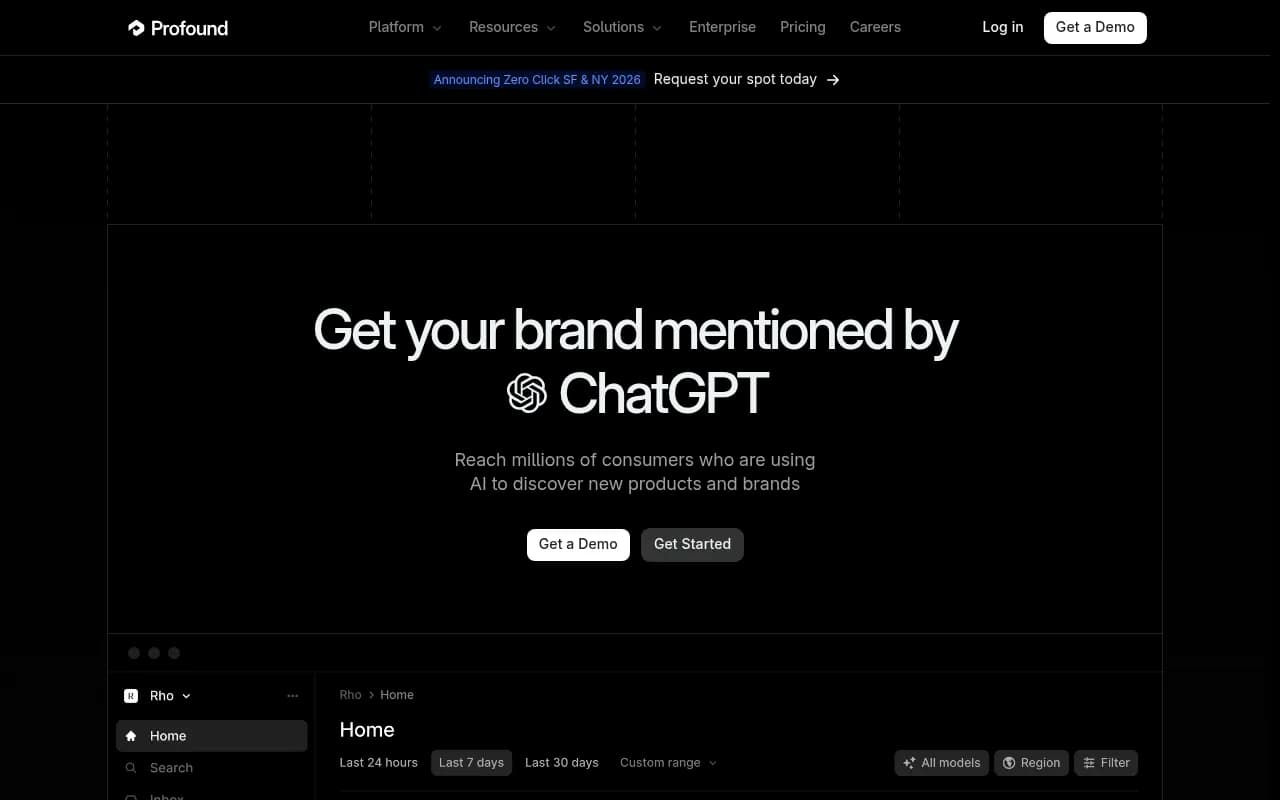
What sets Profound apart is research output. The 50K-prompt "Parrot Problem" study, multi-million-prompt citation analyses, retailer and shopping behavior reports. No one else in the category publishes at this volume, and it means your team can evaluate the quality of their thinking before a single sales call.
Pricing is tiered: a $99/month Starter (ChatGPT only, 50 prompts, 1,500 responses, one seat) that most reviewers correctly call a funnel tier; a $399/month Growth plan where multi-engine tracking and the Agents content engine actually begin; and custom enterprise contracts from roughly $2,000 to $5,000+ per month that add Claude, Gemini, Copilot, Grok, DeepSeek, and AI Mode coverage, plus SSO and API access.
The honest limitation: Profound's scope is narrower than Bluefish's five modules. It's intelligence-first. There's no commerce module and no equivalent to Bluefish's Accuracy auditing of whether AI systems describe your brand truthfully. If your use case is brand misrepresentation in regulated categories, Bluefish's pitch is genuinely differentiated there.
2. Promptwatch, the end-to-end platform with published pricing
Here's the thing that surprises most enterprise buyers about Promptwatch: it publishes its pricing. Essential is $95/month, Professional is $245/month, Business is $579/month, and enterprise deals are custom. For a Fortune 500 procurement team that wants to pilot before committing to a five-figure contract, that alone changes the evaluation math.

But the pricing isn't the real story. The real story is that Promptwatch is one of the few platforms that goes beyond monitoring into execution, and it does it with data most competitors don't have. Its dataset covers more than 4.5 billion citations, clicks, and prompts analyzed, growing by 100M+ new data points per day, collected from real UI monitoring rather than API outputs (user-facing answers and shopping recommendations can differ from what APIs return). More than 1,840 brands and agencies use it, including Duolingo, Yelp, Typeform, Shutterstock, Rabobank, and ABN AMRO, and it holds a 4.7/5 rating on G2.
The pieces that matter for a Fortune 500 evaluation:
- AI crawler logs. Promptwatch logs when ChatGPTBot, ClaudeBot, PerplexityBot, GoogleOther, Meta-WebIndexer, and 400+ other crawlers hit your site, what they read, and what errors they hit. This is the "why" behind your visibility scores, and most competitors, Bluefish included, don't offer it. Given that Meta-WebIndexer went from ~2% to nearly 38% of tracked AI crawler requests in under a month, per Promptwatch's Meta web indexer data, knowing who's crawling you and what they find has real operational value.
- Visitor analytics. It tracks actual traffic and conversions from AI platforms to your site, not just mentions. Crisp, a customer, found 2x higher conversion rates from AI traffic than from traditional channels.
- Reddit and YouTube citation tracking. Dedicated reports for the two channels AI engines lean on socially. Promptwatch's social media citations data shows ChatGPT sends 5.19% of its citations to Reddit while AI Overviews and Grok favor YouTube at 4.08% and 4.85% respectively. If your brand strategy ignores these channels, you're leaving citation share on the table.
- ChatGPT Shopping and Ads Radar. Track product recommendations in ChatGPT shopping results and see which competitors bid on your prompts, their ad copy, and positioning. With ads now in roughly a fifth of ChatGPT Search responses and climbing, this is fast becoming a mandatory capability for consumer brands.
- Content Agents. The platform plans, writes, and publishes GEO-optimized content to Webflow, Framer, or WordPress on a schedule you control, with a review inbox or fully automated. Monks (the agency behind Netflix and BMW work) uses Promptwatch's Answer Gap Report and Visibility Score to build content roadmaps for enterprise clients.
The trade-off: Promptwatch is a younger company than Profound or Bluefish, founded in 2024 and launched in April 2025. If your procurement process requires a decade of enterprise track record, that will matter. If it requires results and a complete stack at a defensible price, Promptwatch is arguably the strongest value in this comparison.
3. Evertune, measurement depth over module breadth
Evertune takes a different bet than everyone else on this list: instead of more modules, it built a better instrument. EverPanel, its 150M-person consumer panel, grounds its measurement in real-prompt data at a statistical scale that panel-less competitors can't replicate. Each prompt gets sampled 100 times across 11 AI models, according to third-party analysis, which smooths out the notorious variance in LLM responses.
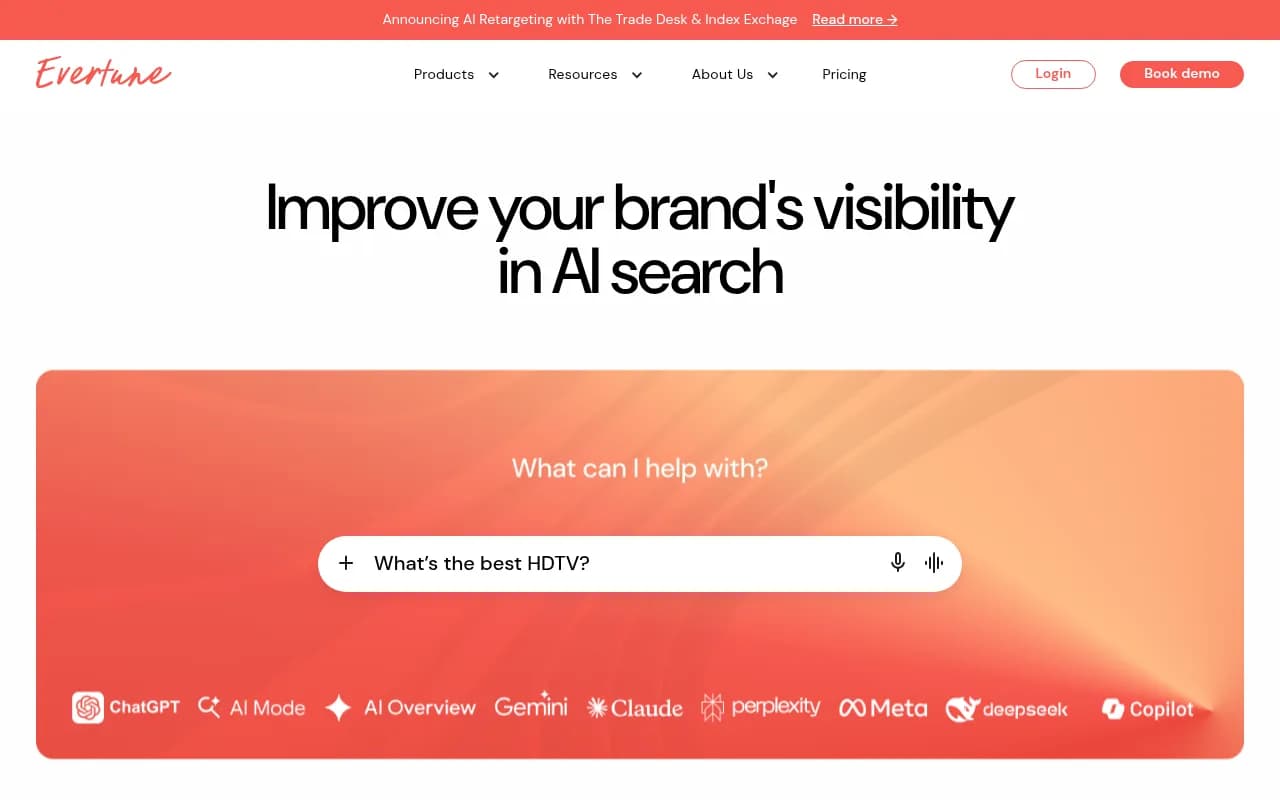
The company has raised $20M including a Series A from Felicis, and it publishes free public assets (an AI Brand Index, an AI Model Release Tracker) that preview its approach. Pricing is demo-gated; one competing vendor estimates $3,000/month for its Pro tier, but treat that as an estimate since Evertune doesn't confirm it.
Choose Evertune if measurement rigor is the deciding module, for instance if you're a high-consideration B2B or B2C brand where the CMO needs defensible numbers on AI brand presence for the board, not directional dashboards. Skip it if you need commerce coverage or a heavy execution layer; its Content Studio exists but the platform's center of gravity is clearly measurement.
4. Scrunch, now Sitecore's AI search layer
Scrunch AI spent 2025 and early 2026 as the independent, agent-readiness-focused alternative: monitoring plus agentic web optimization, SOC 2 certified, sales-led. Then Sitecore acquired it on June 3, 2026.
This changes the calculus. If your organization already runs Sitecore's DXP, Scrunch just became the path of least resistance: AI search visibility bundled into an existing contract and roadmap. If you don't, you're now weighing whether to buy into the Sitecore ecosystem to get a point solution that used to be standalone. That's either consolidation or lock-in, depending on your stack.
Scrunch's thesis, that brands need to optimize their websites for AI agents reading them, not just for humans browsing them, remains one of the sharper ideas in the category. The ownership question is just something to price in.
5. Conductor, for consolidating SEO and AEO
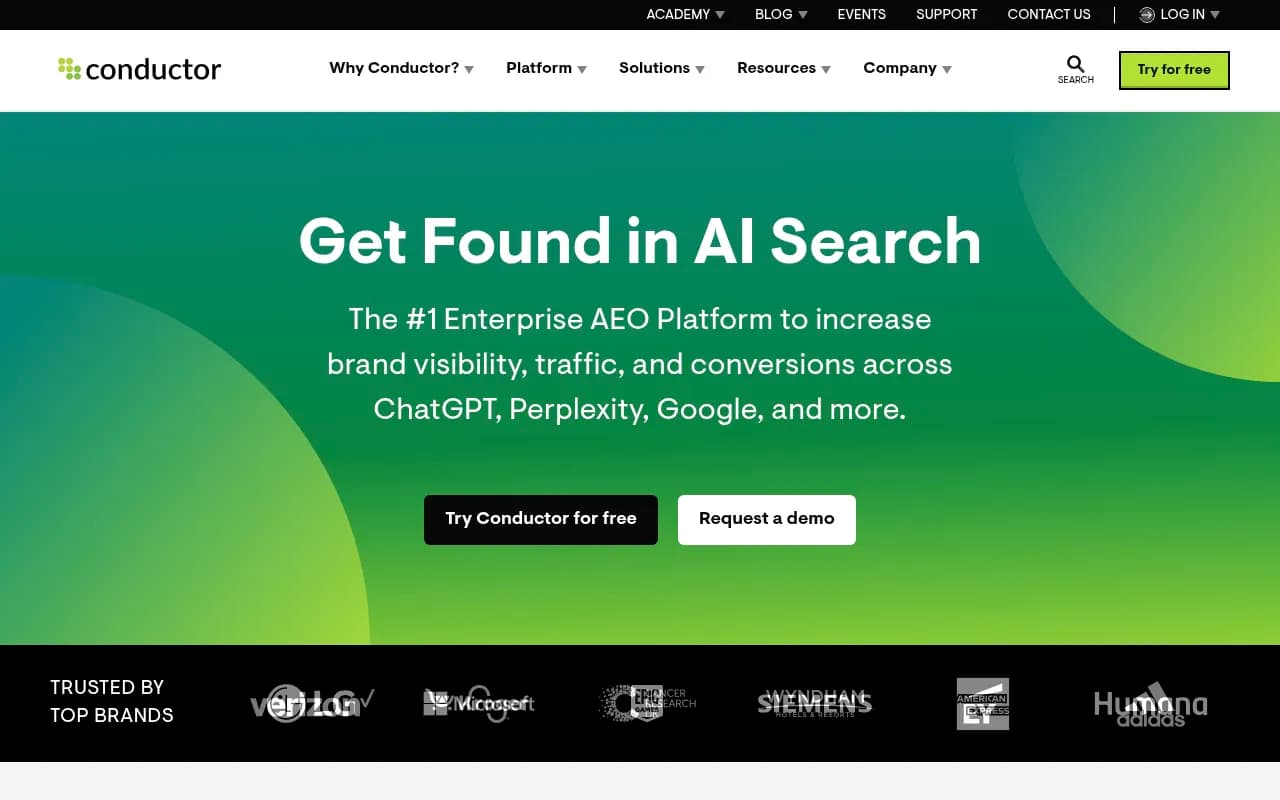
For Fortune 500 brands where the SEO team is leading the AI search initiative (which is still most of them), Conductor offers enterprise SEO, AEO, and revenue attribution in one platform. Its AI visibility features are newer and shallower than the specialists above, but the pitch is vendor consolidation: one contract, one login, one attribution model connecting traditional and AI search to revenue.
The same logic applies to the broader legacy camp. Semrush sells an AI Toolkit add-on at $99/month, and Ahrefs has Brand Radar. Both are reasonable if you already run them and want AI visibility adjacent to your existing workflow. Neither matches the specialist platforms on crawler logs, AI traffic attribution, or depth of AI-specific data. They're bundled convenience, not best-of-breed.
How to choose: a decision framework
| If your priority is... | Shortlist |
|---|---|
| Best-in-class research and enterprise benchmark | Profound |
| Published pricing plus execution (content that ships) | Promptwatch |
| Statistical measurement rigor for the board | Evertune |
| Brand misrepresentation auditing in regulated categories | Bluefish AI (its Accuracy module is genuinely differentiated) |
| Staying inside your existing DXP | Scrunch (Sitecore) |
| One vendor for SEO and AI search | Conductor, or Semrush/Ahrefs if already deployed |
| Commerce and shopping-assistant coverage (Amazon Rufus, Alexa) | Bluefish AI, or Promptwatch for ChatGPT Shopping |
A practical suggestion for the evaluation itself: run a 30-day paid pilot with two vendors on the same prompt set before signing anything annual. The variance between platforms' visibility scores on identical prompts is often larger than the variance between vendors' marketing claims, and a pilot surfaces it in a way no demo can. Promptwatch's free AI Brand Visibility Report and Profound's published research both give you a zero-cost starting baseline.
Frequently asked questions
Is Bluefish AI a bad platform?
No. It's a well-funded, genuinely enterprise-grade platform with real Fortune 500 traction and unique modules (Accuracy, Commerce, Amazon Rufus coverage). The case for alternatives is about pricing transparency, depth versus breadth, and execution capability, not quality.
Which alternative is closest to Bluefish's full scope?
Promptwatch comes closest on the monitoring-plus-optimization-plus-commerce spectrum, with crawler logs and visitor attribution Bluefish doesn't offer, plus ChatGPT Shopping tracking. Nothing replicates all five modules exactly.
What does an enterprise AI visibility platform cost in 2026?
Published prices range from $95/month (Promptwatch Essential) to $399/month (Profound Growth) to $579/month (Promptwatch Business). Enterprise contracts across Profound, Bluefish, Evertune, and Conductor typically run $2,000 to $5,000+ per month, with large deployments well beyond that.
Do we need to track Reddit and YouTube separately?
Yes, if consumers discuss your category there. ChatGPT sends over 5% of its citations to Reddit, and AI Overviews and Grok lean heavily on YouTube. Promptwatch is the only platform in this comparison with dedicated Reddit and YouTube citation reports. Reddit's citation share is also volatile, so treat any Reddit strategy as something to monitor monthly, not set-and-forget.
The bottom line
For most Fortune 500 evaluations in late 2026, the shortlist writes itself: Profound if research depth and enterprise track record decide it, Promptwatch if you want the complete insight-to-execution stack at a published price, Evertune if measurement rigor is non-negotiable, and Scrunch or Conductor if ecosystem fit drives the decision. Bluefish remains the right answer for a specific buyer, the brand consolidating all five modules under one managed contract, particularly in regulated or commerce-heavy categories. Just go in with your eyes open on pricing, and pilot before you commit.
If you want to browse the full field before shortlisting, the GEO software directory at bestgeosoftware.com covers dozens of platforms beyond the enterprise lane covered here.