Key takeaways
- Coding agents like Claude Code, Codex and OpenCode now pick tools, SDKs and docs for developers, so a recommendation from an agent can matter as much as a Google ranking for developer-tool and API companies.
- Only a handful of AI visibility products track these agents. Promptwatch, ByDefault and Gauge list them. Lightsage is also in this niche. Most general GEO trackers do not.
- A mention is not adoption. Track discovery, recommendation, what ends up in the final code, and whether the integration works, as four separate things.
- Pricing varies a lot. Promptwatch starts at $95/mo, Gauge Pro is $499/mo, and Lightsage's Scale tier is listed at $1,000/mo. Confirm current prices on each vendor's site.
- Do not confuse these tools with token trackers like ccusage. Those measure what you spend using a coding agent, not what the agent says about your brand.
Why coding agent recommendations are their own problem
If you sell a database, an auth service, a payments API or a developer SDK, a growing share of your "search" now happens inside a terminal. A developer types "add authentication to this app" and the agent picks a library. Nobody opens ten tabs. The agent reads some docs, makes a call, and writes the import statement.
That is a different game from ChatGPT answering "best CRM for startups." The agent doesn't just recommend. It acts. If it recommends you and then implements a competitor, you lost. If it recommends you and the generated code never authenticates, you lost in a more annoying way.
The three agents people ask about most are Claude Code, OpenAI's Codex and OpenCode. They behave differently, partly because the harness around the model matters as much as the model. Tensorlake spent 14 days running Claude Code, Codex, OpenCode and Pi on the same repos and concluded the differences come from the wrapper: system prompt, tools, agent loop, context handling and permissions. Their summary line is worth stealing: pick the harness first, pick the model second.
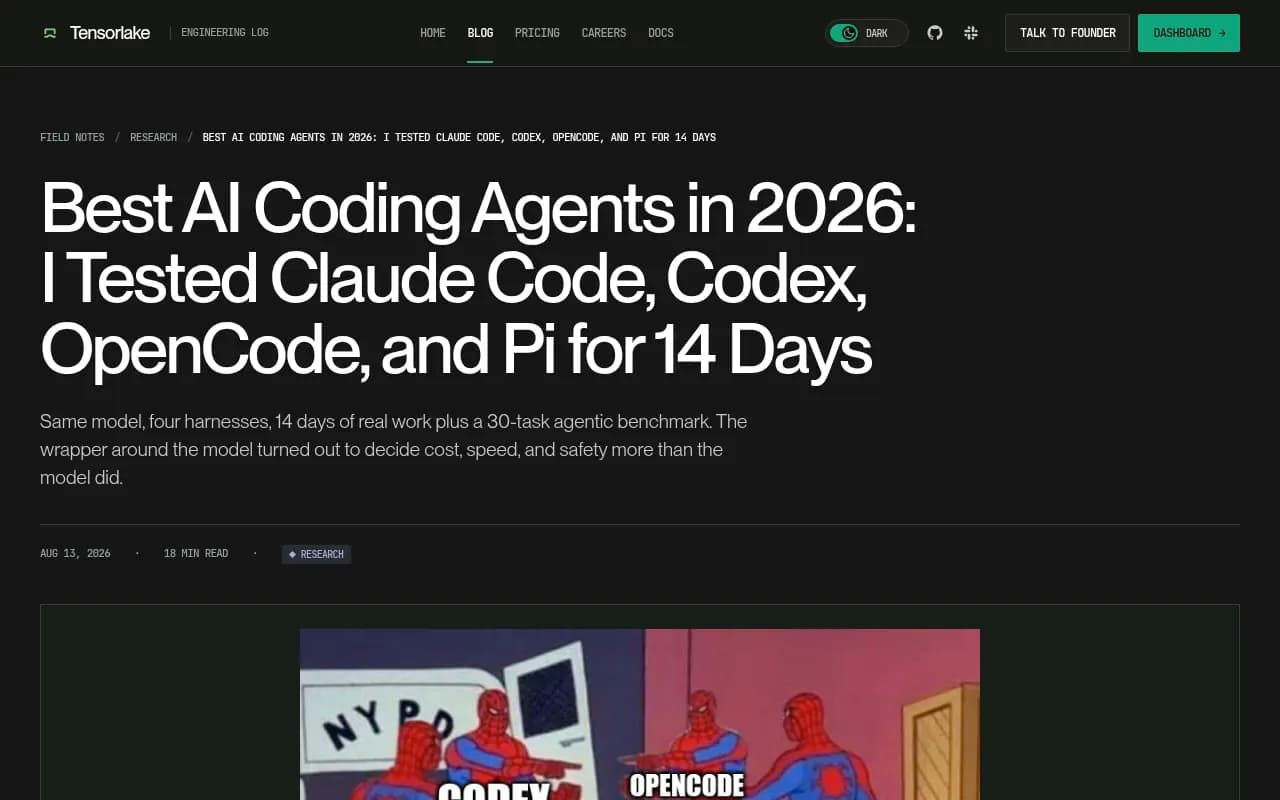
For visibility tracking, that matters in a practical way. Each agent searches differently, reads different sources and sits on different models. Claude Code runs Claude only. Codex defaults to OpenAI models. OpenCode supports 75+ providers, including local models through Ollama, so its recommendations can shift depending on which model the developer plugged in. One number for "coding agent visibility" hides all of that.
What to measure before you pick a tool
Gauge's comparison guide (vendor-authored, so read it with that in mind) makes a useful point: keep four outcomes separate.
- Discovery: did the agent find or read your docs?
- Recommendation: did it name you when asked an unbranded question?
- Adoption: is your package or API in the final diff?
- Successful integration: does the code actually work?
It also lists pitfalls I agree with. An agent may recommend one product and implement another. An installed package may be swapped out later. Code that references your API may never authenticate. A page request proves access, a recommendation proves stated preference, and a functional test proves the integration works. Those are three different kinds of evidence, and no single dashboard number covers all of them.
So when you evaluate tools, ask:
- Which agents are covered, and on which plan?
- Does it query the real agent, or an approximation through an API?
- Can it run unbranded prompts, head-to-head comparisons and use-case prompts?
- Does it show which sources and docs the agent read?
- Can it tell you about crawler access to your docs?
- Does it keep the task, model and session trace behind each result so you can audit it?
One caveat up front. I found no independent, hands-on benchmark of coding agent visibility tools. Most of what is written about this category comes from the vendors themselves. Treat feature lists as claims until you've run a trial.
The best tools at a glance
| Tool | Coding agents covered | Starting price | Best for | Main trade-off |
|---|---|---|---|---|
| Promptwatch | Claude Code, Codex, OpenCode (listed on pricing page) plus ChatGPT, Gemini, Perplexity, AI Overviews and more | $95/mo | Teams that want agent tracking next to general AI search visibility, crawler logs and content workflows | Confirm which agents count toward plan limits |
| ByDefault | Cursor, Codex, Claude Code, OpenCode plus ChatGPT, Claude, Gemini, AI Overviews | $99/mo | Prompt tracking plus AI crawler data from your own site | You pick any four models per plan |
| Gauge | Claude Code, Codex, OpenCode, Pi, Antigravity (Pro plan) | $499/mo (Pro) | Deep agent testing in real repos with pass/fail checks | Priciest entry point to agent coverage among these |
| Lightsage | Coding agents on its Scale tier | $1,000/mo (Scale, per Gauge) | Recommendation share and recorded integration runs | Pricing from a competitor's page, unverified by me |
I did not verify pricing for ByDefault, Lightsage, Amplifying or Known Agents beyond what their own pages or competitors say. Check before you budget.
Promptwatch
Promptwatch is the option I'd start with if you care about coding agents as one part of a wider AI visibility program rather than a standalone experiment. Its supported-models list includes Claude Code, Codex and OpenCode alongside ChatGPT, Google AI Overviews and AI Mode, Gemini, Perplexity, Copilot, Meta AI, Claude and others. It collects data from the real interfaces of these platforms rather than only through APIs, which matters because user-facing answers and citations can differ from raw model output.

Where it earns its place for developer-tool companies:
- Prompt tracking with query fan-outs, so you see the web searches an agent runs before it recommends something. OpenCode, for example, searches the web through Exa.
- IP-verified AI crawler logs that show whether GPTBot, ClaudeBot, PerplexityBot and others actually read your docs, and where they hit errors. If an agent can't read your docs, it can't recommend you.
- Visitor analytics for AI-referred traffic, so you can connect visibility to sessions and signups.
- Content gap analysis and a Content Agent that writes and publishes the pages agents and AI engines cite, to WordPress, Webflow or Framer, then tracks whether those pages get crawled and cited.
- An MCP server and REST API, so you can pull visibility data into Claude Code, Cursor or your own reporting.
Pricing: Essential is $95/mo (50 prompts, 1 project), Professional is $245/mo, Business is $579/mo and adds the Content Agent, faster-than-daily tracking and Fact Check. Enterprise is custom. All paid plans include unlimited seats. Confirm current numbers at promptwatch.com/pricing, since there is a seasonal discount running right now.
Honest caveat: the plan cards on the pricing page show a shorter model list than the supported-models section, so check whether the coding agents count toward any per-plan model limit before you buy. Another vendor's comparison claims Promptwatch has no Codex coverage. The pricing page currently lists Codex, so that claim looks out of date, but verify in a trial. The 7-day free trial is the easy way to do that, and the free AI visibility report gives a quick read on how ChatGPT, Gemini and Perplexity describe you today.
If you're comparing it with other platforms, the Promptwatch vs Profound page covers the enterprise end.
ByDefault
ByDefault is the tool that most directly mirrors the coding-agent use case. Its model list is ChatGPT, Claude, Gemini, Google AI Overviews, Cursor, Codex, Claude Code and OpenCode, and you choose any four per plan. It also combines prompt-level tracking with real-time AI crawler data from your own site, which is the right pairing for the same reason as above: visibility without crawl access is half a picture.
Entry price is listed at $99/mo with Claude tracking included. The "pick four" model is the thing to think about. If you want Claude Code, Codex and OpenCode tracked plus ChatGPT, you're already at the limit. That's fine for a focused developer-tool brand, tight for anyone who also needs Gemini and AI Overviews.
Note that ByDefault published the comparison where this pricing is laid out, so it has a stake in how it reads.
Gauge
Gauge is the most coding-agent-native product here. Its Agent Preference module runs agents on unbranded tasks, head-to-head comparisons and use-case analysis, shows the sources and docs agents read, and can be scheduled daily, weekly or monthly. Agent Experience goes further: it runs agents in real repos with explicit pass/fail criteria, has a CLI, and can run checks on pull requests. That second piece is what addresses the "recommended but never integrated" problem.
Gauge's Pro plan is $499/mo and includes Claude Code, Codex, OpenCode, Pi and Antigravity. It also covers AEO and AI traffic analytics.
The catch is the same as with every vendor in this list: the comparison article that ranks it first was written by Gauge, based on public docs and not hands-on testing. That doesn't make it wrong. It does mean you should ask for a trial and check the session traces yourself.
Lightsage, Amplifying and Known Agents
Three smaller names show up in the coding-agent space, each aiming at a slightly different slice:
- Lightsage focuses on recommendation share, recorded integration runs and website requests. Gauge's page lists its Scale tier at $1,000/mo for coding-agent access.
- Amplifying does competitive product-selection research, useful if your question is "why does the agent pick them over us."
- Known Agents looks at agent requests to your site and APIs, plus referral traffic.
I couldn't verify pricing or hands-on quality for these three, and none is in our tools catalog, so treat this as a shortlist to investigate rather than a recommendation.
General AI visibility tools that skip coding agents
Most of the GEO category tracks chat assistants and AI search, not terminal agents. That's still useful, because developers also ask ChatGPT and Perplexity which tools to use, and coding agents often lean on the same web sources. But if Claude Code or Codex coverage is a requirement, check before paying.
| Tool | Coding agent coverage | Notes |
|---|---|---|
| Otterly.AI | Not listed | Claude is a paid add-on ($29 to $439/mo depending on tier, per ByDefault's comparison) |
| Peec AI | Not listed | Claude is a paid upgrade |
| Profound | Not listed in my research | Claude and Gemini reserved for Enterprise; Starter tracks ChatGPT only |
| Scrunch | Not listed | Claude on Enterprise |
| Ahrefs Brand Radar | Not listed | Claude through Custom Prompts only |
If you want to browse more options, the GEO software directory at bestgeosoftware.com lists the wider field. Our entries for Otterly.AI, Profound and Peec AI are also in the catalog.



Token trackers are a different category
Search results for this topic are cluttered with tools like ccusage, Agentlytics, CodexBar and claude-code-otel. They're good at what they do. ccusage (npx ccusage) is the most mature Claude Code usage tracker, with about 12k GitHub stars, and the Starmorph guide recommends CodexBar for always-on menu bar monitoring plus Agentlytics for historical analysis.
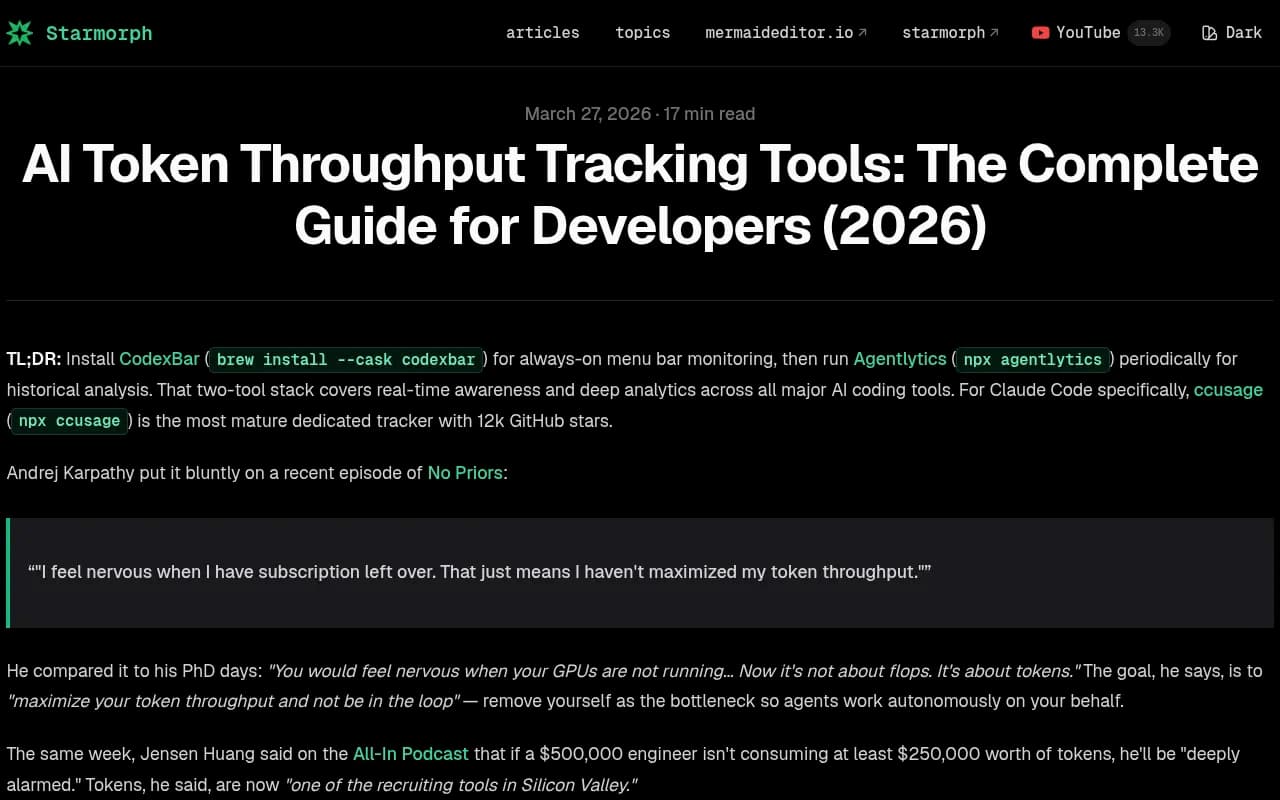
But they track your own token consumption and spend as a developer. They say nothing about whether Claude Code recommends your product to someone else. If you're a user watching costs, use those. If you're a vendor watching recommendations, you need the visibility tools above.
What the data says about how AI answers get built
No Promptwatch Data report covers coding-agent recommendations directly, and I won't pretend otherwise. The closest relevant signal is how AI search products assemble sources. Promptwatch's Average Sources Per Response report (older, from September 2025) found ChatGPT cites about 5 sources per web-search answer, while Google AI Overviews and Perplexity cite about 10. More recent Promptwatch Data on ChatGPT shows almost half of responses cite 10 or more unique domains (Sep 28 to Oct 4, 2026), and for software prompts, GitHub, Microsoft's docs and G2 lead ChatGPT citations, with documentation and help centers earning the largest share.
The takeaway for developer-tool teams: docs and GitHub presence are the surface area. If agents reach for documentation when they search, your docs structure and crawlability are the first thing to fix. Markdown files themselves are a tiny share of AI search citations (0.05%, per Promptwatch's markdown report), because markdown serves agents rather than AI search, so don't assume a markdown dump alone will win citations in search products.
A practical setup for developer-tool brands
Here is a workflow that works without buying everything:
- Write 30 to 50 prompts the way developers actually ask. Unbranded ("best way to add auth to a Next.js app"), comparison ("X vs Y for queues"), and use-case prompts. Include a few for each agent.
- Run them in a tool that covers your target agents, on a schedule. Daily is enough to start.
- Record the model, agent and session behind every result. OpenCode results with a local model are not comparable to Claude Code results.
- Check the final diff. Which package got installed? Gauge's Agent Experience style checks or a simple manual run in a scratch repo both work.
- Check your crawler logs. If agent-linked bots hit errors on your docs, fix that before you rewrite anything. The AI crawler URL inspector and Agentic Readiness Check are free ways to see which crawlers can read your site and whether you support standards like llms.txt.
- Fix content gaps: quickstarts, comparison pages, migration guides and honest limitation docs. Agents quote what's easy to find and easy to parse.
- Re-measure weekly. Pages that don't get cited or crawled go back on the list.
Which one should you choose?
- You want agent tracking plus broader AI search visibility, crawler logs and content execution: Promptwatch.
- You want a model-picker with crawler data on a similar budget: ByDefault.
- You care most about whether agents successfully integrate your API, with pass/fail testing: Gauge.
- You're a large API company with a bigger budget and want recommendation share research: shortlist Lightsage and Amplifying.
- You only need ChatGPT, Perplexity and AI Overviews right now: a general tracker like Otterly.AI is cheaper, but you'll outgrow it once agents matter.
Whatever you pick, run a free trial against ten of your real prompts and compare the output with what you see when you run Claude Code or Codex yourself. If the tool's answers don't match reality, that tells you more than any feature table.
If the broader question is how to get cited across AI search, not just by coding agents, agencies like 1001 SEO Media work on GEO alongside technical SEO, but for the agent-specific tracking in this guide you can start on your own with the tools above.