Key takeaways
- Most AI visibility platforms price their entry tier around 15-50 prompts, so a sub-20-prompt team has real options at $29-$95/month, not just free trials
- A single prompt tracked daily is statistically noisy; aim for 15-20 well-chosen prompts rather than fewer, broader ones
- Otterly.AI Lite ($29/mo, 15 prompts) and AI Peekaboo ($50/mo, 40 prompts) are the cheapest credible entry points for small teams
- Promptwatch offers 50 prompts at the Essential tier for $95/month but includes crawler logs, visitor analytics, and content generation that pure trackers skip, which matters if you plan to grow past 20 prompts
- Don't just pick the cheapest tool; filter your prompt list first, because a team with 12 well-targeted prompts gets better signal than a team with 20 vague ones
If you're a two-person marketing team, a solo founder, or an agency testing AI visibility for a single client, the idea of tracking 150 prompts across ten models sounds absurd. You don't have the content team to act on that volume of data, and honestly, you don't have 150 things worth asking ChatGPT about your brand. You need something smaller. Something that answers "are we showing up for the 10-15 questions that actually matter" without charging you like you're Yelp.
This guide is for that team. I'm going to walk through what "fewer than 20 prompts" actually means in practice, which tools are built for that size, and where the real tradeoffs are, because there are tradeoffs. The cheap tools are cheap for a reason.
Why fewer than 20 prompts is a real category, not a compromise
There's a persistent myth that more prompts equals more insight. It doesn't, past a point, and it definitely doesn't below a point. A single prompt tracked daily across three models produces roughly 21 readings a week, and the margin of error on that is something like plus or minus 16 percentage points, according to a statistical breakdown from Obsero (https://obsero.ai/insight/how-many-prompts-do-you-need-to-track-ai-visibility). That's not a visibility score, that's noise with a number attached.
The fix isn't necessarily "track more prompts." It's track the right 15-20. A GEO practitioner on Reddit put it well: a small set of 20-30 prompts is enough if it covers different intent types, category discovery, competitor comparison, problem-based queries, rather than 20 variations on the same question (https://www.reddit.com/r/GEO_optimization/comments/1uqcrbp/). Conductor's guidance lands in the same place: most organizations should track 10-30 topics tied to core content pillars, because too many topics dilutes the dataset and too few hides real gaps (https://www.conductor.com/academy/ai-prompt-tracking/).
So if your budget or your use case caps you at 15-18 prompts, you're not under-resourced. You're in the sweet spot that most of the research says is actually workable, as long as you pick the prompts carefully. SE Ranking's filtering framework is useful here: prioritize prompts where your brand could realistically appear ("best CRM tools for marketing agencies") over prompts you have zero shot at ranking in.
What actually changes at under-20-prompt volume
A few things shift once you're this small:
- Cost per prompt matters more than feature breadth, because you're paying for a handful of data points, not a dashboard
- Daily tracking frequency becomes more important, since you can't compensate for sparse prompt coverage with sparse time coverage too
- Multi-model coverage is worth more than multi-country coverage for most small teams, because you're usually trying to understand "does ChatGPT see us" before "does ChatGPT see us in Germany"
- Reporting and exports matter less; you're probably checking the dashboard yourself, not sending PDFs to a board
Keep those four in mind as you compare tools below.
The cheapest credible options under 20 prompts
Here's where the actual sub-20-prompt market sits in late 2026, based on current published pricing.
| Tool | Entry price | Prompts included | Models tracked | Daily tracking | Notable limit |
|---|---|---|---|---|---|
| Otterly.AI Lite | $29/mo | 15 | 4 | Yes | No API/MCP, no Agent Analytics below Standard |
| AI Peekaboo Starter | $50/mo | 40 | 3 | Every 2 days | Pay-per-prompt scaling, no free plan |
| Promptwatch Explore | Free | 10 | ChatGPT only | No | Single project, no API |
| LLM Pulse Starter | ~$49/mo (EUR) | 50 | 5 | Weekly only | No Agent Analytics or AI traffic data |
| Qwairy Starter | ~$86/mo | 100 | 10+ | Yes | Credit-based, premium models cost more credits |
| Peec AI Starter | $95/mo | 50 | 3 of 6 chosen | Yes | Reports only, no execution features |
| Promptwatch Essential | $95/mo | 50 | All 9+ | Yes | Highest feature set at this price, but priced above your floor if you only need 15 |
A couple of things jump out. Otterly.AI Lite is genuinely the cheapest serious option for a team that wants exactly what the name implies, affordable tracking, nothing else. It tracks 15 prompts daily across four models and throws in unlimited team seats, which is unusual at this price. [tool:otterly-ai]
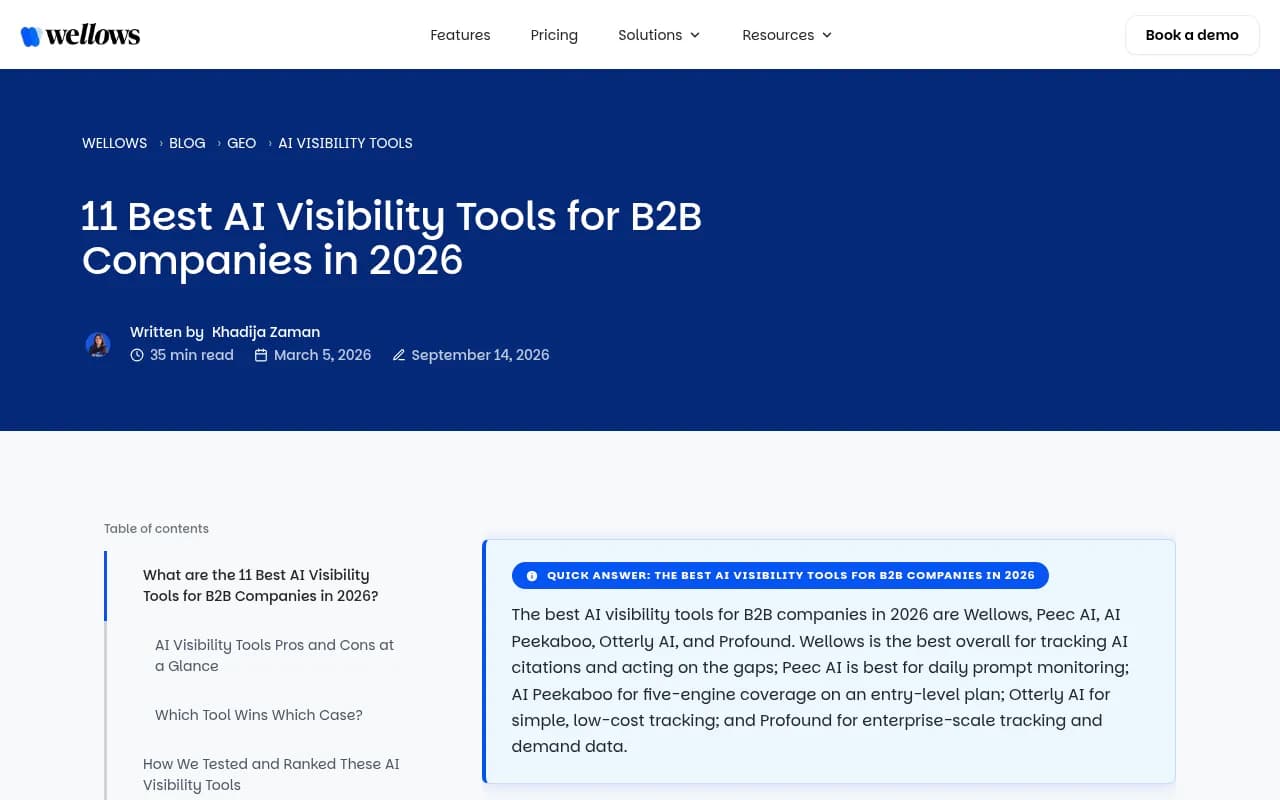
AI Peekaboo is worth a look if five-engine coverage matters to you more than a rock-bottom price. Wellows' B2B roundup specifically calls it out for "five-engine coverage on an entry-level plan," and at $50/month for 40 prompts checked every two days, it undercuts most competitors on frequency-adjusted cost (https://wellows.com/blog/ai-visibility-tools/). [tool:ai-peekaboo]
LLM Pulse is the budget play if weekly tracking is acceptable for your use case. It's meaningfully cheaper than most of the field at comparable prompt counts, but the tradeoff is real: no Agent Analytics, no AI traffic attribution, and weekly instead of daily checks means you'll miss short-lived shifts in how models answer. [tool:llm-pulse]
Where Promptwatch fits for small teams
Promptwatch's free Explore tier covers 10 prompts on ChatGPT only, which is a fine way to test the waters but too thin for anything you'd call a program. The Essential plan at $95/month gives you 50 prompts, 6,000 responses, and tracking across all nine-plus models (ChatGPT, Gemini, Claude, Perplexity, Grok, Copilot, DeepSeek, Mistral, Meta Llama), plus AEO content generation, API and MCP access, and Agent Analytics (crawler logs showing which AI bots actually visit your site).

According to Promptwatch's own cost-per-prompt benchmark across 21 GEO platforms, Essential works out to about $1.90 per prompt and $0.016 per response, which is roughly in line with Otterly.AI Standard and Peec AI Starter, but with every model included from day one instead of locked behind add-ons (https://promptwatch.com/best-geo-and-ai-visibility-platforms-compared-2026). If your real prompt count is closer to 15-18 and you don't need crawler logs or content generation yet, the Essential tier is more capability than you strictly need to pay for. But if you expect to grow past 20 prompts within six months, or you want to see why you're invisible (not just that you are), it's worth the jump over a pure tracker.
The honest way to think about it: Otterly.AI and AI Peekaboo answer "are we mentioned." Promptwatch is built to also answer "why aren't we mentioned, and what should we publish to fix it," with its Content Agents and Unified Actions turning visibility gaps into a prioritized to-do list. That extra layer isn't free, but it changes what the tool does for you day to day.
What you give up by staying small
It's worth being honest about the tradeoffs of a lean prompt list, beyond just the statistical noise issue.
First, you'll miss intent diversity if you're not deliberate. Fifteen prompts that are all variations of "best [category] tools" tell you about one moment in the funnel. You're better off splitting a small list across discovery ("best tools for X"), comparison ("X vs Y"), and problem-based queries ("how to fix Z"), even if that means fewer prompts per intent type.
Second, most entry tiers restrict which models you track. Peec AI Starter makes you pick 3 of 6 models; Profound's entry plan (when it existed as a self-serve option before shifting to agency-only pricing in September 2026) covered ChatGPT only. If your buyers actually live in Gemini or Perplexity, a ChatGPT-only plan will quietly misrepresent your visibility.
Third, daily versus weekly tracking changes what you can act on. Microsoft Copilot's average citation count has swung from under 2 to nearly 17 sources per response within a few weeks according to Promptwatch's data (https://promptwatch.com/data/average-sources-per-response), and that kind of volatility is invisible on a weekly check.
A simple way to pick your 15-18 prompts
Before you sign up for anything, write the prompt list out. A rough framework that works for small teams:
- Five to seven category or discovery prompts ("best [category] for [audience]")
- Three to five competitor comparison prompts ("[you] vs [competitor]")
- Three to five problem-based prompts your buyers would plausibly type
- Two to three branded prompts ("what is [your brand]", "[your brand] reviews")
That's 13-20 prompts, which maps cleanly onto Otterly.AI Lite's 15, AI Peekaboo's 40 (room to grow), or Promptwatch Essential's 50 (room to grow a lot). Write this list before you look at pricing pages. It's easy to let a vendor's included prompt count define your strategy instead of the other way around.
When to upgrade past 20 prompts
A few signals it's time to move up a tier:
- You keep adding prompts to cover new product lines or markets and you're bumping against the limit every month
- You need multi-country or multi-language tracking, which almost no entry tier includes
- You want to see which pages on your site AI crawlers actually read, which requires Agent Analytics (not available below mid-tier plans on most platforms)
- You're ready to act on gaps with content, not just watch them, which pushes you toward platforms with content generation and CMS publishing rather than report-only trackers
If any of those apply, Promptwatch's Professional tier ($245/month, 150 prompts, 18,000 responses, automated content generation, shopping insights) or a comparable step-up from Peec AI or Scrunch becomes worth evaluating. For a broader look at the GEO software market once you outgrow the entry tier, the directory at bestgeosoftware.com is a reasonable next stop.
Final take
Don't let prompt count anxiety push you into an overpriced plan you won't use. A well-chosen list of 15 prompts tracked daily across three or four real models beats a sloppy list of 30 tracked weekly across one. Start with Otterly.AI Lite or AI Peekaboo if budget is the constraint, start with Promptwatch Essential if you want room to act on what you find and expect to grow, and revisit the decision in three months once you actually know what your buyers are asking.