Key takeaways
- DTC brands need more than a mention counter. The useful questions are which products AI recommends, which reviews it quotes, and which competitors it picks instead.
- In Promptwatch Data (Sep 28 to Oct 4, 2026), product pages were the most cited content type in ChatGPT at 22.4%, and landing pages added 16.8%. Your own catalog pages are the main lever.
- Reviews matter more for branded prompts (5.6% of citations, over 3x their share across all prompts), so review hygiene is part of AI visibility.
- Pick a tool by the job: monitoring only, monitoring plus content fixes, or enterprise-scale reporting. Shopping-card tracking and crawler logs are the features that separate DTC-grade tools from basic trackers.
- Verify pricing on vendor pages before buying. Plans and limits change often.
Why DTC brands need a different kind of AI search tool
Most AI visibility tools were built for B2B SaaS. They ask a simple question: did ChatGPT mention my brand for this prompt? That is a fine starting point. For a DTC brand it is not enough.
Shoppers ask AI things like "best sulfate-free shampoo for curly hair under $30" or "is Brand X better than Brand Y." The answer is a short list of products, a few quoted reviews, and sometimes a shopping carousel. Your brand can be "mentioned" and still lose, because a competitor's product sits first in the list or the review that gets quoted is two years old and mediocre.
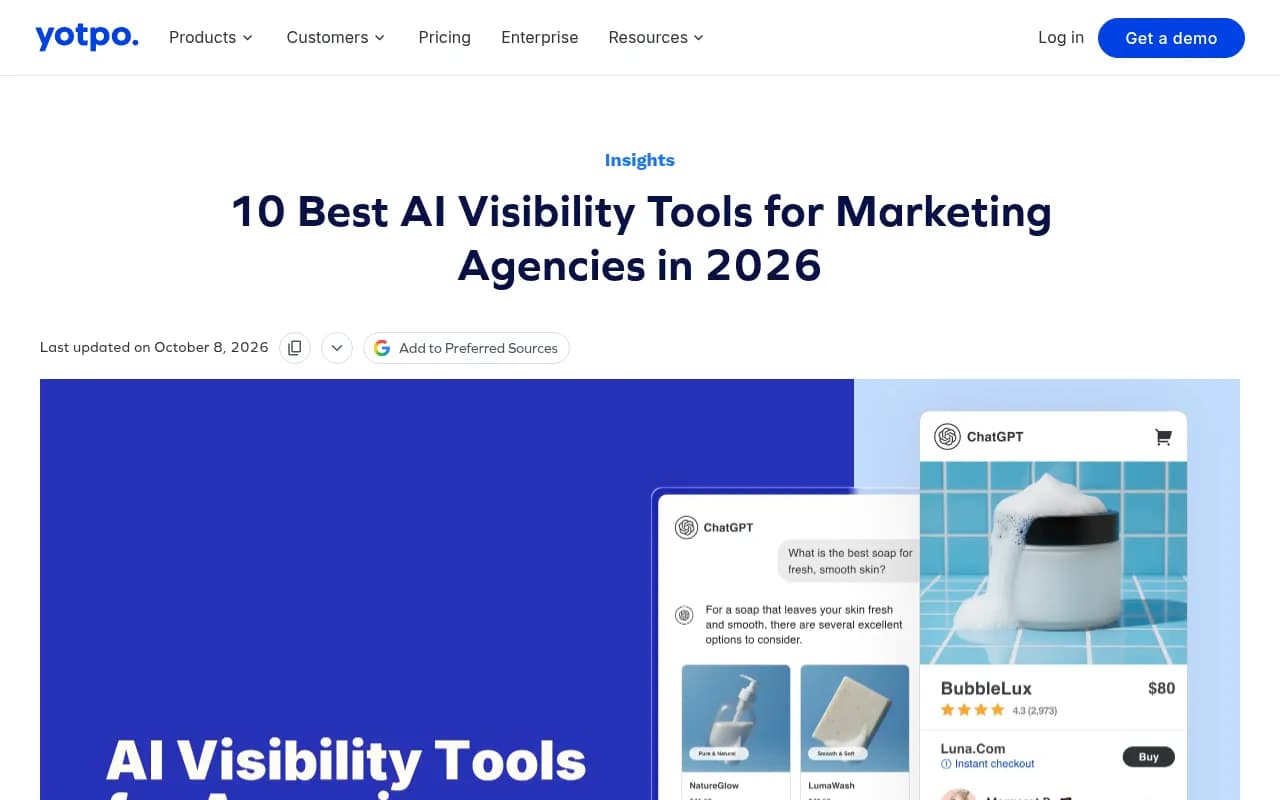
The stakes are real. The Yotpo write-up on AI visibility tools cites Adobe Analytics data showing AI-referred traffic to US retail sites grew 138% year over year in May 2026. Yotpo sells reviews, so read its framing with that bias in mind, but the traffic number is a useful signal that this channel is worth tracking.
What a DTC brand should actually track
Before comparing tools, decide what you need the data to answer. I would split it into four buckets.
Products
Which of your SKUs show up for commercial prompts, in what position, and with what claims attached? Brand-level scores hide the fact that your hero product might be everywhere while your second bestseller is invisible. Look for tools that let you tag prompts by product line or topic, and that surface the individual claims AI makes ("runs small", "great value", "battery life is weak").
Reviews and third-party sources
AI does not only read your site. It reads review sites, listicles, Reddit threads, YouTube videos and retailer pages. Promptwatch's content-type report found reviews make up just 1.7% of ChatGPT citations overall, but 5.6% on branded prompts. So when someone asks about you by name, reviews carry real weight. You want to see which review pages and which sources get cited, not only whether you are named.
One caveat. Social sourcing varies a lot by engine. In Promptwatch's social media citations report for Sep 28 to Oct 4, 2026, ChatGPT drew 0.46% of its citations from social platforms while Google AI Overviews drew 12.2%. If Reddit and YouTube are part of your strategy, track them per engine. They also moved fast: Promptwatch's data shows reddit.com's share of ChatGPT citations collapsed from about 4% to 0.5% on August 14, 2026.
Competitor picks
This is the one DTC teams underuse. For every commercial prompt, you want to know which competitor wins the slot, what AI says about them, and which of their pages it cites. That tells you exactly which page to build or fix. Share of Voice and position metrics help, but the citation list behind the answer is what you can act on.
Shopping surfaces and ads
ChatGPT shows product cards and price comparisons in some responses. Promptwatch's shopping usage data shows these appear in a low single-digit percentage of web-search responses overall, but far more on commercial and transactional prompts, and the rate moves in steps, which suggests OpenAI tunes it actively. Ads are growing too. In the ChatGPT ads report, ads first appeared May 27, 2026 and averaged 20.1% of web-search responses over the following 90 days, with a 7-day average of 32.4% at publication. If you sell physical products, tracking both is worth the effort.
What the data says about winning citations
The most useful first-party finding for DTC is simple. Per Promptwatch's content-type breakdown (Sep 28 to Oct 4, 2026):
- Product pages: 22.4% of classified ChatGPT citations
- Landing pages: 16.8%
- Listicles: 13.6%
- How-to guides: 8.7%
- Comparisons: 5.9%
On commercial prompts, product pages hit 26.0%, landing pages 20.6%, listicles 15.0% and comparisons 7.9%. Those four types are almost 70% of commercial citations.
The practical read: complete product pages (specs, prices, availability, positioning), get into the "best of" roundups AI already cites, publish your own comparison pages, and collect reviews on trusted sites. Also note that news loses half its citations in about five weeks while landing pages and docs keep most of theirs for months. Evergreen product and category pages beat launch press.
Features that matter for DTC (and ones that do not)
| Feature | Why DTC cares | Nice to have or must have |
|---|---|---|
| Real-interface tracking (not just API) | Shopping cards and citations differ from API output | Must have |
| Prompt tagging by product or topic | See SKU-level gaps | Must have |
| Competitor citation view | Shows which pages beat you | Must have |
| Shopping carousel tracking | Which brands fill the product cards | Must have if you sell physical goods |
| AI crawler logs | Tells you if bots can read your catalog | Strongly recommended |
| AI traffic attribution | Proves revenue, not just visibility | Strongly recommended |
| Content generation and CMS publishing | Closes the gap instead of reporting it | Depends on team size |
| Reddit and YouTube citation reports | Reviews and UGC sources | Useful |
| Persona or location prompts | Different buyers, different answers | Nice to have |
The best AI search tools for DTC brands in 2026
I have grouped these by what they do best rather than ranking them 1 to 10. Some are strong for one job and weak for another.
Promptwatch: tracking plus fixing, with shopping coverage
Promptwatch is the one I would look at first for a DTC brand that wants to act on the data, not just watch it. It monitors the real interfaces of ChatGPT, Google AI Overviews, Google AI Mode, Gemini, Perplexity, Copilot, Meta AI and Amazon Alexa, then traces which pages get cited. For DTC specifically, the relevant pieces are ChatGPT Shopping tracking (which products AI recommends and which competitors it picks instead), Brand Narrative (the individual claims AI makes about you and rivals, grouped by themes like Pricing or Features), and Reddit, YouTube and Instagram citation reports.

The action side is what separates it from monitoring-only tools. The Action Board prioritizes gaps, the Content Agent writes and publishes to WordPress, Webflow or Framer, and IP-verified AI crawler logs show whether bots can actually read your product pages. Visitor analytics then show whether AI sends traffic and conversions. Crisp, for example, reported 2x higher conversion rates from AI traffic versus other channels.
Pricing (confirm at promptwatch.com/pricing): Essential is $95/mo with 50 prompts, Professional is $245/mo with 150 prompts and 5 AEO articles, and Business is $579/mo with 350 prompts, the Content Agent, ChatGPT Shopping insights, Ads Radar and local targeting. Shopping tracking and the Content Agent start at Business, so a DTC brand that wants the full loop should budget for that tier. There is a 7-day free trial on monthly billing, and a free AI visibility report if you want a baseline first. For head-to-head details see Promptwatch vs Profound and Promptwatch vs Peec.
Profound: enterprise monitoring
Profound is built for large brands with big budgets. It offers citation analytics, prompt volumes and agent analytics. It is strong at monitoring, but sits at a higher price point and does not include Reddit tracking, ChatGPT Shopping or agentic content execution, which matter for DTC.

Peec AI and Otterly.AI: lightweight trackers
If you just want to know whether you show up and how you compare to competitors, these are affordable and simple. The trade-off is no crawler logs, no visitor analytics and no content generation. Good for a first month of data, limiting once you need to fix things.


Semrush and Ahrefs Brand Radar: add-ons to your SEO suite
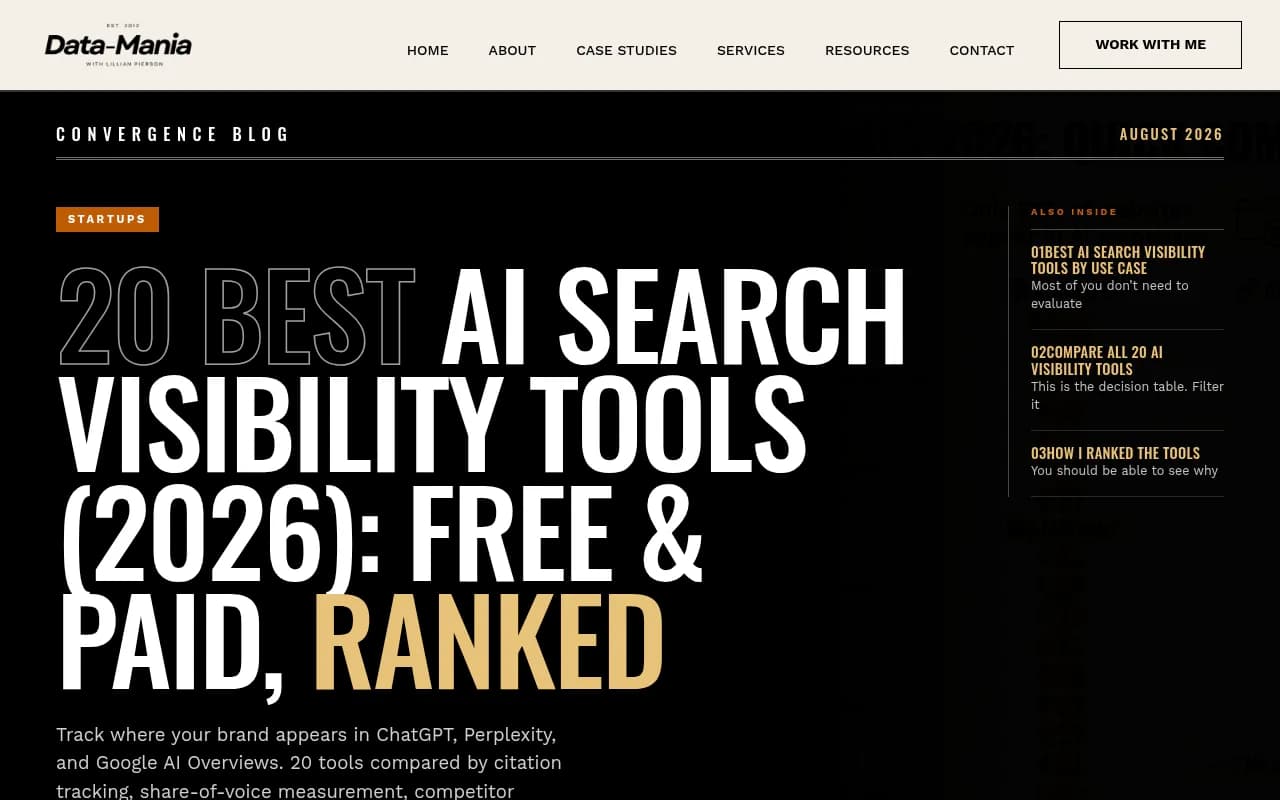
If your team already lives in Semrush, the AI Visibility Tracking add-on is a convenient start. Data-Mania's ranked list names Semrush its best overall pick, with a $99/month add-on and a large prompt database. Data-Mania says it evaluated tools from documentation and reviews rather than hands-on testing, and flags the Semrush link as an affiliate link, so treat the ranking as one input. SEO suites tend to use fixed prompt sets and have shallower AI-specific data, and they lack crawler logs.

AthenaHQ, Scrunch and Brandlight: monitoring-first platforms
Athena HQ and Scrunch track visibility across several engines. Brandlight targets enterprise brand visibility. All three skew toward monitoring and reporting rather than execution.

Yotpo Discover: reviews-first commerce angle
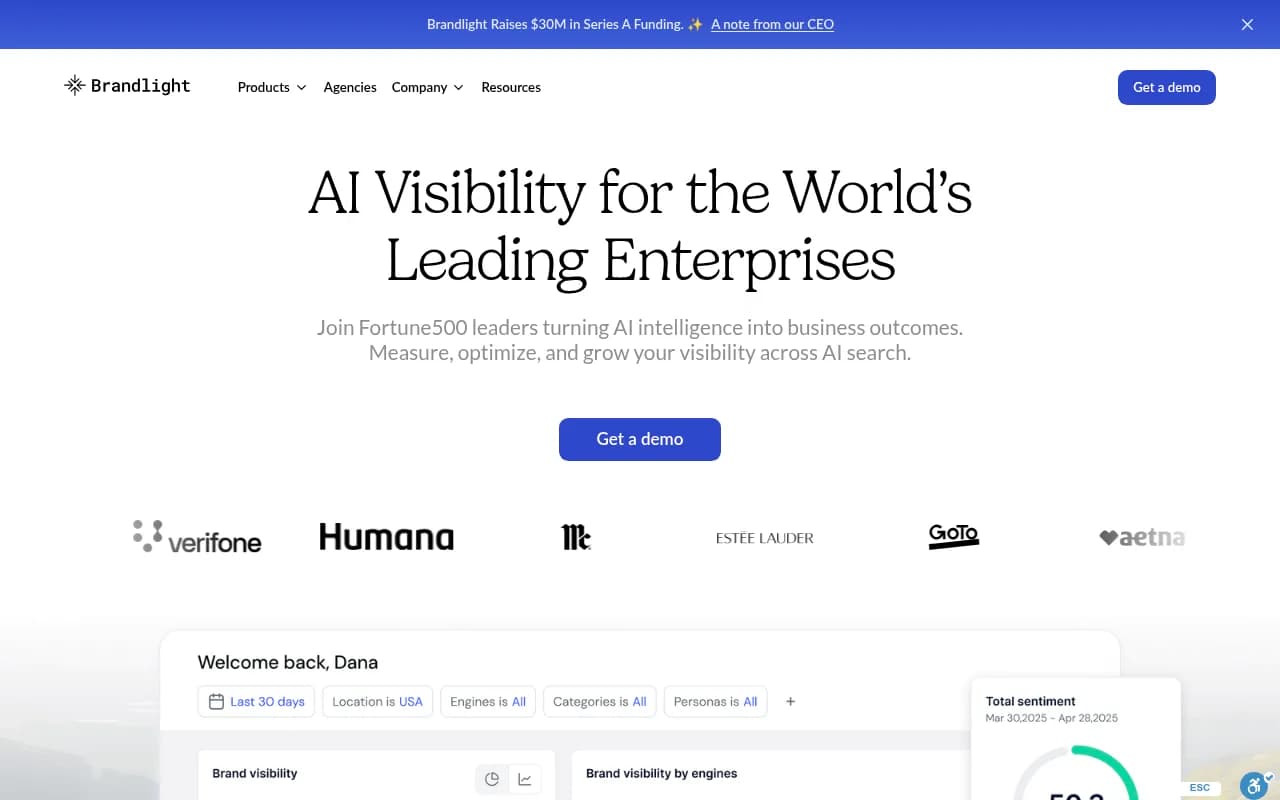
Yotpo positions Discover as AI visibility for commerce, with agents that fix sites and build review-backed pages. If Yotpo already holds your reviews, it is worth a look. Note it is a vendor ranking itself first in its own list.
Goodie and Nudge: shopping-specific coverage
Goodie lists shopping assistant coverage and Nudge pitches agentic commerce with AEO tooling. I have not tested either deeply. Ask for a demo that shows a real shopping-card result for your category.
Comparison table
| Tool | Best for | Shopping tracking | Crawler logs | Content fixes |
|---|---|---|---|---|
| Promptwatch | DTC teams that want to track and fix | Yes (Business plan) | Yes | Yes (Content Agent) |
| Profound | Large enterprise monitoring | No | Agent analytics | Limited |
| Peec AI | Cheap prompt tracking | No | No | No |
| Otterly.AI | Small-team monitoring | No | No | No |
| Semrush AI tracking | Existing Semrush users | No | Site audit only | Limited |
| Athena HQ / Scrunch | Multi-engine monitoring | Varies | No | Limited |
| Yotpo Discover | Reviews-centric stores | Varies | Varies | Review-backed pages |
This table reflects vendor positioning and Promptwatch's 2026 comparison; confirm current features on each vendor's page, since I did not re-verify competitor pricing. Promptwatch's full side-by-side comparison is a good cross-check, and the GEO software directory at bestgeosoftware.com lists more options.
The rest of the DTC stack
Visibility tools do not replace the rest of your ecommerce stack. The AY Automate roundup lists what high-volume DTC brands typically run: Klaviyo or Attentive for retention, Gorgias for support, Triple Whale or Northbeam for attribution, Rebuy for recommendations, and Yotpo or Okendo for reviews. Profound-style tools sit next to these as a separate category, since they measure how AI cites you rather than what happens after the click.
For competitor monitoring beyond AI answers (pricing pages, launches, ads), tools like Crayon and Klue are common in product marketing, though they are aimed at B2B sales teams. DTC brands often get more from ad trackers and scrapers pulling competitor one- and two-star reviews to spot product gaps.
A simple setup process for a DTC brand
- Build a prompt list from buyer language. Include category prompts ("best X for Y"), comparison prompts ("Brand A vs Brand B"), and branded prompts ("is Brand A worth it"). Tag them by product line.
- Record a baseline. Visibility, position, sentiment and the competitors that win each prompt. A free report is enough to start.
- Check crawler access. If AI bots are blocked or erroring on your product pages, nothing else matters. Promptwatch's free Agentic Readiness Check and robots.txt generator for AI help here.
- Fix product and landing pages first. Complete specs, prices, availability, Product schema, and a clean merchant feed.
- Fill gaps with comparison and FAQ pages. Then pursue listings in roundups AI already cites.
- Work on review sources. Look at which review sites and subreddits get cited for your category and where you are missing.
- Measure traffic and conversions. Remember ChatGPT stopped sending a referrer on October 8, 2026, so tag links with utm_source=chatgpt.com where you can control them.
- Repeat weekly. The shopping-card rate and ad rate shifted several times this year. A monthly check will miss it.
How to choose
If you have a small team and a small catalog, start with a lightweight tracker or the free report and learn what your gaps look like. If you are already paying an agency or running 100+ SKUs, you probably need crawler logs, shopping tracking and content execution in one place, which is where a platform like Promptwatch earns its price. If you want help beyond software, an SEO and GEO agency such as 1001 SEO Media can run the program with you, and it uses Promptwatch itself.
Whatever you pick, judge it by one test. Ask the vendor to open an answer where a competitor beat you and show the exact pages behind it, then show what you would do about it. If the answer is a score and a chart, keep looking.
FAQ
Do DTC brands really need a dedicated AI visibility tool?
If AI search sends you even a few percent of orders, yes. Manual spot checks do not scale and miss changes in shopping cards, citations and sentiment.
Which engines matter most for DTC?
ChatGPT is usually first, followed by Google AI Overviews and AI Mode, Perplexity and Gemini. Track real interfaces, not only APIs, since user-facing answers and shopping results can differ.
Are reviews or product pages more important?
Product pages are cited far more overall. Reviews punch above their weight on branded prompts. You need both.
How often should I check?
Daily tracking is the norm on most plans. Hourly options on higher tiers are useful around launches and sales.