Key takeaways
- Promptwatch Data recorded
site:-scoped queries rising from 0.37% to 16.8% of ChatGPT fanouts on August 8, 2026, and average fanouts per response rising from about 1.08 to 1.83. - The extra searches look additive. Generic web searches still run, and domain-scoped lookups come on top of them.
- Independent API-based data (DEJAN AI) did not see the shift, so the effect may be specific to the consumer ChatGPT product.
- Practical response: make your domain indexable and easy to retrieve from, cover more angles per topic, and monitor continuously instead of rewriting everything.
What happened on August 8, 2026
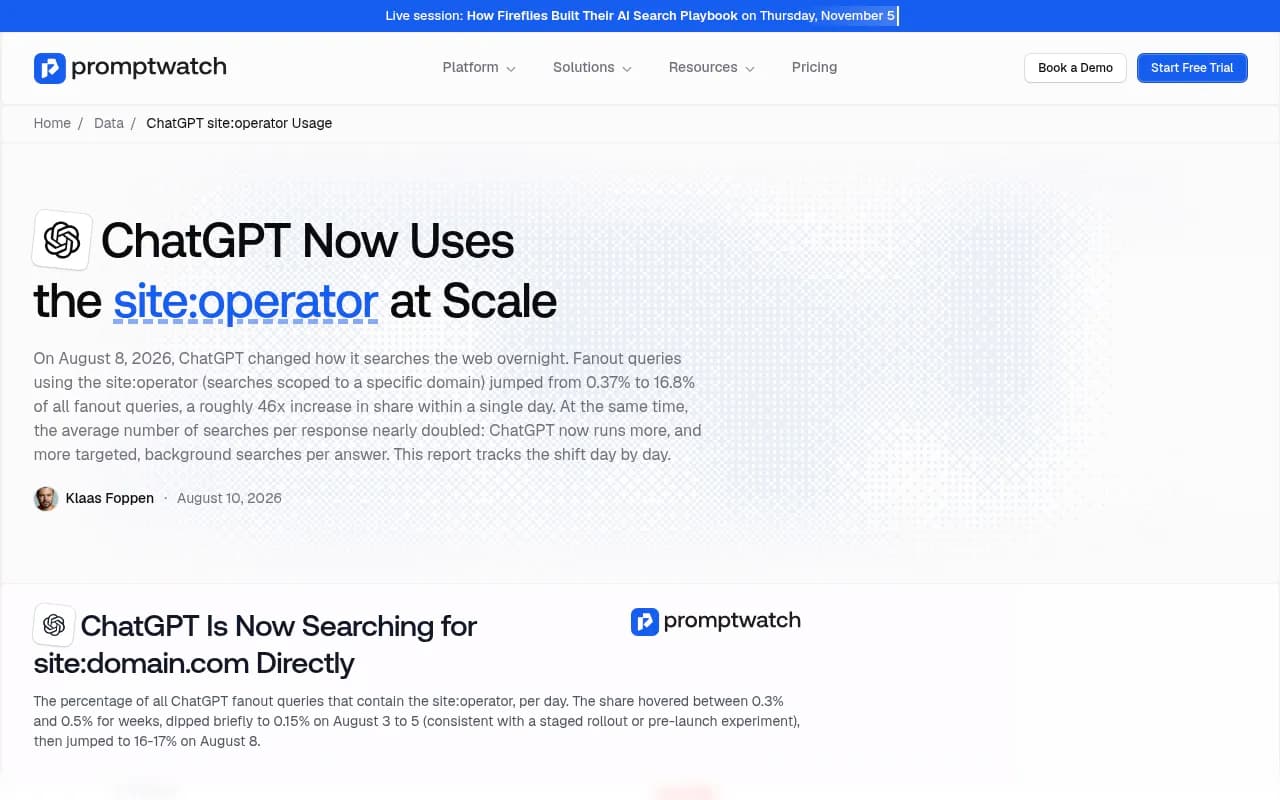
When ChatGPT answers a question with search turned on, it fires off background queries, called fanouts. For weeks, almost none of those queries used the site: operator, which restricts a search to one domain. According to Promptwatch's report on the site: operator shift, the share sat between 0.3% and 0.5%, roughly 1 in 280 fanouts.
Then on August 8 it jumped to 16.8%. That is about 46x in a single day, and it works out to roughly 1 in 6 fanouts aimed at a specific domain.
The data also shows a small dip to 0.15% on August 3 to 5. Promptwatch calls that consistent with a staged rollout or a pre-launch experiment. I would treat that as a plausible reading, not a confirmed one. Nobody outside OpenAI knows.
The second change: more searches per answer
The same day, average fanout queries per response moved from about 1.08 to about 1.83 and stayed there. The timing matters. If ChatGPT had swapped generic queries for site: queries, the average would have stayed flat. It rose, so the domain-scoped searches look like extra retrieval layered on top of the old behavior.
That is mildly good news. Whatever chance you had of showing up through generic searches is intact. You just have an additional path in, and an additional way to be missed.
Why a one-day jump points to OpenAI
A change this abrupt and this broad is almost certainly a model or system-prompt rollout, not something thousands of sites did at once. Simon Willison linked the shift to the GPT-5.6 rollout and pointed to OpenAI's August 6 announcement that GPT-5.6 Sol in Chat would be "more reliable with facts and provide more focused answers" for Plus and Pro users. The announcement does not mention search behavior, so the link is an inference.
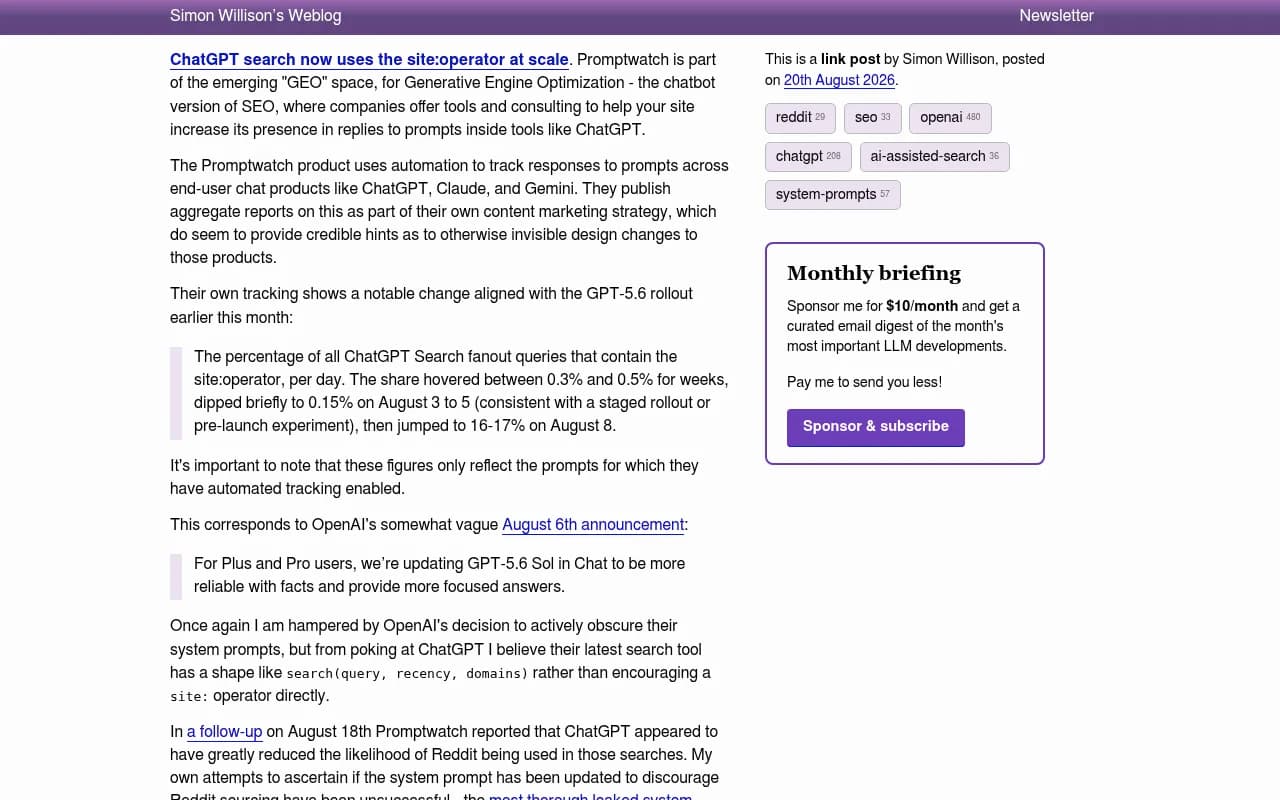
Willison also suspects ChatGPT's search tool looks more like search(query, recency, domains) than a literal site: operator typed into a query. That is his reading from poking at the product, since system prompts are not public. For you, the effect is the same: the query is scoped to your domain.
Where the evidence disagrees
This is the part many summaries skip. The Promptwatch numbers are not universally reproduced.
| Source | Method | What it found |
|---|---|---|
| Promptwatch Data | Samples the consumer ChatGPT interface | site: share 0.37% to 16.8% on Aug 8; fanouts per response 1.08 to 1.83 |
| DEJAN AI (Aug 25, 2026) | OpenAI Responses API with web search, gpt-5.2, 5.4, 5.5, fixed daily panel | site: only 0.14% of 196,692 fanouts in August; peak day 0.86%; 0 of 371 on Aug 8; fanouts per response flat at 1.09 to 1.10 |
| Zian AI | 40 API polls, 573 answers | No step change in cited URLs per answer (15.68 before, 15.91 after); fanouts not captured |
Two caveats from the sources. Willison notes Promptwatch's figures only cover prompts it tracks. And Zian quotes Promptwatch as saying exact decimals vary by methodology, so the direction and timing are the reliable part.
My reading, and it is only that: the API and the consumer product probably behave differently. The change may live in the Plus and Pro GPT-5.6 Sol experience and not in the models behind the API. That would explain why an API panel sees nothing while a UI sampler sees a step change. It also means you should not assume your own API tests reflect what real users get.
OpenAI's own release notes for mid-August mention nothing about search or site: behavior. They cover study quizzes, the Think option on Free and Go, and Android updates. I found no official OpenAI guidance for publishers on this.
The Reddit change six days later
Promptwatch also reported that reddit.com's share of ChatGPT citations fell from roughly 4% to 0.5% on August 14. Both Google surfaces declined more gradually. See Promptwatch's Reddit citations report. The size of that drop is described as provisional, and DEJAN does not contest it. Whether it connects to the site: shift is unknown. Willison could not find a system-prompt change aimed at Reddit.
What a site: query can and cannot do
A site:yourdomain.com topic search is a search-engine lookup restricted to your domain. Three consequences follow.
- It can only return pages the underlying search index already knows about. Unindexed pages cannot be found this way.
- It ranks pages within your own site. Titles, headings, and clear topical focus decide which of your pages comes first.
- Weak internal structure hurts. Thin category pages, duplicated pages, and orphaned content give the lookup poor material to return.
This is a retrieval problem, not a copywriting problem. A page can be well written and still lose here because nobody indexed it.
How to adapt your pages
1. Confirm your key pages are indexed
Start with the boring check. Search site:yourdomain.com plus your main topics in Google and Bing and see what comes back. Then compare against Search Console. Google Search Console shows indexing status per URL, and a crawler such as Screaming Frog can list what exists on your site so you can spot gaps.
Promptwatch's recommendation is the same: a site: query surfaces only what has been indexed from your domain, so coverage gaps become gaps in AI answers.
2. Fix thin and overlapping pages
Run the same site: searches for your commercial topics: pricing, alternatives, comparisons, integrations. If the top result for "yourdomain.com pricing" is a blog post or a thin category stub, that is what ChatGPT's lookup is likely seeing too. Give each topic one clearly dominant page with a descriptive title and H1.
3. Cover more angles per topic
At about 1.8 fanouts per response, an answer now draws on more distinct retrievals. Comparisons, pricing, alternatives, and domain-scoped lookups are separate chances to be found. If you only have a feature page, you are present for one of those angles and absent from the rest.
Page types worth checking against your topic list:
- A pricing page that states numbers
- Comparison and alternatives pages
- Documentation or help content
- A short FAQ per product area
Promptwatch Data shows product pages are the most cited content type in ChatGPT at 22.4% of citations (Sep 28 to Oct 4, 2026), and that landing pages and docs stay cited longest while news loses half its pages within 36 days. Those are the pages a domain-scoped lookup is most likely to find, so they are where I would spend effort first.
4. Check that AI crawlers can read the site
Indexing in a search engine is one thing. AI bots reading your pages is another, and a blocked bot or a failing server hurts both. Check robots.txt and server errors for GPTBot, OAI-SearchBot, and ChatGPT-User. Tools like Promptwatch's AI crawler logs show which bots hit which pages and where they fail, and the free AI crawler URL inspector lets you test a single page.
5. Re-run your fanout analysis
Keyword mappings built before August 8 are stale. The queries ChatGPT generates from a prompt changed. Redo the mapping for your priority prompts, ideally with real fanout data. The free ChatGPT query fan-out generator gives a quick approximation, and Promptwatch's query fan-out guide explains how to read the results.
6. Hold off on big rewrites
The shift was platform-wide, so it is not evidence that your content failed. Do not tear up pages that were working. Fix retrieval problems, fill topic gaps, then measure.
Monitoring this kind of change
One-off audits miss overnight shifts, and that is the real lesson of August 8. You want a way to see how ChatGPT queries the web for your prompts, which of your pages get cited, and whether crawlers can reach them.
Promptwatch tracks prompts in the real ChatGPT interface, shows query fan-outs, logs AI crawler visits, and ties citations back to specific pages. It is also the source of the data in this guide, so weigh that when you read it.

Other options in the category include:
| Tool | Angle | Notes |
|---|---|---|
| Promptwatch | Tracking plus crawler logs, content gaps, content creation | Real-UI prompt tracking and fan-outs; plans start at $95/mo, confirm on promptwatch.com/pricing |
| Otterly.AI | Prompt tracking | Monitoring focus, lighter on crawler and traffic data |
| Peec AI | Prompt tracking | Monitoring without optimization workflows |
| Profound | Enterprise AI visibility | Higher price point |
| Screaming Frog | Technical crawl | Finds indexability and internal link problems, no AI data |



For a wider list, the GEO software directory covers more tools in this category.
A quick test you can run today
- List ten prompts your buyers would ask ChatGPT.
- For each, note the topics a good answer would cover: comparison, price, alternatives, how-to.
- Search
site:yourdomain.complus each topic in Google and Bing. Record which page ranks first, or whether nothing does. - Mark every miss. Those are your fix list: unindexed pages, missing pages, or the wrong page ranking.
- Re-check in two to four weeks and compare citations for the affected prompts.
It is not glamorous. It is also the most direct response to what the data suggests ChatGPT is doing.
What we still do not know
- Whether the shift applies to every ChatGPT plan or mainly Plus and Pro users.
- Whether the API and the consumer product genuinely differ, or the measurement methods do.
- Whether
site:lookups favor certain kinds of domains. No source I found tests that. - Whether OpenAI will publish publisher guidance. None exists yet.
Promptwatch's own note is that the direction and timing are the reliable part, not the decimals. Treat the 16.8% figure as a signal that ChatGPT began looking inside specific sites more often, and make sure your site gives it something to find. For more first-party research on how AI search behaves, the Promptwatch Data hub is updated regularly.