Key takeaways
- Brand-level tracking and product-level tracking are different things. Most AI search trackers only do the first, even when the sales page implies the second.
- Shopping surfaces read merchant feeds, not just web pages. ChatGPT, Google and Amazon each pull from catalog data you control, so robots.txt and blog content only cover part of the job.
- Product-level tracking is usually gated to higher tiers. Check the vendor's live pricing page before you commit, because this category re-prices constantly.
- A prompt budget of 50 to 350 covers categories and comparison queries. It does not stretch across thousands of SKUs.
- Pick the tool by the surface that matters most to you: ChatGPT Shopping, Amazon, Google AI Mode, or your own Shopify store.
Why ecommerce needs different AI search tracking
A standard AI visibility tool answers one question: does an assistant say your brand name? That is close to useless when you sell 12,000 SKUs and the shopper asked for "a waterproof hiking boot under $150." What matters is whether a specific product shows up, in what position, at what price, and which competitor product sits next to it.
The demand side is real. Adobe, working from more than a trillion visits to US retail sites, reported that traffic from AI sources to US retail sites grew 393% year over year in the first quarter of 2026, and that AI traffic converted 42% better than non-AI traffic in its March 2026 data. Those numbers come from Adobe's own analytics and are worth treating as directional, but the pattern matches what most stores are seeing: smaller volume, better buyers.
The measurement side is messier. Four different surfaces now matter, and each behaves differently:
- ChatGPT Shopping: product cards, recommendations and price comparisons that appear when ChatGPT runs a web search.
- Amazon's Alexa for Shopping (formerly Rufus): recommends only products sold on Amazon. Amazon says Rufus helped over 300 million customers in 2025.
- Google AI Mode and AI Overviews: product-heavy answers drawn from Google's shopping data and the open web.
- Your own store: Shopify and other platforms have on-site assistants, which are a separate problem from external AI visibility.
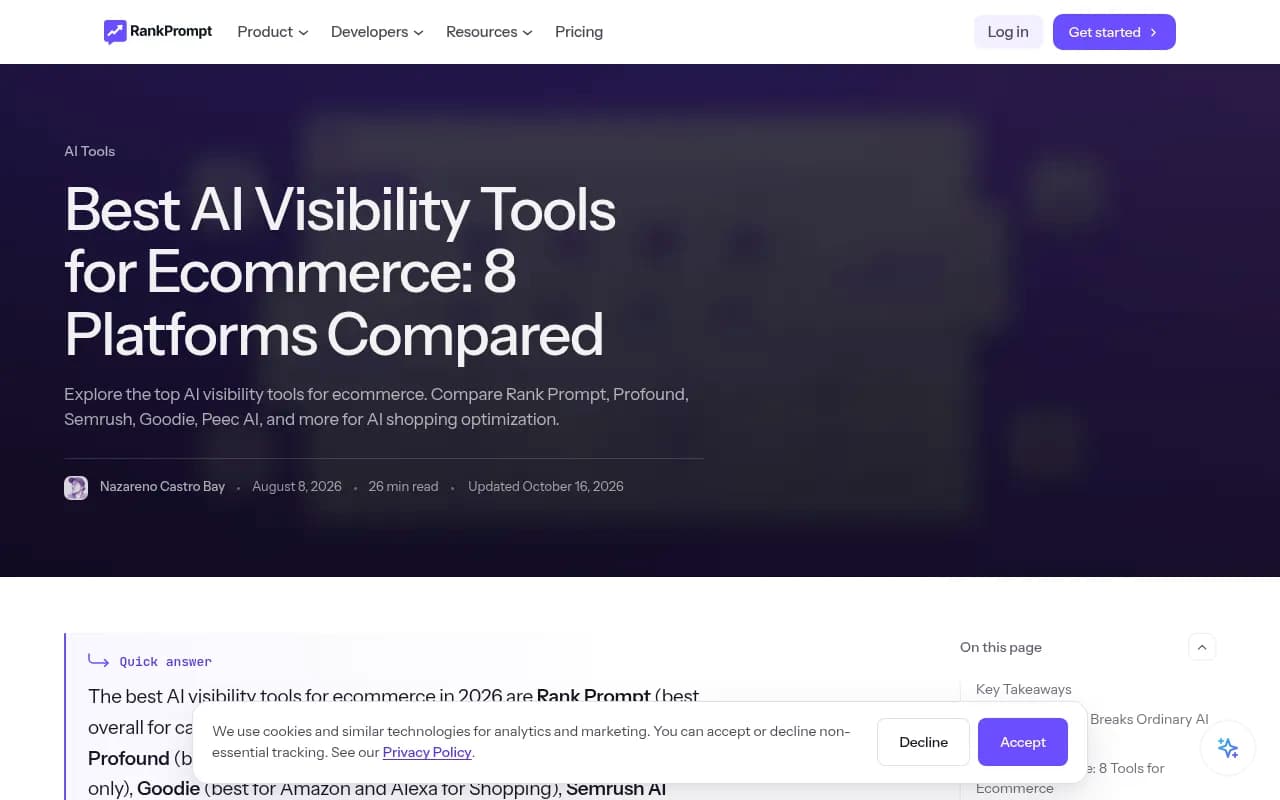
The question an ecommerce tracker has to answer is about products, not brand names. Screenshot from Rank Prompt's ecommerce comparison, captured July 2026.
How AI shopping answers differ by platform
Before choosing a tracker, it helps to know which surface actually sends you revenue. First Page Sage's 2026 shopping study scored the main assistants across eight product categories. Google Gemini with AI Mode led overall at 88.7 out of 100, ChatGPT's shopping research mode followed at 87.8, and Amazon Rufus scored 85.7. Gemini won five of the eight categories, ChatGPT won home and kitchen plus toys and gifts, and Rufus won groceries and household.
Two details from that study matter for trackers. Rufus gave the most accurate recommendations, 91.3% correct and in stock at the quoted price, but it only recommends Amazon products. And ChatGPT's shopping research took about 94.6 seconds per answer, which hints at how much searching happens behind each response.
How often shopping features show up at all is a separate question. Promptwatch Data's ChatGPT Shopping usage report found that product cards and price comparisons appear on only a low single-digit share of web-search responses overall, concentrated on commercial and transactional prompts. The rate also moves in steps, which Promptwatch reads as OpenAI tuning when cards appear. The report is dated November 2025, so treat it as a description of the pattern, not a current percentage.
What ChatGPT cites matters too. In Promptwatch's citation share by content type data for Sep 28 to Oct 4, 2026, product pages were the most cited type at 22.4% of citations, followed by landing pages at 16.8% and listicles at 13.6%. For commercial prompts, product pages hit 26.0% and comparisons rose to 7.9%. If you sell things, your product pages and the roundups that mention you are the two assets AI actually quotes.
What to look for in an ecommerce AI search tracker
Skip the feature-count comparisons. These are the questions that separate tools.
Does it track products or only brands?
Ask the vendor to show a report where a single SKU appears with a position, not a brand mention count. Rank Prompt's research notes make the point bluntly: almost every tool in this category measures brand mentions and sells it as product visibility.
Which shopping surfaces does it cover?
Profound's shopping module is marked "Powered by ChatGPT" on its own page, so it is single-surface. Goodie is the one that explicitly covers Amazon and Alexa for Shopping. Azoma positions itself around shopping agents including ChatGPT, Gemini, Google AI Mode and Amazon Rufus. Whichever you pick, confirm the surfaces on the live page.
Does it read your feed?
Shopping surfaces read merchant feeds. A tool that ingests your catalog can track SKUs. A tool that only runs prompts can track categories and comparison queries. Rank Prompt says openly that it does not ingest a product feed, which makes it a poor fit for pure SKU shelf tracking even though it is cheap and broad.
Can you see what to fix?
Tracking that ends in a chart leaves the work to you. For ecommerce the fixes are concrete: complete Product schema, accurate prices and availability, a clean merchant feed, reviews on trusted sites, and inclusion in the listicles ChatGPT cites. The best tools connect visibility gaps to those tasks.
Does it measure traffic and crawler access?
If AI sends visitors, you want to see them. Adobe scored US retail product pages as only 66% machine readable, the lowest of any page type it measured, so crawler access and page readability are often where stores lose out.
AI search trackers for ecommerce compared
Pricing below comes from the research notes and vendor pages as of mid-2026. Verify before buying.
| Tool | Best for | Shopping coverage | Starting price |
|---|---|---|---|
| Promptwatch | End-to-end visibility plus fixes for stores | ChatGPT Shopping, Amazon Alexa product results, Ads Radar, crawler logs, content agent | $95/mo (Business $579/mo for Shopping) |
| Profound | Enterprise SKU tracking in ChatGPT Shopping | ChatGPT only | Enterprise for product-level; entry plans vary |
| Goodie | Amazon-first sellers | Amazon, Alexa for Shopping | Higher tiers for product-level |
| Azoma | Commerce teams tracking shopping agents | ChatGPT, Gemini, AI Mode, Rufus | Custom |
| Peec AI | Multi-market retail groups | Prompt-level monitoring | From $80/mo (50 prompts) |
| Rank Prompt | Category and comparison queries on a budget | Seven engines, no feed ingestion | From $49/mo |
| Semrush AI Visibility | Teams already in Semrush | Brand-level, product tier higher | Varies |
The tools, one by one
Promptwatch
Promptwatch is the option I would look at first if you want tracking and fixing in one place. Its ChatGPT Shopping tracking shows which products ChatGPT recommends, which competitors it picks instead, and how your own uploaded catalog performs, with the same coverage for Amazon Alexa product results. Ads Radar adds the sponsored placements appearing on your prompts.

The part that matters for stores is what happens after the report. IP-verified AI crawler logs show whether GPTBot, OAI-SearchBot or ChatGPT-User can actually read your product pages. Visitor analytics measure AI-referred traffic and conversions. The Action Board and Content Agent turn gaps into prioritized tasks and published pages, and Page Tracker shows whether those pages start getting cited. Prompts run against the real interfaces of ChatGPT, Google AI Overviews, Google AI Mode, Gemini, Perplexity, Copilot, Alexa and Meta AI, by country and language.
The catch is plan gating. Shopping insights and Ads Radar start on Business at $579/mo (5 projects, 350 prompts, 42,000 responses). Essential at $95/mo and Professional at $245/mo cover monitoring, crawler logs from Professional, and visitor analytics, but not Shopping. Agencies get Ads Radar on every plan from Kick-off at $199/mo, but not ChatGPT Shopping. Confirm everything at promptwatch.com/pricing. There is a 7-day free trial on monthly billing, and a free AI visibility report if you just want a first look.
If you also run content for a catalog, the Promptwatch vs Profound comparison covers where the two differ.
Profound
Profound is the strongest name for SKU-level tracking inside ChatGPT Shopping, according to Rank Prompt's review, and it is aimed at enterprise retail teams. Two limits: the shopping module covers only ChatGPT, and product-level tracking sits behind Enterprise. Another roundup lists an entry price of $99/month, but that tier is brand-level monitoring, not the SKU view.

Goodie
Goodie is the pick if Amazon is your main channel. Rank Prompt notes that no other tool in its list names Alexa for Shopping as a covered surface. If most of your revenue sits in Amazon listings, that gap is worth a lot. If it does not, you are paying for coverage you will not use.
Peec AI
Peec AI is clean, focused monitoring. Triple Whale's roundup lists Starter at $80/mo for 50 prompts, Pro at $205/mo for 150 prompts across 3 models, and Advanced from $420/mo for 350 prompts. It suits retail groups running many markets. It is a monitoring tool, so expect no crawler logs, no content generation and no feed-level product tracking.

Semrush AI Visibility
Semrush makes sense when your ecommerce SEO team already works in it and wants AI tracking next to rankings. The tradeoff is depth. Product-level tracking is above the entry plan, and prompt sets are more fixed than in AI-native tools.
Azoma and WorkDuo
Azoma is built around agentic shopping discovery and tracks products across ChatGPT, Gemini, Google AI Mode and Amazon Rufus, with custom pricing. WorkDuo, listed at $33 per project per month in Raccoon AI's roundup, is a cheaper product-level option for smaller teams. Neither is in our catalog, so check their sites directly.

Otterly.AI and Rank Prompt
For a low-cost start, Otterly.AI and Rank Prompt cover category and comparison prompts without enterprise commitments. Rank Prompt's own ecommerce page positions it at seven engines from $49/mo. Remember the author of that comparison builds Rank Prompt, so read its rankings with that in mind.

Shopify stores: what to track and what to ignore
Shopify itself does not give you an AI visibility report. Sidekick, Shopify's admin assistant, helps you write content and analyze orders, but it does not tell you whether ChatGPT recommends your hiking boots. The tools worth connecting around a Shopify store are different ones:
- An external AI visibility tracker for category and product prompts.
- Crawler and visitor analytics so you can see AI bots and AI-referred sessions. Promptwatch also has a Shopify-behind-Cloudflare guided setup for crawler logs.
- A clean product feed and Product schema, since those drive shopping cards.
- Google Search Console, which is free and shows how pages perform in Google before AI enters the picture.
One note on attribution: ChatGPT stopped sending a referrer on October 8, 2026, so AI traffic may land in "direct" unless you tag links with utm_source=chatgpt.com or use an analytics tool that handles it. Promptwatch's guide to attributing AI traffic walks through the options.
Amazon sellers: a separate problem
Amazon's assistant only recommends products sold on Amazon, and in First Page Sage's tests it won groceries and household because catalog depth, delivery times and Subscribe and Save prices mattered more than comparison across stores. That means listing quality, reviews and availability matter more than anything on your own site. For these sellers, a tracker that actually covers Alexa for Shopping (Goodie, or Promptwatch's Alexa product results) belongs on the shortlist, and general brand trackers do not.
A practical checklist before you buy
- Write down your top 20 category and comparison prompts. If a vendor cannot run them in a trial, move on.
- Ask which of ChatGPT Shopping, Google AI Mode and Amazon is actually covered, and how data is collected (real interface or API).
- Ask whether SKU-level tracking is on your plan tier, not only on Enterprise.
- Do the prompt math. 350 prompts is a lot for categories and nothing for a full catalog. Track your top sellers and top categories.
- Check for crawler logs and visitor analytics so you can prove revenue, not just visibility.
- Re-read pricing the day you buy.
For wider lists beyond ecommerce, the GEO software directory at bestgeosoftware.com and the rank tracker directory at ai-rank-tools.com are good places to keep browsing.
Quick recommendations
| If you are... | Start with |
|---|---|
| A Shopify or DTC brand wanting tracking plus fixes | Promptwatch |
| Enterprise retail focused on ChatGPT Shopping SKUs | Profound |
| An Amazon-first seller | Goodie, or Promptwatch for Alexa product results |
| A multi-market retail group wanting simple monitoring | Peec AI |
| A small store on a tight budget | Rank Prompt, Otterly.AI or WorkDuo |
| An SEO team living in Semrush | Semrush AI Visibility |
The honest summary: no tool tracks every SKU on every surface for a low price. Pick the surface that earns you the most, confirm product-level tracking on your tier, and put the fixable basics first: complete product data, a clean feed, readable pages, and reviews on sites AI trusts.