Key takeaways
- A weekly routine beats a quarterly GEO project. Small, steady touchpoints keep insight fresh, and you find out within days whether a fix worked.
- The Discovery agent in Promptwatch investigates your data on a weekly schedule and suggests up to five evidence-backed actions per run. Five is a number a team can actually finish.
- Borrow the cadence from continuous discovery: one outcome, one weekly ritual, the whole team in the room, and a decision at the end of every session.
- Every action needs an owner, a due date, and a follow-up check. Otherwise the board turns into a graveyard of good ideas.
- Different content decays at different speeds, so your weekly routine should treat news, product pages, and docs differently.
Why a weekly habit and not a quarterly audit
Most GEO work I see follows the same arc. Someone runs a big audit, produces a 40-page deck, and the team nods. Three weeks later nothing has shipped because the deck had 60 recommendations and no order.
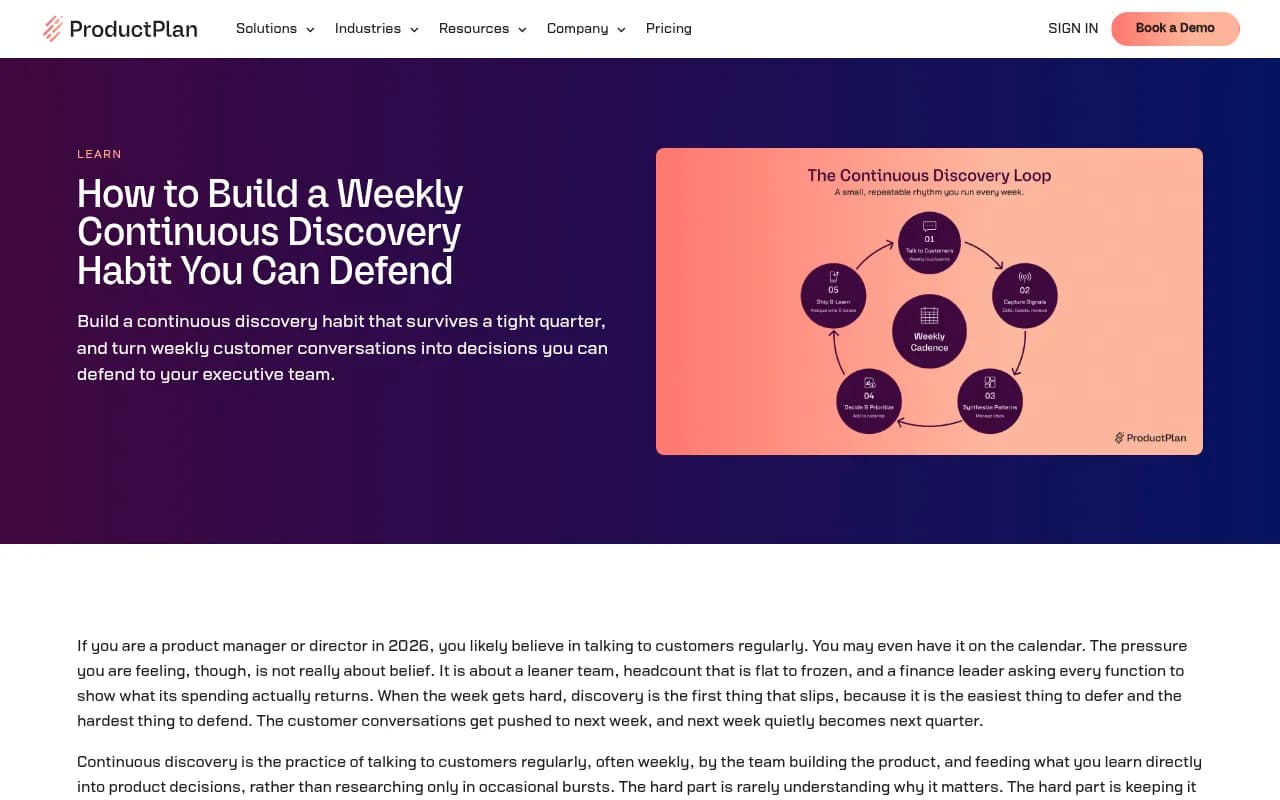
Product teams solved a version of this problem years ago. Teresa Torres's Continuous Discovery Habits argues that a product trio should talk to customers every week, together, and feed what they learn into an opportunity solution tree. Her point is that discovery fails when it is a project and works when it is a rhythm. ProductPlan's write-up makes a similar case: small, steady touchpoints beat large, infrequent research pushes, because you can disprove one idea and start on the next within days. It also notes that in ProductPlan's 2026 State of Product Management report, 49% of teams named resource and capacity constraints as the top cause of roadmap misalignment. That is exactly why discovery slips first when the week gets hard.
GEO has the same failure mode. AI search changes weekly. Models get updated, citation behavior shifts, crawlers change their mix. A quarterly review is always looking at a world that has already moved.
Promptwatch Data shows how fast things move. reddit.com's share of ChatGPT citations fell from about 4% to about 0.5% on August 14, 2026, practically overnight. And on August 8, 2026 ChatGPT started using the site: operator at scale, jumping from roughly 0.4% to about 17% of fan-out queries. If you only looked at your data every quarter, you would have found out about both in a post-mortem.
The mapping: continuous discovery to GEO
The vocabulary transfers better than you might expect.
| Continuous discovery | Weekly GEO routine |
|---|---|
| Product outcome | One GEO outcome, such as AI-referred conversions or Share of Voice on a topic cluster |
| Weekly customer interview | Weekly review of what AI says, cites, and crawls |
| Opportunity solution tree | Prioritized board of actions tied to prompts, pages, and sources |
| Assumption test | Publish or fix a page, then check crawl, citation, and traffic |
| Product trio attends together | SEO, content, and one person who can ship on the site, in the same session |
Torres's starting advice, as summarized by Perspective AI, is to start with one outcome, one tree, and one interview per week, and to remove friction from that single interview before scaling. Copy that. Do not try to run five workstreams in week one.
What the Discovery agent actually does
The agent is the part that removes the "synthesis tax" the discovery literature keeps complaining about. In human product research, the recruiting and synthesis work is what kills the cadence. In GEO, the equivalent is digging through prompts, citations, crawler logs, and traffic to figure out what deserves attention this week.
Promptwatch is an end-to-end AI visibility platform that monitors how ChatGPT, Gemini, Perplexity, Claude, Google AI Overviews and other engines mention and cite a brand, then helps fix the gaps. Its Action Board is an AI-generated, prioritized GEO to-do list. A Discovery agent investigates your data on a weekly schedule and suggests up to five evidence-backed actions per run, and a weekly digest email lands every Monday.

The cap matters. Five actions is a constraint that forces prioritization, and "evidence-backed" means each suggestion should point at something in your data, not a generic best practice. Actions cover content gaps, sentiment, Reddit, offsite mentions, site health, performance, untracked or untapped pages, and setup. You can also add custom actions with assignees and comments, in board or list layout.
A word of caution, because I have seen teams get this wrong. An agent that suggests five things does not mean you should do all five blindly. Treat the output as a prepared agenda for a conversation, the way a good analyst walks into a meeting with a short list instead of a spreadsheet. The agent saves you the digging. The team still decides.
The 45-minute weekly routine
Here is a structure that works for a small team. Adjust the timing, keep the order.
Monday: read the digest (5 minutes, solo)
The weekly digest email arrives Monday. The owner of the routine, usually the SEO lead, skims it before the meeting. The only job is to spot anything alarming, like a drop in visibility on a core topic or a spike of crawl errors, so the meeting does not open with surprise.
Tuesday: the review session (30 minutes, whole team)
Open the Action Board with the same people every week. Torres is clear that interviewing as a team prevents everyone from working off a different set of information. The same logic applies here: if the content writer never sees why a page is flagged, they will write the fix badly.
Walk through the agent's suggestions in this order:
- Read the evidence first. Which prompts, pages, or sources is the action based on? If the evidence is thin, decline the action and move on.
- Classify the problem. Low Share of Voice is a coverage problem. Late Position is a prominence problem. Mentions without self-citations point to a content or crawlability problem. Weak sentiment is a reputation problem. The metrics overview in the Promptwatch Academy explains how to read these together.
- Pick the two or three you can finish this week. Say no to the rest, out loud.
- Assign an owner and a date to each. No owner, no action.
That last step is the one teams skip. A board without owners is a wish list.
Wednesday to Friday: ship (the actual work)
This is where the routine either pays off or does not. Keep the unit of work small: one page refreshed, one FAQ added, one robots.txt rule fixed, one Reddit thread answered.
For content actions, a Content Agent can plan, write, and publish against your visibility gaps to WordPress, Webflow, or Framer, with a review inbox where you approve, edit, or decline drafts. It is available on Business and Enterprise plans. If you are on a lower plan, content actions still go on the board and your writers pick them up. Content Refresh gives git-diff-style updates for existing pages, which is a faster review than rereading a whole article.
The following Tuesday: close the loop (10 minutes)
Start next week's session by checking last week's shipped work. Did the AI crawlers fetch the page? Did it get cited? Did traffic show up? Promptwatch tracks each published document through crawls, citations, and AI traffic, and underperformers come back as new actions. If you do nothing else, do this. Shipping without checking is just publishing.
Match the refresh to the content type
Not everything decays at the same rate, and your weekly routine should reflect it. Promptwatch's content half-life data tracked every page ChatGPT cited on July 6, 2026 for 90 days:
| Content type | Still cited at 60 days | Notes |
|---|---|---|
| Landing pages | 69% | Cited longest |
| Docs | 67% | 93% cited again after day 0 |
| Comparisons | 63% | Stable |
| Listicles | 60% | Refresh on a schedule |
| Product pages, reviews, how-tos | about 55% | Half-life of 74 to 77 days |
| News | 41% | Half of pages gone after 36 days |
The practical reading: put product pages, listicles, and how-tos on a rolling refresh calendar, and treat news as a short burst of visibility, not an asset. When the Discovery agent flags an older page, check which bucket it falls into before deciding how urgent it is.
What gets cited also matters. In Promptwatch's content-type report for Sep 28 to Oct 4, 2026, product pages were 22.4% of ChatGPT citations and landing pages 16.8%, so about 39% of citations go to pages describing what a company sells. Listicles were 13.6%. Informational prompts lean more on how-tos (10.7%) and docs (8.5%). If your board is full of blog post ideas but your product pages are stale, the data says you have your priorities backwards.
Check the plumbing before you write anything
Some weeks the right action is not content. It is access. If AI crawlers cannot read your pages, a perfect article does nothing.
Promptwatch's AI crawler traffic report (weekly, IP-verified, June 8 to September 6, 2026) found OpenAI made up 79.8% of verified AI crawler requests in the week of Aug 31 to Sep 6, down from 94.8% in mid-June. Its advice is simple: compare your own logs against that mix. A provider that is a big share in the benchmark but near zero in your logs probably means you are blocking it through robots.txt, your CDN, or a WAF rule.
Promptwatch's AI crawler logs do that comparison with IP-verified requests, so spoofed bots are filtered out. A good habit is to glance at crawl errors in every weekly session, takes two minutes. Free tools help too: the Agentic Readiness Check shows which AI crawlers can read your site.
Picking the one outcome
Torres insists on one clear outcome, and I agree. For GEO, pick one of these for the quarter:
- Share of Voice on a defined topic cluster
- Self-citation rate (the share of citations pointing at your own domain)
- AI-referred conversions
- Visibility Score in one market or language
Every action the team accepts should plausibly move that number. Anything that does not goes in a parking lot. This is also how you answer a CFO asking what the program returns. The ProductPlan piece frames discovery as risk reduction, the cheapest insurance against shipping the wrong thing, and the same framing works for GEO: you are spending a few hours a week to avoid spending a month on the wrong content.
Tooling options for the routine
The routine itself is tool-agnostic. What you need is a source of evidence, a board with owners, and a way to check outcomes. Here is how a few options compare for this specific job.
| Tool | Weekly action suggestions | Crawler logs | Content publishing | Fit |
|---|---|---|---|---|
| Promptwatch | Yes, Discovery agent plus Action Board | Yes, IP-verified | Yes, WordPress, Webflow, Framer | Teams that want find, fix, and measure in one place |
| Otterly.AI | Monitoring focused | No | No | Basic tracking on a budget |
| Peec AI | Monitoring focused | No | No | Prompt tracking without optimization |
| Profound | Monitoring and analytics | Limited | Limited | Enterprise monitoring |



Trackers like these answer "was my brand mentioned?" which is a fine start. The weekly routine needs more: a list of what to do, and a way to see whether it worked. For a head-to-head view, see Promptwatch vs Profound or the broader 2026 comparison of GEO platforms. If you want to browse alternatives, the GEO software directory at bestgeosoftware.com lists many more.
If you do not use the agent, you can still run a lighter version by hand: a weekly look at your tracked prompts, one competitor gap, one crawl check, and a shared board. It takes longer, which is the whole argument for the agent.
Making it stick
Habits die in specific, predictable ways. Here are the ones to plan for.
- The meeting moves. Put it on the calendar as a recurring event with a fixed owner, and protect it the way you would a sprint planning.
- Only one person attends. Torres's advice about doing discovery as a team, not a solo act, spreads the load so it does not rest on one person. Require at least SEO, content, and a developer or CMS owner.
- Everything is priority one. Keep the cap at the agent's five, and ship two or three.
- Nobody checks results. Make the first agenda item every week a review of last week's shipped work.
- The routine only runs when things are quiet. Shorten it instead of skipping it. A 20-minute session beats a cancelled one.
Two more things that help. Use Agent Chat or a scheduled chat in Slack to pull a quick briefing before the meeting, so people arrive with context. And keep a running log of what you shipped and what happened. After a quarter you will have your own evidence for which kinds of actions pay off in your market, which is more useful than any benchmark.
A sample first month
| Week | Focus | Output |
|---|---|---|
| 1 | Set one outcome, connect data, run first Discovery session | Two shipped actions, owners assigned |
| 2 | Check week 1 results, fix crawler access issues | Crawl errors cleared, one page refreshed |
| 3 | Content gap action, product page refresh | One new page, one updated page |
| 4 | Review the month, drop what did not work | Short retro, next month's outcome confirmed |
The 90-day GEO program in the Promptwatch Academy is a good companion if you want a longer arc around this cadence. To try the agent, Promptwatch has a 7-day free trial on monthly billing, and the free AI visibility report gives a no-login read on where you stand today. Confirm current plans at promptwatch.com/pricing; the Discovery agent is part of the Action Board, which is included in the platform.
The short version
Pick one outcome. Meet weekly with the same three people. Let the agent bring five evidence-backed actions, choose two or three, give each an owner, ship them, and check them next week. Do that for a quarter and you will have something most GEO programs lack: a record of what worked.