Key takeaways
- AI search monitoring tools track how your brand appears in ChatGPT, Perplexity, Gemini, Claude, and other LLM-powered search engines -- something traditional rank trackers can't do.
- Most tools in this space are monitoring-only dashboards. A smaller number go further and help you actually fix visibility gaps through content gap analysis and AI-optimized content generation.
- The right tool depends on your stage: solo marketers and small teams have solid affordable options; enterprise teams need deeper prompt intelligence, multi-region support, and attribution.
- Promptwatch is the only platform in 2026 rated as a "Leader" across all evaluation categories in a 12-platform comparison, largely because it closes the loop from gap detection to content creation to traffic attribution.
- Free trials are available across most platforms -- test before committing.
Traditional SEO made sense for a long time. You tracked keywords, watched your rankings climb, and traffic followed. That loop worked.
It's breaking down now. A growing share of search queries never reach a results page -- they get answered directly by ChatGPT, Perplexity, Google's AI Overviews, or Gemini. The user gets their answer. They move on. Your ranking at position one is irrelevant if the AI didn't cite you.
This is the problem AI search monitoring tools solve. They run queries against LLMs on your behalf, record whether your brand appears, track which pages get cited, and -- in the better platforms -- tell you what to do about the gaps.
This guide covers the best options available in 2026, from lightweight trackers to full optimization platforms. I've organized them by use case so you can find the right fit quickly.
What to look for in an AI search monitoring tool
Before getting into specific tools, it's worth being clear about what separates a useful platform from a dashboard that just looks busy.
The core function is straightforward: the tool sends prompts to AI models (ChatGPT, Perplexity, Gemini, Claude, etc.), records the responses, and tells you whether your brand or URLs appeared. That's monitoring.
Where tools diverge is what happens next. Monitoring tells you that you're invisible. Optimization tells you why and helps you fix it. The best platforms do both.
Here's what to evaluate:
- Platform coverage: Does it monitor the AI engines your customers actually use? ChatGPT and Perplexity are table stakes. Google AI Overviews, Gemini, Claude, Grok, and DeepSeek matter depending on your audience.
- Prompt intelligence: Can you see which prompts drive visibility? Volume estimates and difficulty scores help you prioritize instead of guessing.
- Content gap analysis: Does it show you which prompts competitors rank for that you don't? This is where monitoring becomes strategy.
- Content generation: Can it help you create content engineered to get cited -- not generic SEO filler?
- Attribution: Can you connect AI visibility to actual traffic and revenue?
- Crawler logs: Does it show you which AI crawlers are hitting your site, which pages they read, and how often?
Most tools handle the first two. Far fewer handle the rest.
The tools, ranked and reviewed
Promptwatch -- best overall for AI search optimization
Promptwatch is the platform I'd recommend first for most marketing teams in 2026. It's the only tool in a recent 12-platform comparison rated as a "Leader" across every evaluation category, and the reason is straightforward: it doesn't stop at monitoring.

The core workflow is what Promptwatch calls the Action Loop. First, Answer Gap Analysis shows you exactly which prompts competitors are visible for that you're not -- specific topics, angles, and questions that AI models want to answer but can't find on your site. Second, a built-in AI writing agent generates content grounded in real citation data (880M+ citations analyzed), prompt volumes, and competitor analysis. Third, page-level tracking shows your visibility scores improving as AI models start citing the new content. Traffic attribution via GSC integration, a code snippet, or server log analysis closes the loop to revenue.
That full cycle -- find gaps, create content, track results -- is what separates Promptwatch from the monitoring-only tools that dominate this space.
A few other things worth noting: it monitors 10 AI models (ChatGPT, Perplexity, Google AI Overviews, Google AI Mode, Claude, Gemini, Meta/Llama, DeepSeek, Grok, Mistral, Copilot), has real-time AI crawler logs showing which pages AI engines read and how often, tracks Reddit and YouTube discussions that influence AI recommendations, and monitors ChatGPT Shopping carousels. Multi-language and multi-region support with customizable personas rounds it out.
Pricing starts at $99/month (Essential: 1 site, 50 prompts, 5 articles), $249/month (Professional: 2 sites, 150 prompts, 15 articles, crawler logs), and $579/month (Business: 5 sites, 350 prompts, 30 articles). Agency and enterprise pricing is custom. Free trial available.
Profound -- best for enterprise teams with budget
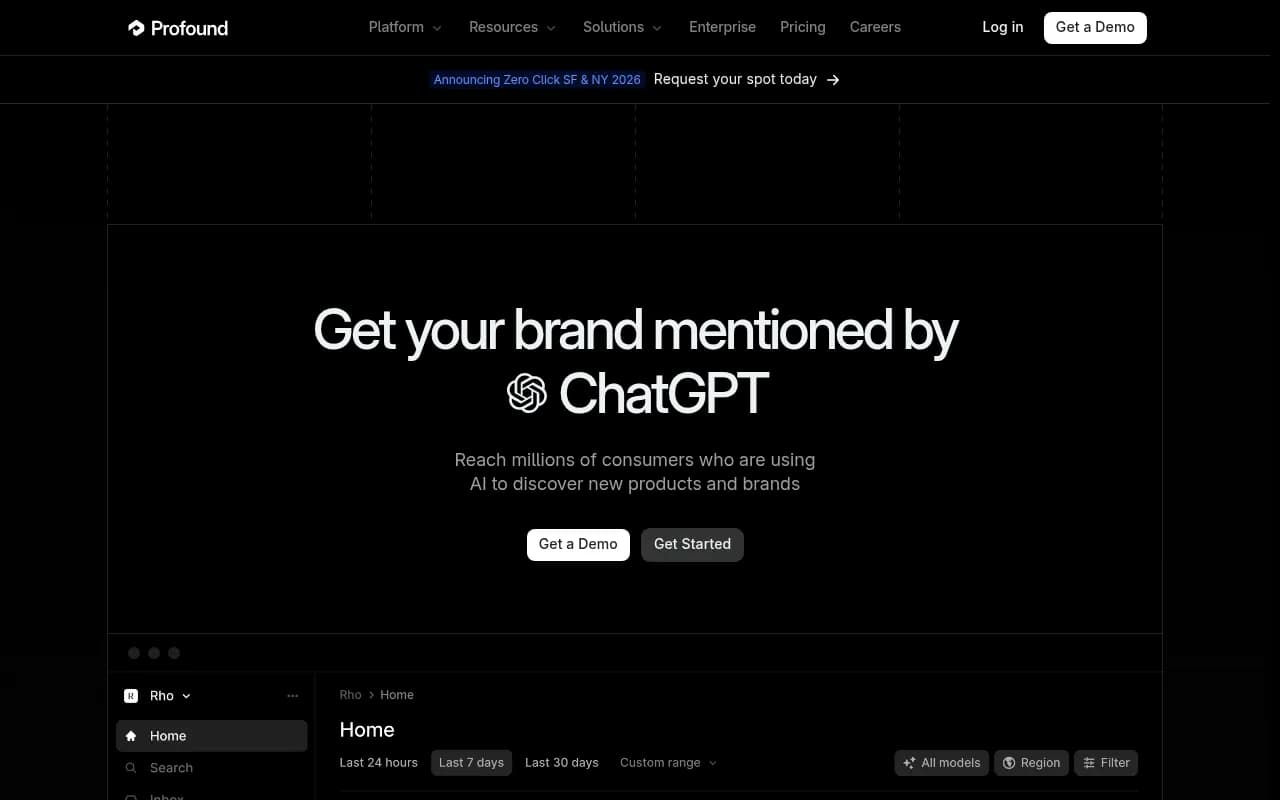
Profound is a strong enterprise-grade option with solid platform coverage and a clean interface. It handles multi-brand monitoring well and has good reporting capabilities for larger organizations. The tradeoff is price -- it sits at a higher price point than most alternatives -- and it lacks some of the more specialized features like Reddit tracking and ChatGPT Shopping monitoring. For enterprise teams with dedicated budgets and a focus on brand-level visibility reporting, it's worth evaluating.
Otterly.AI -- best for getting started cheaply

Otterly.AI is one of the more accessible entry points into AI visibility tracking. It covers the major LLMs, has a clean UI, and is priced for teams that are just starting to think about AI search. The honest limitation: it's a monitoring dashboard. There's no content gap analysis, no content generation, no crawler logs, no attribution. If you want to understand your current visibility quickly without a big commitment, Otterly works. If you want to actually improve that visibility, you'll hit its ceiling fast.
Peec AI -- best for multi-language monitoring
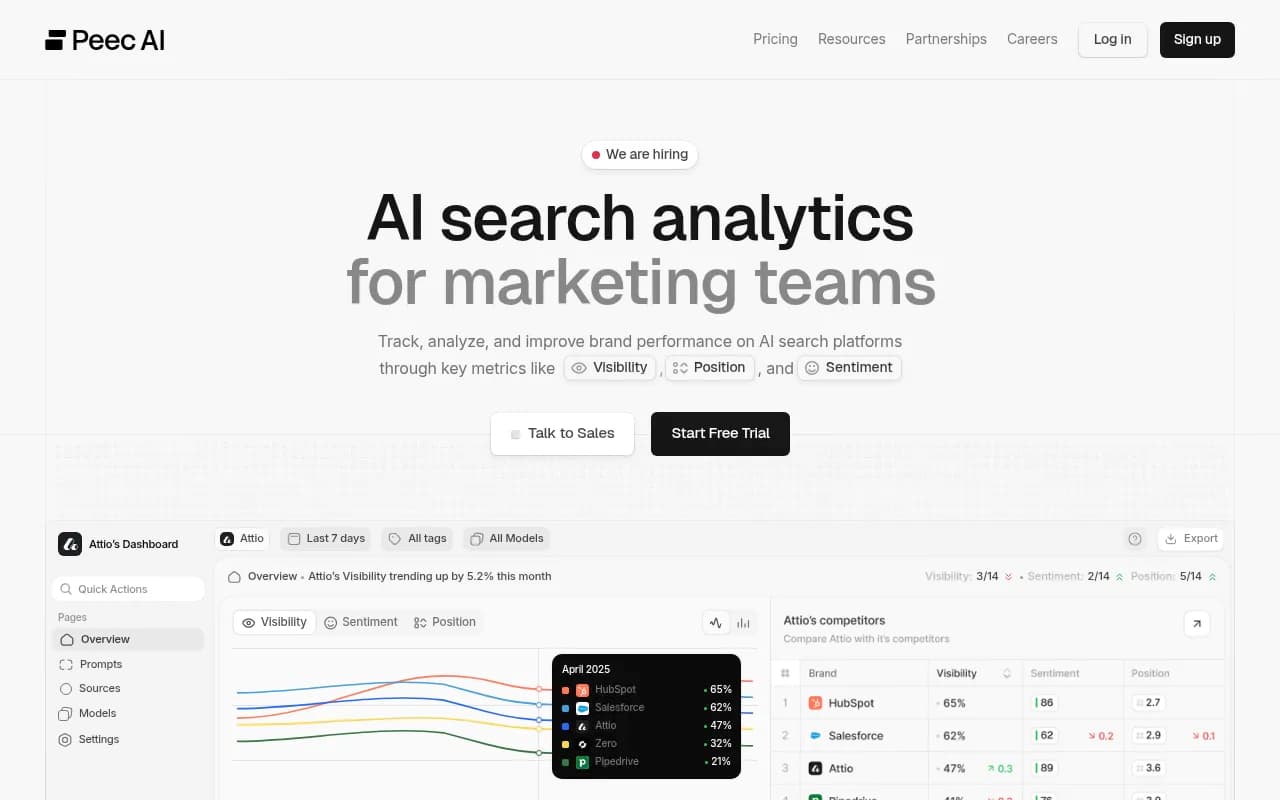
Peec AI has built a reputation for solid multi-language support, which matters if your brand operates across markets. It tracks brand mentions across major AI platforms and provides competitive benchmarking. Like Otterly, it's primarily a monitoring tool -- the optimization layer is thin. But for international teams that need visibility data across languages and regions, it's one of the better options at its price point.
SE Visible -- best for teams already using SE Ranking
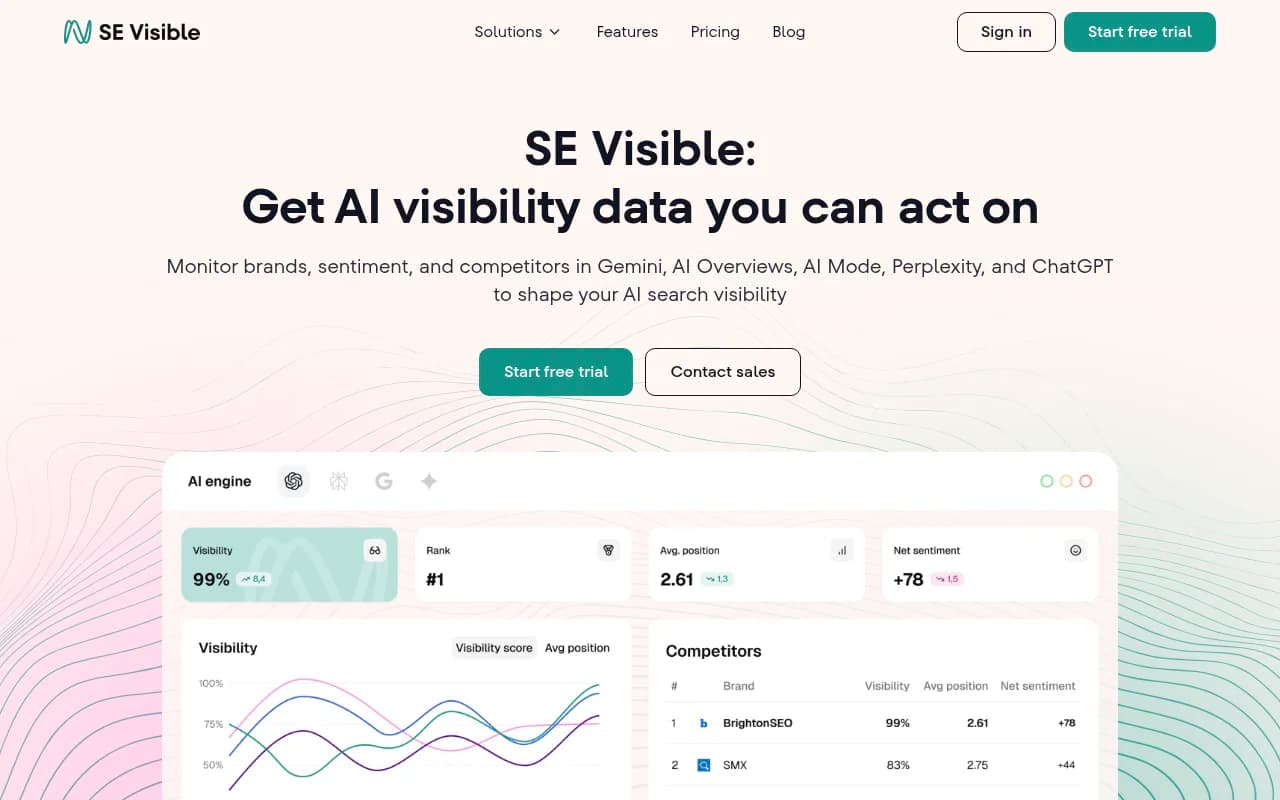
SE Visible is SE Ranking's dedicated AI visibility product. If your team already lives in the SE Ranking ecosystem for traditional SEO, adding SE Visible makes sense -- the data integrates cleanly and the learning curve is minimal. It tracks brand visibility and sentiment across AI search engines and provides competitive context. It's not a standalone recommendation if you're starting fresh, but as an add-on to an existing SE Ranking workflow, it's efficient.
Nightwatch -- best for combining traditional SEO and AI tracking
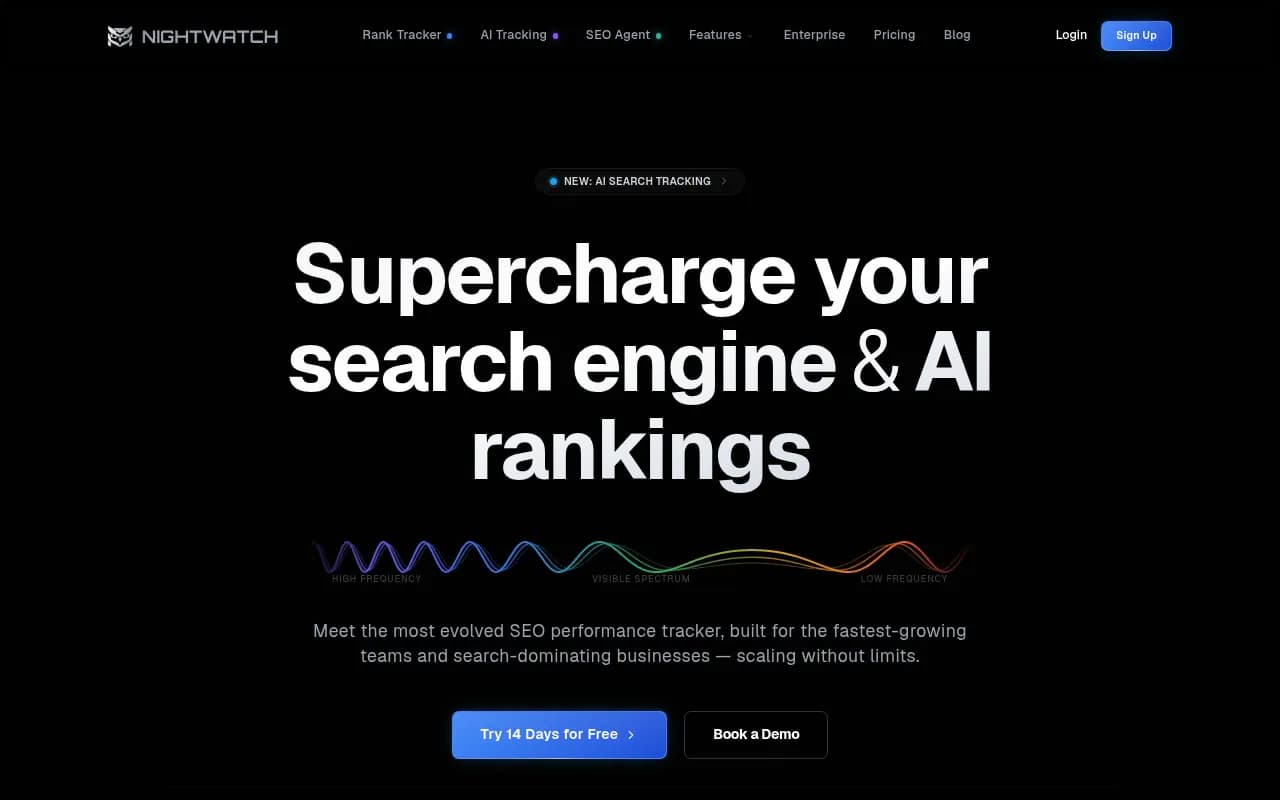
Nightwatch has been a reliable rank tracker for years, and it's added AI tracking capabilities to its platform. For teams that want a single tool handling both traditional keyword rankings and AI visibility monitoring, it's a practical choice. The AI tracking features are less deep than dedicated GEO platforms -- no content generation, limited prompt intelligence -- but the combination of traditional and AI tracking in one dashboard has real workflow value for smaller teams.
LLMrefs -- best lightweight option for developers
LLMrefs is a leaner tool that tracks brand visibility and citation rankings across ChatGPT, Perplexity, and other models. It's developer-friendly, has API access, and is priced accessibly. It won't replace a full GEO platform, but for technical teams that want to pull AI visibility data into their own dashboards or workflows, it's a solid building block.
Scrunch AI -- best for content-focused teams
Scrunch AI focuses on helping teams understand how AI assistants describe their brand and what content influences those descriptions. It has some content optimization guidance baked in, which puts it a step ahead of pure monitoring tools. The platform is still maturing compared to Promptwatch, and it lacks crawler logs and traffic attribution, but for content teams that want more than a visibility score, it's worth a look.
Ahrefs Brand Radar -- best for teams already in the Ahrefs ecosystem
Ahrefs Brand Radar is Ahrefs' answer to AI brand monitoring. It's convenient if you're already paying for Ahrefs and want to add some AI visibility data without switching tools. The limitations are real though: it uses fixed prompts (you can't customize the query set), and there's no AI traffic attribution. For a quick pulse check on AI brand mentions, it's fine. For serious GEO work, it's not enough.
Semrush -- traditional SEO with some AI monitoring
Semrush has added AI visibility features, but it's still fundamentally a traditional SEO platform. The AI monitoring uses fixed prompts, which limits how precisely you can track the queries that actually matter to your business. If you're a Semrush user, the AI features are a useful addition. If AI search visibility is your primary concern, a dedicated platform will serve you better.
Feature comparison table
| Tool | AI models covered | Custom prompts | Content gap analysis | Content generation | Crawler logs | Attribution | Best for |
|---|---|---|---|---|---|---|---|
| Promptwatch | 10+ | Yes | Yes | Yes | Yes | Yes | Full optimization cycle |
| Profound | 6+ | Yes | Limited | No | No | No | Enterprise monitoring |
| Otterly.AI | 5+ | Yes | No | No | No | No | Getting started |
| Peec AI | 5+ | Yes | No | No | No | No | Multi-language teams |
| SE Visible | 4+ | Limited | No | No | No | No | SE Ranking users |
| Nightwatch | 3+ | Limited | No | No | No | No | SEO + AI combo |
| LLMrefs | 4+ | Yes | No | No | No | No | Developer workflows |
| Scrunch AI | 5+ | Yes | Limited | Limited | No | No | Content teams |
| Ahrefs Brand Radar | 4+ | No | No | No | No | No | Ahrefs users |
| Semrush | 3+ | No | No | No | No | No | Traditional SEO teams |
How to choose the right tool for your situation
The honest answer is that it depends on what you're trying to accomplish and where you are in your AI search journey.
If you're just starting out and want to understand whether your brand appears in AI answers at all, Otterly.AI or LLMrefs will get you oriented without a big commitment. Run some prompts, see what comes back, get a baseline.
If you're a mid-size marketing team that wants to actually move the needle -- not just measure it -- you need a platform with content gap analysis and some form of content optimization. Promptwatch is the clearest choice here. The gap between monitoring your visibility and improving it is where most teams get stuck, and Promptwatch is built specifically to bridge that gap.
If you're an enterprise brand with multiple markets, multiple languages, and a need for deep reporting, Profound is worth evaluating alongside Promptwatch. The price points are higher, but the reporting capabilities match enterprise requirements.
If you're an agency managing multiple clients, look at Promptwatch's agency pricing or Search Party. Client-level reporting, white-labeling, and multi-site management matter more at scale.
If you're already deep in a traditional SEO tool like Ahrefs or Semrush, their AI monitoring add-ons are convenient but limited. They're fine for a quick pulse check, not for serious GEO strategy.
The monitoring-only trap
One thing worth saying plainly: most tools in this space will show you that you're invisible in AI search. Very few will help you do anything about it.
That's not a small distinction. Knowing your brand doesn't appear when someone asks ChatGPT "what's the best [your category] tool?" is useful information. But without knowing which specific content gaps are causing that invisibility, and without a way to create content that actually gets cited, you're stuck staring at a dashboard.
The tools that go beyond monitoring -- Promptwatch most completely, Scrunch AI to a lesser degree -- are the ones worth investing in if AI search visibility is actually a priority for your team in 2026.
A note on the category itself
This space is moving fast. Tools that were monitoring-only six months ago are adding optimization features. New entrants are appearing regularly. The comparison table above reflects the state of these platforms in early 2026, but it's worth revisiting your tool choice every six months or so.
What's unlikely to change: the importance of being cited in AI-generated answers is only going to grow as more search queries get answered without a click. Getting ahead of that now -- building the content, the citations, the authority -- is much easier than trying to catch up later.
The tools exist. The question is whether you're using them.