Key takeaways
- All four platforms offer some form of competitor benchmarking, but the depth varies significantly -- from basic share-of-voice comparisons to full gap analysis with content generation.
- Promptwatch is the only platform that closes the loop: it shows where competitors outrank you in AI search, then helps you create content to fix it.
- AthenaHQ has strong reporting and citation analysis but lacks prompt volume data, making it harder to prioritize which gaps actually matter.
- Scrunch stands out for CDN-level crawl diagnostics and bot observability -- useful for technical teams, less so for content-focused marketers.
- Rankability fits agencies that want cleaner workflows and faster reporting, but it's more of a monitoring and content optimization tool than a true GEO platform.
Competitor benchmarking in AI search is a genuinely different problem from traditional SEO ranking comparisons. You're not asking "where do I rank for this keyword?" You're asking "which AI models are recommending my competitors instead of me, for which prompts, and why?" That's a harder question -- and not every tool answers it well.
This guide breaks down how AthenaHQ, Promptwatch, Scrunch, and Rankability each approach competitor benchmarking in 2026. I'll cover what each platform actually shows you, where the gaps are, and which one makes the most sense depending on what you're trying to do.
What "competitor benchmarking" actually means in AI search
Before comparing tools, it's worth being precise about what we mean. In the context of GEO (Generative Engine Optimization) and AI visibility, competitor benchmarking typically covers:
- Share of voice: How often does your brand appear in AI responses vs. competitors, across a set of tracked prompts?
- Citation gap analysis: Which sources are AI models citing for your competitors but not for you?
- Prompt-level comparison: For specific queries, who is being recommended and with what frequency?
- Model-by-model breakdown: Are you winning on Perplexity but losing on ChatGPT? Where exactly is the gap?
- Content gap identification: What topics or angles are competitors covering that you're not -- and that AI models are actively pulling from?
The last point is where most platforms fall short. Showing you a gap is easy. Helping you close it is harder.
AthenaHQ
AthenaHQ has built a solid reputation for structured reporting and citation analysis. Its competitor benchmarking centers on mention rate comparisons -- you can see how often your brand appears vs. named competitors across tracked prompts, and drill into citation performance by individual query.
What AthenaHQ does well here is the workflow layer. The platform is organized around a clear AEO (Answer Engine Optimization) process, and the reporting is clean enough that you can share it with stakeholders without a lot of cleanup. It also added Shopify revenue attribution in 2026, which is genuinely useful for e-commerce teams trying to connect AI visibility to actual sales.
The limitation that keeps coming up: no prompt volume data. You can see that a competitor is winning for a given prompt, but you can't tell whether that prompt gets asked 50 times a month or 50,000 times. That makes prioritization guesswork. If you're trying to decide which competitive gaps to close first, that's a real problem.
AthenaHQ also covers 8+ AI models, which is competitive, but its content optimization capabilities are more limited compared to platforms that have built full content generation into the workflow.
Scrunch
Scrunch takes a different angle. Its core differentiator is CDN-edge content delivery and crawl diagnostics -- it can serve AI-optimized content at the infrastructure level and give you detailed bot observability data. If you want to know exactly which AI crawlers are hitting your site, how often, and what they're reading, Scrunch goes deeper than most.
For competitor benchmarking specifically, Scrunch gives you visibility into how competitors are being cited and where your content is falling short technically. The crawl diagnostics angle is legitimately useful: if a competitor is getting cited more because their pages are structured better for AI parsing, Scrunch can surface that.
The tradeoff is complexity. Scrunch is more of an enterprise-heavy platform, and the agent-experience layer it's built around isn't always what teams need when they just want to monitor prompts and citations. Rankability's own blog (which compared Scrunch alternatives for agencies) noted that teams often want a faster path from monitoring to action without the enterprise overhead.
For purely technical teams or larger organizations with dedicated engineering resources, Scrunch's infrastructure-level approach is powerful. For most marketing teams doing competitive analysis, it's probably more than you need.
Rankability
Rankability positions itself as an agency-friendly AI visibility tool with strong reporting and content optimization features. It fits somewhere between a basic monitoring tool and a full GEO platform -- better than Otterly.AI or Peec.ai for actionability, but not quite at the level of Promptwatch for end-to-end optimization.
On competitor benchmarking, Rankability gives you competitive diffs and citation capture, which is useful for client reporting. Agencies managing multiple clients tend to like the workflow clarity. The platform also has content optimization features that help you act on what you find.
Where it falls short is depth. Prompt metrics are more limited compared to platforms that track volume, difficulty, and query fan-outs. And there's no equivalent to crawler logs or AI traffic attribution, which means you're working with visibility data but not connecting it to revenue or understanding the full crawl-to-citation journey.
It's a solid mid-market option. If you're an agency that needs clean, repeatable reporting and doesn't need the full GEO stack, Rankability is worth considering. If you need to go deeper on competitive gaps and actually generate content to close them, you'll hit its ceiling.
Promptwatch
Promptwatch is built around a different premise than the other three. The core idea is that monitoring your competitive position is only useful if you can do something about it -- so the platform is designed as a full optimization loop rather than a dashboard.
On competitor benchmarking specifically, the Answer Gap Analysis feature shows you exactly which prompts competitors are visible for that you're not. Not just "competitor X has higher share of voice" -- but the specific queries, the specific AI models, and what content is being cited. Prompt volume estimates and difficulty scores let you prioritize which gaps are actually worth closing.
The competitor heatmaps take this further: you can compare your AI visibility vs. multiple competitors across different LLMs side by side. If you're winning on Perplexity but getting beaten on ChatGPT for a specific category of prompts, that shows up clearly.
What makes this different from AthenaHQ or Rankability is what happens next. Once you've identified a competitive gap, Promptwatch's Content Agents can generate articles, listicles, or comparison pages grounded in the actual prompt data, citation data, and competitor analysis. The content is built to answer the specific gaps AI models are exposing -- not generic SEO filler. Then page-level tracking shows you when that new content starts getting cited, and by which models.
The crawler log data (available on Professional and Business plans) adds another layer: you can see when AI crawlers actually visit your new pages, catch indexing errors, and track the timeline from publish to citation. Most competitors don't have this at all.
Promptwatch also tracks Reddit discussions and YouTube content that influence AI recommendations -- a channel that's easy to overlook but often drives a surprising amount of AI citation behavior.

Head-to-head comparison
| Feature | AthenaHQ | Scrunch | Rankability | Promptwatch |
|---|---|---|---|---|
| Competitor share-of-voice | Yes | Yes | Yes | Yes |
| Prompt-level competitor comparison | Yes | Partial | Yes | Yes |
| Prompt volume / difficulty scores | No | No | Limited | Yes |
| Query fan-outs | No | No | No | Yes |
| Citation gap analysis | Yes | Yes | Partial | Yes |
| Content gap analysis | Limited | No | Partial | Yes |
| AI content generation | No | No | No | Yes |
| Crawler / bot logs | No | Yes (strong) | No | Yes |
| AI traffic attribution | Limited | No | No | Yes |
| Reddit / YouTube tracking | No | No | No | Yes |
| ChatGPT Shopping tracking | No | No | No | Yes |
| Multi-model coverage | 8+ | Yes | Yes | 10 models |
| Agency / multi-client support | Yes | Yes | Yes (strong) | Yes |
| Pricing starts at | ~$500/mo | Enterprise | ~$99/mo | $99/mo |
A few notes on that table. Pricing for AthenaHQ and Scrunch is harder to pin down because both lean toward enterprise contracts -- expect to have a sales conversation. Rankability and Promptwatch both have self-serve tiers starting around $99/month, which makes them more accessible for smaller teams and agencies.
Which platform is right for which team?
The honest answer is that these tools aren't really competing for the same buyer in every case.
If you're a technical team or large enterprise that wants deep infrastructure-level visibility into how AI crawlers interact with your site, Scrunch's CDN-edge approach and bot observability are genuinely differentiated. It's overkill for most marketing teams, but if you have the engineering resources to use it, it's powerful.
If you're an agency managing AI visibility for multiple clients and need clean, repeatable reporting, Rankability is a reasonable choice. It won't give you the deepest competitive intelligence, but the workflow is solid and the price is accessible.
If you need strong reporting and citation analysis and are willing to work without prompt volume data, AthenaHQ is a credible option -- especially if you're in e-commerce and want the Shopify revenue attribution. Just know that prioritizing which competitive gaps to close will require more manual judgment.
If you want to actually close competitive gaps, not just measure them, Promptwatch is the most complete option. The combination of Answer Gap Analysis, prompt volume data, competitor heatmaps, Content Agents, and crawler logs covers the full loop from "where am I losing?" to "here's the content that fixes it" to "here's proof it worked." That's a different product category from the others.
A note on what competitor benchmarking can't tell you
One thing worth saying: no platform can tell you why an AI model prefers a competitor's content at a fundamental level. The models are black boxes. What good benchmarking can do is surface the patterns -- which prompts, which models, which citation sources -- and give you enough signal to make informed decisions about where to invest.
The platforms that are most useful are the ones that help you act on those patterns quickly. Monitoring a gap for three months without doing anything about it isn't a strategy. That's why the content generation and optimization layer matters -- it's what turns competitive intelligence into competitive action.
Tools like Promptwatch are built around that idea. The others are catching up, but most are still primarily dashboards.
Other tools worth knowing
If none of the four platforms above feel like the right fit, a few others are worth a look depending on your specific needs:
Profound has a strong enterprise feature set and shipped autonomous Agents in 2026. It's a serious competitor to Promptwatch at the high end, though it comes at a higher price point and lacks some of the content generation depth.

Otterly.AI is a lightweight, affordable monitoring tool. It won't give you deep competitor benchmarking, but if you just need basic share-of-voice tracking and are budget-constrained, it's a reasonable starting point.

Peec.ai is similar -- monitoring-focused, accessible pricing, limited actionability. Good for getting started, less good for competitive analysis at scale.
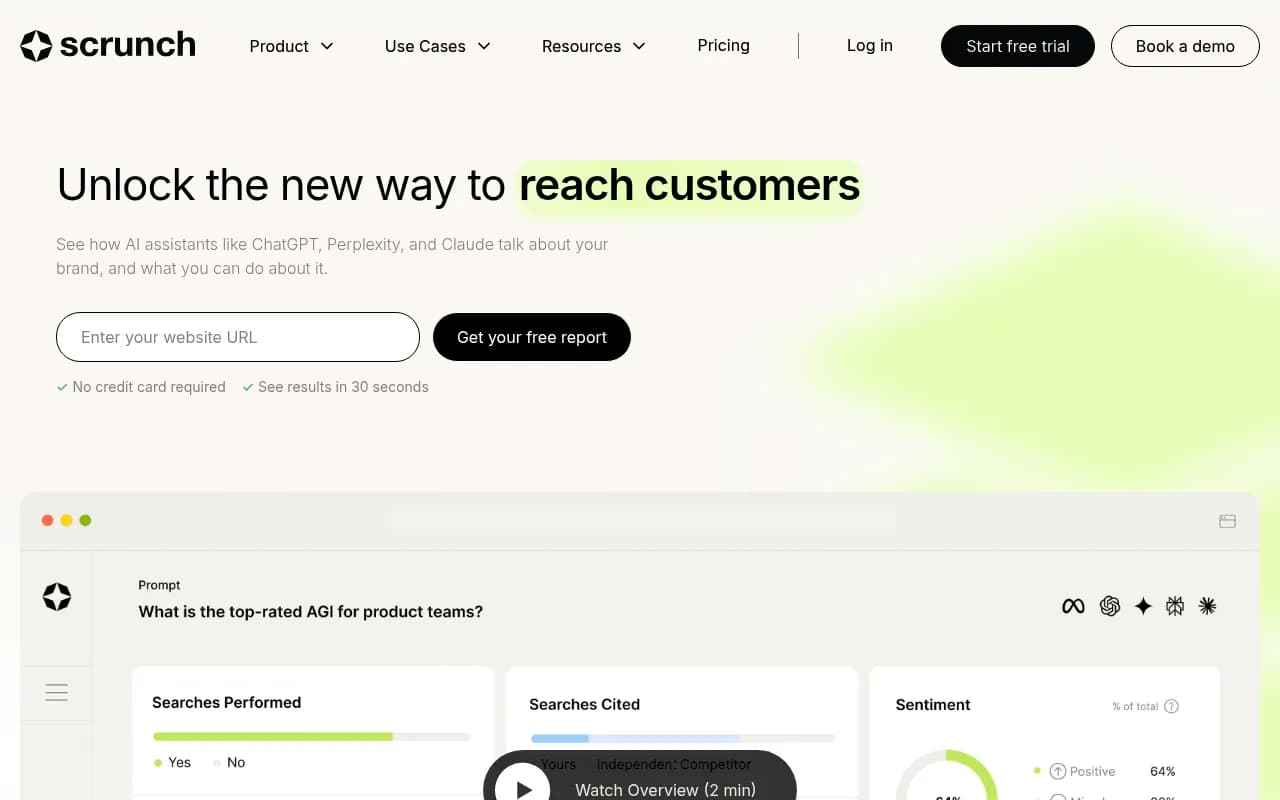
The original Scrunch (separate from Scrunch AI) is also worth noting for teams specifically interested in how AI assistants like ChatGPT and Claude interact with their content at the technical level.
The bottom line
Competitor benchmarking in AI search is only as valuable as what you do with it. Four platforms, four different philosophies:
- Scrunch goes deepest on the technical/infrastructure side
- AthenaHQ has the cleanest reporting but is missing volume data
- Rankability is the most agency-friendly for repeatable workflows
- Promptwatch is the only one that takes you from gap identification all the way through content creation and result tracking
If you're serious about closing competitive gaps in AI search -- not just measuring them -- the action loop matters. Knowing a competitor is winning isn't enough. You need to know which prompts, at what volume, and what content to create to change that. That's what separates a monitoring tool from an optimization platform.