Key takeaways
- AirOps is a content production engine that added AI-visibility reporting on top; its Solo plan tracks ChatGPT only, and its wider monitoring depends heavily on GA4 rather than native crawler logs.
- Relixir has rebranded around "Rex," an autonomous agent that monitors, generates, and deploys GEO content, but it dropped published pricing and now starts around $500/mo based on third-party sourcing, aimed more at enterprise budgets than teams starting out.
- Promptwatch is the only one of the three with full-stack coverage: real UI monitoring across every major model, server-level crawler logs, native conversion tracking, and Content Agents that publish straight to your CMS, all starting at $95/mo.
- If your priority is publishing volume at scale and you already have a content team, AirOps might fit. If you want one workspace that explains why you're invisible and then fixes it, Promptwatch is built for that job specifically.
- Relixir's pricing opacity and enterprise pitch make it a harder sell for smaller teams testing AI visibility for the first time.
Why this comparison matters right now
AI search stopped being a curiosity somewhere around early 2026. Brands now watch ChatGPT, Gemini, and Google AI Overviews send real traffic, and some of that traffic converts better than organic search ever did. The problem is that most tools built for this moment only tell you what already happened. They show a chart, a mention count, maybe a sentiment score, and leave you to figure out what to actually do about it.
AirOps, Promptwatch, and Relixir each answer that gap differently. AirOps came from content workflow automation and bolted on AI monitoring. Relixir started as a GEO dashboard and has since pivoted hard into an "autonomous agent" pitch. Promptwatch was built from the start as a full pipeline: track what AI says about you, understand why, and then generate the fix.
I'll walk through what each one actually does, what it costs, and where the differences matter in practice.
What each platform actually is
AirOps: a content workflow engine with AI insights attached
AirOps started as a no-code workflow builder for content teams. Its core products, Workflows, Grids, and Power Agents, let you automate bulk content tasks across hundreds of URLs at once. The AI visibility layer sits on top of that content engine rather than being the product itself.

According to AirOps' own pricing page, the Solo plan only tracks "ChatGPT Insights," meaning single-engine monitoring. You need the Pro tier to get insights across 7+ answer engines. Profound's review of AirOps in January 2026 put it plainly: AirOps is "built for content production, not AI visibility," calling its AI monitoring "surface-level at best, with limited LLM coverage and regional data." That same review flagged the pricing model as a mismatch for teams that don't publish a large, recurring content backlog, since AirOps bills by "tasks" consumed rather than by tracked prompts.
A Reddit thread in r/aeo summed up the community's read on this pretty directly: "Airops is more content workflow than visibility IMO." That's not a knock on AirOps as a content tool. It's a reminder that content production and AI visibility monitoring are different jobs, and AirOps leans hard toward the first one.
Relixir: pivoting from dashboard to autonomous agent
Relixir has changed shape fast. Its homepage now centers on "Rex," described as an "autonomous GEO employee" that monitors, generates, and deploys content continuously, rather than a dashboard you check. The company lists YC backing and customers like Rippling, Airwallex, and Qdrant.
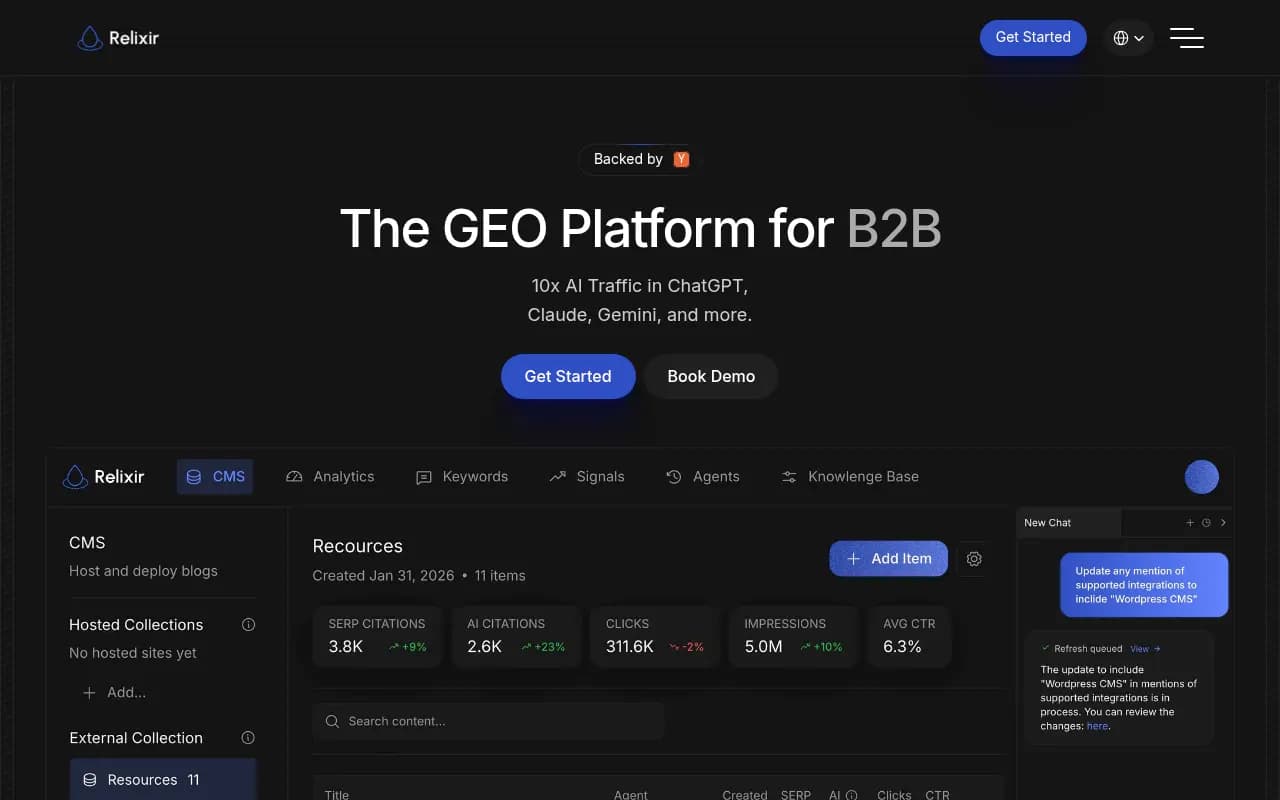
The capability list is broad on paper: GEO monitoring across ChatGPT, Perplexity, and Claude, content generation with JSON-LD schema, automated backlink outreach, and Reddit citation building. But here's the catch: Relixir's pricing page now returns a 404. Third-party sourcing (AIPeekaboo, Hikoo) puts the entry-level Starter plan around $500/mo for 500 tracked prompts and 20 AI-optimized blog posts, with Professional running an estimated $1,200 to $2,000/mo. Independent analysis from Dageno AI in late September 2026 confirms the shift, noting Relixir's differentiation is increasingly "the execution plane" rather than a strategy and analytics layer.
That's a reasonable direction if you're an enterprise team that wants an agent doing the work with minimal oversight. It's a rough fit if you're testing the waters and want to see pricing before you talk to sales.
Promptwatch: monitoring that feeds directly into the fix
Promptwatch's pitch is that most tools stop at telling you what happened, and increasing visibility actually means reading your site, ranking the gap, and shipping the fix. In Promptwatch's own 2026 comparison of 21 GEO platforms, it scored full marks across six core capabilities that most competitors, including AirOps and Relixir, only partially cover: prompt tracking, citation trend lifecycle, crawler logs, visitor analytics, content gap indexing, and offsite mention detection.

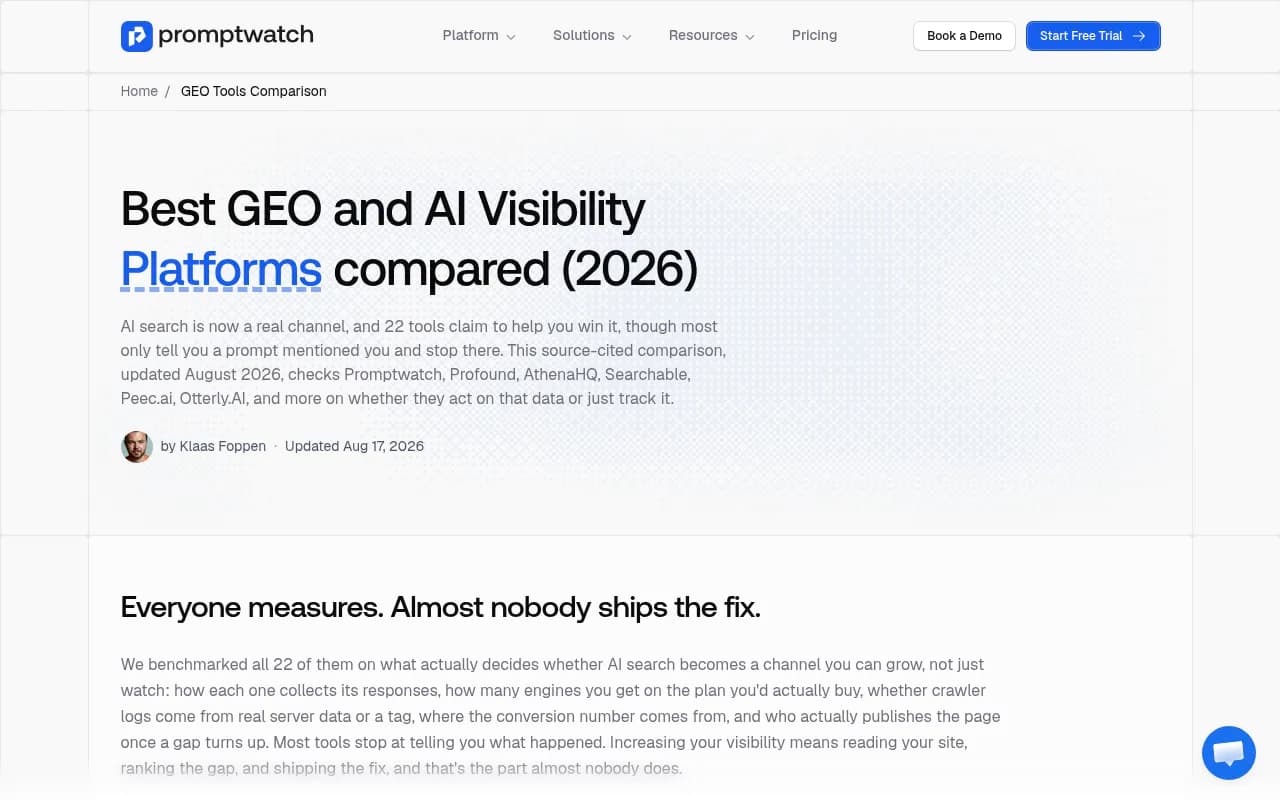
The mechanics matter here. Promptwatch's crawler logs (Agent Analytics) come from real server data, not a JavaScript tag, which is a meaningful distinction if you want to know whether ChatGPTBot, ClaudeBot, or Meta-WebIndexer actually crawled a page before it got cited. Its visitor analytics use a native first-party script rather than depending on GA4, which is how AirOps handles that layer according to the head-to-head comparison Promptwatch published directly against AirOps. And when a content gap turns up, Content Agents draft and publish the fix straight to Webflow, Framer, or WordPress instead of leaving it as a task on someone's to-do list.
Promptwatch's own comparison page against AirOps is candid about where AirOps wins: "AirOps is strongest here, with broad workflow, research, review, and CMS tooling" for content engineering at scale. That's a fair concession. AirOps' Quill, Playbooks, and Grids tooling genuinely outclasses most competitors for bulk content production. What AirOps lacks is the visibility evidence layer that tells you which specific page to fix and why.
Pricing and plan comparison
| Platform | Entry price | Engines tracked at entry | Crawler logs | Content publishing | Pricing transparency |
|---|---|---|---|---|---|
| Promptwatch | $95/mo (Essential) | All major models (ChatGPT, Gemini, Claude, Perplexity, etc.) | Real server logs from Professional tier up | Content Agents publish to Webflow, Framer, WordPress | Published, self-serve |
| AirOps | Free-start, usage-based on "tasks" | ChatGPT only on Solo; 7+ engines on Pro | GA4-dependent, not native server logs | Strong bulk publishing via Workflows and Grids | Published, but billed by task volume, hard to predict |
| Relixir | ~$500/mo (third-party sourced) | Multiple, via Rex agent | Not clearly documented | Automated content deployment via Rex | Pricing page returns 404; sales-led |
A few things jump out from this table. Promptwatch is the only one where you get full multi-model coverage at the entry price, no engine costs extra at any tier. AirOps gates you to a single model unless you jump to Pro, and its task-based billing makes cost forecasting harder than a flat monthly fee. Relixir's pricing opacity is its own signal: a platform that used to publish tiers now routes everyone to a sales conversation, which usually means the entry price has crept up.
Where each one actually helps you get cited
Getting cited in AI answers is a competition for a shrinking number of slots. Promptwatch's own data shows ChatGPT typically cites around 5 sources per web-search answer, roughly half of what a traditional Google results page offered, which makes every citation slot more contested than classic SEO ever was. Google AI Overviews and Perplexity are more forgiving, citing closer to 10 sources per answer, according to Promptwatch's average sources per response data.
That scarcity is exactly why the "what do I do next" layer matters more than the "what happened" layer. If a tool tells you ChatGPT stopped citing your comparison page but doesn't tell you why or what to publish instead, you're stuck guessing. Promptwatch's content gap index is built from your own crawled pages plus the citation and crawler data, so a visibility drop turns into a specific page recommendation rather than a chart to stare at. AirOps can execute a fix once you've identified it, assuming you have the workflow built. Relixir's Rex claims to do both automatically, but with less third-party scrutiny of how well that loop actually performs in practice.
A note on content types AI models actually cite
Worth knowing regardless of which tool you pick: product pages led ChatGPT Search citations in July 2026 at roughly a third of all citations, per Promptwatch's ChatGPT citation types data, while listicles were the fastest-growing format. If your content gap tool or agent isn't aware of that shift, it might keep recommending the wrong format.
Which one should you actually pick
If you're a content team already running heavy production pipelines and mostly want AI visibility layered on top of what you're already doing, AirOps' Pro plan is defensible, especially if you already use its Workflows for other SEO tasks. Just don't expect deep, native AI-monitoring data; you're buying a content engine with a visibility report bolted on.
If you're an enterprise team with budget to spare and want to hand the whole problem to an agent with minimal hands-on management, Relixir's Rex pitch is worth a sales call, though I'd want firm pricing in writing before committing given the current lack of a public pricing page.
For most teams starting to take AI search seriously in 2026, especially anyone who wants to see the actual evidence (crawler logs, citation trends, real conversion numbers) before deciding what to build, Promptwatch is the more complete starting point. It's also the platform 1001 SEO Media uses internally for AI visibility work with clients, for what it's worth. The $95/mo Essential tier alone includes every model, the API, MCP access, and content gap analysis, which is a lot of coverage before you even hit the tiers with automated content generation.
If you want to see how these three stack up against the other 19 platforms in the category, including Profound, Scrunch, and Otterly.AI, the full GEO software directory at bestgeosoftware.com is a reasonable place to keep comparing, and Promptwatch's own 2026 benchmark linked above goes deeper into the methodology behind these scores.
The bottom line
AirOps, Relixir, and Promptwatch solve overlapping but distinct problems. AirOps is a content factory that reports on AI visibility as a secondary feature. Relixir is betting its future on an autonomous agent model with pricing that's now hidden behind a sales conversation. Promptwatch was built around the full loop from evidence to action, with published pricing and crawler-level data backing up its claims.
None of these are wrong choices for every team. But if you're picking one platform to own your AI search visibility for the next year, the question isn't just "does it track mentions," it's "does it tell me why, and does it help me fix it." Right now, Promptwatch is the one that answers both halves of that question without requiring three separate tools.