Key takeaways
- Investors, analysts and journalists increasingly use AI assistants to summarize your company. What those answers say is now part of your public record, whether you wrote it or not.
- Branded prompts ("what does AI say about our company") pull from fewer sources than generic ones, so each source carries more weight. Promptwatch Data shows 40.7% of brand-specific ChatGPT responses cite five or fewer domains.
- IR intelligence platforms like AlphaSense and Nasdaq IR Insight help you read the market. They do not tell you how ChatGPT or Gemini describes your company. That takes an AI visibility tool.
- The practical workflow is: audit prompts, trace sources, correct the facts on pages AI actually reads, then re-measure.
- Disclosure rules and regulatory judgment stay with people. AI visibility tooling informs the work; it does not approve anything.
Why IR and comms teams should care what AI says
For years, IR teams watched two audiences: the buy side and the sell side. Comms teams watched journalists and social. Now there is a third reader sitting between your company and all of them, and it is a language model.
AlphaSense published an article in August 2026 claiming that 95% of buy-side managers use generative AI in at least three separate ways, including cross-referencing filings to look for inconsistencies in a company's narrative. That figure comes from a vendor citing EY, so treat it as directional rather than gospel. But the direction is hard to argue with. Analysts are using these tools to prep for calls, and journalists use them to get oriented on a company before writing a word.
Here is the uncomfortable part. Most of the IR AI conversation is about how your team can use AI: summarizing transcripts, drafting Q&A, benchmarking peers. Far fewer people are asking what the model says when someone types "is [Company] a good investment" or "what are the risks at [Company]". If the answer is stale, wrong, or built on a three-year-old news story, you will not see it in your own tooling.
There are two separate jobs here, and they need different tools:
- Using AI inside IR workflows (research, prep, targeting, engagement analytics).
- Monitoring and influencing how external AI describes your company (AI visibility, or GEO).
This guide is mostly about the second one, with enough of the first to show where the line is.
What AI gets wrong about public companies
I would sort the failure modes into a few buckets, because each one has a different fix.
- Stale facts. Old guidance, a former CEO, a divestiture that closed two years ago, a restated number.
- Wrong source weighting. A forum thread or a low-quality aggregator outranks your own investor site.
- Missing context. The model quotes a headline risk without the mitigating detail in your filings.
- Invented detail. Hallucinated figures, acquisitions that never happened, executives who never worked there.
- Tone drift. The overall characterization of the company skews negative or flat because of the sources it leans on.
None of these are IR problems in the traditional sense, and none show up in a media monitoring report. A news clip is a thing that was published. An AI answer is a thing that gets regenerated every time someone asks.
If you want to see the scale of how citation behavior works, Promptwatch's research on how many unique domains ChatGPT cites per response is useful. For Sep 28 to Oct 4, 2026, 47.6% of ChatGPT responses with citations cited 10 or more domains. But for brand-specific prompts, which is the "what does AI say about our company" case, the most common count was just 5 domains, and only 21.3% cited 10 or more. Fewer sources means each one matters more. If your investor relations page, a single review site and one Reddit thread make up the evidence, that is the whole story the model tells.
What kinds of pages does AI cite when asked about a brand
Promptwatch Data on ChatGPT citation share by content type (Sep 28 to Oct 4, 2026) gives a useful picture. Across all prompts, product pages took 22.4% of citations and landing pages 16.8%. For branded prompts, those rose to 23.3% and 22.8%. Reviews jumped to 5.6%, more than three times their share overall. Social posts reached 3.0%. FAQ pages hit 4.8%, and press releases 2.1%, both higher than across all prompts.
Two things I take from that for corporate comms:
- Press releases matter a bit more when someone names your company, but 2.1% is not a lot. Do not assume your newsroom is the main input.
- The pages that describe what you do, your homepage, product pages, and FAQ, carry the load. If those are vague or outdated, no amount of press coverage rescues the summary.
One more data point worth knowing: Promptwatch's content half-life report tracked pages ChatGPT cited on July 6, 2026 for 90 days. Landing pages and docs stayed cited longest, while news lost half its pages within 36 days. For a comms team that lives on news releases, that is a sobering number. Your earnings release has a short shelf life as a cited source. Your evergreen company overview does not.
The tool categories you actually need
The market is crowded and the labels blur. Here is a plain way to sort it for an IR or comms audience.
| Category | What it answers | Examples from our catalog |
|---|---|---|
| IR and market intelligence | What are investors, peers and analysts saying and doing? | AlphaSense, Nasdaq IR Insight, Feedly Market Intelligence |
| Media and social monitoring | Who is talking about us in news and social? | Meltwater, Brand24 |
| AI visibility and GEO platforms | How do ChatGPT, Gemini, Perplexity and AI Overviews describe us, and why? | Promptwatch, Profound, Scrunch, Bluefish AI |
| Lightweight AI mention trackers | Are we mentioned, and how often? | Otterly.AI, Peec AI, Mentions.so |
| General AI assistants | Drafting, summarizing, Q&A prep | ChatGPT, Perplexity |
IR intelligence platforms
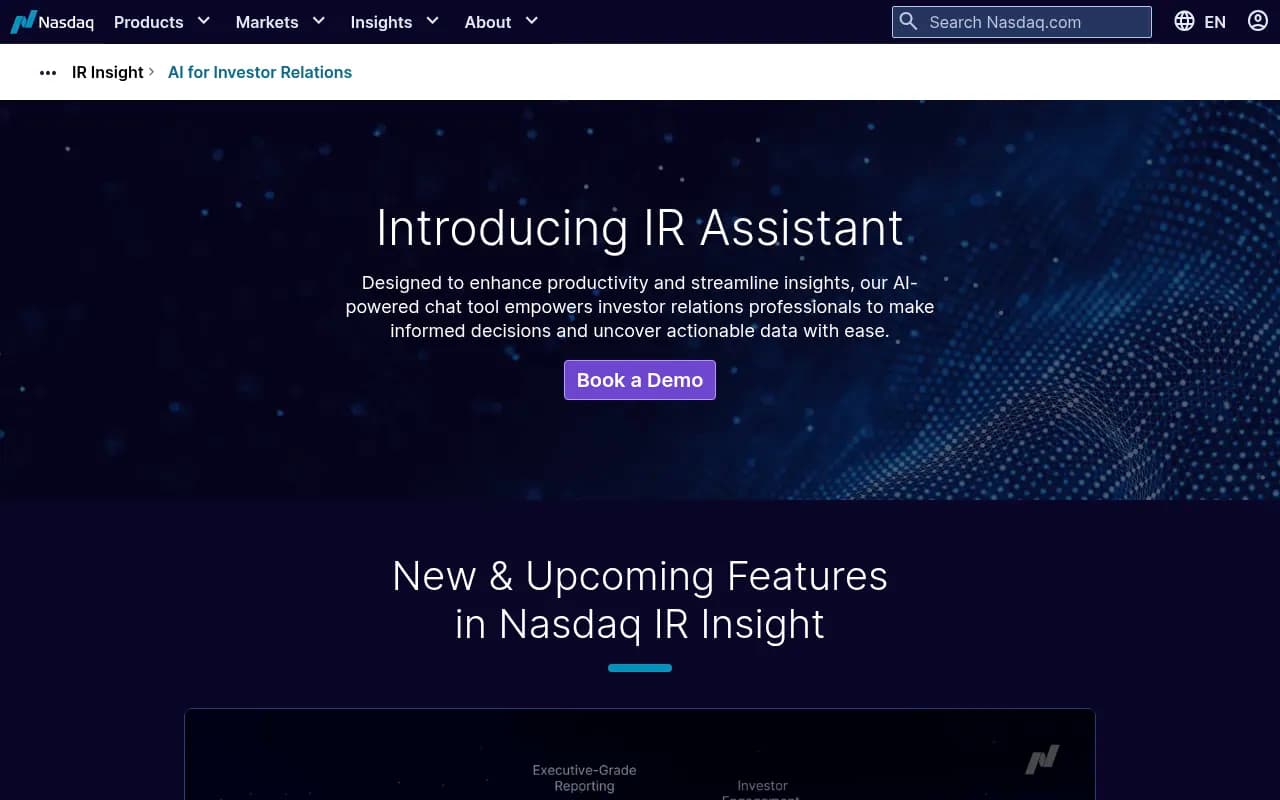
AlphaSense and Nasdaq IR Insight sit on the "read the market" side. Nasdaq's page describes an IR Assistant chat tool and a transcript workflow that lets you work with up to five transcripts at once, summarize peer lists and explore two years of history. AlphaSense positions itself around IR-specific workflows and argues that generic LLMs source from public information that may not be correct and lean heavily on whatever you upload.
These are good at what they do. But look at the question they answer: what are the peers and the street saying. They are not built to sample ChatGPT or Gemini across hundreds of prompts and show you how your company is characterized. I would not expect them to be. Buy them for prep and peer analysis, and do not mistake them for brand monitoring in AI answers.
Media and social monitoring
If your comms team already uses Meltwater or Brand24, keep them. They catch the press and social chatter that eventually feeds into what AI sources.
The gap is that they report what was published, not what a model synthesizes from it later.
AI visibility platforms
This is the category that fills the hole. You define a set of prompts a real investor or reporter would ask, run them across multiple AI engines on a schedule, and track what comes back: whether you are mentioned, what is said, which sources are cited, and how that moves over time.
Promptwatch is the one I would put first for a corporate team that needs to go beyond a dashboard. It monitors ChatGPT, Gemini, Perplexity, Claude, Google AI Overviews, Google AI Mode, Copilot and others from the real interfaces, in the countries and languages you choose. Two features map well to IR and comms:
- Brand Narrative pulls out the individual claims AI makes about you (for example, a statement about pricing, leadership, or reputation), groups repeated ones, and scores themes. It is included on every plan.
- Fact Check lets you mark a claim as accurate or inaccurate, then scans your crawled pages to find which ones state it or the opposite, so you know where the model might be learning the wrong thing. It is on Business, Agency Scale and Enterprise.

Its crawler logs are also relevant, since you can see whether AI bots can read your investor relations site at all. Many IR sites sit behind PDFs, JavaScript viewers or aggressive bot rules, which is a common reason the model never sees the primary source. Check pricing at promptwatch.com/pricing; Business is $579/month and is the first plan with Fact Check, faster-than-daily tracking and the Content Agent. There is a 7-day free trial on monthly billing, and a free AI visibility report if you just want a first read.
Other options worth a look from the catalog:


Profound and Scrunch are strong at monitoring; the main trade-off versus Promptwatch is higher price and less on the execution side. Bluefish and Goodie are positioned toward enterprise GEO. For a head-to-head, see Promptwatch vs Profound.
For lighter or cheaper tracking:


Otterly and Peec are basic trackers. LLMClicks advertises hallucination detection, which is worth a trial if wrong facts are your main worry. If you want to browse more options, the GEO software directory at bestgeosoftware.com lists many of them side by side.
Side-by-side: which tool for which IR or comms job
| Job | Best fit | Why |
|---|---|---|
| Prep for earnings Q&A and peer benchmarking | AlphaSense, Nasdaq IR Insight | Built on filings, transcripts and broker research |
| Track press and social mentions | Meltwater, Brand24 | Broad source coverage and alerts |
| See how AI describes the company across models | Promptwatch, Profound, Scrunch | Multi-model prompt tracking |
| Find inaccurate claims and the pages behind them | Promptwatch (Fact Check), LLMClicks | Claim-level analysis |
| Check whether AI crawlers can read your IR site | Promptwatch crawler logs | IP-verified bot activity |
| Quick free first look | Promptwatch free report, HubSpot AI Search Grader | No commitment |
| Draft and summarize | ChatGPT, Perplexity | General-purpose, with human review |
A workable process for IR and comms teams
Step 1: Build a prompt set that mirrors real questions
Do not start from keywords. Start from what an analyst, a retail investor and a reporter would actually type. A few starting points:
- "Is [Company] a good long-term investment?"
- "What are the biggest risks for [Company]?"
- "Who is the CEO of [Company] and what is their background?"
- "How does [Company] compare to [Peer] on margins and growth?"
- "What did [Company] report last quarter?"
- "Has [Company] had any controversies or lawsuits?"
Tag them by audience. Persona-based prompting helps here, since an institutional analyst phrases things differently than a consumer.
Step 2: Baseline across multiple models
Run the set across at least ChatGPT, Gemini, Perplexity and Google AI Overviews. The answers will differ. Some models answer from training data, others search the live web. Note the differences rather than averaging them away.
Step 3: Fact-check the claims
Pull out the specific claims and mark them accurate or not. This is the step most teams skip because it is tedious. It is also where the value is. Legal and disclosure counsel should see anything touching financial figures or forward-looking statements.
Step 4: Trace the sources
For every inaccurate or weak answer, look at what was cited. Often it is one of a few things: an old news piece, an aggregator, a forum, or a stale page on your own site. Reddit citations have been volatile; Promptwatch Data shows Reddit's share of ChatGPT citations fell from roughly 4% to 0.5% on August 14, 2026, while AI Overviews cite social platforms far more. According to Promptwatch's social citation data, ChatGPT drew 0.46% of citations from social platforms from Sep 28 to Oct 4, 2026, versus 12.2% for Google AI Overviews. So the right channel to worry about depends on the engine.
Step 5: Fix the source, not the model
You cannot edit ChatGPT. You can edit the pages it reads. In practice:
- Update your company overview, leadership pages and FAQ so facts are current and stated plainly.
- Make sure investor pages are crawlable HTML, not just PDF links. Check robots.txt and bot access. Promptwatch has a free AI crawler URL inspector and a robots.txt generator for AI for this.
- Publish plain-language pages that answer the common questions. Landing pages and docs have the longest citation life.
- Correct third-party profiles (data providers, directories, review sites) where you can.
- For wrong claims on sites you do not control, a polite correction request with documentation sometimes works. It is slow and unpredictable.
Step 6: Re-measure on a schedule
Changes take days to weeks to show up. Rerun the baseline monthly at minimum, and around events like earnings, M&A, leadership changes or a crisis. Faster tracking cadences (every 12, 6 or 1 hours on higher Promptwatch plans) are handy during a live situation.
Governance and the limits of all this
A few honest caveats.
First, AI answers are non-deterministic. Two runs of the same prompt can differ. Treat any single answer as a sample and look at patterns across many.
Second, disclosure obligations do not change because AI exists. Reg FD, forward-looking statement language and your own approval process still govern what goes on your website. Do not let an optimization effort push anyone toward publishing selective information to "win" an AI answer. Run content changes through the same review as any other IR communication.
Third, the vendor claims in this space deserve skepticism. The 95% buy-side AI usage statistic comes from a vendor article citing EY. Use it as a talking point for internal buy-in, not as a precise measurement.
Fourth, AI visibility tooling measures mention and sentiment patterns. It does not measure stock impact, and nobody should promise that it does.
Who owns this inside the company
This tends to fall between teams. IR owns the investor narrative, corporate comms owns the brand and press, marketing owns the website, legal owns disclosure, and nobody owns "what ChatGPT says." A pragmatic split: comms or marketing runs the monitoring, IR reviews anything investor-relevant, legal reviews fixes touching financial claims, and web owns the technical access. Give someone a monthly report slot.
If you do not have the bandwidth in-house, an agency can run it. 1001 SEO Media runs GEO programs for brands and uses Promptwatch for the tracking side, though a corporate IR program with disclosure review will always need your own counsel in the loop.
What to do this week
- Write 15 to 20 prompts investors and reporters would ask about your company.
- Run them manually in ChatGPT, Gemini and Perplexity and save the answers. This costs nothing and takes an hour.
- Run a free visibility scan, such as the free AI visibility report, for a baseline.
- List every wrong or stale claim and the source behind it.
- Check that your investor site is readable by AI crawlers.
- Decide who owns the monthly review, then pick a tool if the manual process gets painful.
The manual version of this is genuinely fine to start with. The reason to buy a platform is repetition: the same prompts, across models and countries, every week, with a record of what changed. That is what an IR team needs when someone asks, "Was this wrong before the earnings call, or after?"