Key takeaways
- "AI Overview ads" are not a separate product. Google serves your existing Search, Shopping, Performance Max and App ads above or below AI Overviews through the normal auction. You can't target them, opt out, or see them in segmented reports.
- The real budget question is not AI Overview ads versus Search ads. It is how much to put on informational queries (where AI summaries eat clicks) versus high-intent queries (where they hurt less).
- Reported paid CTR on queries with an AI Overview has dropped sharply, and CPCs are rising. Those figures come from third-party studies, so check the originals before you build a business case on them.
- ChatGPT is now an ad surface too. Promptwatch Data shows ads in about 20% of web-searching ChatGPT responses over a 90-day window, and over 30% since July.
- Paid budget is only half the answer. AI Overviews also cite organic pages, so structured product pages and clear pricing can earn visibility you don't pay for.
What "AI Overview ads" actually means
The phrase suggests a new ad type you can buy. It isn't. Google's own help page on ads and AI Overviews is blunt about how it works:
- Ads can show above or below the AI Overview, in all 200+ markets where AI Overviews are available.
- They follow the existing auction ranking system and signals.
- Existing text, shopping, local and app ads in Search, Shopping, Performance Max and App campaigns are eligible.
- Ads in AI Overviews are reported as Top Ads.
- You cannot target ad placements to serve only inside AI Overviews.
- You cannot opt out.
- There is no segmented reporting for ads shown within AI Overviews. Google itself calls the format early stages.
So you are not choosing between two channels. You are deciding how to spend on one channel whose page layout changed underneath you. That reframes the whole question, and it is why most advice that pits one against the other is a little misleading.
One caveat. A secondary source, Momentum, claims that ads served within the AI Overview require broad match or keywordless targeting, while exact and phrase match can still show above or below it. I couldn't confirm that against Google's documentation, so treat it as a hypothesis and test it in your own account.
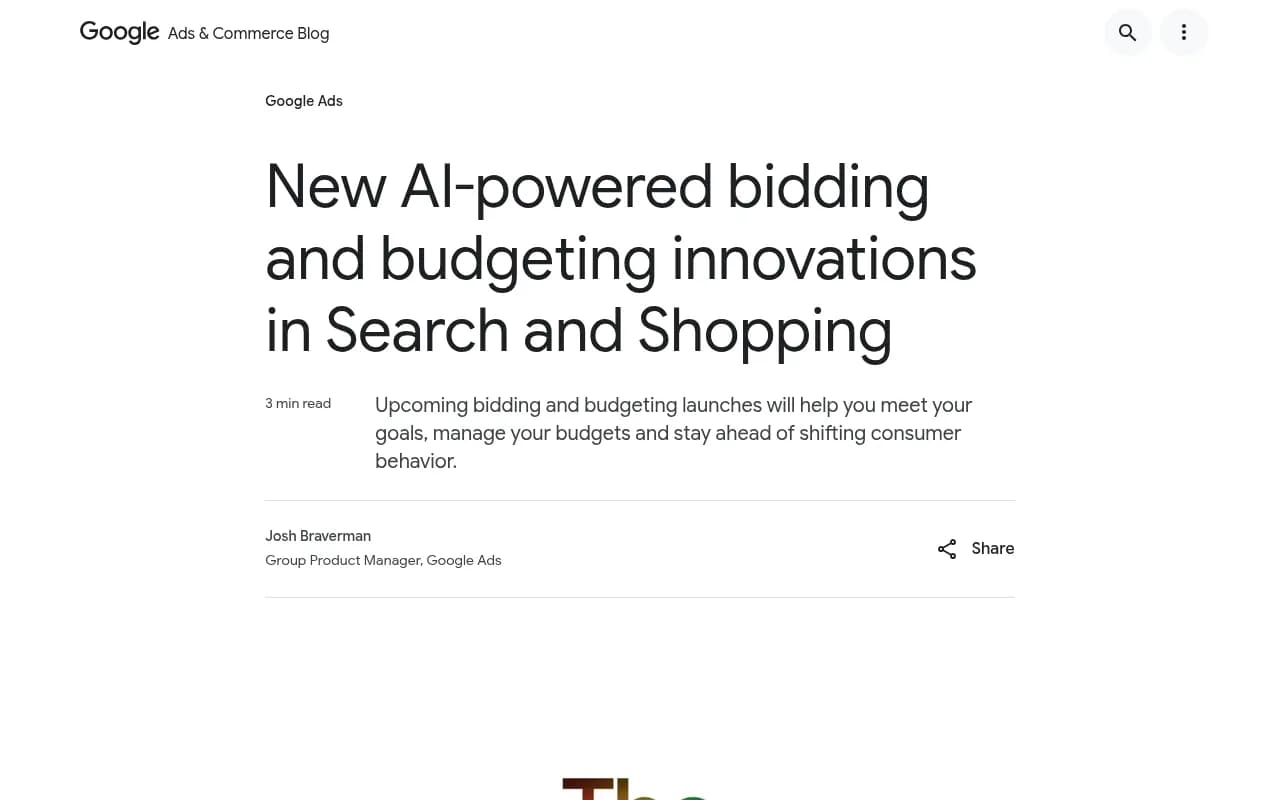
Google's Marketing Live 2026 bidding and budgeting post is worth a read for the upcoming demand-led pacing, which shifts spend toward peak days while staying inside monthly limits.
What the data says about paid performance
The numbers going around are dramatic, and some are probably real. They also mostly come from a vendor with something to sell, so here is how I'd handle them.
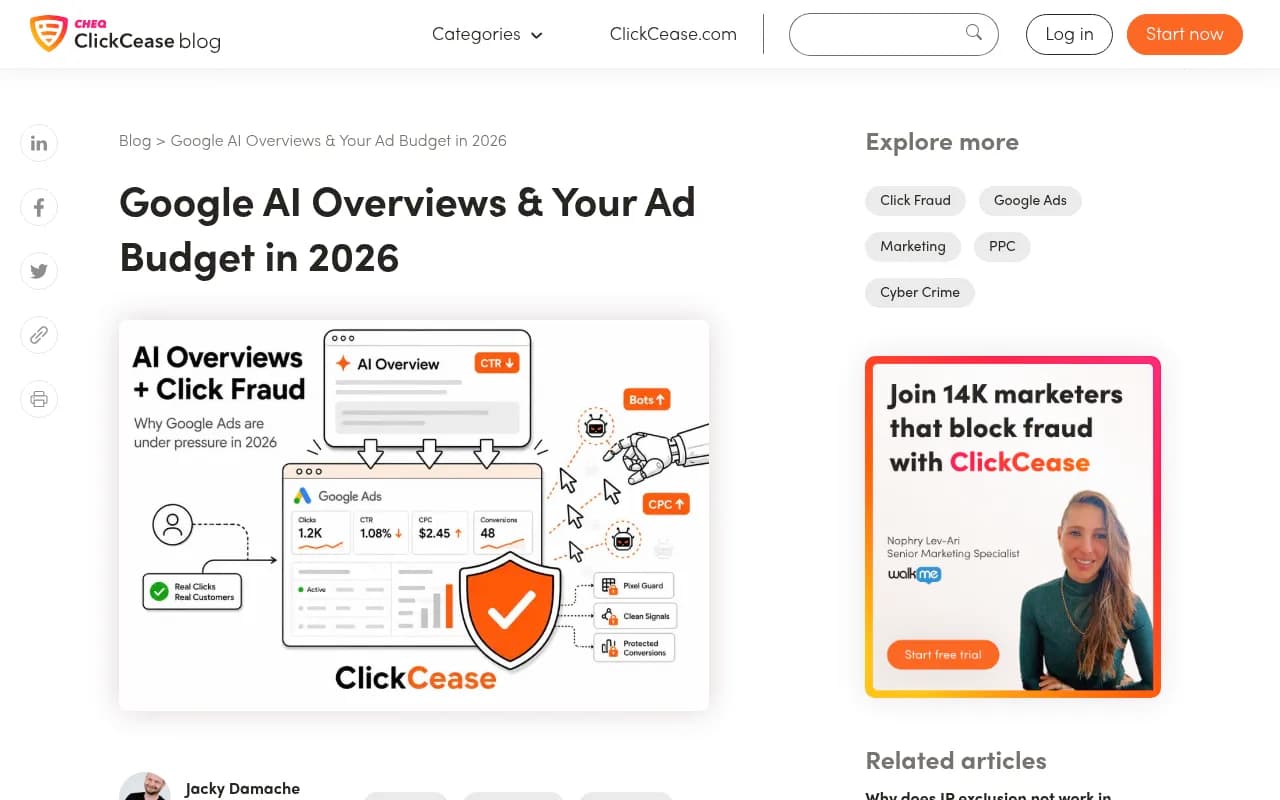
A ClickCease post (it sells click-fraud protection) cites these figures:
| Metric | Reported figure | Original source cited |
|---|---|---|
| Searches triggering an AI Overview | ~48% | BrightEdge |
| Paid CTR on AI Overview queries | 19.70% down to 6.34% (June 2024 to Sept 2025) | Seer Interactive |
| Average Google Ads CPC | $2.96, up 12% year over year | WordStream Q1 2026 |
| Advertisers using Smart Bidding | 86% | SearchLab 2026 |
I haven't independently verified these. Pull them from Seer, BrightEdge and WordStream directly before putting them in a client deck. The direction is plausible, though: when a summary sits at the top of the page, ads below it get seen less, and the same auction pressure gets spread across fewer clicks.
The Smart Bidding point is the one I find most interesting. Fewer real clicks means less conversion data, and weaker data means the bidding model learns more slowly. Adthena's February 2026 analysis, quoted in Search Engine Land, describes exactly that chain reaction. It is a fair reason to watch conversion quality, not just volume.
What we don't have is any CPC, CTR or conversion benchmark for ads shown inside an AI Overview versus classic Search. Google offers no segmentation, so nobody outside Google can measure it cleanly. Be suspicious of anyone who quotes one.
Where the budget should go
Since you can't buy the placement, think in intent layers. Both Birch and Momentum, and Google's own guidance, point the same way.
Informational queries: spend less, expect less
AI Overviews hit exploratory searches hardest. If a query is answered on the results page, the click you used to buy often never happens. Keep spend here small and tied to a clear next step (a lead magnet, a comparison tool), or move it to the organic side where citations can work for you.
Commercial and transactional queries: concentrate
Terms with modifiers like "pricing", "quote", "near me" or "[brand] vs [competitor]" are where AI summaries matter less and buyers are closer to purchase. Expect these to get more competitive. Birch warns that as exploratory traffic gets answered on the SERP, auction pressure concentrates around revenue-dense keywords, which could raise CPC volatility in margin-sensitive industries.
Brand queries: protect, but measure incrementality
Cheap to defend, but position one under an AI summary can deliver less incremental value than it used to. Test holding back brand spend in a small region before assuming it all pays off.
A starting split to test
This is my own rule of thumb, not a benchmark. Adjust after 6 to 8 weeks of data.
| Intent layer | Suggested share of search budget | Main goal |
|---|---|---|
| Brand | 10-15% | Defend, test incrementality |
| High-intent commercial | 55-65% | Conversions and revenue |
| Mid-funnel comparison | 15-20% | Capture shortlisting |
| Informational | 5-10% | Remarketing pools, selective testing |
The 2026 Google Ads changes that matter for this
AI Max for Search
AI Max left beta on April 15, 2026. Google says Dynamic Search Ads, automatically created assets and the campaign-level broad match setting get upgraded to AI Max starting in September 2026, and that the full suite averages 7% more conversions or conversion value at similar CPA or ROAS. Read that carefully: the 7% compares the full suite with search term matching alone for non-retail advertisers, not against DSA. One secondary source says the DSA timeline was changed in June, so check Google's help page for the exact date. See Google's AI Max announcement.
New AI-search formats
Per Momentum, Google Marketing Live 2026 brought Conversational Discovery ads, Highlighted Answers in AI Mode, AI-powered Shopping ads and Business Agent for Leads. Eligibility reportedly requires AI Max for Search, AI Max for Shopping or Performance Max. That is a secondary source, so confirm before planning around it.
Budgeting tools
Campaign total budgets are live for Search, Shopping and Performance Max, and Google says advertisers using them made 66% fewer manual budget adjustments than those on daily budgets. Demand-led pacing is coming in the following months. Both are Google-reported numbers.
Guardrails
Broad match plus AI Max can burn money on irrelevant traffic. Momentum's tips are sensible:
- Add aggressive campaign-level negatives.
- Add brand exclusions on Performance Max.
- Exclude Search Partner placements.
- Set first-party audience signals on Performance Max.
ChatGPT ads change the question
"AI ads" no longer means only Google. According to Promptwatch Data on ChatGPT ads, ads appeared in an average of 20.1% of ChatGPT responses that ran a web search between May 20 and August 17, 2026. None ran until May 27, when the rate was 1.69%. It passed 30% on July 1 and stayed there, with a daily peak of 43.9% and a past-7-day average of 32.4% at publication.
The breakdown of ad-bearing responses by prompt type was organic 73.3%, brand-specific 18.0% and competitor comparison 8.6%. The report notes that is a volume mix, not the likelihood a prompt type triggers an ad. The count also only includes responses where ChatGPT searched, returned at least one citation and completed ad extraction.
I couldn't find reliable pricing or format details for ChatGPT ads (CPM versus CPC, minimums), so I won't guess. For now, treat it as something to monitor and test with a small budget once access opens up to you.
The organic side of AI Overviews
Paid isn't the only way to show up. AI Overviews cite pages, and what they cite is shifting. Promptwatch Data's July 2026 AI Overviews citation report found this mix for July 1 to 31:
| Content type | Share of AI Overview citations |
|---|---|
| Listicle | 18.0% |
| Product page | 16.3% |
| How-to | 15.1% |
| News article | 13.5% |
| Video | 5.9% |
| Social post | 5.1% |
| Landing page | 4.7% |
| Comparison | 3.6% |
Product pages became the most cited format every day from July 28 and ended the month at 17.9% against 16.2% for listicles. Listicles averaged about 26% in Q1 2026, while product pages were around 9% in January. For advertisers this is useful: structured specs, clear pricing and fresh availability data on product pages can earn citations directly, which partly offsets the click loss on paid.
The broader pattern across AI surfaces is also uneven. Promptwatch's social media citations report puts AI Overviews at 12.2% of citations from social platforms for Sep 28 to Oct 4, 2026, versus 0.46% for ChatGPT. Where you invest in earned content should depend on which surface your buyers use.
Measuring what you can't segment
Because Google won't break out AI Overview impressions in Ads, you need proxies.
- Track performance at the query level, not just campaign level. Birch notes impression share is an incomplete metric in AI layouts.
- Compare queries that you know trigger an AI Overview against ones that don't, and watch CTR and conversion rate separately.
- Check conversion quality, not just count, so Smart Bidding doesn't train on junk. If you suspect invalid traffic, a click-fraud tool is a reasonable audit, just weigh the vendor's claims with care.
- Use first-party data. Google Search Console shows organic query and click shifts, and your analytics shows which landing pages convert.
For the organic and AI citation side, you need a way to see where your brand shows up in AI answers. Tools like Promptwatch track visibility in AI Overviews, ChatGPT and other models, including which pages get cited and what AI traffic converts, so you can compare it against paid performance.

Other trackers in this space include Profound, Otterly.AI and Peec AI, which are more monitoring-focused. For a wider comparison, the GEO software directory lists more options.


A practical plan for the next 90 days
- Audit campaigns by intent layer. Split informational, comparison, commercial and brand into separate campaigns or clearly labeled ad groups.
- Shift budget toward high-intent terms, with a hard cap on informational spend.
- If you use broad match or AI Max, set negatives and brand exclusions first, then monitor search terms weekly.
- Move to campaign total budgets where you run promotions or fixed-period pushes.
- Improve product and pricing pages so they work as citation targets in AI Overviews.
- Set up AI visibility tracking and compare it with paid results monthly.
- Hold a small test budget aside for new AI-surface formats once you meet the eligibility requirements.
So where should the money go?
Most of it stays in Google Search, but concentrated on terms that signal purchase intent, with less on broad informational queries. Don't wait for a clean AI Overview ad benchmark. Google doesn't provide one, and you can't opt out anyway. Spend the effort you'd put into that on query-level measurement, conversion quality, and the pages AI Overviews might cite for free.