Key takeaways
- Peec AI is a clean, easy-to-use monitoring tool, but it stops at showing you data -- it doesn't help you act on it
- The best alternatives either go deeper on monitoring (more engines, more data) or add optimization features like content gap analysis and AI-native content generation
- If you're an agency or enterprise team, look for tools with multi-site support, crawler logs, and traffic attribution -- not just brand mention counts
- Platforms like Promptwatch close the loop between finding visibility gaps and fixing them with content engineered to get cited by AI models
- Pricing ranges from $24/mo for basic monitoring to $579/mo+ for full optimization suites -- pick based on what you actually need to do, not just what you want to see
Peec AI had a good run as an early mover. When AI search visibility was a new problem and most SEO teams were still figuring out what "appearing in ChatGPT" even meant, Peec gave them a dashboard to start with. Clean interface, quick setup, decent coverage of ChatGPT and Perplexity. For 2024, that was enough.
It's not 2024 anymore.
Teams running real GEO programs in 2026 are hitting the same walls: prompt limits that get expensive fast, accuracy issues in niche industries, and a fundamental gap between "here's where you're invisible" and "here's what to do about it." Peec shows you the problem. It doesn't help you solve it.
That's the honest reason people look for alternatives. Not because Peec is broken -- it isn't -- but because visibility data without an optimization path is just an expensive anxiety dashboard.
This guide covers 9 alternatives worth considering, with honest takes on what each one actually does well and who it's built for.
What to look for before you switch
Before jumping to a new tool, it's worth being clear about what you actually need. A few things that separate good AI visibility platforms from mediocre ones:
Engine coverage. Some tools track ChatGPT and Perplexity. Others cover Claude, Gemini, Google AI Overviews, Google AI Mode, DeepSeek, Grok, and Copilot. If your buyers use multiple AI tools (and they do), blind spots in your tracking mean blind spots in your strategy.
Monitoring vs. optimization. This is the big one. Most tools tell you where you stand. Fewer tell you what's missing and help you fix it. If you want to actually move the needle, you need the second kind.
Prompt intelligence. Not all prompts are equal. Volume estimates, difficulty scores, and query fan-outs (how one prompt branches into sub-queries) help you prioritize what to go after first instead of guessing.
Traffic attribution. Knowing you got cited is nice. Knowing that citation drove 400 sessions and 12 conversions is useful. Look for tools that connect AI visibility to actual business outcomes.
Agency and team features. Multi-site support, white-label reporting, and client workspaces matter if you're managing more than one brand.
Keep these in mind as you read through the options below.
The 9 best Peec AI alternatives in 2026
1. Promptwatch -- best for teams that want to act, not just monitor
Promptwatch is the most complete option on this list for teams that want to close the loop between finding visibility gaps and fixing them. Most tools show you where you're invisible. Promptwatch shows you that, then helps you do something about it.

The core workflow is built around three steps: find the gaps (Answer Gap Analysis shows which prompts competitors rank for that you don't), create content to fill them (a built-in AI writing agent generates articles grounded in 880M+ citations analyzed), and track results as your visibility improves. Page-level tracking shows which pages AI models are citing, how often, and in which engines.
A few things that stand out compared to Peec and most other alternatives:
- AI crawler logs show you exactly which pages ChatGPT, Claude, and Perplexity are crawling, how often, and what errors they're hitting. Most competitors don't have this at all.
- Reddit and YouTube tracking surfaces the discussions that directly influence AI recommendations -- a channel almost everyone else ignores.
- ChatGPT Shopping tracking monitors when your brand appears in product recommendation carousels.
- Traffic attribution via code snippet, GSC integration, or server log analysis connects AI citations to actual revenue.
It covers 10 AI models: ChatGPT, Perplexity, Claude, Gemini, Google AI Overviews, Google AI Mode, DeepSeek, Grok, Copilot, and Meta AI.
Pricing starts at $99/mo (Essential: 1 site, 50 prompts, 5 articles), $249/mo (Professional: 2 sites, 150 prompts, crawler logs), and $579/mo (Business: 5 sites, 350 prompts). Agency and enterprise plans available. Free trial included.
Best for: Marketing and SEO teams that need to improve AI visibility, not just measure it. Agencies managing multiple clients. Brands that want to connect AI citations to revenue.
2. Scrunch -- best for enterprise brand safety
Scrunch sits at the premium end of the market and earns it with the broadest engine coverage available: ChatGPT, Claude, Perplexity, Gemini, Google AI Overviews, AI Mode, and Meta AI from one dashboard.
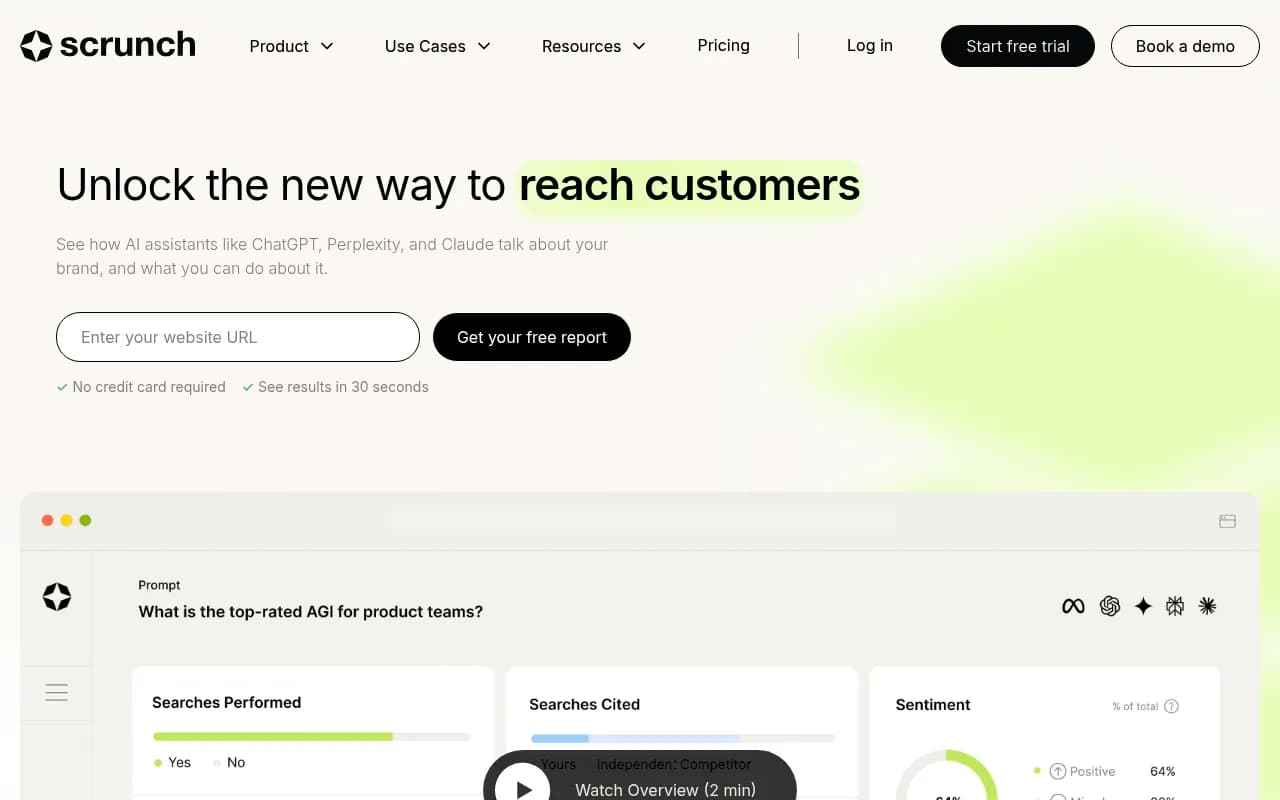
What makes Scrunch different from lighter tools is its focus on brand safety. It detects when AI models make false claims about your brand (hallucinations) and maps how customers interact with AI throughout their research journey. For enterprise teams worried about AI-generated misinformation, this is genuinely useful.
It also connects to GA4, so you can tie AI visibility data to actual traffic. That's not a given with most tools in this space.
The downside: it's expensive, and it's primarily a monitoring and analysis platform. You won't find the content generation or gap analysis features that optimization-focused tools offer.
Best for: Enterprise brands with brand safety concerns and budget to match.
3. Profound -- best for comprehensive platform coverage
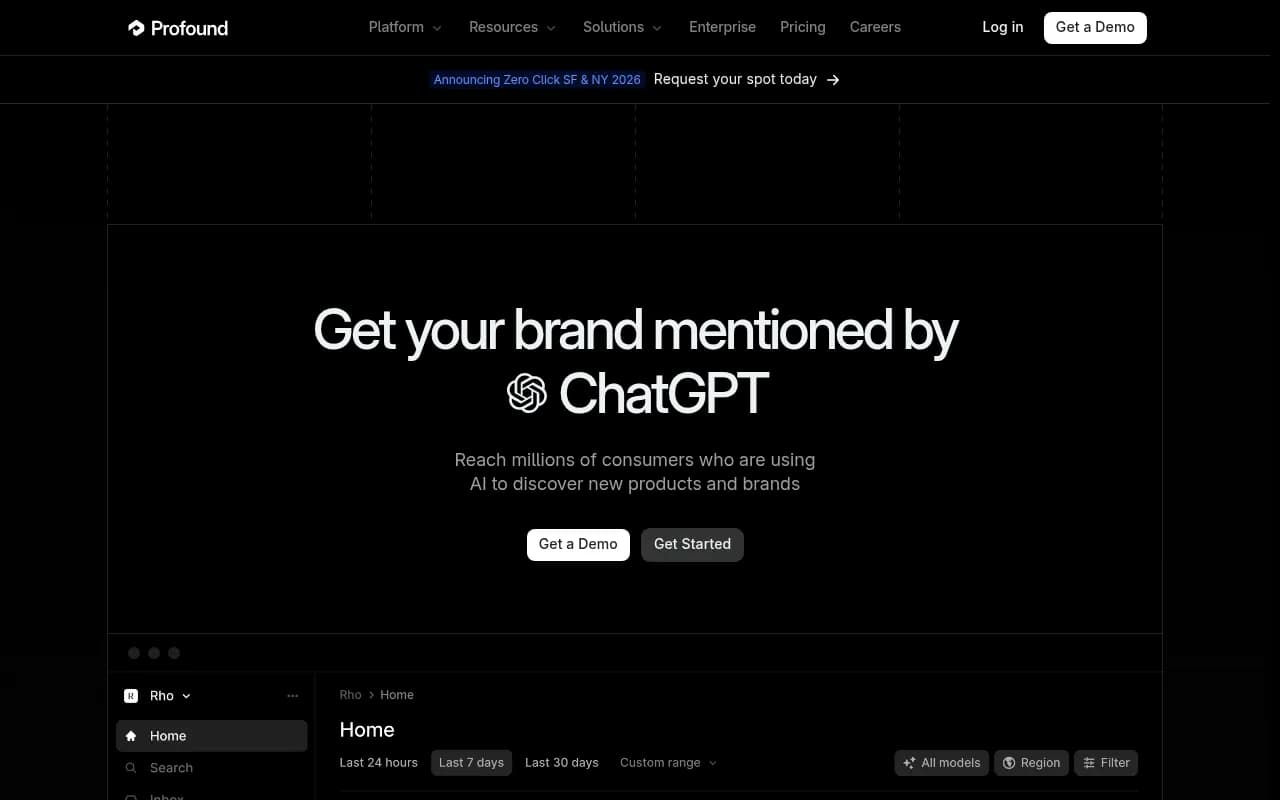
Profound covers 10+ AI models including ChatGPT, Perplexity, Claude, Gemini, Grok, Copilot, Meta AI, DeepSeek, and Google AI Overviews. It's one of the more thorough monitoring platforms available and has earned a G2 Leader position.
The platform does solid work on entity extraction and attribution mapping -- useful if you're running entity-driven SEO alongside your GEO work. Pricing starts at $99/mo for the Starter plan, which makes it accessible for smaller teams.
The gap: like most tools on this list, Profound is primarily a monitoring platform. It tells you where you stand across a lot of engines, but the optimization guidance is limited compared to tools built around the full content-to-citation workflow.
Best for: Teams that need broad engine coverage and solid monitoring without the enterprise price tag.
4. AthenaHQ -- best for multi-engine analysis
AthenaHQ tracks Google AI Overviews, Perplexity, ChatGPT, and Claude with a focus on competitive intelligence. The platform has published case studies showing 10x citation growth for some customers, which is a specific and verifiable claim worth noting.
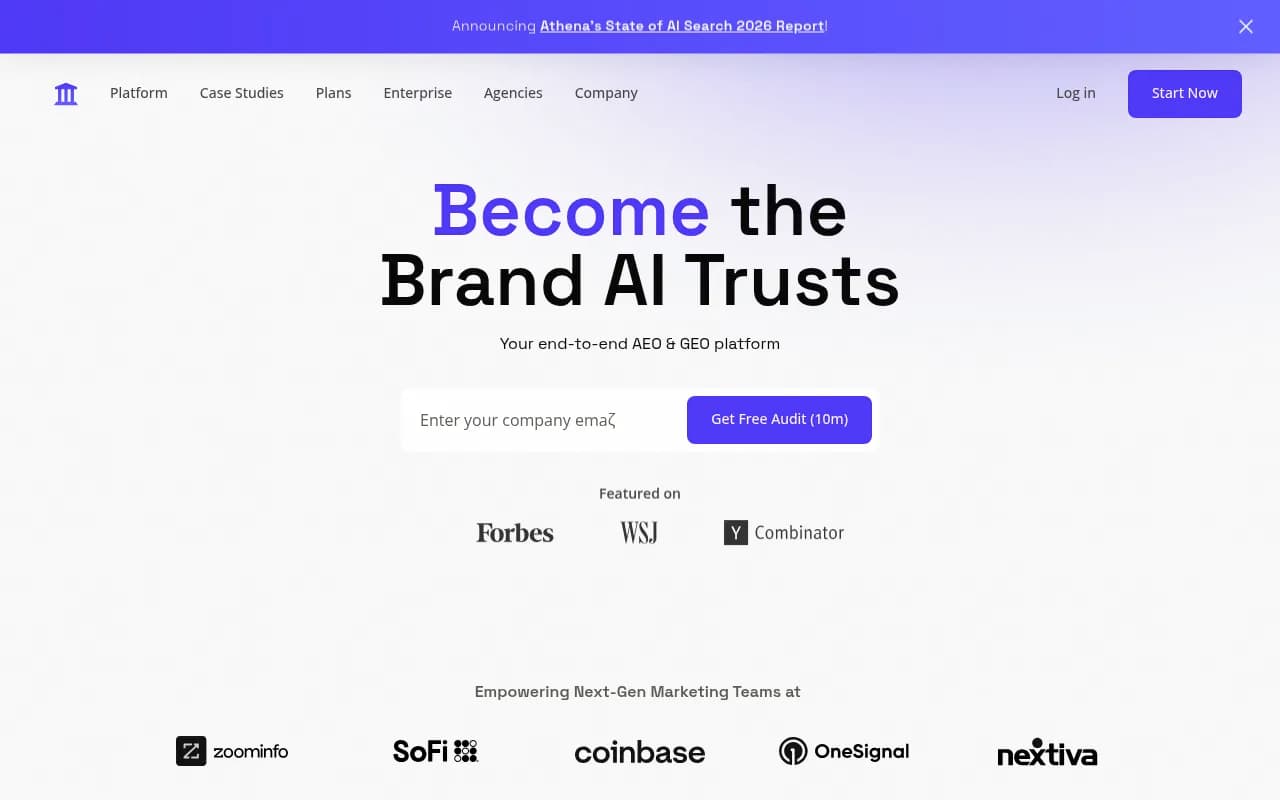
Starting at $295/mo, it's priced for teams that are serious about AI visibility. The competitive heatmaps are genuinely useful for understanding where you're losing ground to specific competitors across specific engines.
That said, AthenaHQ is monitoring-focused. Content optimization and generation aren't core features. If your main need is understanding the competitive landscape across AI engines, it's a strong choice. If you need to act on that data, you'll need additional tools.
Best for: Competitive intelligence teams and brands running detailed multi-engine analysis.
5. Otterly.AI -- best budget option for getting started
Otterly.AI is the most affordable entry point on this list at $29/mo for the Lite plan. It covers ChatGPT, Perplexity, and Google AI Overviews, and the setup is fast.

For small businesses or individual marketers who just want to know if they're showing up in AI answers, Otterly does the job. The interface is clean and the data is easy to understand.
The limitations are real though: no crawler logs, no content generation, no traffic attribution, and limited prompt volume on lower plans. It's a starting point, not a growth platform. If you're already past the "I just want to see if I exist in AI search" phase, you'll outgrow it quickly.
Best for: SMBs and solo marketers who want basic AI visibility monitoring without a large budget commitment.
6. SE Visible -- best for strategic marketing decisions
SE Visible is the AI visibility layer built by SE Ranking, which means it comes with the credibility of an established SEO platform behind it. It focuses on strategic visibility tracking, competitor benchmarking, and sentiment analysis -- positioning it more toward CMOs and marketing leaders than technical SEO teams.
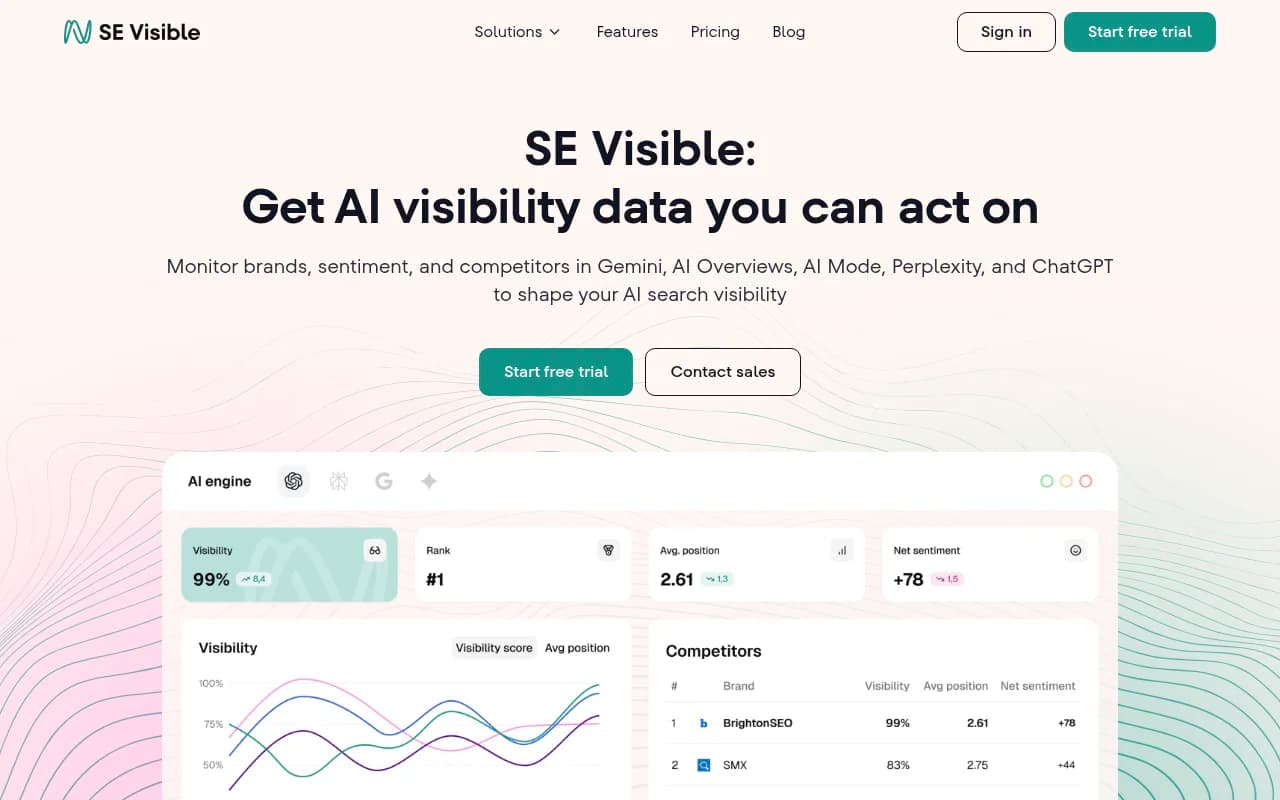
Starting at $189/mo, it's mid-market pricing for a platform that does solid work on brand narrative analysis and competitive positioning. The sentiment tracking is a differentiator -- knowing not just whether you're mentioned but how you're being characterized matters for brand management.
It's not the deepest tool for technical GEO work, but for marketing leaders who need to report on AI visibility as part of a broader brand strategy, it fits well.
Best for: CMOs, brand marketers, and agency owners who need strategic visibility reporting.
7. Writesonic -- best for teams combining content creation with GEO
Writesonic has evolved from an AI writing tool into a more complete GEO platform that tracks visibility across ChatGPT, Google AI Mode, Gemini, Perplexity, and Claude while also offering content optimization workflows.
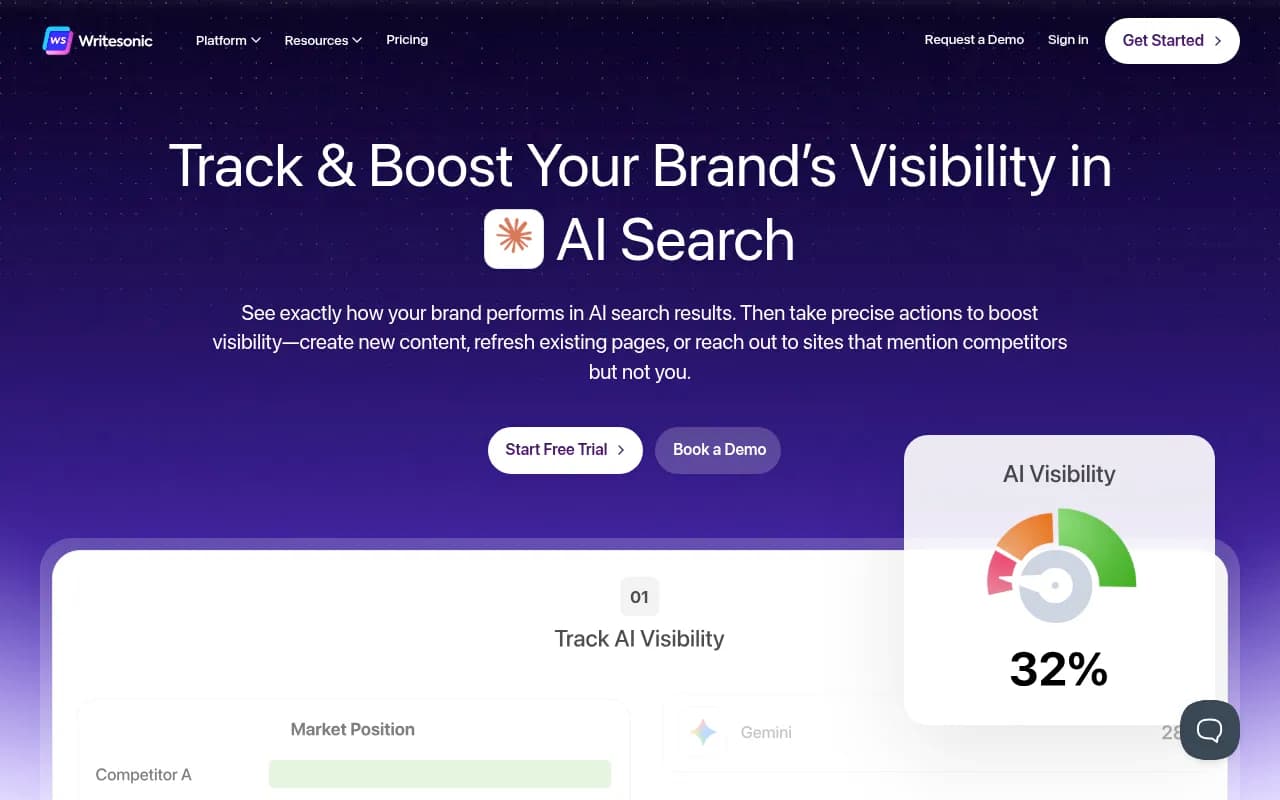
Starting at $199/mo for the GEO features, it's positioned for enterprises and marketing agencies that want to combine content production with visibility tracking. The integration between writing and monitoring is the key differentiator -- you can see what's missing and create content to fill the gap without switching platforms.
The monitoring depth isn't as comprehensive as dedicated tracking tools, and the content generation is more general-purpose than citation-optimized. But for teams already using Writesonic for content who want to add AI visibility tracking, it's a natural extension.
Best for: Content-heavy marketing teams that want GEO tracking alongside their existing writing workflow.
8. Airefs -- best for affordable ChatGPT-first monitoring
Airefs starts at $24/mo with a ChatGPT-first focus, making it one of the cheapest ways to get structured AI visibility data. It supports agencies with multi-client features and has a clean interface that doesn't require a lot of setup time.
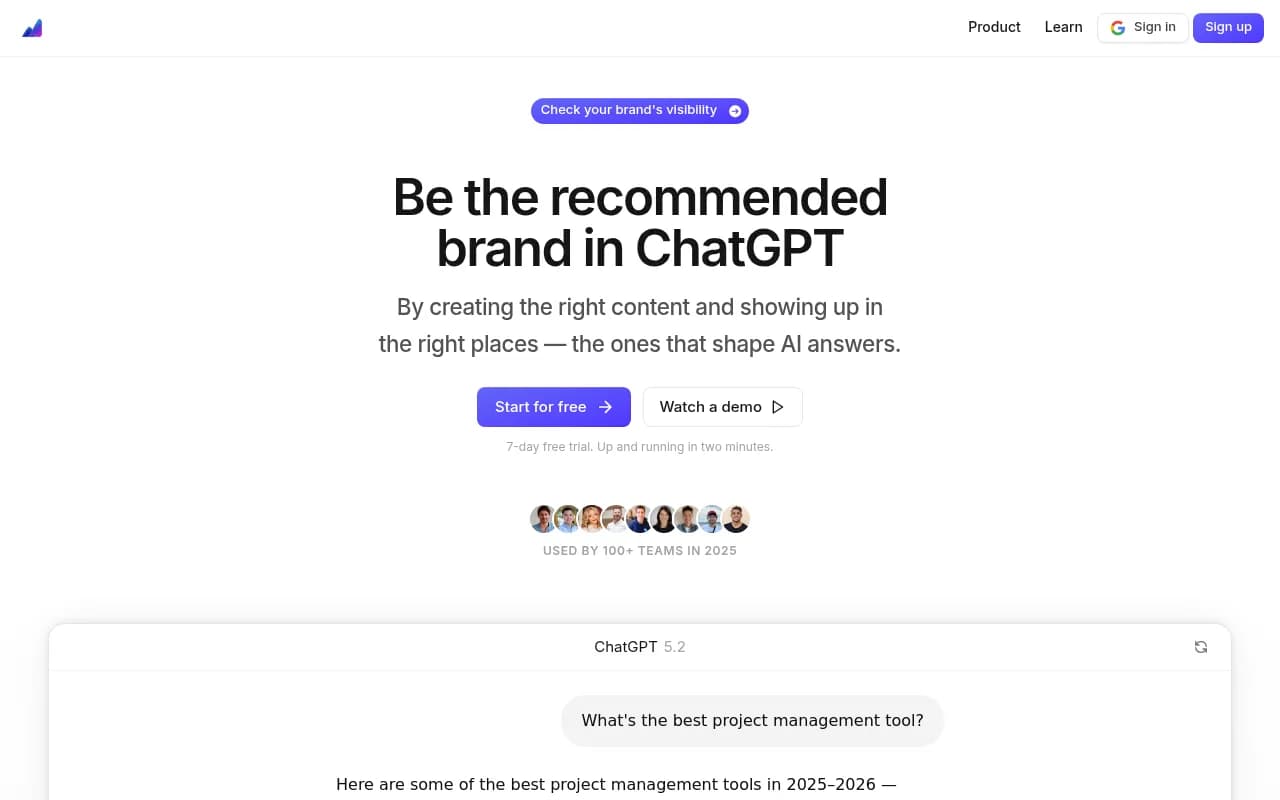
The ChatGPT focus is both a strength and a limitation. If ChatGPT is your primary concern and budget is tight, Airefs delivers real value. If you need broad engine coverage across Claude, Gemini, and Perplexity, you'll hit its limits quickly.
No crawler logs, no content generation, no traffic attribution -- it's a monitoring tool at heart. But at $24/mo, that's an honest trade-off.
Best for: Startups, freelancers, and small agencies that need affordable ChatGPT monitoring without enterprise complexity.
9. Radarkit -- best for realistic UI-level AI visibility
Radarkit takes a different approach to AI visibility tracking by focusing on how AI responses actually render in the UI -- not just whether your brand is mentioned in the raw text. This matters because AI models present information differently depending on context, and a mention buried in a long response has different value than a top-of-answer citation.
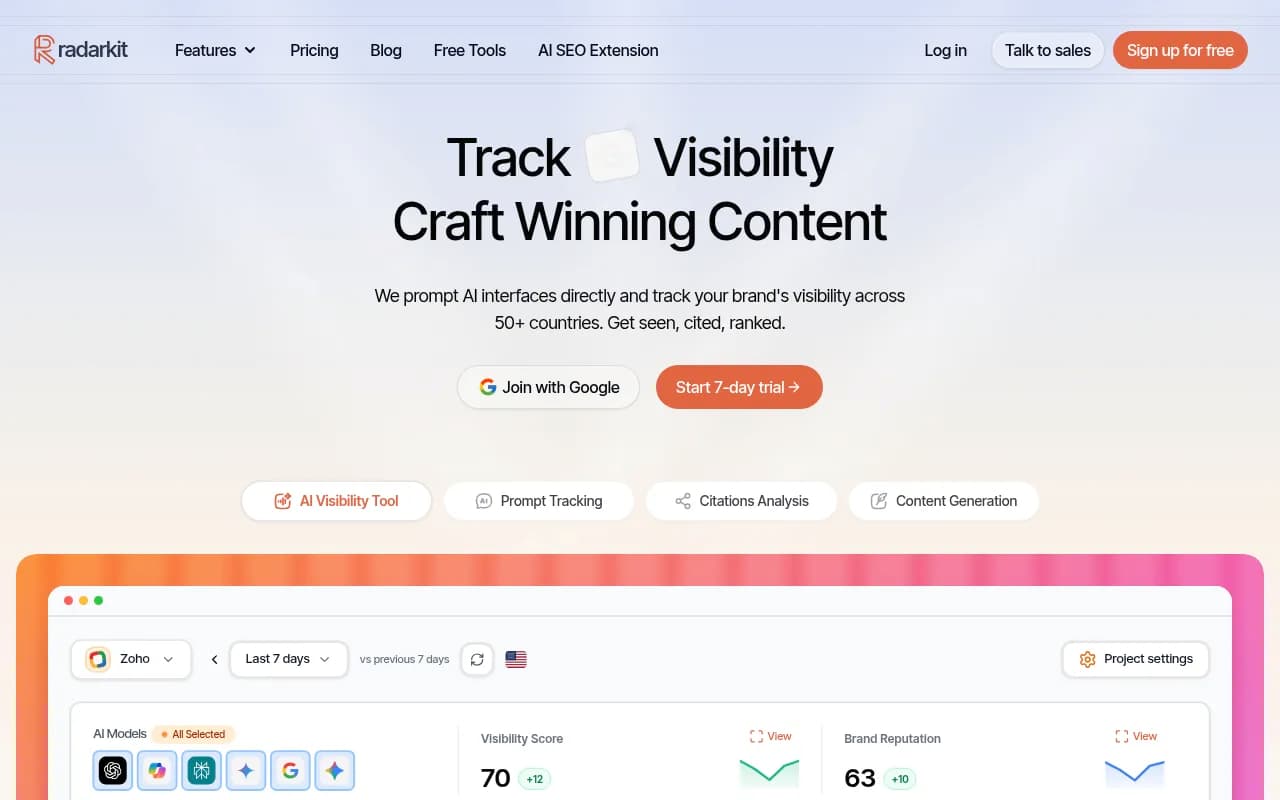
It's a newer platform and the feature set is still developing, but the core insight -- that visibility quality matters as much as visibility quantity -- is sound. For teams that want to understand not just if they're cited but how prominently, it's worth evaluating.
Best for: Teams that want nuanced visibility analysis beyond simple mention counting.
Side-by-side comparison
| Tool | Starting price | AI engines covered | Content generation | Crawler logs | Traffic attribution | Best for |
|---|---|---|---|---|---|---|
| Promptwatch | $99/mo | 10 (ChatGPT, Perplexity, Claude, Gemini, GAI, AI Mode, DeepSeek, Grok, Copilot, Meta AI) | Yes | Yes | Yes | Full optimization loop |
| Scrunch | Custom/premium | ChatGPT, Claude, Perplexity, Gemini, GAI, Meta AI | No | No | GA4 integration | Enterprise brand safety |
| Profound | $99/mo | 10+ | No | No | No | Broad monitoring coverage |
| AthenaHQ | $295/mo | ChatGPT, Perplexity, Claude, GAI | No | No | No | Competitive intelligence |
| Otterly.AI | $29/mo | ChatGPT, Perplexity, GAI | No | No | No | Budget monitoring |
| SE Visible | $189/mo | Multiple (SE Ranking ecosystem) | No | No | No | Strategic brand reporting |
| Writesonic | $199/mo | ChatGPT, Gemini, Perplexity, Claude, AI Mode | Partial | No | No | Content + GEO combined |
| Airefs | $24/mo | ChatGPT (others on request) | No | No | No | Affordable ChatGPT tracking |
| Radarkit | Varies | Multiple | No | No | No | UI-level visibility analysis |
| Peec AI | Varies | ChatGPT, Perplexity, GAI | No | No | No | Basic starting point |
The honest verdict
Most of these tools are monitoring dashboards. They'll tell you where you're invisible in AI search, which is genuinely useful information. But knowing you're invisible doesn't make you visible.
The platforms that actually move the needle are the ones that connect the data to action -- finding the specific content gaps, generating content engineered to get cited, and tracking whether it works. That's a shorter list.
If you're just starting out and need to understand your current AI visibility, Otterly.AI or Airefs will get you there cheaply. If you need broad engine coverage for competitive analysis, Profound or AthenaHQ are solid choices. If you're running a serious GEO program and need to show results, the tools with optimization capabilities are worth the higher price.
The question isn't which tool has the best dashboard. It's which tool helps you rank.